


More news on this day
Travel across Oceania faces fresh upheaval as a wave of sudden cancellations and 146 major delays across Sydney, Wellington and Christchurch disrupts operations at Air New Zealand and Qantas, stranding passengers and exposing ongoing pressure on the region’s aviation network.
Get the latest news straight to your inbox!
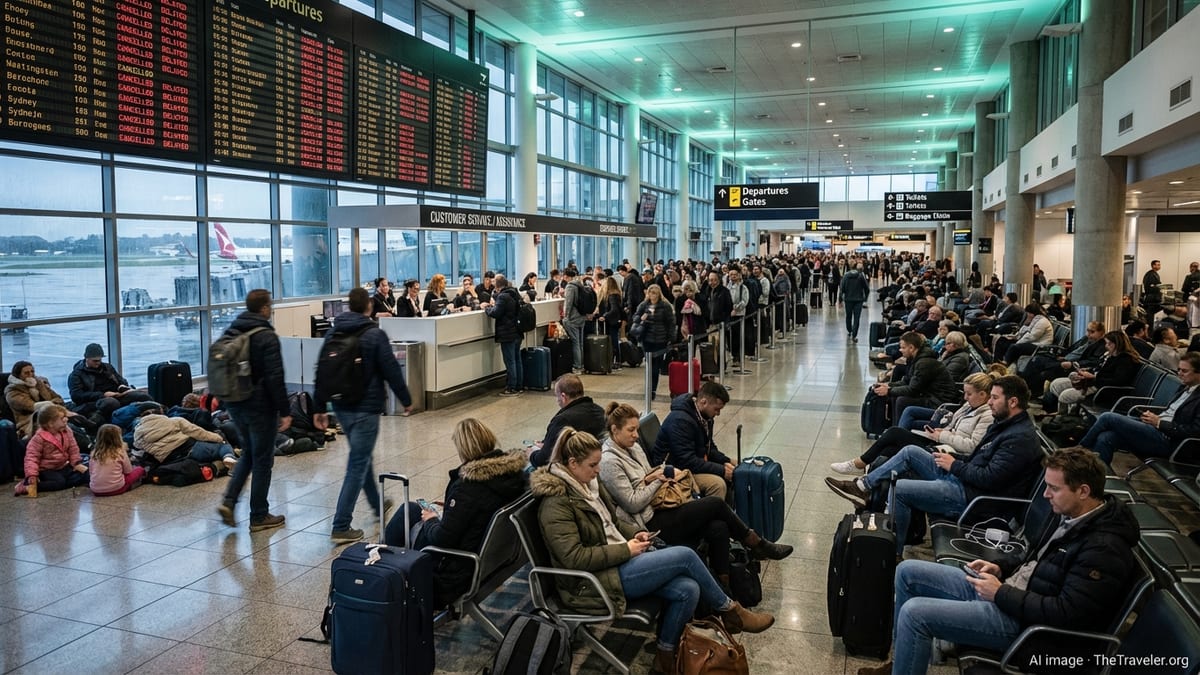
Weather Turbulence and Operational Strain Collide
Publicly available flight-tracking data and local media coverage indicate that a convergence of strong winter weather systems, air traffic control constraints and existing aircraft maintenance backlogs has pushed major carriers in Australia and New Zealand into a new period of disruption. Sydney, Wellington and Christchurch have been among the hardest hit, with services operated by Air New Zealand and Qantas experiencing extensive knock-on delays across domestic and trans-Tasman routes.
In Sydney, recent rain, low cloud and strong crosswinds have repeatedly forced the airport to operate on reduced runway capacity, triggering ground delay programs that slow departures and arrivals over several hours. When this happens, airlines are required to trim schedules at short notice, concentrating cancellations and pushing remaining flights into significant delay as crews and aircraft fall out of position.
Across the Tasman, Wellington and Christchurch have faced their own weather-related constraints, particularly high winds and turbulent approaches into the capital. Wellington’s short, exposed runway frequently leads to go-arounds or diversions in strong gusts, and current conditions have again translated into large clusters of delayed regional services that feed into the wider Air New Zealand network.
The result is a chain reaction that stretches well beyond any single storm cell or low-pressure system. Aircraft and crews delayed in Sydney arrive late into New Zealand, where further weather or curfews compress operating windows. This creates a rolling backlog in which one day’s disruption can cascade into the next, amplifying the scale of cancellations and long waits at terminals.
Air New Zealand Under Pressure Amid Fleet and Network Challenges
The latest disruptions land at a delicate moment for Air New Zealand, which has been working through engine maintenance delays, grounded widebody aircraft and a strategic review of its business. Company financial filings and investor updates in early 2026 outline efforts to restore long-haul capacity and improve reliability after a period marked by constrained fleets and volatile demand.
Industry analysis shows the airline gradually returning grounded aircraft to service and preparing new international routes from Christchurch. At the same time, the domestic network linking Auckland, Wellington and Christchurch remains the backbone of the carrier’s operation, relying heavily on tight turnarounds and frequent services. When weather closes in on Wellington or Christchurch, this high-frequency model can quickly become a liability, with regional turboprop and jet flights delayed or cancelled and crews reaching duty limits.
Consumer rights platforms that track disruption-related compensation cases report a noticeable cluster of recent cancellations on key Air New Zealand sectors between Auckland, Wellington and Christchurch. While these data sets are incomplete, they illustrate how repeated schedule changes and late-notice cancellations are flowing through to passengers in the form of missed connections, unplanned overnight stays and lengthy queues at service desks.
Air New Zealand’s published guidance to customers emphasises rebooking onto the next available service, offering credits or refunds where flights are cancelled. However, during large-scale disruption events, spare seats are scarce, and travellers often face extended waits before they can be accommodated, particularly on peak business and weekend leisure services.
Qantas Faces Domestic Gridlock and Network Knock-On Effects
Qantas, the dominant Australian carrier, has also been grappling with a series of cancellations and prolonged delays centred on Sydney. Flight-status portals show clusters of late-running services on major domestic corridors such as Sydney to Brisbane and Melbourne during recent weather events, as well as tactical cancellations used to stabilise the schedule.
Publicly available advisory materials from the airline explain that when Qantas alters flights for operational reasons, affected customers are informed by text message and email and can then rebook or seek alternative options. In practice, during large disruption windows these alternatives can be limited, especially for passengers connecting from regional Australia onto trans-Tasman flights.
Travel forums and passenger reports describe long lines at Sydney’s domestic terminals as travellers attempt to rebook missed connections, including services to New Zealand that are marketed by partner airlines but operated by Qantas. With Sydney acting as a crucial hub, any reduction in outbound capacity quickly affects flights bound for Wellington and Christchurch and reverberates across partner networks.
Australian aviation data released in recent months underline that even before the latest wave of disruptions, on-time performance for carriers including Qantas had been under strain, with weather, industrial action and resource constraints at airports all playing a role. The current cluster of cancellations and heavy delays builds on this fragile base, testing the resilience of schedules just as winter conditions intensify.
Passengers Confront Long Delays, Missed Trips and Limited Options
For travellers caught in the middle, the operational causes provide little comfort. Social media posts, travel forums and consumer advisory sites across Australia and New Zealand describe a familiar pattern: lengthy delays announced incrementally at the gate, cancellations late in the evening when curfews loom, and difficulty securing new seats on already busy routes.
Some passengers report having to reroute via alternative cities, flying for example from Christchurch to Auckland before continuing to Sydney or vice versa, adding many hours to relatively short trans-Tasman journeys. Others recount being rebooked for departures the following day and searching for last-minute accommodation in already expensive CBDs and airport precincts.
Budget-conscious travellers are especially exposed. With school holidays and major events scheduled around Sydney and in New Zealand’s main centres, alternative flights on competing carriers can be costly or sold out, limiting the ability of disrupted passengers to simply switch airlines. The result is a growing sense of frustration as travellers compare the price of their tickets with the level of reliability they are currently experiencing.
Consumer advocates note that complex itineraries booked through online travel agencies can be particularly difficult to untangle when multiple segments are affected. Passengers may find themselves directed between airline desks and third-party booking platforms to resolve refunds and future credits, prolonging an already stressful experience.
What Travellers Can Expect in the Coming Days
Aviation data and weather forecasts suggest that further bouts of wind, low visibility and heavy rain are likely to pass through eastern Australia and central New Zealand in the near term, heightening the risk of additional disruptions at Sydney, Wellington and Christchurch. Even on days of calmer weather, backlogs in aircraft and crew positioning can continue to generate delays until schedules fully reset.
Travel experts recommend that passengers flying through these hubs build extra time into their plans, particularly when connecting to international long-haul departures. Monitoring flight status more frequently than usual, arriving early at the airport and being prepared for last-minute gate or schedule changes are widely advised precautions in the current environment.
Publicly accessible government statistics on aviation punctuality for both countries show that, while overall on-time performance has improved from the depths of the pandemic recovery, it remains below historical highs. This indicates that the margin for absorbing shocks such as adverse weather or technical problems is still relatively thin across the region’s airlines and airports.
With Air New Zealand and Qantas both pursuing fleet renewal, schedule adjustments and operational reforms, the medium-term outlook points to a gradual strengthening of resilience. In the short term, however, passengers moving through Sydney, Wellington and Christchurch are likely to continue feeling the effects of any new wave of cancellations and severe delays, keeping travel plans across Oceania on uncertain ground.