


More news on this day
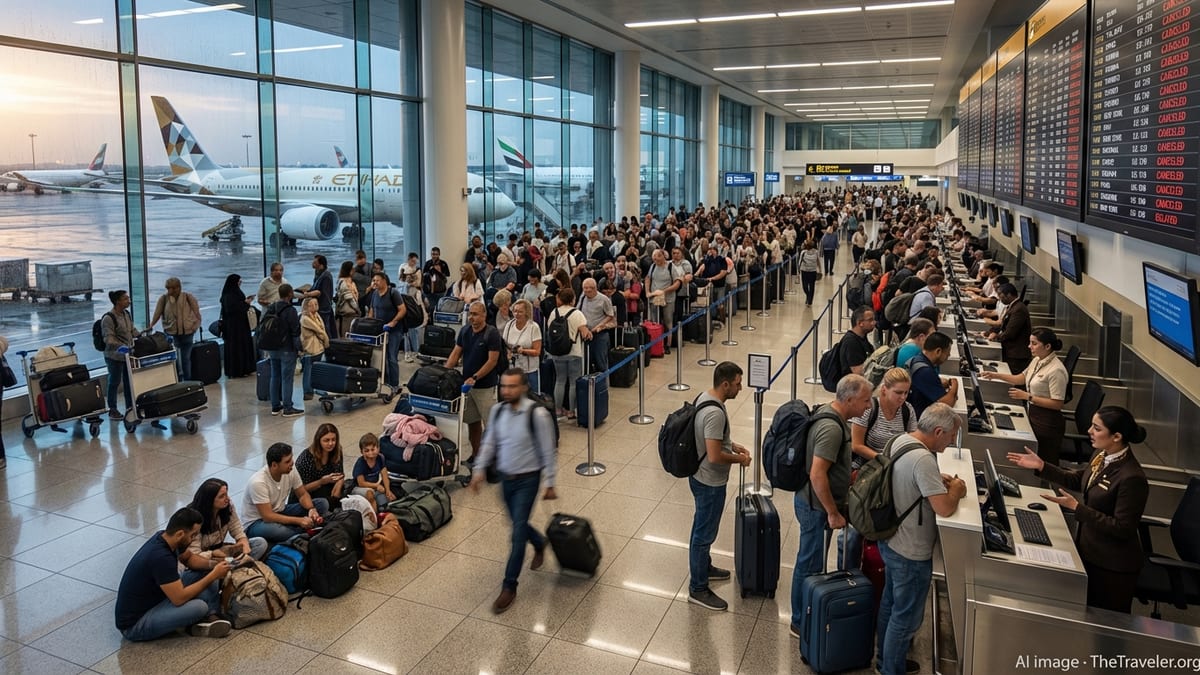
A fresh wave of short-notice flight cancellations affecting Oman Air, Etihad Airways, and Flydubai is unsettling travel between Oman and the United Arab Emirates, with services linking Muscat, Salalah, Abu Dhabi, and Dubai again exposed to volatile schedules amid heightened regional uncertainty.
Get the latest news straight to your inbox!
Half a Dozen Cancellations Underscore Fragile Recovery
Recent flight-tracking data and published travel reports point to at least half a dozen short-notice cancellations on key Oman–UAE corridors in May 2026, disrupting passengers on routes that only recently began to stabilize. Services operated by or marketed through Oman Air, Etihad Airways, and Flydubai between Muscat, Salalah, Abu Dhabi, and Dubai have seen rotations scrubbed or reshuffled, often within days of departure.
Coverage of the Oman market earlier in May highlighted a cluster of cancellations involving Oman Air and Flydubai that temporarily pulled several Muscat–Salalah and Oman–Dubai services from schedules. Those pockets of disruption have since been followed by further ad hoc changes as the month progressed, suggesting that airlines are still recalibrating capacity and routings in response to external pressures rather than operating on a fully settled summer timetable.
While none of the carriers have publicly characterized the latest changes as a systemic shutdown, the pattern of scattered but repeated cancellations has been enough to cause renewed uncertainty for travelers who rely on predictable, high-frequency links between Oman and neighboring Gulf hubs.
Regional Tensions and Airspace Constraints Weigh on Networks
The cancellations are unfolding against a backdrop of broader instability in the wider region, including recent security incidents in and around Oman and temporary closures of parts of Middle Eastern airspace earlier in the year. Publicly available information on Etihad’s network shows that the Abu Dhabi-based airline has already gone through a period of suspended and then gradually restored operations on some routes in early 2026, with waivers and refund options offered to affected travelers.
Travel forums and passenger accounts also describe periodic delays and reroutings attributed to restrictions in Omani airspace, adding further complexity to flight-planning for carriers trying to maintain tight connection banks at major hubs. Even when flights ultimately operate, extended routings or holding patterns can ripple across schedules and leave airlines with difficult choices about which rotations to prioritize on any given day.
In this environment, relatively short sectors such as Muscat–Abu Dhabi or Muscat–Dubai can become vulnerable to late tactical adjustments, especially when aircraft are needed to cover longer-haul segments that feed intercontinental networks. The result is a patchwork of cancellations and schedule tweaks that may not show a clear long-term pattern but collectively translate into a more fragile travel experience for passengers.
Oman’s Domestic Lifeline Routes Feel the Strain
The Muscat–Salalah corridor, often described by local travel observers as a domestic lifeline route connecting Oman’s capital with its southern region, has not been immune to recent volatility. Schedules compiled for May 2026 show a dense pattern of services operated by Oman Air and other carriers, but tracking data and earlier travel coverage indicate that a number of rotations have been cut or consolidated at short notice during the month.
On days when cancellations occur, travelers report being shifted onto later departures or rebooked for the following day, stretching seat availability on remaining flights. The timing is particularly sensitive, coming as the country moves through key holiday and travel periods in late May, when demand for both domestic and outbound trips can spike.
Oman’s efforts to build a more integrated aviation sector, including the government-backed consolidation of local carriers, are meant to strengthen resilience on core domestic and regional routes over the medium term. In the near term, however, the combination of regional security jitters and tight aircraft utilization means that even high-priority links like Muscat–Salalah can experience sudden disruption when conditions change.
Etihad and Flydubai Adjust Oman–UAE Links
Across the border, services tying Oman into the major UAE hubs at Abu Dhabi and Dubai have shown signs of flux throughout the spring. Historical schedules list Muscat among Etihad’s regular destinations, yet recent days have seen individual Abu Dhabi–Muscat rotations vanish from daily timetables, according to airport data and independent schedule trackers, leaving gaps that would otherwise be filled by multiple daily frequencies.
Flydubai, which has long marketed Oman as part of its short-haul Gulf network, has also been cited in travel reports as having pulled or reshuffled particular Oman-bound flights earlier in May. Although the airline continues to advertise regular connections between Dubai and both Muscat and Salalah, the earlier cancellations have reinforced perceptions that these links can be subject to rapid change when operational or regional considerations demand it.
For passengers, the impact is felt most acutely in missed onward connections and the loss of redundancy on routes that used to offer several daily options on different carriers. When one airline trims a frequency, alternatives may still exist, but when multiple operators simultaneously tighten capacity or alter timings, the margin for error in trip planning narrows considerably.
Passengers Face Rebooking Battles and Uncertain Summer Plans
Travelers caught up in the latest wave of Oman–UAE cancellations describe a familiar pattern of overnight schedule changes, reissued itineraries, and long waits to secure acceptable alternatives. Published accounts from passengers on Etihad and Oman Air in recent weeks detail cases where flights were canceled days before departure, leaving travelers to choose between substantial date changes or full refunds and the task of rebuilding itineraries on other carriers.
Consumer guidance shared across travel forums stresses the importance of monitoring bookings closely, checking flight status tools repeatedly in the 48 hours before departure, and understanding each airline’s rebooking and compensation policies. Some passengers report proactively purchasing backup tickets on alternative routings through non-Gulf hubs to hedge against the risk of further disruptions in the region.
With the peak summer travel period approaching, the cluster of Oman Air, Etihad Airways, and Flydubai cancellations across Muscat, Salalah, Abu Dhabi, and Dubai has become an early test of traveler confidence. Unless regional conditions stabilize and airline schedules begin to show a more consistent pattern, passengers planning journeys through Oman and the UAE may continue to face a travel environment defined as much by contingency planning as by confirmed bookings.