


Walk down to the Bosphorus waterfront in Ortaköy and you will quickly understand why this neighborhood has become synonymous with kumpir, Istanbul’s famously overloaded baked potatoes. Neon-lit counters, clouds of steam, and vendors calling out topping combinations line the small streets behind Ortaköy Mosque. The setting is atmospheric and the portions are huge, but the experience can also be crowded, slightly chaotic, and sometimes underwhelming if you pick the wrong stall or arrive at the wrong time. This guide breaks down exactly how to navigate Ortaköy’s kumpir scene, what to expect in terms of price and quality, and whether the detour is really worth it for you.
Get the latest updates straight to your inbox!
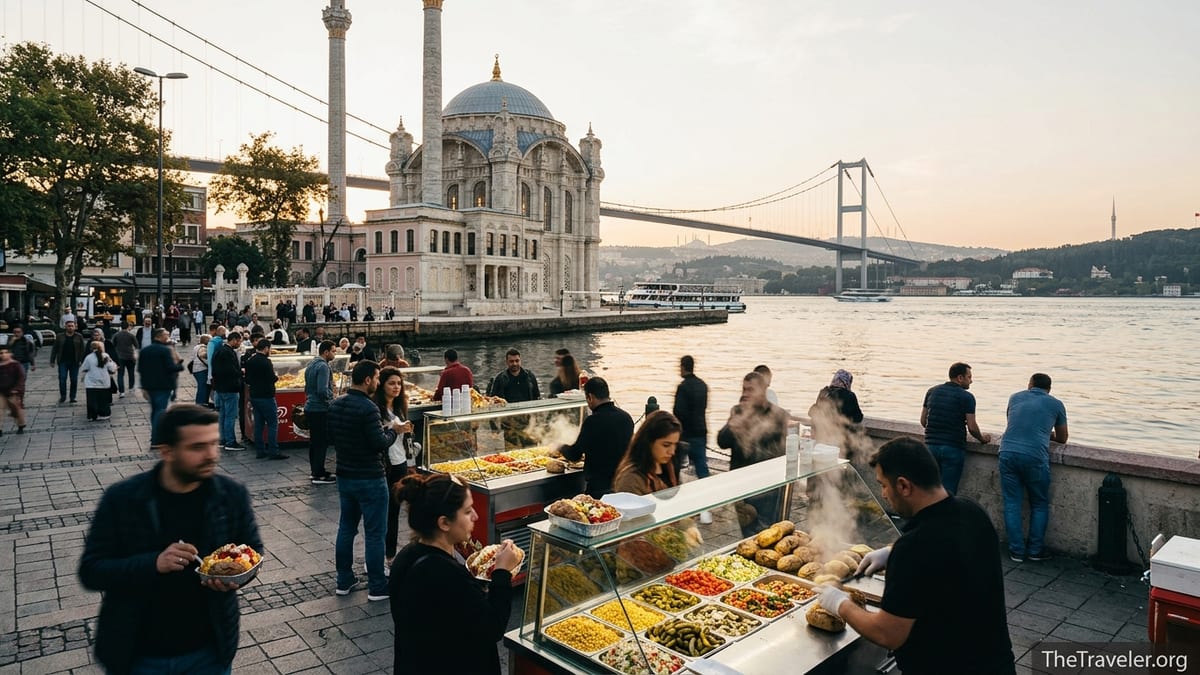
What Exactly Is Kumpir, And Why Ortaköy?
Kumpir is essentially Turkey’s over-the-top answer to the loaded baked potato: a large potato baked until the skin is crisp and the interior fluffy, then split open, mashed on the spot with generous knobs of butter and handfuls of kaşar cheese, and finally buried under a mountain of toppings. Typical additions include Russian salad, sweetcorn, pickles, olives, sausages, grated carrots, green peas, cabbage, mushrooms and various mayonnaise-based salads. The result is closer to a full meal than a snack, and for many visitors it becomes a memorable, if slightly messy, food experience on the Bosphorus.
Ortaköy is where this modern street food really exploded in popularity. Beginning in the 1990s, small stalls clustered along Mecidiye Köprüsü Sokak and the square behind Ortaköy Mosque started selling giant stuffed potatoes to students and late-night crowds. As the mosque-and-bridge view became one of Istanbul’s most photographed scenes, the kumpir counters right behind it turned into a ritual stop. Today, guidebooks, hotel concierges and even Istanbul’s official tourism promotion materials still point to “kumpir in Ortaköy” as a classic local experience.
You will find kumpir all over Istanbul now, from shopping mall food courts to residential neighborhoods. Some locals argue that other districts actually serve better-tasting versions. Still, if you want the classic postcard combination of steaming potato, street bustle, Ortaköy Mosque and the Bosphorus Bridge in the background, the Ortaköy stalls remain the most atmospheric place to try it at least once.
It is worth understanding, however, that what you get in Ortaköy is not a delicate culinary masterpiece but a fun, overfilled comfort-food bowl in potato form. Go in expecting a playful, slightly over-the-top street food rather than refined cuisine and you are more likely to enjoy it.
Where To Find The Kumpir Stalls In Ortaköy
The kumpir action in Ortaköy is tightly concentrated. When you arrive in the neighborhood and walk toward the waterfront, head for the small streets directly behind Ortaköy Mosque and the main square. Here you will find a dense row of nearly identical kumpir stands, their windows stacked with colorful topping pans and bright signs advertising “kumpir” and “waffle.” Many visitors first spot them when they exit onto the square from the waterfront promenade and turn inland.
Most of the stalls sit along the pedestrian lanes off Mecidiye Köprüsü Sokak and around the central square. You might see names like “Ortaköy Kumpir 14,” “Tarihi Ortaköy Kumpircisi” or other variations repeating the words Ortaköy and Kumpir. In practice, what matters less is the brand and more the freshness of the toppings in the front display and how busy the stand is with locals rather than just tour groups. A quick look at the shine on the salads, whether the sausage slices look recently replenished, and how efficiently staff are working can tell you more than the signboard.
Because the stalls are so close together, you can easily walk the entire row in a couple of minutes before committing. This quick scan is useful to compare topping displays, check how aggressively staff are calling to you, and see where Turkish-speaking customers are lining up. Even on a short visit, pausing to observe for five minutes can make the difference between a fresh, satisfying kumpir and a lukewarm potato topped with tired salads.
If you prefer to sit while you eat, look for stalls that are connected to small upstairs or back-room seating areas. Many counters serve their kumpir in takeaway trays meant to be eaten on the low walls by the waterfront or while strolling around the square. That can be enjoyable in good weather, but if you are visiting on a cold or rainy day, having even a basic indoor table becomes valuable.
How Ordering Works: From Potato To Mountain Of Toppings
Ordering kumpir in Ortaköy is very visual and straightforward, even if you do not speak Turkish. You first indicate that you want a kumpir at the counter and usually pay or take a ticket. Staff will grab a large baked potato from the oven, slice it open and start mashing the inside with metal spatulas. At this point they work in butter and kaşar cheese until the interior turns creamy and stretchy. If you prefer less butter or cheese, it is worth gesturing early, because the default is extremely generous.
Once the base is ready, you move along the glass case while the server gestures toward the toppings. You point to what you want added: perhaps a line of black olives, a scoop of Russian salad, a spoon of pickled red cabbage, some corn and a spoonful of spicy ezme. Most Ortaköy stalls advertise that toppings are “hepsi” or “all included” in a single fixed price, so you can choose a wide combination without worrying about the cost of each ladle. That said, some premium items such as sucuk slices or extra cheese may be added more sparingly.
If you have dietary preferences, it pays to go slowly. Vegetarians can easily build a meat-free kumpir from vegetables, pickles, cheeses and salads. Vegans will need to skip the butter and cheese at the mashing stage and stick to vegetable toppings; you can say “tereyağ yok, kaşar yok” to avoid them and rely on items like beans, olives, bulgur salad and cabbage instead. Gluten-free travelers will generally be safe with a plain potato plus simple toppings, but mayonnaise-heavy salads may contain traces of other ingredients, so choose more straightforward options like corn, olives and pickles if you are sensitive.
At the end of the line, your potato is handed over in a sturdy foil or plastic tray with a small fork and sometimes a napkin. Portions are large, so many couples or families share one potato as a snack while others order one each as a full meal. There is no table service: you simply carry your tray to a nearby ledge, bench or, if available, indoor seating and dig in while it is still hot.
Prices, Portions And What You Get For Your Money
Prices in Ortaköy fluctuate with inflation, but as of mid-2026 a standard fully loaded kumpir from the waterfront stalls typically falls into a mid-range street food bracket rather than being a true budget bite. Expect to pay roughly what you would for a simple sit-down main course in a casual local restaurant elsewhere in Istanbul. Exact figures change, but recent traveler reports suggest that a single kumpir in Ortaköy often costs the equivalent of a modest lunch for one at a neighborhood lokanta in a less touristy district.
What you absolutely get for your money is size. The potatoes used in Ortaköy are usually very large, sometimes described as being “the size of a human head.” For a solo traveler with a normal appetite, finishing a whole one can be a challenge, especially once multiple mayonnaise-heavy salads have been piled on top. Many visitors sensibly split one potato between two people, then share a waffle from a nearby stall for something sweet afterward.
Drinks are usually sold separately. Stalls and neighboring kiosks sell bottled water, soft drinks, ayran or occasionally freshly squeezed juice. Ordering a drink from a different vendor while standing near the kumpir stalls is rarely a problem, although if you are using seating that clearly belongs to a particular business, it is courteous to order at least part of your food or drink from them.
Compared with other forms of Turkish street food, kumpir in Ortaköy tends not to be the cheapest option in town. A filling dürüm or a couple of simit bought elsewhere may cost less. You are paying partly for location and atmosphere: the privilege of eating an oversized, photogenic potato right by one of the city’s most famous waterfront vistas. If you are strict about your food budget, consider whether you would rather allocate that same amount to a meyhane spread, a seafood dinner or multiple smaller snacks elsewhere in the city.
Queues, Crowds And How To Avoid Tourist Traps
The cluster of kumpir stands behind Ortaköy Mosque is one of the busiest corners of Istanbul’s street food scene. On warm evenings, weekends, public holidays and especially summer nights, the area can become packed with domestic and international visitors all queuing for the same set of stalls. Long lines, shouted sales pitches and jostling crowds are part of the experience, but they can also be tiring if you have already spent the day sightseeing.
To minimize waiting, aim for off-peak times. Late afternoon on a weekday, between the lunch and dinner rush, often strikes a good balance: many stalls are open, the light along the Bosphorus is still beautiful for photos, and queues are manageable. Early evening just before sunset can also be pleasant in spring and autumn, but expect more people vying for the same viewpoint and the same potatoes. Weekend nights in peak season are best avoided if you dislike crowds or are visiting with young children or anyone who finds tightly packed spaces stressful.
As for tourist traps, nearly all stalls in Ortaköy target visitors to some extent. The key is to avoid the worst offenders while accepting that you are in a prime tourist zone. Be wary of staff who pressure you aggressively, try to steer you to a table before you have seen a menu board, or are vague about prices when you ask. Choose stands where prices are clearly displayed at the counter and where you see a mix of locals and tourists in line rather than only tour groups following a guide.
Also pay attention to how the toppings look. Freshly prepared salads should appear moist but not dried out, with no crust forming around the edges of the pans. If the mayonnaise-based dishes have been sitting too long, opt for simpler toppings like pickles, olives and corn. Since the stands are tightly packed, you can easily step away from one that does not feel right and move to the next without losing much time.
Topping Strategies: From Classic Combos To Lighter Options
One of the pleasures of eating kumpir is designing your own flavor combination. A very typical “tourist” order in Ortaköy might include butter and cheese mashed into the potato, plus Russian salad, sweetcorn, black olives, pickled red cabbage, sliced sausage, grated carrot and a drizzle of ketchup and mayonnaise on top. This creates a colorful, over-the-top mound that photographs well and delivers an indulgent mix of creamy, salty and tangy bites.
If you prefer something a little more restrained, you can build a more focused combination. A practical approach is to choose one or two heavier salads, one protein, and then mostly pickled or fresh vegetables. For example, you might ask for kisir (bulgur salad), a scoop of beans, lots of pickles, olives, cabbage and hot pepper, skipping extra sauces. This keeps the potato from becoming a homogenous bowl of mayonnaise and adds more distinct textures and flavors.
Travelers who care about feeling reasonably light after eating can create a nearly “salad bowl in a potato skin” by skipping Russian salad, sausage and mayonnaise-based mixtures entirely. Instead, emphasize vegetables, corn, pickled gherkins, cabbage and perhaps a little cheese. The potato itself is still substantial, but you will likely walk away feeling less weighed down than after a fully loaded version.
Spice lovers should look out for toppings like acılı ezme or finely chopped pickled peppers. These add a welcome kick to what can otherwise be a very mild, creamy dish. If you are unsure, you can point and ask for a small spoonful first. Since everything is added in front of you, there is room to customize both flavor and richness on the fly.
Is Ortaköy Kumpir Actually Worth It?
Opinions among locals and frequent visitors are divided on whether Ortaköy is truly the best place for kumpir in Istanbul. Many Istanbulites now prefer individual specialist shops in neighborhoods like Kadıköy or Ataşehir, where the focus is less on tourist volume and more on perfecting texture and flavor. Online discussions often describe the Ortaköy stalls as “all basically the same” and sometimes “average” compared with more local spots, especially for travelers who already know Turkish street food well.
However, those same locals will still often recommend that first-time visitors experience kumpir in Ortaköy at least once. The logic is simple: you are unlikely to find another place where you can stand with a stuffed potato in hand, the Bosphorus Bridge glowing above you, Ortaköy Mosque illuminated at your side, and a sea breeze coming off the water. In this sense, the dish and the setting are a package. Even if the potato itself is not life-changing, the memory of the scene can be.
Whether it is worth it for you depends on your priorities. If you have limited days in Istanbul and are more excited about traditional grills, regional stews or meze feasts, you might prefer to allocate your appetite elsewhere and try kumpir in a quieter neighborhood if the opportunity arises. If, on the other hand, you like slightly chaotic food rituals, do not mind a crowd, and enjoy trying dishes strongly associated with one specific place, then scheduling an evening stop in Ortaköy for kumpir and a waterfront stroll makes sense.
For many travelers, the most satisfying approach is to treat Ortaköy kumpir as a one-time, box-ticking experience rather than something to repeat several times. Go with measured expectations, share a potato rather than over-order, enjoy the view and the atmosphere, and then move on to explore the rest of Istanbul’s incredibly diverse food culture.
Practical Tips For A Smooth Kumpir Experience
The Ortaköy kumpir ritual is simple, but a few practical details can make it easier. First, arrive with some cash on hand. Many stalls increasingly accept cards, but systems can be inconsistent and small minimum charges may apply. Having Turkish lira in smaller notes helps you pay quickly and avoid delays at the very busy counters. Prices are usually fixed per potato, so you should not feel obliged to add extras just to reach a minimum amount.
Second, dress for potential mess. Kumpir is famously overflowing, and as you dig into the interior, toppings tend to spill over the sides of the foil container. If you are wearing light-colored clothing or have just bought souvenirs, take care to keep them away from the tray. Carrying a small pack of tissues or wet wipes is useful, since napkins from the stalls can be limited, especially at peak times when staff are focused on serving as many people as possible.
Third, plan your route so that you can linger in Ortaköy before or after eating. Many visitors pair their kumpir stop with a Bosphorus-side walk, a quick visit inside Ortaköy Mosque when it is open outside prayer times, or a short cruise departing from the nearby pier. Coming only to rush through a potato and leave misses much of the neighborhood’s charm. If you stay until after sunset, the illuminated bridge and mosque can turn your simple street meal into one of your most evocative Istanbul memories.
Finally, listen to your own preferences rather than treating kumpir as an obligation. It is easy to feel that you “must” try it because every guidebook suggests it, but if huge baked potatoes loaded with mayonnaise salads simply do not appeal, there is no need to force the experience. Ortaköy also offers waffles, seafood restaurants, tea gardens and cafes with Bosphorus views. You can still enjoy the setting even if you pass on the potatoes.
The Takeaway
Ortaköy’s kumpir stands sit at the intersection of food, tourism and urban theater. They are not a hidden local secret but a very visible, well-worn ritual that blends comfort food with postcard scenery. You walk through the crowd, choose your stall, watch a giant potato be transformed into a molten, topping-laden mound, then carry it to the edge of the Bosphorus and eat with the lights of the bridge overhead. It is straightforward, slightly chaotic and undeniably memorable.
From a pure flavor perspective, the kumpir you eat here may or may not become your favorite meal in Istanbul. From an experiential perspective, especially if it is your first time in the city, it can be a fun, low-stakes way to join a local tradition that has grown into a tourist phenomenon. Go for the atmosphere, customize your toppings with intention, share a portion to avoid waste, and treat it as one chapter in a much larger story of Turkish food rather than the definitive highlight.
If you approach Ortaköy kumpir with realistic expectations and a sense of play, you are likely to enjoy it for what it is: a hearty, slightly over-the-top street food eaten in one of Istanbul’s most iconic locations. Whether you end up raving about the taste or simply smiling at the memory of eating a potato the size of your head by the Bosphorus, it will probably earn its place in your mental scrapbook of the city.
FAQ
Q1. Where exactly are the famous kumpir stalls in Ortaköy?
The kumpir stalls are clustered in the streets directly behind Ortaköy Mosque and the main square, a short walk from the Bosphorus waterfront where most people take photos of the mosque and bridge.
Q2. How much does a kumpir cost in Ortaköy?
Prices change frequently with inflation, but expect to pay a mid-range street food price, roughly comparable to a simple main dish at a casual local restaurant elsewhere in Istanbul.
Q3. Are all the kumpir stalls the same, or is there a best one?
Most stalls offer very similar potatoes and toppings. Instead of chasing a single “best” stand, look for places with fresh-looking toppings, clear prices and a healthy mix of local and foreign customers.
Q4. When is the best time to go for kumpir to avoid long queues?
Weekday late afternoons or early evenings outside peak holiday periods are usually calmer. Weekend nights and public holidays tend to be the most crowded and can involve long lines.
Q5. Can vegetarians and vegans enjoy kumpir in Ortaköy?
Vegetarians have plenty of options using cheese, vegetables and salads. Vegans should ask the server to skip butter and cheese in the mash and focus on vegetable, bean and pickle toppings.
Q6. Is kumpir in Ortaköy considered good value for money?
You pay partly for location and atmosphere rather than bargain pricing. Portions are very large and filling, but other street foods in less touristy areas may cost less for a similar level of satisfaction.
Q7. Is it safe to eat the toppings from street stalls?
Thousands of visitors eat here without issues, but use your judgment. Choose busy stalls where toppings are replenished frequently and avoid salads that look dry or as if they have been sitting too long.
Q8. Can one person finish a whole kumpir?
The potatoes are big and heavily loaded, so many people find them too much as a solo portion. It is common for two people to share one kumpir, especially if you plan to try dessert or other snacks afterward.
Q9. Is Ortaköy the best place in Istanbul to try kumpir?
Many locals feel that smaller specialist shops in other districts can taste better, but Ortaköy remains the most iconic place to try kumpir because of its setting by the mosque and Bosphorus.
Q10. Do the kumpir stalls accept credit cards, or should I bring cash?
Some stalls accept cards, but systems can be inconsistent. It is wise to carry Turkish lira in cash, especially smaller notes, to pay quickly and avoid any issues at busy times.