


Mount Teide rises from the center of Tenerife to 3,718 meters above sea level, making it Spain’s highest peak and the dramatic centerpiece of Teide National Park, a UNESCO World Heritage Site. Visiting the volcano is a highlight of many Canary Islands trips, but the park’s regulations, permits and logistics can be confusing. This guide brings together the latest verified information as of November 21, 2026, so you can plan a safe, compliant visit that matches your time, fitness and interests.
Get the latest updates straight to your inbox!
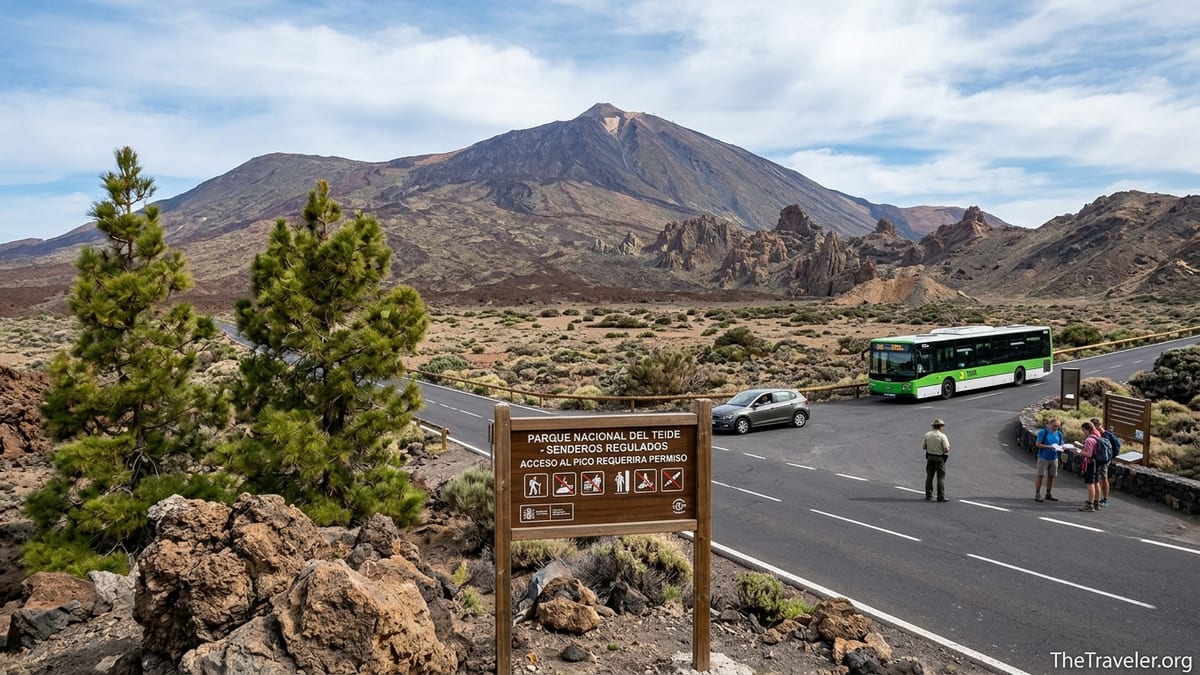
How Teide National Park Is Managed and Why Rules Matter
Teide National Park protects a high-altitude volcanic landscape on the island of Tenerife. The park itself is managed by the Spanish National Parks system and the Canary Islands authorities, who are responsible for conservation rules, trail regulations, permits and general visitor norms. Within the park, certain services, such as the cable car, are operated by private concessionaires under those rules, but ultimate authority over access, trails and environmental protection lies with the park administration.
In recent years, Teide has experienced heavy visitor pressure, particularly on the main ascent routes to the summit and other sensitive paths. To protect fragile volcanic ecosystems and improve safety, authorities have tightened regulations on specific trails, introduced daily quotas and, since January 2026, implemented a paid access system on the most popular regulated ascent routes. These measures are updated periodically, so any plans involving summit access or specific trails should be cross-checked with the official Teide National Park and Tenerife environment portals shortly before your visit.
For visitors, this means that “just turning up” is no longer a reliable option for the summit or certain high-demand trails. Instead, you should think in terms of clearly defined experiences: road viewpoints and short walks that remain freely accessible, hiking itineraries that may or may not require advance authorization, the cable car journey run by the Teleférico del Teide operator, and the strictly controlled final summit section. Understanding which authority manages which element will help you book correctly and avoid disappointment at the park.
In this guide, all references to permits, quotas, trail restrictions and cable car operations are based on official or primary sources checked up to November 21, 2026. Because policies can change rapidly, especially in response to weather, volcanic risk or crowding, you should always reconfirm details shortly before travel rather than relying solely on long‑planned information.
Visiting by Road: Viewpoints, Scenic Drives and Short Walks
For many travelers, the simplest and most flexible way to experience Teide is by road. A well-maintained network of highways climbs from the coast into the caldera, with multiple viewpoints and short walking paths that do not require permits in normal conditions. These are ideal if you have limited time, are sensitive to altitude or simply want to enjoy the scenery without committing to strenuous hiking.
The three main road approaches are from the south and southwest resorts via TF‑21 (through Vilaflor), from Puerto de la Cruz in the north via TF‑21 (through La Orotava), and from Santa Cruz and La Laguna via TF‑24 across the island’s high spine. Driving times from the principal tourist bases are typically about 1 hour 15 minutes to 1 hour 30 minutes from Costa Adeje or Los Cristianos, about 45 minutes to 1 hour from Puerto de la Cruz, and roughly 1 hour 15 minutes from Santa Cruz or La Laguna, depending on traffic and conditions. Curvy mountain sections mean you should allow extra margin, especially in winter or at dawn and dusk.
Parking is available at the main viewpoints, the Roques de García area near the Parador hotel, the cable car base station, and several trailheads such as Montaña Blanca. However, spaces at these popular stops are limited and can fill quickly in high season and on weekends. Local authorities have periodically discussed or introduced traffic‑management measures, including temporary restrictions, one‑way systems and time limits in peak periods, so it is essential to check current access and parking rules with Teide National Park or the Tenerife island government close to your visit date.
If your priority is landscape photography and short walks, a full day is recommended. This allows time to stop at multiple miradores along the crater rim, explore circuits such as the Roques de García loop, and experience different light conditions without rushing. Even for a more cursory visit focused on a few viewpoints and lunch at or near the Parador area, plan a minimum of half a day and be prepared for slower driving than coastal highways due to curves, occasional fog and wildlife such as rabbits crossing the road.
The Teide Cable Car: Operations, Tickets and What It Offers
The Teide cable car is operated by a private company under concession and provides the quickest way to reach high altitude. The base station sits at about 2,356 meters, and the upper station, known as La Rambleta, is at roughly 3,555 meters, just 163 meters in elevation below the true summit. From La Rambleta, you do not automatically have access to the summit; instead, you can walk short signposted paths to scenic viewpoints such as the Pico Viejo overlook, subject to any current restrictions.
Cable car operation is highly dependent on weather and safety conditions. Strong winds, icing or storms can lead to full‑day or sudden same‑day closures at any time of year. The operator publishes seasonal timetables and ticket prices, and as of late 2026 a typical schedule offers morning and afternoon departures with reduced hours in winter and extended service in summer. Because departures often sell out in busy periods, advance online booking is strongly recommended. You should also monitor the operator’s service status announcements right up to the morning of your booking.
Tickets are usually sold with timed slots for the ascent and a recommended maximum stay at altitude, both to manage crowding and to reduce the risk of altitude‑related issues. Certain products combine the cable car ride with guided walks from La Rambleta to viewpoints or, when accompanied by a summit permit, to the crater. Conditions and inclusions vary, and an additional environmental fee is currently levied for access to the main summit trail, so you should read the fine print carefully when reserving.
It is important to understand that the cable car operator does not control access to the summit itself or to regulated trails. Those are governed by the Teide National Park authorities and the Tenerife environmental department. What the operator can do is package permitted summit access within guided products that include the necessary authorizations. If you plan to visit La Rambleta only, a standard return ticket is sufficient. If your goal is the summit, ensure your booking explicitly includes summit authorization or secure that permit separately through the official channels described below.
Hiking Without Special Permits: Key Park Trails
Teide National Park offers a dense network of marked trails, many of which can be enjoyed without special permits, subject to the usual park regulations and any temporary closures. The official trail list maintained by the national parks authority classifies routes by number, name, distance, estimated duration and difficulty, and you should consult the latest version when planning. Some routes have become subject to new access rules in recent years, so always verify their current status shortly before your trip.
Among the park’s classic day hikes, the Roques de García circuit, starting near the Parador at Las Cañadas, is a standout. This loop, which circles a group of striking rock formations on the caldera floor, is of moderate length and usually takes a few hours at a relaxed pace. It offers close‑up views of lava spires, the Ucanca plain and Mount Teide itself, with relatively modest elevation change compared to summit routes, although there are still some short steeper sections and uneven footing.
Another popular option consists of mid‑length routes on the caldera floor or along its flanks, such as those linking the El Portillo area with viewpoints over the sea of clouds, or trails that traverse pumice slopes and volcanic cones away from the busiest areas. These trails have varying levels of difficulty but share similar hazards: intense sun, thin air compared to the coast, loose volcanic gravel and almost complete lack of natural shade. Sturdy footwear, sun protection and ample water are essential even on apparently gentle walks.
As of November 2026, certain higher‑impact routes, including some ascent paths, require advance authorization and payment of an environmental fee, while others remain free but may have recommended maximum group sizes or seasonal advisories. Because these designations can shift, especially under the new management regime introduced in 2024 and 2026, the safest approach is to choose several possible routes from the official park trail map, then confirm for each one: whether it is currently open, whether a permit or booking via the official Tenerife ON platform is required, and whether any specific equipment conditions apply under current regulations.
Reaching the True Summit: Permits, Quotas and Guided Tours
Ascending to the true summit of Mount Teide is a tightly regulated experience. The final section from La Rambleta to the crater rim follows the short but steep trail known as Telesforo Bravo, which covers around 650 to 700 meters in length but climbs sharply at very high altitude. To protect this sensitive area and manage safety, the park enforces strict daily quotas on how many people can access this path, divided into timed slots across the day.
Historically, access was free but limited by a fixed number of permits issued in advance. Since late 2024 and especially from January 2026, the authorities have introduced a system that combines these quotas with a paid environmental fee for the main summit routes. Permits or authorizations are obtained via official booking platforms linked from the national park and Tenerife environment websites, and are typically released well in advance. Slots during busy seasons can sell out quickly, so anyone determined to stand on Spain’s highest point should plan months ahead.
There are two practical ways for most visitors to reach the summit legally under current rules. One is to book an official guided tour that includes both the cable car ticket and the required summit authorization, provided by licensed guides who work under agreements with the park. The other is to secure your own summit permit for a given time window and either hike all the way from lower down or combine the ascent with a standard cable car ride to La Rambleta. In all cases, park rangers check permits at the start of the Telesforo Bravo trail and deny access to those without valid authorization for that specific date and time.
Weather and safety conditions can override any permit. High winds, ice, or volcanic risk may force the closure of the cable car, the summit trail, or both, even if you hold a confirmed booking. In such cases, the treatment of refunds or rebookings depends on the operator or platform through which you reserved. The park’s own permits are linked to conservation policy rather than commerce, and do not guarantee that conditions will allow safe ascent. It is crucial to read cancellation and modification policies at the time of booking and to accept that a degree of uncertainty is part of attempting a high‑mountain summit, even on a holiday island.
Getting to Teide: Driving Routes, Public Buses and Excursions
Most visitors access Teide National Park by rental car. From the southwest resort belt around Costa Adeje and Los Cristianos, the usual approach is via TF‑1 motorway and then TF‑28 and TF‑51 or TF‑21, climbing through Vilaflor before entering the park near the Boca Tauce junction. From Puerto de la Cruz and La Orotava in the north, TF‑21 winds up the Orotava Valley directly into the caldera. From Santa Cruz and La Laguna, TF‑24 traverses the spine of the island, offering grand views over both coasts before descending toward the park center.
These routes are paved and well signposted but involve sustained climbs, tight bends and occasional fog banks where the road passes through the trade‑wind cloud layer. Typical drive times from major resorts to the cable car base or Parador area are between 45 minutes and 90 minutes, but can be longer if you stop at viewpoints or if conditions are poor. Fuel stations are limited within the high central zone, so it is wise to fill up at or near the coast before heading inland.
Public transport access is provided by the island bus company under a very limited schedule. As of checks in October and November 2026, line 342 runs from Costa Adeje, passing Los Cristianos and Arona before climbing to the park, while line 348 runs from Puerto de la Cruz through La Orotava and Aguamansa to Las Cañadas. Both lines currently have only one departure up to the park in the morning and one return in the afternoon, stopping at key points such as the cable car base, the Parador and El Portillo. These services are subject to special tariffs and may not accept the same discounts or passes as urban routes, so you should confirm current timetables and fares directly with the official bus operator before travel.
If you are staying in Santa Cruz or La Laguna without a car, you typically connect first to Puerto de la Cruz or Costa Adeje by regular bus, then transfer to lines 348 or 342. Given the one‑bus‑per‑day pattern on these park routes, you must plan conservatively, allowing extra time for any connection and always checking the return departure time to avoid being stranded at altitude. For travelers who prefer more flexibility or cannot match their schedule to the bus times, organized excursions from major resorts offer another option. These tours usually combine round‑trip transport with a guided visit, and in some cases with cable car tickets or stargazing components, operating under park rules.
Day vs Night Visits: Weather, Altitude and Stargazing Rules
Conditions in Teide National Park differ markedly from the coast. By day, even in winter, strong sun at high altitude can make it feel warm in sheltered spots, but air temperatures are often 10 to 15 degrees Celsius lower than at sea level. In summer, daytime temperatures on the caldera floor can be quite hot under relentless sun, while in winter they can be near or below freezing at higher elevations, especially with wind. Cloud inversions are common: you may drive through dense cloud around 1,000 to 1,500 meters, only to emerge into clear skies above a broad white sea below.
For a classic daytime visit involving several viewpoints and a short walk, a minimum of half a day is realistic from coastal resorts. For a cable car ride plus time at La Rambleta and an additional trail at lower altitude, most travelers should allocate a full day including driving. Summit attempts and longer hikes, such as the strenuous ascent via Montaña Blanca, require a full day in good weather, along with careful acclimatization and briefing on altitude effects.
Altitude deserves serious consideration. The cable car upper station sits around 3,555 meters, and the summit is higher still. At these elevations, even fit people can experience shortness of breath, headache, dizziness or nausea. Travelers with known cardiovascular, respiratory or severe anemia conditions, pregnant visitors, and those with a history of altitude problems should seek medical advice before planning a rapid ascent. Children and older adults may also be more susceptible to discomfort. No itinerary or permit can guarantee how your body will respond. If symptoms appear, the safest response is to descend and rest rather than pushing on.
At night, Teide is one of Europe’s leading stargazing sites, thanks to low light pollution and the stable atmosphere above the trade‑wind clouds. However, nighttime access is more constrained. Official park regulations define visiting hours, parking rules and what is allowed after dark, and these may be tightened during periods of high fire risk or adverse conditions. Commercial stargazing tours must operate under specific licenses and are not allowed to set up telescopes just anywhere; they use designated pullouts and viewpoints agreed with the authorities. Before planning independent nighttime photography or astronomy, check the current rules on park closing times, which parking areas remain open, and any temporary restrictions published by the park or island government.
Clothing, Gear and Seasonal Conditions
Because of the large altitude range within Teide National Park, clothing and gear choices are critical. In summer, coastal temperatures can be above 25 to 30 degrees Celsius, while daytime readings on the caldera floor may be in the high teens to low twenties, dropping quickly after sunset. In winter, it is common for temperatures at altitude to hover around freezing or even below, especially in the morning and at night, with wind chill making it feel substantially colder. Snow and ice are not unusual on the upper slopes and summits during colder spells.
In all seasons, plan for layers: a breathable base layer, a warm midlayer and a wind‑resistant outer shell, along with a hat and gloves in the cooler months. Footwear should be closed, sturdy and suitable for rough volcanic terrain; flip‑flops or delicate sandals are inappropriate even for short walks near the viewpoints. Sunglasses, high‑SPF sunscreen and a brimmed hat are important because UV exposure is stronger at altitude and reflected by pale pumice and, in winter, snow.
Weather in the high mountains can change rapidly. A day that starts clear can see cloud build‑up along the crater rim, sudden drops in temperature or strengthening winds that force the closure of the cable car. Forecasts issued by official meteorological services and local authorities should be checked the day before and the morning of your visit, paying close attention to wind warnings, snow or ice advisories and any park announcements about partial closures.
For hikers, additional essentials include at least 1.5 to 2 liters of water per person for moderate routes, more for longer or hotter days; snacks or a light meal; a basic first‑aid kit; and if you are attempting higher ascents in shoulder seasons, traction aids if required by current conditions. In some recent winters, park authorities have made specific gear compulsory on icy summit routes for safety. Always read the latest route conditions and equipment requirements before committing to a demanding hike.
Safety, Conservation and Current Regulations
Teide’s volcanic environment is both beautiful and fragile. Park regulations require visitors to remain on marked trails and respect signs and barriers. Straying off path can accelerate erosion on loose ash slopes, damage rare endemic plants and disturb nesting or feeding areas for wildlife. It also increases your own risk of slipping on unstable gravel or becoming disoriented in areas that can look deceptively similar, especially in sudden fog or snow.
Open fires, wild camping and the use of camping equipment such as tents and gas stoves are prohibited in the national park outside of specifically authorized areas, which are extremely limited or currently closed. Overnight stays that used to be possible at facilities like the Altavista refuge have been subject to long suspensions and regulatory changes in recent years; as of late 2026, you should not assume that any mountain refuge or bivouac area is open without checking directly with park or island authorities. Standard accommodation options for most visitors remain in coastal or mid‑altitude towns outside the park boundary.
Drones and model aircraft are heavily restricted to protect fauna, reduce noise and preserve the natural soundscape. Recreational drone flying is generally not allowed without explicit authorization, and commercial operators require permits and must comply with aviation and park‑specific rules. Music played at high volume, megaphones and similar devices are also discouraged or banned in many areas to maintain tranquility.
The regulatory trend in recent years has been toward tighter control of visitor numbers on sensitive trails, the introduction of environmental fees on the most heavily used ascent routes, and more active enforcement of rules through ranger presence and vehicle checks, sometimes starting before dawn at key trailheads. Visitors who respect these norms help ensure that Teide’s unique landscapes remain intact and accessible for future generations while also contributing to their own safety.
Booking Strategy and Final Practical Advice
Given the combination of popularity and regulation, advance planning is now essential for many Teide experiences. For cable car rides, booking tickets for your preferred day and time slot well in advance is advisable, especially during school holidays, local festive periods and the high season months when Tenerife is busiest. You should also retain some flexibility in your itinerary in case the cable car suspends operations due to weather, in which case the operator’s published cancellation or rebooking policy will determine your options.
For summit access and other regulated ascent routes, check the official booking platforms linked from the park and Tenerife environmental authority sites and note when new quotas are released. During peak months, permits for the most desirable time slots can be taken as soon as they appear, so monitoring release dates and booking promptly can make the difference between securing a place and missing out. Licensed guided tours that include summit access also tend to sell out early on popular dates, and may have their own cancellation windows and fees.
Travelers relying on public buses should structure their whole Teide day around the current timetable of lines 342 and 348, allowing contingency time for connections from other parts of the island and avoiding last‑minute cable car or hiking plans that would cut too close to the afternoon return to the coast. Those driving should aim to arrive early in the morning for better parking availability and softer light, and always park only in designated areas in accordance with the latest regulations.
Above all, treat Teide as a true high‑mountain environment rather than just a photo stop. By understanding the different ways to experience the park, respecting quotas and regulations, planning for weather and altitude and booking key elements through official channels with up‑to‑date information, you can enjoy one of Europe’s most extraordinary volcanic landscapes safely and responsibly.