


For years, travelers have debated whether classic package holidays or do it yourself bookings offer better value. With dynamic pricing, airline fees and ever tighter cancellation rules, the answer in 2026 is no longer obvious. To find out which option can save you more today, it helps to compare like for like: the same flights, similar hotels, equivalent transfers and comparable cancellation terms, rather than relying on old assumptions.
Get the latest updates straight to your inbox!
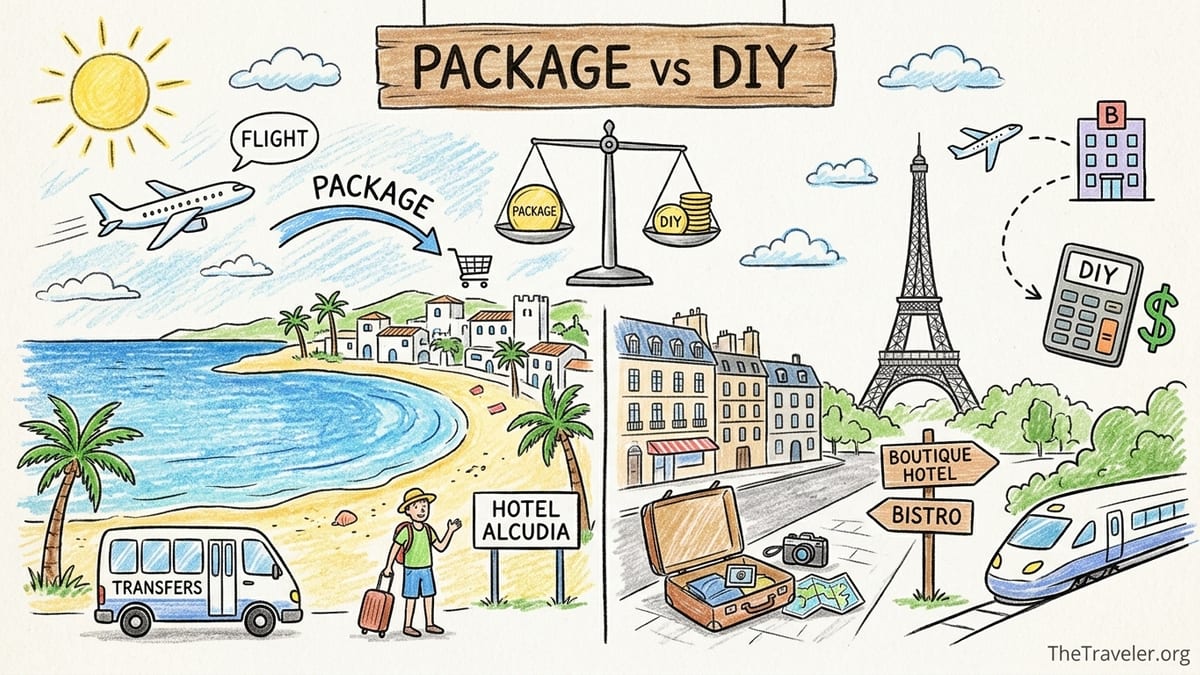
What Counts as a Package Holiday in 2026?
Before comparing prices, it is important to understand what counts as a package holiday in law. In destinations such as the United Kingdom and the European Union, a package usually means at least two key elements, for example flights and hotel, sold together at a total price under a single booking. Consumer regulators explain that you either sign one contract covering all elements, or you see one inclusive price for everything you select in a single booking path, even if the travel company issues separate confirmations for flights and hotel.
In markets like the United States, vacation packages sold by airlines or travel agencies are structured similarly, with one overall price shown when you combine flight and hotel in a single purchase. American Express Travel, for instance, notes that your credit card statement may show separate charges for each component of a package, but your receipt displays a total amount paid for the trip. The key idea is that you buy the flight and hotel together as one arranged product rather than assembling them yourself, piece by piece.
This distinction matters because financial protection and cancellation rules often depend on whether your booking qualifies as a package. In the United Kingdom, the ATOL scheme run by the Civil Aviation Authority provides financial protection when a company selling flight based packages collapses, and the associated Package Travel Regulations impose responsibilities on organizers to provide refunds or alternative arrangements if significant elements of the trip change or fail. In contrast, separate bookings often leave you relying on each airline or hotel’s own policies and any travel insurance you have purchased.
Online travel agencies and airline holiday arms use both traditional packages and dynamic packaging technology that assembles flights, hotels and transfers in real time from different suppliers but still sells them for one opaque price. Whether your bundle is pre set or dynamically built, if it meets the legal definition of a package you usually gain stronger protection than you would receive from stand alone bookings.
Real World Price Comparison: Beach Week in Spain
To see how prices can differ, consider a simple example familiar to many European travelers. In October 2026, a major tour operator in the United Kingdom is selling seven night package holidays from regional airports to Majorca that include charter flights, 3 star half board hotels, shared airport transfers and checked luggage. On randomly checked dates after the school holiday peak, prices for two adults sharing a mid range hotel in a resort such as Alcudia or Palmanova are advertised from roughly 750 to 900 pounds total, equivalent to about 375 to 450 pounds per person, including both flights and accommodation.
When similar trips are reconstructed as do it yourself bookings, the numbers look different. Scheduled airlines from London or Manchester to Palma de Mallorca on the same October week often price return economy fares, including one checked suitcase, around 220 to 280 pounds per person once compulsory seat selection and luggage are added. Mid range 3 star hotels in the same resorts, bookable directly or via hotel platforms, commonly charge in the region of 80 to 110 pounds per night for a double room on a half board basis in late season. Over seven nights, that yields a hotel cost of roughly 560 to 770 pounds per room, plus airport transfers which can add around 50 to 70 pounds return for two on a shared shuttle, or more for a private taxi.
Adding these do it yourself elements together, two travelers might expect to pay somewhere in the region of 1,050 to 1,400 pounds in total for their flights, hotel and shared transfers on the same dates and at a similar standard. In this comparison the mainstream package comes out several hundred pounds cheaper, largely because the tour operator has pre purchased flight seats and hotel beds in bulk and is able to fill them late in the season at a lower inclusive price, while still including transfers and checked luggage that independent travelers often pay for separately.
This kind of saving is not guaranteed in every case, and prices can swing the other way in peak periods or on routes with intense low cost competition. However, for traditional sun and sea destinations with large charter operations, late season packages often undercut well constructed do it yourself bookings, particularly once necessary extras like in destination transport and luggage are factored in.
Real World Price Comparison: City Break from the United States
The picture can look different for travelers departing from North America, especially for long haul city breaks where airlines and hotel chains run frequent promotions. Take a four night trip from New York to Paris in early spring, outside major holidays. A quick search in late 2026 shows that online travel agencies and airline vacation arms are marketing packages combining economy flights and 3 star hotels in central districts for around 1,100 to 1,300 United States dollars per person based on double occupancy, often excluding airport transfers but sometimes including basic breakfast.
If you price the same trip separately, a non stop economy return flight from New York to Paris on a full service carrier in late March or early April is often found around 650 to 800 dollars including taxes and one checked bag, depending on the day of week and advance purchase. Independent hotel bookings for 3 star properties in neighborhoods such as the 10th or 11th arrondissement on those dates frequently show nightly rates around 150 to 220 dollars including taxes for a standard double room. Over four nights, that equates to 600 to 880 dollars per room, or roughly 300 to 440 dollars per person when shared.
Adding flights and hotel together this way, separate bookings can come to approximately 950 to 1,240 dollars per person. That sits remarkably close to the 1,100 to 1,300 dollar range advertised for popular packages. When the package includes a slightly better located hotel or flexible ticket conditions, it may flip to the better deal. When the independent flyer is willing to choose a budget friendly connection or a hotel a little further from the central districts, do it yourself options often beat the package price.
The lesson is that long haul city breaks are highly sensitive to fare sales and hotel discounts. Package providers sometimes secure special contract fares or block hotel allocations that allow them to undercut normal public prices. In other cases, sales on airline websites or flash deals on hotel platforms make independent bookings cheaper. Comparing both on the same day, and adjusting for whether breakfast, resort fees and checked bags are included or extra, is vital before deciding which road to take.
Transfers, Hidden Extras and the True Cost
Transfers are a good example of costs that can tilt the balance between packages and separate bookings. Classic Mediterranean packages typically include shared coach transfers in the upfront price, taking you from airport to hotel and back on scheduled buses that serve multiple properties. If you try to replicate that yourself, shuttle services booked independently in destinations such as Tenerife, Crete or Antalya can cost around 25 to 35 pounds per person return, while private taxis often start around 45 to 60 pounds one way depending on the distance to the resort.
In urban destinations or trips from North America, packages more often leave transfers optional, mirroring independent travel habits where people use trains, ride hailing or local taxis. Here the real comparison is between whether the operator has bundled checked luggage and seat reservation into the flight component and whether the hotel component includes breakfast or resort fees. Some United States based vacation providers structure their offers so that hotel resort fees and local taxes are either included in the main price or clearly broken out during checkout, while independent travelers who focus on headline room rates can be caught by surprise at check in when daily resort charges and city taxes are added on top.
Ancillary fees on flights complicate comparisons further. A do it yourself traveler choosing an ultra low cost carrier from a regional European airport to Spain in high summer might see an enticing base fare of under 40 pounds each way, yet once a single checked bag, a standard seat and priority boarding are added, the actual cost can approach that of a seat on a charter flight already bundled in a package. In the United States, basic economy fares on major carriers may look sharply cheaper than standard economy at first glance, but they can involve strict change penalties and no seat selection, restrictions that many package holiday fares negotiate around.
To get a fair answer on which option saves more, travelers should construct a detailed comparison table for their specific trip: base flight cost including luggage and seat selection, hotel including all taxes and resort fees, round trip transfers using the mode they realistically plan to use, and estimated costs of likely changes or cancellations based on each provider’s current rules. Only then does the real financial difference between packaging and do it yourself emerge.
Cancellation Terms: Packages vs Separate Bookings
The money at stake is not only the upfront price but also how much you stand to lose if plans change. Package holidays sold in jurisdictions with strong consumer rules often include clear staged cancellation fees. For example, major European tour operators publishing their 2026 terms indicate that canceling a standard package several weeks before departure usually triggers the loss of a deposit and a percentage of the balance, rising as departure nears and reaching close to 100 percent within a week of travel. Some premium or special fare components can be non refundable from the moment of booking.
Airline holiday arms provide similarly detailed scales. A large United Kingdom based airline holiday brand explains that where you have a single package price, hotel, car and transfer elements share the same cancellation schedule linked to departure date. In the United States, Southwest’s vacation division sets out that canceling a package within 24 hours of booking generally allows a refund to the original form of payment, but once that window closes and you are close to departure, refunds may be restricted and some supplier penalties deducted even when airline rules would otherwise allow changes.
When you book flights and hotels separately, the picture fragments. Many discounted airfares in both Europe and North America are now changeable for a fee or for the fare difference, but not refundable in cash except within short cooling off periods or on higher flexible fare types. Hotel bookings may be fully refundable until a day or two before arrival, subject to time zone cutoffs, or they may be marketed as advance purchase with no refunds at all. American Express Travel, for instance, advises that hotel cancellation penalties on package bookings can range from the cost of one night up to the entire stay, depending on the property’s rules, and the same variation shows up in stand alone hotel reservations.
A traveler who values flexibility might therefore find it better to assemble their own trip using refundable hotel rates and flexible airline fares, particularly for complex itineraries or long lead bookings where the chance of change is high. On the other hand, many mass market packages now allow low deposit schemes or fee based flexibility add ons that let you change your travel dates or hotel once before departure at a reduced cost, which can be more affordable than changing a non refundable flight and a non refundable hotel separately.
Financial Protection and What Happens if a Company Fails
The risk that a travel provider becomes insolvent is another dimension where package holidays can look attractive. In the United Kingdom, every company selling most kinds of flight inclusive packages to residents must hold an ATOL license. The ATOL scheme provides financial protection so that if the tour operator collapses, travelers who have not yet departed receive refunds, while those already abroad are brought back home and usually allowed to complete their stay without extra cost, as seen in high profile airline and tour operator failures over the past decade.
Similar protections exist in other European countries under national systems implementing the Package Travel Directive. Consumer agencies highlight that, with a compliant package, you will not be left to negotiate separately with airlines and hotels if your organizer goes out of business; instead, the protection scheme or the organizer’s bond covers the failure. Additionally, the Package Travel Regulations make the organizer responsible for the overall performance of the trip, so if the hotel is significantly not as described or the transport element fails, the company must find a suitable alternative or offer compensation in many circumstances.
Independent travelers booking separate flights and hotels have more limited safety nets. If an airline fails, you may be left trying to recover funds from a credit card provider or travel insurance, and replacement flights at short notice can cost much more than the original ticket. If a hotel closes or changes hands, you rely on the platform or the property to re accommodate you. Some travel insurance policies offer scheduled airline failure or supplier failure coverage, but the limits and exclusions vary and you need to check policy wording carefully to know exactly what is covered.
In the United States and other markets without a comprehensive package protection framework equivalent to ATOL, credit card chargeback rights and the financial robustness of the brand you book with take on more importance. Vacation packages purchased from well capitalized airlines or widely known travel companies may offer greater informal security than obscure independent suppliers, but they do not usually deliver the same legal guarantees that regulated package holidays provide in parts of Europe.
Flexibility, Control and the Value of Your Time
Money is not the only factor. Many travelers prize the flexibility and control of do it yourself bookings. By choosing each flight and hotel separately, you can mix a low cost carrier on the outbound leg with a legacy airline on the return, or combine a boutique guesthouse in one neighborhood with a chain hotel in another. You can decide to stay three nights in Barcelona and four in Valencia, or add an extra stopover, without being constrained by the fixed durations and limited hotel lists that dominate many mainstream packages.
Packages can still offer meaningful choice, especially with dynamic packaging where you pick from multiple airlines and hotels inside a single booking flow. However, the range is usually curated, and some options that are available independently might not appear at all. On a practical level, if you want a particular room type such as a family suite with a kitchenette, or if you plan to combine a hotel stay with an independent rental car and rural accommodation, a fully packaged approach may not fit your plans neatly.
On the other hand, the time and effort saved with a package has its own value. Comparing dozens of flight combinations, checking hotel reviews, deciphering transfer options and reading pages of cancellation rules can easily consume several evenings. For travelers with demanding jobs or limited patience for detail, one of the biggest advantages of a package is that the heavy lifting has already been done by the tour operator or travel agent. You trade some flexibility for a single, relatively streamlined transaction and one point of contact if questions or problems arise.
The right balance between control and convenience depends on your personality and the nature of the trip. A short weekend in a well known city, where you have visited before and know the neighborhoods, might be ideal for independent booking. A complex multi generational holiday to a beach resort with flights from different regional airports, infants and older relatives may be smoother and less stressful as a package where transfers, room configurations and special requests are handled centrally.
When Each Option Tends to Win on Price
Looking across the examples and the current market, some broad patterns emerge. Traditional package holidays often deliver the best savings on straightforward sun, sand and sea trips from markets where tour operators still charter their own flights or buy seats in bulk. Late season departures to destinations such as Spain, Greece and Turkey, or shoulder season weeks to the Canary Islands, frequently show packages undercutting well built do it yourself equivalents by significant amounts once luggage, transfers and meals are considered.
Conversely, do it yourself booking can shine on routes where low cost airlines or aggressive fare sales on full service carriers create opportunities that package providers do not always match in real time. City breaks from North America to Europe, domestic trips within large countries, and niche routes with limited package demand may all be cheaper if you watch for airfare promotions and pair them with independent hotels that you choose for price, loyalty benefits or specific locations.
Another area where independent booking can win is for trips requiring unusual flexibility or non standard durations. Packages often price neatly into seven, ten or fourteen night blocks and can look disproportionately expensive or simply unavailable for stays of three, five or eleven nights. If you are adding a city stopover to a cruise, or tacking a work visit onto a vacation, booking each segment separately might allow you to optimize both timing and cost in ways that a conventional package cannot easily match.
The most reliable way to know which route saves more for your specific trip is to run two or three concrete scenarios on the same day. Price at least one package from a reputable operator, then recreate the itinerary by separately booking flights, hotel and transfers with equivalent standards and cancellation terms. Repeat the exercise a week later to see how sensitive each option is to fare changes. Over time, you will develop a personal sense of when packages offer a clear edge and when do it yourself bookings are worth the extra effort.
How to Decide for Your Next Trip
In the end, the choice between a package holiday and booking everything separately is less a question of ideology and more a practical calculation. Think first about your priorities: is the absolute lowest price the key, or do you care more about legal protection, flexible cancellation, or having a single point of contact? If you are highly price sensitive and the destination is a classic package stronghold, check at least one or two package providers before you commit to a self built itinerary, because the savings can be substantial on certain dates.
If flexibility and customization matter most, start from a do it yourself mindset, but still use package pricing as a benchmark. If an airline’s vacation arm offers a flight and hotel combination only slightly more expensive than booking the same components separately, the extra protection or booking simplicity might be worth a small premium. On the other hand, if a package looks cheaper but has much stricter cancellation rules than the flexible hotel rate you prefer, bear in mind the potential cost of needing to change plans.
Pay particular attention to cancellation and change conditions written in the small print. Whether you book a package or separate components, knowing the deadlines, fees and refund mechanisms upfront can prevent nasty surprises later. If you want the security of being able to walk away with minimal loss, consider combining a flexible package or independent bookings with well chosen travel insurance that covers your key risks, such as medical emergencies, serious illness before departure or supplier failure in markets where no formal package protection scheme exists.
By grounding your decision in actual prices, concrete itineraries and the realities of today’s cancellation and protection rules, you can move beyond blanket advice and choose the approach that best fits each journey. For some trips, the old fashioned package holiday still offers unmatched value and peace of mind. For others, especially complex itineraries and destinations outside the package mainstream, a carefully assembled do it yourself trip can deliver better experiences and competitive costs.