


More news on this day
Paris Charles de Gaulle Airport faced a fresh spell of aviation turmoil on June 13, as a cluster of cancellations and severe delays on Air France and United Airlines services triggered hours of disruption for transatlantic and European travelers.
Get the latest news straight to your inbox!
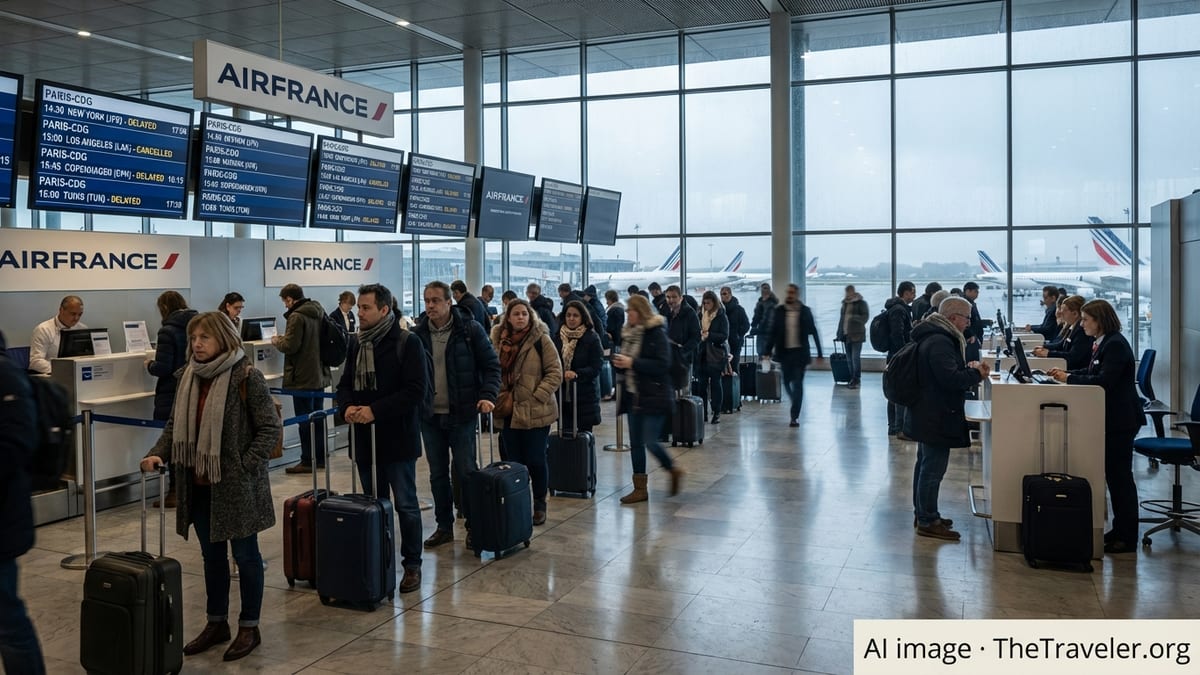
Fifteen Flights Axed as Pressure Builds on Paris Hub
Publicly available flight-tracking data and airport information for June 13 point to at least 15 cancellations and dozens of delays involving departures and arrivals at Paris Charles de Gaulle, including multiple services operated or marketed by Air France and United. The disrupted flights span long-haul routes to North America and shorter intra-European sectors, creating a knock-on effect across the broader networks of both carriers.
On the Air France side, monitoring platforms indicate a pattern of significant schedule strain that has been building through the spring, after a March and April period already marked by large-scale delays across the Air France KLM group. While many flights are still operating, real-time data for services such as AF022 from Paris to Los Angeles on June 13 show extended departure delays, illustrating how even flights that are not cancelled outright can add to crowding at gates and connection bottlenecks.
United Airlines operations at Charles de Gaulle have also been under visible stress. Real-time status information for key transatlantic services, including the daily UA56 link from Paris to Newark, shows flights departing later than scheduled and arriving behind timetable. The immediate impact is missed connections and rebookings, which in turn contribute to the tally of at least 15 flights cancelled or heavily altered around the Paris hub on the same day.
Although exact counts of cancellations can shift as airlines adjust schedules during the day, aggregated tracking data and passenger reports from June 13 consistently describe a sharp spike in flight changes and scrapped departures, particularly on routes touching major hubs in the United States and Western Europe.
Fuel Shock, War Risk and Weather Feed Into Network Strain
The latest turbulence at Paris is unfolding against a wider backdrop of global aviation stressors. Earlier this year, Air France’s low-cost sister carrier Transavia disclosed that it was trimming part of its May and June schedule due to an acute jet-fuel squeeze linked to disruptions in energy supplies. That decision highlighted how route economics have become more fragile when fuel prices surge and supply chains tighten.
At the same time, carriers across Europe, including Air France, have been rerouting or suspending services on some Middle East corridors in response to conflict-related airspace restrictions. Published travel coverage in recent months has described extended suspensions on certain routes, with aircraft forced to take longer paths around closed or high-risk airspace. Those diversions increase operating costs and can limit the availability of aircraft for other parts of the network.
Weather has added another layer of complexity. Recent accounts from travelers and aviation observers point to storms and low-visibility conditions across parts of Northern Europe, feeding back into delays on long-haul operations and onward connections. United’s network, heavily reliant on hub flows through airports like Newark, has seen intermittent waves of disruption when poor weather coincides with high summer demand, leaving little slack in crew and aircraft rosters.
Taken together, these factors have made Paris particularly vulnerable to cascading operational problems. When a single long-haul aircraft runs significantly late into Charles de Gaulle, the aircraft’s onward rotation and its crew duty limits can force late-stage cancellations, converting what initially appears to be a local delay into a multi-route disruption.
Passenger Impact: Missed Connections, Long Queues and Rebookings
For travelers, the practical effects of the June 13 Paris disruption have been immediate and visible. Social media posts and online travel forums describe long lines at transfer desks, crowded departure halls, and information screens dotted with “cancelled” or “delayed” markers beside Air France and United flights. Many passengers connecting from secondary European cities through Charles de Gaulle onto North American destinations reported missed onward flights and unplanned overnight stays.
Some accounts indicate that passengers on disrupted United itineraries from Paris to U.S. hubs have been rebooked on later departures or routed through alternative European gateways. Others have described being shifted between codeshare partners, a common tactic airlines use to preserve itineraries when their own metal is unavailable. While such options can eventually get travelers to their destinations, they also increase traffic at already strained check-in counters and boarding gates.
Air France customers on affected long-haul flights face a similar mix of outcomes. Those whose services were among the roughly 15 cancelled flights appear most likely to encounter involuntary rebookings onto later days or different routings, while passengers on heavily delayed flights must navigate tight minimum connection times and the risk of missing onward legs. Crowding at customer service points has been amplified by high summer traffic volumes, with June historically among the busiest months for transatlantic leisure travel.
Observers note that staffing pressures in airport ground handling and customer service roles are compounding the issue. Even when airlines can arrange new tickets electronically, travelers often still need in-person assistance for baggage, boarding passes, and overnight accommodation, creating choke points in the terminal experience.
Rights, Remedies and the Limits of Compensation
The Paris aviation meltdown has also refocused attention on passenger rights regimes in Europe and North America. Under European Union rules, travelers departing from Charles de Gaulle on either Air France or United are generally covered by regulations that can entitle them to care and, in some cases, monetary compensation when flights are significantly delayed or cancelled for reasons within the airline’s control.
Consumer advocates emphasize, however, that not all disruptions qualify. Events tied to extraordinary circumstances, such as certain airspace closures or severe weather, may fall outside mandatory compensation requirements, even though airlines are still expected to offer rerouting or refunds. As a result, two passengers affected by the same day’s chaos in Paris could face very different outcomes depending on the specific cause recorded for their flight disruption.
In the United States, where many of the disrupted Paris flights are headed, federal consumer reports published this week show that complaints about cancellations and delays remain elevated compared with pre-pandemic baselines. While these reports do not focus solely on Paris or on Air France and United, they illustrate the broader difficulty travelers encounter when high demand meets constrained capacity and complex international operations.
Travel specialists recommend that passengers caught up in the latest wave of disruptions retain boarding passes, receipts and written confirmations of any changes. Such documentation can be crucial when filing claims with airlines or third-party compensation services, particularly in multi-leg itineraries where a cancellation in Paris reverberates across connections in other regions.
What Travelers Can Expect in the Coming Weeks
Looking ahead, industry forecasts and scheduling notices suggest that conditions in and out of Paris are unlikely to normalize immediately. Summer 2026 is projected to bring record transatlantic demand, and airlines including Air France and United have built ambitious schedules to capture that traffic. Operational resilience, however, remains uneven, as carriers continue to rebuild workforces and fine-tune route networks amid volatile fuel prices and geopolitical uncertainty.
Timetables published for the rest of June point to continued heavy reliance on major hubs such as Charles de Gaulle and Newark, meaning that any fresh bout of storms, technical outages or airspace closures could lead to repeat episodes of disruption. Travelers booked on Paris routes are being advised in publicly available guidance to monitor flight status closely in the 24 hours before departure and to allow additional buffer time for connections where possible.
Analysts note that airlines have an incentive to stabilize operations ahead of the peak July and August travel window, when aircraft and crews will be stretched even further. That could translate into tactical schedule trims, aircraft swaps or selective capacity reductions on marginal routes, especially if fuel prices stay elevated or operational bottlenecks persist.
For now, the events of June 13 stand as a pointed reminder of how quickly a major hub like Paris Charles de Gaulle can seize up when multiple stress factors collide. With Air France and United at the center of the latest episode, the experience for thousands of passengers has been a day of missed holidays, disrupted business trips and a renewed sense of uncertainty about just how stable international air travel really is this summer.