


Standing on the Acropolis above modern Athens, the Parthenon looks deceptively simple: a rectangle of columns in warm white stone. Yet almost no line in this 5th century BC temple is perfectly straight, and every detail, from the swelling of its Doric columns to the shimmer of Pentelic marble, was calculated to shape what visitors see as they climb the rock. Understanding how this building works makes a visit far richer, turning a quick photo stop into a lesson in ancient engineering, aesthetics and power.
Get the latest updates straight to your inbox!
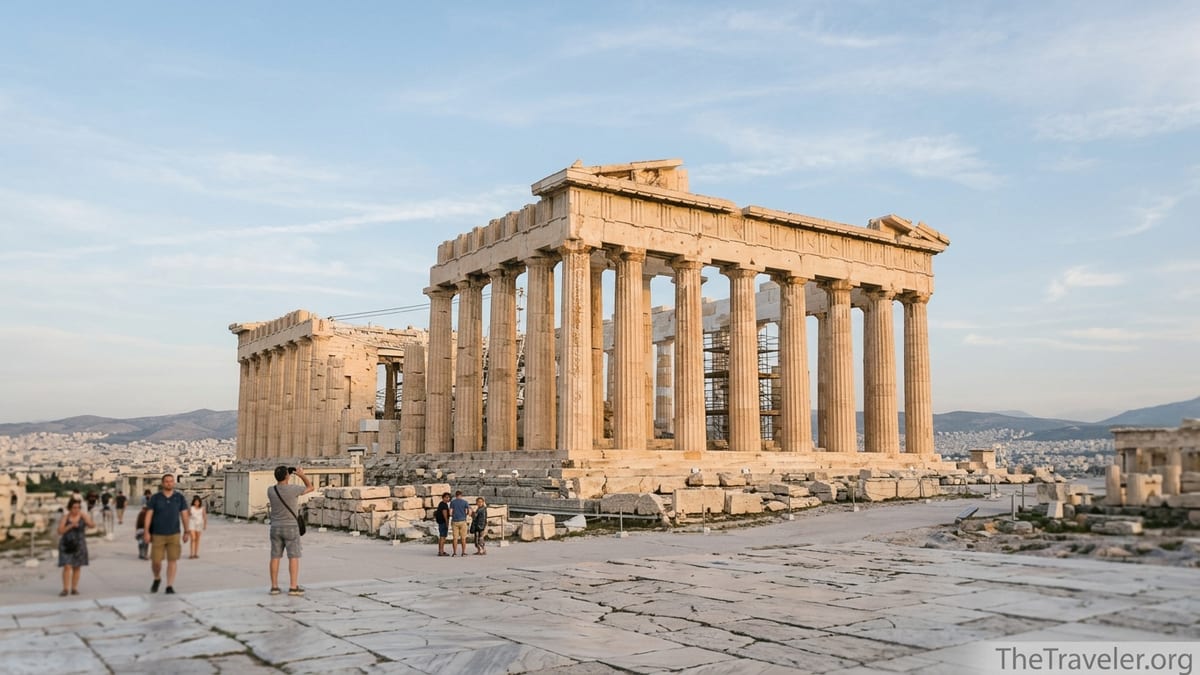
How to Read the Parthenon Before You Walk Up
Most travelers first glimpse the Parthenon from street level around Syntagma or Monastiraki, or from a rooftop bar in Plaka at sunset. From that distance it can resemble a ruinous but regular colonnade. By the time you pass the ticket booth at the Acropolis Archaeological Site and follow the stone path uphill, the temple begins to loom, but its subtleties are still invisible. To really see the architecture, you have to know what to look for when you step onto the marble platform that circles the building.
The Parthenon is a Doric peripteral temple, completed around 432 BC and dedicated to Athena Parthenos. Its outer ring of columns forms a rectangle, with eight columns on the short ends and seventeen on the long sides. This “eight by seventeen” plan is unusual and signals that the architects Iktinos and Kallikrates were pushing beyond the standard six-by-thirteen Doric layout used in many earlier temples. When you stand on the south side today, scaffold and cranes from ongoing restoration work frame this colonnade, a reminder that the building is still an active engineering project almost 2,500 years after it was finished.
As you circle the exterior, imagine the original setting: a brightly painted temple with a massive gold and ivory statue of Athena inside, bronze shields glittering on the exterior, and colored details on the triglyphs, metopes and sculpted figures. The creamy white you see today is only the stone beneath the paint. Visiting the Acropolis Museum before or after you go up the hill helps translate this, since its Parthenon Gallery reconstructs the frieze, metopes and pediments at eye level with fragments and casts arranged as they would have appeared on the temple.
On a practical level, try to visit early in the morning or later in the afternoon outside peak season. In July and August, the marble surfaces around the temple can become extremely bright and hot under the midday sun, which makes subtle curves harder to see and can be uncomfortable underfoot. A hat, sunglasses and shoes with some grip are not just comfort items but can make it easier to linger and study details without rushing.
Doric Columns and the Language of Proportion
The Parthenon’s exterior is built in the Doric order, an architectural language that uses sturdy, fluted columns with simple cushion-like capitals and a frieze of triglyphs and metopes above. For travelers used to the tall, slim Corinthian columns of later Roman buildings, the Parthenon’s supports can look squat and muscular. That impression is deliberate. Doric architecture evolved in mainland Greece and was associated with austerity and strength, which suited a temple designed as a monument to Athenian power after the Persian Wars.
Walk right up to a column on the north side and look closely at its components. Each column stands directly on the stylobate, the top step of the platform, without a separate base. Vertical flutes run up the shaft, meeting in sharp ridges. At eye level you will see the individual “drums” that stack to form the shaft, with hairline joints between them. Above, the capital consists of a narrow square slab (the abacus) over a rounded cushion (the echinus). This simple capital design is a key Doric marker and contrasts with the scrolls of the Ionic order that you may notice inside the Parthenon’s ruined cella area, where Ionic columns once supported an inner frieze.
Proportion is where the Parthenon begins to differ from other Doric temples. The eight columns across the east and west fronts give the building a broader, more stable appearance than the more common six-column front. The ratio of column height to diameter and the spacing between columns all follow a consistent scheme, which historians see as a search for visual harmony. Standing near the southeast corner and looking diagonally across to the northwest, you can sense how the rhythm of columns and spaces creates a visual pulse, encouraging your eye to move around the structure rather than fix on any single element.
Architects and students often bring sketchbooks or tablets to this spot and trace the column grid. Even if you are not drawing, pause and count the columns along one long side and one short end. Understanding that eight-by-seventeen pattern anchors everything else you will notice, from the placement of metopes above to the way the interior once housed a two-room cella with double-tiered columns framing the cult statue of Athena.
Optical Refinements: Curves Where You Expect Straight Lines
The most discussed aspect of Parthenon architecture is its system of optical refinements, subtle adjustments that correct or exploit how the human eye perceives large structures. While scholars still debate exactly how far the ancients went in calculating these effects, certain features are easy to observe in person if you know where to stand and what to compare.
Start with the stylobate, the top step on which the columns stand. From a distance it looks level, but if you walk to the center of the long south side, crouch, and sight along the step toward either corner, you will notice that the line rises gently in the middle. Measurements show that this curvature is only a few centimeters over the entire length, but it helps counteract the optical illusion that a long perfectly flat line appears to sag in the middle. The same gentle upward curve appears in the entablature above the columns, tying the whole composition together.
Next, look at an individual column from arm’s length. Rather than running straight from bottom to top, the shaft swells slightly around one-third of the way up and then tapers again toward the capital. This subtle bulge is called entasis. On a sunlit morning, when the flutes cast clear shadows, you can photograph the column from the side and later draw a straight line over the image to see how the shaft departs from it. The effect is too slight to be consciously noticed when you stand back, but without it, the columns would appear thinner and weaker in the middle.
There is also evidence that the corner columns are slightly thicker and spaced more closely to the adjacent columns than those in the middle of each side. If you stand near the northeast corner and compare the first two intercolumniations (spaces between columns), you may feel that the corner bay is more compressed. This adjustment gives extra strength visually and structurally at the corners, where the building’s outline is most exposed against the sky. Finally, surveys suggest that many columns lean very slightly inward, so that if their axes were extended upward they would meet far above the roof. Together, these refinements create a building that appears geometrically perfect from human eye level, even though it is made of delicately curved surfaces.
Pentelic Marble: Stone With a Golden Glow
The Parthenon is constructed almost entirely from Pentelic marble, quarried from Mount Pentelikon about 10 to 16 kilometers northeast of central Athens. If you ride the suburban train toward northern suburbs today, you can see the pale scar of the ancient quarry on the mountainside. In antiquity, blocks were cut high on the slope, rough-shaped, and then transported by ox-drawn carts and human labor down to the city, a major logistical feat for a project of this scale.
Pentelic marble is prized for its fine grain and a faint yellowish tint that gives it a warm, honey-colored glow in sunlight. On a clear late afternoon, when you stand on the Acropolis and look at the sunlit east front of the Parthenon, you may notice that the stone seems to radiate a soft gold rather than harsh white. Photographers often time their shoots for this “golden hour” precisely because the marble responds so beautifully to low-angle light, bringing out the texture of the fluting and the shallow relief of surviving sculpture.
The stone also weathers in interesting ways. In areas that are still protected or have been recently restored, the marble remains creamy and relatively smooth. In older blocks exposed to pollution and acid rain, especially from 20th century Athens traffic, the surface has roughened and darkened, sometimes with visible pitting. The Acropolis Restoration Service has spent decades carefully dismantling damaged sections, inserting fresh Pentelic marble where necessary, and re-erecting the blocks so that the overall geometry is preserved. When you visit today, you can easily distinguish the bright new stone from the older, honeyed blocks, giving a visual timeline of intervention.
Inside the Acropolis Museum, look for exhibits that explain how ancient masons finished Pentelic marble. They used iron tools, abrasives and polishing techniques to achieve a smooth but not glassy surface. Remember that the marble was originally covered in pigments and, in some cases, thin metal attachments. The stone was therefore as much a substrate for color and gleam as a visible material in its own right. Seeing the Parthenon in full sun and again under cloud, or even at night when floodlights pick out the volumes against the dark sky, gives a sense of how responsive this marble is to changing conditions.
Friezes, Metopes and Pediments: Storytelling in Stone
While the Parthenon’s structural system is Doric, its sculptural program is unusually rich, combining Doric and Ionic elements. The three main sculptural zones are the metopes, the continuous frieze around the upper cella walls, and the pediments at each end. Even in their damaged state, they are crucial for understanding why the building is considered the high point of Classical Greek art.
Above the outer colonnade runs the Doric frieze of triglyphs and metopes. Triglyphs are the grooved panels that suggest the ends of wooden beams, while metopes are the square spaces between them. On the Parthenon, all 92 metopes were carved in high relief, something not seen on any other Greek temple at this scale. The south side showed a battle between Lapiths and centaurs; the east, a gigantomachy or battle of gods and giants; the north, scenes related to the Trojan War; and the west, an Amazonomachy, or battle with Amazons. Standing below the south side today, you can pick out a few surviving centaur figures, though many originals are now in the Acropolis Museum and the British Museum. For a traveler, connecting the weathered blocks above you with the clearer museum casts can make the mythological program suddenly vivid.
Set back from the outer colonnade, around the upper walls of the central cella, ran an Ionic-style continuous frieze about 160 meters long. It likely depicted the Panathenaic procession, the civic and religious festival that wound through Athens every four years to honor Athena. In the Acropolis Museum’s top-floor gallery, glass walls align with the real Parthenon outside, and the frieze blocks are mounted in the same order and at roughly the same height. As you walk this rectangular circuit, you see horsemen, chariots, musicians, elders, gods and the presentation of a folded cloth, probably the peplos robe offered to the goddess. Back up on the Acropolis itself, you can look toward the building’s inner core and picture that band of figures running just above where the roof rafters once sprang.
The two pediments, the triangular gables at the east and west ends, were filled with monumental free-standing sculpture. The east pediment likely showed the birth of Athena from the head of Zeus, with reclining river gods and horses framing the central scene. The west pediment represented the contest between Athena and Poseidon for patronage of Attica. Today, only fragments remain in situ, but the Acropolis Museum and other collections preserve torsos, heads and drapery that convey the original drama. When you stand near the east end of the Parthenon and look up into the empty triangle, it helps to have just come from the museum, where you have seen the surviving figures displayed at eye level with reconstructions of their original positions.
Why the Parthenon Became an Icon of Western Architecture
From the 18th century onward, travelers on the Grand Tour treated the Parthenon as a model of architectural perfection. Engravings by European artists circulated widely, and measured drawings influenced everything from British country houses to American courthouses and museums. If you have visited buildings like the British Museum in London or the National Gallery in Washington, D.C., you have already encountered façades that consciously echo the Parthenon’s colonnaded front.
Several aspects of the building’s design help explain this enduring influence. First is the clarity of its form. The rectangular footprint, ring of columns, simple pitched roof and legible structural system make it easy to understand even for viewers unfamiliar with Greek architecture. Second is the way geometry and refinement coexist. Architects see in the Parthenon a perfect balance between strict proportional systems and the subtle optical adjustments described earlier. This combination has made it a touchstone in architectural education, where students still study its plan, elevations and entasis as part of basic training.
The Parthenon is also iconic because of what it has survived. Over the centuries it has been converted into a church, a mosque and a gunpowder magazine. In 1687, an explosion during a Venetian bombardment blew apart much of the central structure. Later, in the early 19th century, large portions of the sculpted decoration were removed to Britain. Modern visitors see a damaged shell surrounded by scaffolding, but precisely this state contributes to its aura. When you stand on the Acropolis amid tourists from around the world, school groups from Athens and restoration teams in hard hats, the building feels both fragile and stubbornly present, a symbol of continuity and conflict.
Today, the Parthenon also functions as a national emblem for Greece and a global shorthand for democracy, classical learning and “Western civilization,” even though those associations are more complex than they appear on postcards. Exhibitions inside the Acropolis Museum and elsewhere increasingly invite visitors to think critically about this legacy, including debates over repatriation of sculptures and the environmental pressures of mass tourism. As a traveler, understanding this layered history can change the way you frame your own photographs and conversations about what the Parthenon represents.
Seeing the Details: Practical Tips on the Acropolis
The Parthenon’s architecture reveals itself differently depending on your route and timing. Many organized tours approach from the Propylaia and pause briefly on the west side to give a general overview. If you have time on your own, consider making a slow circuit in both directions. Walk first clockwise, keeping the building on your right, to study the north side and its restored columns in the softer morning light. Later, loop counterclockwise for views of the south side against the modern city and the Saronic Gulf.
Optical refinements like curvature and entasis are easiest to see when shadows are crisp. On a clear spring or autumn morning, low sun from the east picks up the fluting and the slight bulge of the columns. In winter, when the air is cooler and crisper, distant views from Philopappos Hill or the terraces of nearby cafes can also help you register the building’s proportions without the distraction of crowds in the foreground. In summer, when light is harsher, a pair of polarized sunglasses can cut glare on the marble, making subtle lines easier to discern.
Because much of the sculpture has been relocated, pairing your Acropolis visit with the Acropolis Museum on the same or adjacent day is particularly valuable. Some travelers choose to visit the museum first, studying the original metopes, frieze blocks and pediment fragments in climate-controlled galleries with explanatory labels in Greek and English. Others prefer to see the temple in situ first and then go to the museum to decode what they have just experienced. Either approach works. What matters is treating the hill and the museum as a single architectural and narrative experience.
Finally, be mindful of preservation rules. Walking on the stylobate or touching the columns is prohibited, and drones are typically not allowed. These restrictions can feel limiting when you are eager to get the perfect shot, but they exist to protect extremely fragile surfaces. Instead, use the designated paths and viewpoints. Tripods are usually discouraged on the Acropolis itself but are more accepted on surrounding hills and terraces, where you can still capture the Parthenon’s profile with a telephoto lens that compresses the colonnade and makes the entasis more evident in photographs.
The Takeaway
For many visitors, the Parthenon begins as a checklist item, a required stop on a short stay in Athens. Yet spending even an extra hour with the building, and approaching it as a carefully engineered object rather than a picturesque ruin, can transform the experience. Its Doric columns, adjusted with entasis and curvature, demonstrate a sophisticated understanding of human perception. Its Pentelic marble, quarried from nearby Mount Pentelikon, records both ancient craftsmanship and modern restoration. Its metopes, frieze and pediments tell overlapping stories of myth, ritual and civic identity, even in fragmentary form.
When you next stand on the Acropolis plateau and the wind catches your hat, or the marble underfoot reflects the midday light, pause and trace the curves, proportions and sculptural zones described here. Imagine the temple as it was in the late 5th century BC, vividly painted and crowded with Athenians during the Panathenaic festival. Then see it again as it is today: scaffolded, debated, admired and endlessly photographed. Understanding the architecture does not diminish its magic. If anything, it deepens your sense of how deliberately beauty was constructed on this rocky hill, and why the Parthenon continues to shape how the world imagines what a temple, and a city, can be.
FAQ
Q1. What makes the Parthenon’s columns different from other ancient columns?
The Parthenon’s outer columns are Doric with a subtle bulge called entasis, slightly thicker corner columns and carefully adjusted spacing, all designed to correct visual distortions in such a large, bright setting.
Q2. How can I actually see the optical illusions when I visit?
Look along the top step (stylobate) from the middle of a long side to notice its gentle upward curve, and study a single column from close range to see the slight swelling of the shaft before it tapers toward the capital.
Q3. Where does the Parthenon’s marble come from?
The temple is built mainly from Pentelic marble quarried on Mount Pentelikon northeast of Athens, a fine-grained stone with a faint golden tint that glows warmly in low sunlight.
Q4. Why does some of the marble look bright white and other parts honey-colored or worn?
Newer blocks used in modern restoration are fresh Pentelic marble, so they appear brighter, while older stones have weathered, darkened and roughened through centuries of exposure and pollution.
Q5. What are metopes, and where can I see them?
Metopes are the square sculpted panels between the grooved triglyphs in the Doric frieze above the outer columns; today many originals are in the Acropolis Museum and other collections, while some weathered examples remain on the temple.
Q6. What was shown on the Parthenon’s continuous frieze?
The Ionic-style frieze around the inner cella likely depicted the Panathenaic procession, including riders, chariots, musicians, priests, citizens and gods participating in a ceremonial offering to Athena.
Q7. What did the east and west pediments represent?
The east pediment probably showed the birth of Athena from Zeus’s head, framed by other gods and river deities, while the west depicted Athena’s contest with Poseidon for the patronage of Attica.
Q8. Why is the Parthenon considered an icon of Western architecture?
Its clear form, refined proportions, sophisticated optical adjustments and rich sculptural program became a model for later public buildings, and its image spread widely through drawings, photographs and Neoclassical imitations.
Q9. How is the Parthenon being preserved today?
Greek conservation teams are systematically dismantling unstable sections, inserting new Pentelic marble where necessary, reassembling blocks with titanium clamps and monitoring damage from weather and tourism in a long-term restoration project.
Q10. Is it worth visiting both the Acropolis and the Acropolis Museum for the architecture?
Yes, the hill gives you the setting, proportions and optical refinements in situ, while the museum lets you study original sculptures and architectural fragments at eye level, so together they provide a much fuller understanding of how the Parthenon was designed and decorated.