


Photographing the Parthenon is one of the great pleasures of visiting Athens, but getting a truly memorable shot takes more than simply pointing your camera at the Acropolis. Light, angle, and foreground all matter, as do crowds and access. This guide focuses on the most reliable real-world viewpoints around central Athens, from Areopagus and Philopappos Hills to rooftop terraces in Plaka and Monastiraki, plus a few strategic museum and street angles that reward patient photographers.
Get the latest updates straight to your inbox!
Understanding Light, Season and Practicalities
The Parthenon faces roughly east and west, which means sunrise and sunset produce very different moods. In summer, sunset in Athens can be close to 9 pm, while in winter it can be just after 5 pm. Because the Acropolis itself typically closes before sunset, most golden hour and after-dark photos will be taken from surrounding hills or rooftops rather than beside the temple. Plan your day so that you are in position at least 30 to 45 minutes before the time of sunset for the date of your visit.
For clean, detailed photos of the building itself, early morning side light from the east works well, especially when shooting from streets on the south and northeast sides of the Acropolis. For dramatic silhouettes and glowing marble, aim for late afternoon and golden hour views from the west and southwest, particularly Philopappos Hill or Areopagus Hill. In midsummer the light can be harsh at midday and temperatures high, so many photographers schedule indoor or shaded visits then, and return outside when the sun softens.
Tripods on the Acropolis are usually restricted without special permission, but you can freely use them from public hills and most streets. On busy rooftops and restaurant terraces, staff may prefer you keep equipment compact. A mirrorless or DSLR camera with a mid-range zoom, such as a 24–70 mm lens on full-frame, covers most situations, while a smartphone with a decent night mode can still capture impressive cityscapes from Lycabettus or Monastiraki.
Finally, remember that restoration work is ongoing. In the past, scaffolding frequently obscured part of the temple, although recent phases have briefly revealed cleaner views. Even if some scaffolding is present, careful framing and use of foreground, such as pine trees or city roofs, can still produce photographs that feel timeless rather than technical.
Areopagus Hill: Classic Close-Up and Night View
Areopagus Hill, also known as Mars Hill, is the closest off-site vantage point for the Parthenon and one of the easiest to reach. The rocky outcrop sits just northwest of the Acropolis, a few minutes’ walk from the main entrance on the pedestrian Apostolou Pavlou and Dionysiou Areopagitou promenade. From Monastiraki Square, it is roughly a 10 to 15 minute uphill walk. At the top, you stand almost level with the lower slopes of the Acropolis, giving you an intimate, slightly low-angle view of the Parthenon framed by the fortification walls.
Sunset from Areopagus can be spectacular, as the sun drops behind the hills to the west and the marble of the Parthenon shifts from warm gold to pale rose. Because the hill is compact, it fills quickly in peak season, with visitors lining the western edge for a direct view of the sun and the Acropolis profile. If you want a tripod position or a clear foreground, arrive at least one hour before sunset on summer evenings and be prepared to share the space. For a slightly different composition, walk a few meters down the north side to include the domes and rooftops of central Athens below the glowing Parthenon.
The rock surface at the summit is polished smooth by centuries of footsteps and can be slippery, especially after rain or when people walk in sandals. For stability while shooting at slower shutter speeds, wear shoes with some grip and consider using the metal stairways on the north side instead of scrambling up the steep marble. After dark, the hill remains a popular gathering spot, with the Parthenon fully lit and the city lights stretching toward Piraeus, but bring a small torch or rely on your phone for the descent, as some paths are uneven and only partly lit.
For photographers aiming for a city-meets-ancient feel, a common strategy is to frame the Parthenon slightly off-center, using the jagged rock and silhouettes of people on Areopagus in the foreground. This works particularly well at blue hour, around 20 to 30 minutes after sunset, when the sky retains a deep cobalt tone and the floodlit temple stands out in warm contrast.
Philopappos Hill: The Balanced, Eye-Level Acropolis Portrait
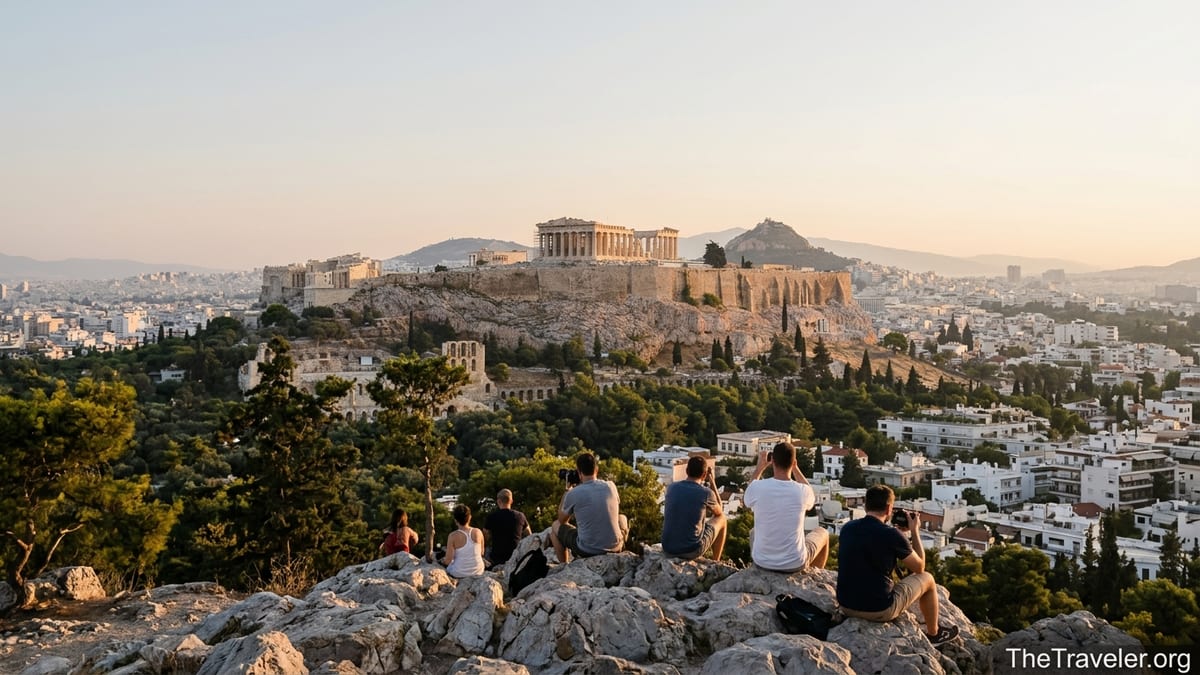
Philopappos Hill, southwest of the Acropolis, is widely regarded by local photographers and guides as offering the most balanced, eye-level view of the Parthenon. A network of pine-shaded paths leads up from the pedestrian promenade near the Acropolis Museum and from the Koukaki neighborhood. From the top, near the Roman Philopappos Monument, you look directly across to the Acropolis with the Parthenon and Erechtheion clearly visible, and fewer modern buildings intruding into the foreground.
This viewpoint excels at late afternoon and golden hour. The sun sets roughly behind the Acropolis from this angle at certain times of year, which means you can capture the temple glowing against the soft haze of the city without shooting into extremely harsh backlight. Many photographers recommend planning a route that reaches the monument area about 60 minutes before sunset, allowing time to scout different clearings. There are several rock platforms with unobstructed views where you can easily set up a small tripod or rest a camera on a backpack for stability.
Compared with Areopagus, Philopappos generally feels calmer, particularly outside of peak summer weeks. Families, dog walkers, and a handful of photographers spread out across the hill rather than concentrating in a single spot. This makes it a good choice if you want a quieter sunset or need space to experiment with long exposures and panoramas. From here you can capture wide 24 mm frames that include the surrounding hills and the Odeon of Herodes Atticus, or zoom in around 70 to 100 mm for tighter architectural shots where the Parthenon fills more of the frame.
Practical details matter on this hill. The paths are mostly dirt and stone, with some uneven sections, so sneakers or light hiking shoes are preferable to sandals. There are no facilities or kiosks at the top, so bring water, especially in summer. If you stay through blue hour to photograph the illuminated Parthenon, allow extra time for a careful walk back down to the city, where you can easily reach Makrygianni or Koukaki restaurants for a late dinner with the Acropolis still visible between buildings.
Lycabettus Hill: Big-City Panorama and Distant Parthenon
Lycabettus Hill, rising to the northeast of the center, delivers the quintessential wide panorama of Athens, with the Parthenon a shimmering focal point among a sea of white buildings. You can reach the upper level either on foot via zigzagging paths from Kolonaki or by taking the funicular railway that departs from a station on Ploutarchou Street. At the summit, near the small chapel of Saint George, several terraces look out toward the Acropolis and the Saronic Gulf beyond.
Because Lycabettus is significantly higher than the Acropolis, the Parthenon appears relatively small in the frame, even with a mid-range zoom. For a strong composition, many photographers treat the temple as a glowing accent rather than the only subject, positioning it slightly off-center within the broader cityscape. A telephoto lens in the 100 to 200 mm range allows you to isolate the Acropolis more effectively, compressing the perspective so that the monument seems to rise from the dense urban fabric. On clear winter days, visibility can be exceptional, revealing distant mountains and giving your skyline shots added depth.
Sunset is the most popular time to visit, when the light fades behind the mountains west of the city and the Acropolis lights switch on. Expect crowds, particularly in high season and on weekends, and plan on arriving early if you want a front-row spot along the terrace railing. If you prefer a calmer scene, consider early morning, when the sun rises behind Lycabettus and the city below is bathed in soft light. This is also a time when locals walk their dogs or jog, and you may have more flexibility to move around with your camera.
There is a café and restaurant near the top, which means you can combine a visit with a drink or meal, though minimum spends for terrace tables with optimal views can apply. If you are working handheld in low light, lean against the terrace walls for stability or rest your camera on the railing. Even smartphone cameras can deliver strong results from here, especially when using night modes that stack multiple exposures to handle the contrast between the bright Parthenon and darker surrounding streets.
Acropolis Museum and Surrounding Streets: Refined Angles and Reflections
The Acropolis Museum, just southeast of the hill, offers a more controlled environment for photographing the Parthenon. The restaurant and terrace on the upper level are designed with direct sightlines to the temple, creating a strong visual dialogue between the ancient and the contemporary. From outdoor tables or the terrace edge, you can capture clean, frontal views of the Acropolis rising above the museum’s glass and concrete geometry, especially effective in late afternoon when the light comes from the southwest.
Inside the top-floor Parthenon Gallery, large windows frame the temple itself. Photography rules sometimes limit tripods and flash, and reflections in the glass can be a challenge, particularly on bright days. To minimize glare, wear dark clothing, move close to the window, and angle your camera slightly away from direct reflections. Even with these constraints, the combination of original sculptural fragments displayed in the gallery and the living Parthenon outside can make for thoughtful, layered images that tell a bigger story than a simple exterior shot.
Just outside the museum, the pedestrian streets of Dionysiou Areopagitou and Makrygianni provide a variety of street-level compositions with the Acropolis as backdrop. Cafés with outdoor seating, musicians, and souvenir stands all contribute to scenes where everyday Athens life unfolds beneath the ancient rock. Early morning is ideal here, when the street is relatively quiet and the first warm light catches the southern walls of the Acropolis. Shooting at around 35 mm or 50 mm allows you to keep both people and monument in the frame without excessive distortion.
On the south side of the Acropolis, a few side streets climb toward the Anafiotika and Plaka districts. From these narrow lanes, you can sometimes find upward-looking angles that place house roofs and bougainvillea in the foreground with the Parthenon peeking above. These are best explored on foot with a small camera or phone, taking advantage of whatever compositions present themselves rather than hunting a single fixed viewpoint.
Plaka Rooftops and Monastiraki Terraces: Dining With a View
Plaka and neighboring Monastiraki are among the most rewarding neighborhoods for combining Parthenon photography with a drink or meal. Many small hotels, cafés, and restaurants here have terraces that look up toward the Acropolis, ranging from simple, family-run tavernas to stylish cocktail bars. Some of the best-known rooftop bars above Monastiraki Square are popular precisely because they frame the Parthenon centered over the square’s church dome and metro station, creating a highly recognizable postcard view, particularly at blue hour.
In Plaka, rooftop restaurants often sit among tiled roofs and neoclassical facades, giving you slightly more intimate scenes. Tables on upper terraces can have direct, unobstructed views of the illuminated Parthenon rising above red-roofed houses. Expect main courses to cost in the region of standard midrange Athens prices, with a premium for front-row tables that face the monument. It is common for rooftop venues to require reservations for sunset slots or to impose a minimum spend per person for tables nearest the view, especially on peak summer evenings.
For photographers, the key challenge on rooftops is balancing the bright temple against darker terraces and foreground diners. Arrive before sunset to capture a sequence of changing light: first, golden hour on the Acropolis with details visible even in the shadows, then blue hour with a richly colored sky, and finally night, when contrast is highest and you may need to expose for the highlights. A fast lens, such as f/1.8 or f/2.8, helps keep ISO levels manageable, but even smartphones perform surprisingly well here thanks to night modes that merge exposures.
If you are using a tripod, always check with staff first. Some busy terraces prefer customers to keep equipment compact so that servers can move safely between tables. A compromise is to use a small tabletop tripod or clamp, setting it on your table while you dine. Be mindful of other guests’ privacy, framing your shots to emphasize the skyline and Parthenon rather than individual faces.
Monastiraki Square and Street-Level Cityscapes
Even without climbing onto a rooftop, Monastiraki Square offers excellent street-level compositions of the Parthenon, especially for photographers who want to capture the contrast between ancient and contemporary Athens. From the northern side of the square, you can frame the mosque building, metro entrance, and flea market stalls in the foreground with the Acropolis rising directly above. This is particularly vivid around sunset, when the sky behind the Acropolis glows and the square’s lights begin to flicker on.
This area remains lively long into the evening, with buskers, vendors, and a constant flow of pedestrians. For candid shots, a 35 mm or 50 mm lens on a full-frame camera (or the equivalent on a phone) allows you to immerse yourself in the scene without excessive distortion. If you prefer more distance, step back along Athinas Street or up some of the side alleys leading toward Psyrri, where you can sometimes gain a slight elevation for a different vantage point on the Acropolis beyond market rooftops.
Blue hour is particularly rewarding here. The Parthenon is fully lit, yet the sky retains color, and the mix of warm street lighting and cooler twilight makes for dynamic contrast. When shooting handheld in this light, brace yourself against a lamppost or building corner to avoid motion blur. In very low light, use your camera’s auto-ISO with a relatively slow shutter limit if your lens has stabilization, or rely on a smartphone’s computational tricks to pull detail from the scene.
For those seeking reflections or slightly unconventional angles, look out for puddles after rain or shiny surfaces such as metro station glass that can mirror the Acropolis at night. These details can turn an otherwise standard skyline shot into something more personal without requiring special equipment or secluded viewpoints.
Additional Sunset Viewpoints and Angles to Try
Beyond the classic hills and rooftops, a few lesser-known spots around central Athens can deliver distinct Parthenon views, especially at sunset. The Pnyx, a historic hill west of the Acropolis associated with ancient democratic assemblies, offers an open terrace of rock with a direct sightline to the Acropolis. It is usually quieter than Areopagus, with enough space to spread out, making it suitable for those who want both a sense of history and a calmer atmosphere while they wait for the sky to turn pink.
Closer to the base of the Acropolis, Anafiotika’s labyrinth of whitewashed lanes and stairways on the north slope yields glimpses of the Parthenon above cottages and fig trees. Rather than a single grand viewpoint, this area rewards wandering and spontaneity. Late afternoon, when the sun skims low above the city to the west, can produce soft, warm light that bounces off the white walls, with the temple glowing above. Because the alleys are narrow, you will often shoot upward with a relatively wide lens around 24 to 28 mm, paying close attention to how vertical lines converge.
Another option is to walk sections of the pedestrian ring around the Acropolis just after sunset, especially along Apostolou Pavlou toward Thissio. From here, you can capture the Acropolis illuminated above tree canopies and café terraces, conveying the sense of a city that lives alongside its ancient landmark. Street lighting and movement add a layer of energy that can be more interesting than a purely static hilltop shot.
If you have multiple nights in Athens, consider varying your vantage points: one evening at Philopappos for a classic postcard, another on a Monastiraki or Plaka rooftop for an urban-skyline feel, and a final night on Lycabettus for a panoramic overview. Each location emphasizes a different relationship between city and monument, and seeing the Parthenon from varied distances and angles deepens your sense of place as much as it enriches your photo portfolio.
The Takeaway
Capturing memorable photographs of the Parthenon is less about chasing a single secret viewpoint and more about understanding how light, distance, and context shape the monument’s character. Areopagus Hill offers immediacy and drama, especially at sunset and after dark. Philopappos Hill provides a balanced, eye-level portrait of the Acropolis with room to breathe. Lycabettus Hill places the Parthenon within the sweep of the entire city, while the Acropolis Museum and surrounding streets allow for thoughtful juxtapositions of past and present.
Plaka and Monastiraki rooftops, along with the square itself, give you the chance to shoot while you dine or wander, embedding the Parthenon in the daily life of Athens. Additional spots like the Pnyx or Anafiotika add variety and intimacy, revealing different faces of the same ancient landmark. With a little planning around opening hours and sunset times, and a willingness to revisit the monument from multiple angles, you can come home with images that go beyond the standard postcard to reflect your own experience of the city.
Whether you are carrying a full-frame camera with interchangeable lenses or relying on a smartphone, the essentials remain constant: arrive early, move thoughtfully through each space, and pay attention to how the Parthenon interacts with the surrounding hills, streets, and people. In a city where nearly every turn reveals a new glimpse of its marble columns, the real challenge is not finding a view, but choosing which one to photograph first.
FAQ
Q1. Where is the single best place to photograph the Parthenon at sunset?
Philopappos Hill is often considered the best all-round sunset spot, with a direct eye-level view of the Acropolis, space to spread out, and softer light than some closer viewpoints.
Q2. Can I watch the sunset from inside the Acropolis next to the Parthenon?
In most seasons the Acropolis closes before sunset for safety and conservation reasons, so you will need to watch and photograph sunset from nearby hills or rooftops instead.
Q3. Is Areopagus Hill safe for evening and night photography?
Areopagus Hill is busy at sunset and early evening, which helps it feel lively, but the rock can be slippery and the paths uneven, so move carefully and avoid walking alone very late at night.
Q4. Do I need a tripod to photograph the Parthenon at night?
You do not strictly need a tripod, as modern cameras and smartphones handle low light well, but a small tripod or stable support improves sharpness for blue hour and night skyline shots.
Q5. Which rooftop areas give the most iconic Parthenon views?
Rooftop bars and restaurants around Monastiraki Square and in Plaka provide some of the most iconic views, often framing the Parthenon above tiled roofs, domes, and the busy streets below.
Q6. How early should I arrive on Lycabettus Hill for sunset photos?
On busy evenings it is wise to arrive at least an hour before sunset on Lycabettus Hill if you want a front-row position on the terraces and time to explore different angles.
Q7. Are there quieter alternatives to crowded sunset spots like Areopagus?
The Pnyx and parts of Philopappos Hill are generally quieter than Areopagus at peak times, offering open rock platforms where you can set up a camera without heavy crowds.
Q8. Can I photograph the Parthenon from inside the Acropolis Museum?
Yes, you can photograph the Parthenon through the windows of the top-floor gallery and from the museum’s terrace, although you may need to work around reflections and follow museum rules.
Q9. What lens is most useful for Parthenon photography around Athens?
A mid-range zoom, such as 24–70 mm on a full-frame camera, is extremely versatile, handling everything from close city scenes in Plaka to wider views from hills and rooftops.
Q10. Is it worth visiting multiple viewpoints, or should I focus on one?
Visiting several viewpoints is worthwhile, because each reveals a different relationship between the Parthenon and the city, and together they create a richer visual story of Athens.