


The Parthenon looks timeless in photos, but your experience on the hill of the Acropolis can vary dramatically depending on when you go. In high summer the marble blazes white under a 35°C sun and tour groups pour off buses and cruise coaches. On a clear February afternoon the same stones glow honey‑gold and you may share the summit with only a few dozen visitors. Choosing the right time of day and time of year will shape everything from your queue time at the gate to how your photos turn out. This guide breaks down real‑world conditions by season and hour so you can plan your visit with eyes open.
Get the latest updates straight to your inbox!
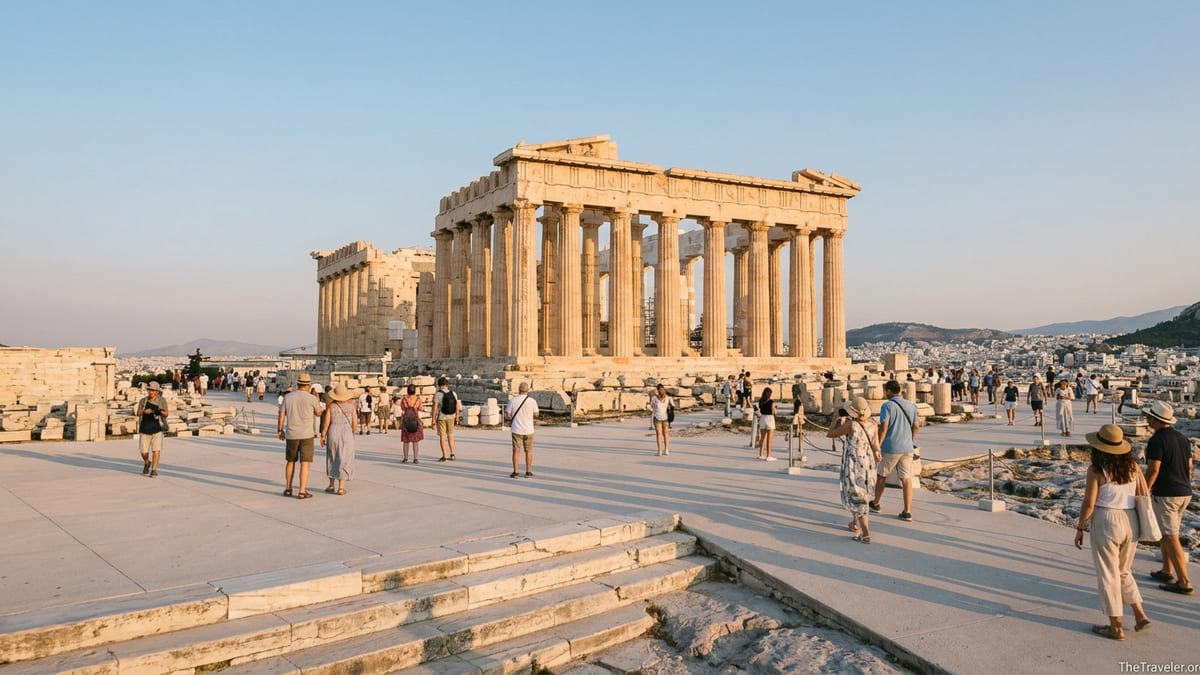
Understanding Hours, Tickets and New Time Slots
The Parthenon sits inside the Acropolis archaeological site, which is what you are actually buying a ticket for. As of 2026, the Acropolis opens daily at 8:00 and closes around sunset, typically 19:30 to 20:00 in the extended summer season and about 17:00 in winter, with last entry roughly 30 minutes before closing. In practice this means that in July you might still be walking down in warm golden light at 19:45, while in January guards begin gently moving people toward the exit by 16:45.
Greece has introduced timed entry for the Acropolis, with tickets valid only within a defined 30‑minute window at the main gates. If your ticket says 8:00, you are expected to enter roughly between 7:45 and 8:15. This has shortened the marathon ticket lines that once snaked down the hill, but it has not removed crowding at popular slots. Early morning tickets between 8:00 and 9:00 and late afternoon slots from about 17:00 often sell out first for peak summer dates, while midday windows may still be available a week before.
There are two main entrances: the busy western main gate near the Propylaea and the usually calmer southern slope gate near the Acropolis Museum. Independent travelers often report that even on crowded days the south entrance has much shorter lines, especially before 9:00 or after 16:00. Buying official e‑tickets in advance, saving them on your phone, and entering via the south slope is one of the simplest ways to avoid long queues.
Because the Parthenon sits on exposed marble pavement, local authorities sometimes shut the site briefly in extreme summer heat or during high winds and storms. Strikes and public holidays can also affect hours. If you have only one afternoon in Athens, avoid planning your visit for the last possible slot of your stay. Give yourself a backup window earlier that day or the following morning so an unexpected closure does not mean you miss the monument entirely.
Morning vs Late Afternoon: Light, Heat and Crowds
From April through October, the two prime windows for a comfortable and photogenic visit are right after opening and in the last two hours before closing. In recent summers, visitors arriving at the 8:00 opening slot in late May or June report cooler temperatures and manageable crowds at first, with the plateau around the Parthenon filling significantly by about 9:30 to 10:00 as bus tours and cruise excursions arrive. By late morning you can easily find yourself shoulder to shoulder at the best viewpoints, waiting for gaps between tour groups to frame a photo.
In high season afternoons, the pattern reverses. At 14:00 in July the sun is high, the light is flat and harsh, and the white Pentelic marble reflects heat and glare. Even with hats and sunscreen many travelers find the experience physically draining, particularly older visitors and families with small children. By 17:00, however, the temperature has usually dropped a few degrees and a breeze often picks up. By 18:00 the light turns warmer and more angled, creating richer texture on the columns and more flattering portraits. Travelers who entered between 17:00 and 18:00 in recent summers frequently describe this as the sweetest spot: busy but not packed, with long shadows and golden color across the city.
In shoulder seasons such as late March or early November, the balance shifts slightly. Mornings can feel brisk, especially on windy days, and the low sun can cast deep shadows on one side of the Parthenon, making even exposures trickier for phones. Late morning between roughly 10:00 and 11:30 often offers a good compromise: milder temperatures than early dawn, softer light than midday, and fewer crowds than prime 8:00 slots that many organized tours target. In the late afternoon, with earlier winter closures, you may only have a narrow 15:30 to 16:45 window of warm light before guards begin clearing the upper level.
Whichever time you choose, remember that you still need 10 to 20 minutes from the gate to reach the Parthenon plateau, including the climb through the Propylaea. If you want to stand in front of the Parthenon at 8:15 with minimal people in the background, aim to be at the entrance turnstile by 8:00 with ticket already in hand.
Summer Heat and Cruise Crowds: What to Expect
From June through early September, Athens regularly sees afternoon highs above 32°C, with heatwaves pushing temperatures even higher. The Acropolis offers virtually no shade aside from the north side of the Parthenon, and the pale stones reflect sunlight upward, so it can feel considerably hotter at 13:00 than street‑level thermometers suggest. On some days authorities reduce opening hours or temporarily close the hill during the fiercest heat, typically mid‑afternoon. Travelers in recent summers have reported being turned away or having to wait until later in the day when on‑site temperatures fell below safety thresholds.
At the same time, Piraeus, the port of Athens, hosts several large cruise ships on many summer days. Shore excursions usually schedule Acropolis visits in the late morning, often between about 9:30 and 12:30. When two or three ships with thousands of passengers arrive within an hour of each other, this can dramatically increase crowding at the main gate and on the summit. Guides gathering their groups near the Parthenon can sometimes occupy the most photogenic angles for extended periods.
Independent visitors have a few ways to work around this crunch. Checking a recent cruise schedule for Piraeus before fixing your day can be helpful: if you see three mega‑ships in port on your only full day in Athens, lean even more strongly toward the 8:00 slot or the last entry window. Many cruise passengers must be back at the ship by late afternoon, so the post‑17:00 period often sees noticeably fewer large guided groups. Another tactic is to visit the Acropolis Museum during the hottest hours then head up to the hill around 17:30, when the air starts to soften and bus tours have largely finished.
Plan accordingly for summer conditions. Concrete examples from recent seasons include visitors who packed one‑liter refillable bottles and topped them up at the water fountains on the hill, wore UV‑blocking hats and light long‑sleeved shirts, and carried small battery fans. By contrast, travelers who underestimated the heat and went at 13:00 in July often describe cutting their visit short and skipping some viewpoints simply because it was too intense to linger.
Season by Season: When the Parthenon Feels Different
Spring, from late March through May, is one of the most rewarding times to see the Parthenon. Daytime highs commonly sit in the low 20s Celsius in April, with wildflowers still visible on the slopes of the hill. Easter week and long weekends can be busy, but overall crowds are lighter than in mid‑summer. In this season, an 8:30 or 9:00 visit can offer a pleasant balance of gentle light, comfortable temperatures and moderate traffic. Travelers often pair a late‑morning Acropolis visit with an afternoon in the nearby Plaka district or at cafés around Monastiraki Square.
High summer, from June to early September, is the most popular and demanding period. Ticket prices are at their standard high‑season level, accommodation in neighborhoods like Koukaki and Plaka sells out far in advance, and tour groups are omnipresent. That said, you also get long opening hours and consistently clear skies, which are ideal for photography. Many repeat visitors deliberately choose either the very start or the very end of a summer day on the hill, planning their Acropolis visit first and then booking island ferries or flights afterward.
Autumn, from mid‑September through late October, is another sweet spot. The sea is still warm on nearby islands, but temperatures in Athens may dip into the high 20s or low 30s. Crowds thin somewhat, especially after the first week of October when many European school holidays end. A 16:00 entry in early October can bring warm, angled light that flatters both marble and skin tones, and you are more likely to enjoy a gentle breeze than in July. By late October the sun sets earlier and the site may already be working on its reduced schedule, so check hours carefully if you are traveling at the very end of the season.
Winter, from November through March, offers a completely different experience. Tickets are usually cheaper, and there are days in January when you may share the upper plateau with just a few small tour groups and locals. The downsides are shorter daylight, more frequent rain, and occasionally strong winds that make the exposed hill feel raw. Some January and February days stay gray all afternoon, which can flatten photos, but when a cold front passes and the sky clears, visibility across Athens and out to the Saronic Gulf can be exceptional. In winter, the best visit window is often late morning through early afternoon, roughly 10:30 to 14:00, when temperatures are highest and the sun is high enough to light both sides of the structure.
Photography: Getting the Best Light and Angles
For most visitors today, the “camera” is a phone, often something like an iPhone or a recent Samsung Galaxy. These devices handle high contrast reasonably well but still struggle with extremely bright midday sun on white marble. Shooting at 8:30 in May or 18:30 in August, when the light is warmer and the sun lower, will instantly give you deeper texture on the fluted columns and more detail in the metopes than shooting at 13:00.
Classic perspectives are easiest to capture from the south and southeast sides of the Parthenon, where scaffolding changes least and you can frame the temple with sky and distant hills behind. In the morning the sun generally rises behind Mount Hymettus, to the east of the Acropolis, so the west side of the Parthenon may be in shade for a while. If you want a fully lit west façade, consider a late‑morning slot. For backlit, atmospheric shots with a glow around the columns, a late‑afternoon visit is ideal. You can, for example, stand near the northwest corner looking southeast at around 18:45 in July and capture the Parthenon glowing against a bright but softening sky.
If you are using a dedicated camera, a wide‑angle lens around 24 mm on a full‑frame body lets you include the full structure even at close range, while a short telephoto around 50 to 70 mm helps isolate column details without too much distortion. Tripods are generally not allowed on the site, but you can stabilize your camera by bracing against low walls or columns of protective fencing. For phone users, enable HDR mode to retain sky detail and tap to expose for the bright marble, letting the crowds go slightly darker in the frame.
Remember that the most photographed angles can be the most crowded. One practical approach is to walk directly to your priority viewpoint as soon as you reach the summit, rather than lingering at the first good spot. Many visitors naturally stop at the first open space, leaving slightly farther viewpoints temporarily emptier. If you are patient, waiting a minute or two between tour group movements often creates a brief pocket when you can capture a clean frame of the Parthenon with just a handful of figures for scale.
Queue Management and Avoiding the Worst Lines
Even with timed tickets, queues still form at the Acropolis, especially at the main western entrance. At busy moments in June or July, travelers have reported lines stretching several hundred meters as they waited for delayed openings or for earlier ticket windows to clear. The key is to separate the ticket queue from the security and entry queue. If you buy your ticket in advance through the official e‑ticket platform, you can usually bypass the line at the ticket booth entirely and go straight to the entrance for your time slot.
Arriving 20 to 30 minutes before your slot, especially for the first morning entry, gives you a buffer in case there is a security delay or a temporary closure. In shoulder season, people who reached the south slope entrance at about 7:45 for an 8:00 opening often experienced only a short, steadily moving line, passing the gate within 10 to 15 minutes. By contrast, visitors arriving at 9:30 without tickets in late May sometimes waited long enough that they were still in line as the midday heat built and school groups crowded the path.
Another practical tactic is to use the combined site ticket, which also covers other ancient sites like the Ancient Agora and Roman Agora. Some travelers buy this combined ticket at a quieter site, for example at the Ancient Agora ticket office in the late afternoon of the day before their planned Acropolis visit, then walk straight past the ticket booths at the Acropolis the next morning. This does not bypass the entry queue, but it can remove one step and reduce your overall waiting time.
Finally, avoid cutting things too close to closing time. Because last entry is typically 30 minutes before closing, arriving at the gate at 19:20 on a summer night with a 19:00–19:30 ticket is risky. Security staff may already be turning people away to ensure that everyone on the hill has enough time to ascend, visit and descend safely. Plan to be at the bottom of the hill at least 45 to 60 minutes before closing, even if you prefer to linger on the summit until the guards begin their gentle sweep.
Special Considerations: Strikes, Closures and Accessibility
Greece experiences occasional nationwide strikes that can affect archaeological sites, public transport and museums. On strike days the Acropolis may open late, close early or in rare cases not open at all, depending on staff participation. In March 2026, for instance, some visitors who arrived before 8:00 reported that the main entrance remained closed for more than an hour due to a work stoppage, creating an unusually long queue. When planning a once‑in‑a‑lifetime visit, it is wise to keep your Acropolis slot flexible within your stay or to schedule it for your first full morning in Athens rather than your last.
Weather can also prompt last‑minute changes. During extreme heat advisories in recent summers, authorities have occasionally closed the site in the mid‑afternoon and reopened later when on‑site temperatures dropped. Conversely, heavy rain can make the smooth marble surfaces slippery, especially on the steps near the Propylaea and around popular photo spots. On wet winter days, walking carefully and wearing shoes with good grip matters more than the exact time of day you go, though you may still prefer the brighter light of midday.
For visitors with limited mobility, there is a lift on the north side of the Acropolis that can greatly ease access to the summit. Its operation can be affected by high winds or technical issues, so if you are relying on it, check current information shortly before your visit and allow additional time in case of delays. In busy periods, it may also have its own small queue, particularly when groups request priority use.
Public transport patterns should also shape your timing. Metro Line 2 connects central Athens with the Acropolis station near the southern entrance. Early morning trains can be crowded with commuters on weekdays, while late evening services thin out and may feel more relaxed. If you prefer to arrive from Piraeus on the suburban train or metro after disembarking from a ferry or cruise, expect some crowding just after 8:00 and again in late afternoon, and factor that into how early you leave your hotel or ship.
The Takeaway
There is no single perfect hour to visit the Parthenon that works for everyone, every month of the year. Instead, the right timing depends on your priorities. If you want the quietest possible experience and do not mind a chill in the air, a late‑morning visit on a sunny winter weekday can feel almost contemplative. If you crave golden light and classic photographs with long shadows, aiming for the last two hours before closing between May and September will reward you with rich colors and city‑wide views.
For most travelers in busy months, a simple rule of thumb works well: think in terms of edges, not the middle. In summer, book the earliest or one of the latest time slots, avoid the 10:00 to 16:00 high‑heat band when possible, and be prepared for the possibility of cruise crowds and temporary heat closures. In shoulder seasons, you can relax this a little and prioritize light over temperature, perhaps targeting a 9:00 or 16:00 entry. Whenever you go, buying tickets in advance, using the quieter south entrance and arriving slightly early will all do more to improve your experience than shaving off a few minutes in either direction.
Plan your day around the Parthenon, not the other way around. Give yourself enough time to absorb the details of the architecture, to circle the temple from different angles and to simply stand at the railings and watch Athens spread out to the sea. With thoughtful timing, you will carry home not only striking images, but also the memory of having shared the hill at a moment when it felt spacious and alive rather than rushed.
FAQ
Q1. What is the single best time of day to see the Parthenon in summer?
In high summer, the most rewarding times are usually right after opening around 8:00 or in the last two hours before closing, typically between about 18:00 and 20:00. Both windows offer cooler temperatures and softer light than midday, but if you value golden, photogenic light above all, the early evening slot tends to be the standout.
Q2. How early should I arrive for an 8:00 ticket?
Plan to be at the entrance 20 to 30 minutes before your 8:00 slot, especially at the south slope gate. This buffer helps you clear any initial queue and start climbing as soon as the hill opens, putting you near the Parthenon within the first 15 minutes when crowds are still relatively thin.
Q3. Are evenings really less crowded if cruise ships are in port?
Often yes. Most cruise excursions to the Acropolis run in late morning or early afternoon so passengers can be back on board well before departure. By the last two hours of opening time, many ship passengers have already returned to Piraeus, and while the site is still busy in peak season, you are likely to see fewer large guided groups.
Q4. Is winter a good time to visit the Parthenon for photography?
Winter can be excellent for photography on clear days, with crisp air and far‑reaching views. The light stays relatively low all day, which softens shadows, but you have fewer daylight hours and a higher chance of clouds or rain. On balance, aim for late morning to early afternoon in winter for the best combination of brightness, warmth and flexibility.
Q5. What time should I avoid if I am sensitive to heat?
If you struggle with heat, avoid roughly 11:00 to 16:00 from June through early September. In this band the combination of direct sun, reflective marble and limited shade can feel overwhelming, especially on days above 32°C. Early morning and early evening are far more comfortable, even if your schedule forces you to accept slightly larger crowds.
Q6. How much time should I allow for a visit including photos?
Most independent visitors spend about 90 minutes to two hours on the Acropolis hill itself, including time to walk up, circle the Parthenon from several angles, photograph the Erechtheion and enjoy the panoramic views. If you are also visiting the Acropolis Museum the same day, plan on adding at least another two hours for the museum and breaks.
Q7. Is it worth visiting both in the morning and again at sunset?
If your schedule and budget allow, seeing the Parthenon in two different lights can be deeply rewarding. A morning visit may offer clearer details and cooler air for close‑up exploration, while a late‑afternoon or near‑sunset return highlights color and atmosphere. Many photographers and architecture enthusiasts consider two shorter visits, spaced across the day, preferable to a single long midday stay.
Q8. What happens if there is a heat closure during my time slot?
During extreme heat, authorities may temporarily close the Acropolis for safety. In that case, staff typically advise visitors to return in a cooler window later that day or on another day, subject to capacity. Policies can vary, so if you are visiting in the hottest months, check for advisories in the morning and keep your wider schedule flexible enough to shift your visit by a few hours if needed.
Q9. Can I change my timed ticket if my preferred light or weather changes?
Official timed tickets are generally tied to a specific day and entry window and may not be easily modified once purchased. Some third‑party providers allow more flexibility at a higher price, but conditions vary. To avoid disappointment, choose a time that works reasonably well for you even if the sky is not perfectly clear, and treat ideal light as a bonus rather than a guarantee.
Q10. Is the south entrance always better for avoiding queues?
Not always, but very often it helps. The south slope entrance tends to attract fewer large tour groups and is closer to the Acropolis Museum, so independent travelers and small parties can usually enter more smoothly there, especially in the morning. On unusually busy days or during strikes and special events, however, queues can form at both gates, so buying tickets in advance and arriving early remain your best defenses.