


Few places fire the imagination like the Parthenon. For many travelers, standing on the Acropolis is a lifelong dream, and a surprising number arrive in Athens assuming they will be able to walk between the columns or even step inside the ruined temple. The reality on the ground is more restricted, but no less rewarding if you know what to expect and where to look. This guide explains exactly what you can and cannot do at the Parthenon today, how restoration works shape your visit, and how to come home with great photos even if you never set foot inside.
Get the latest updates straight to your inbox!
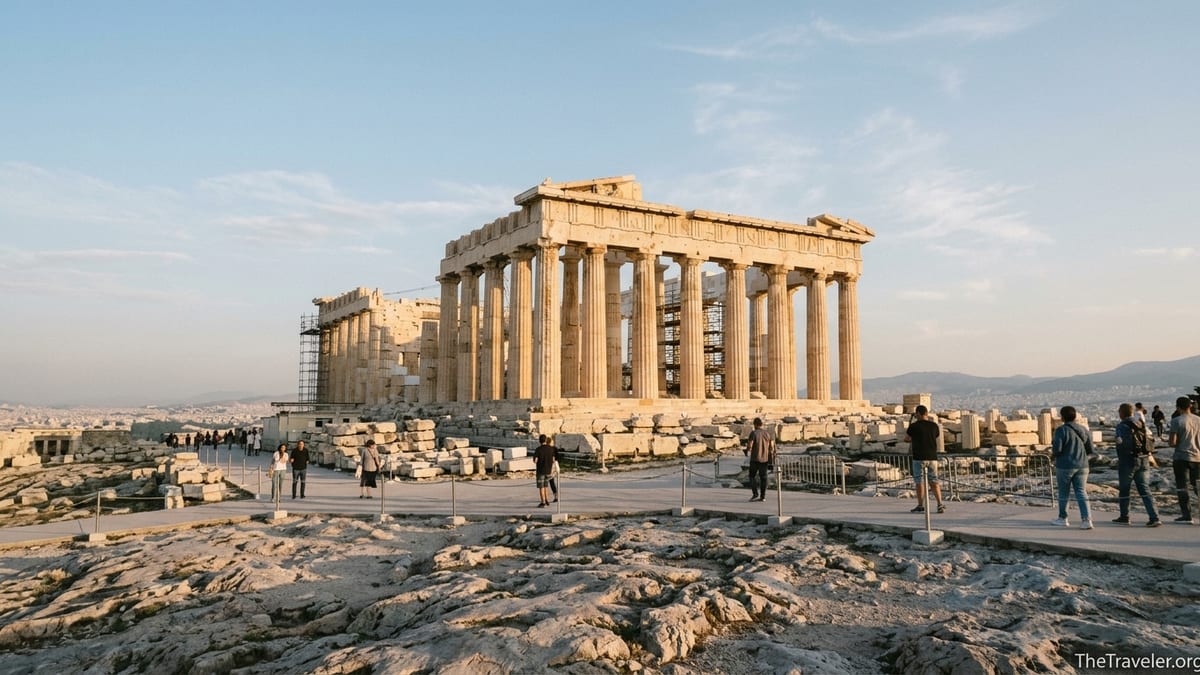
Can You Actually Go Inside the Parthenon?
The short answer is no: ordinary visitors cannot currently go inside the Parthenon in Athens. Access to the temple’s interior has been closed to the general public for many years due to safety concerns, the fragile state of the structure and ongoing restoration works led by the Hellenic Ministry of Culture. When you visit the Acropolis today, you walk around the monument on designated paths and view it from outside the colonnade, but you do not pass between the columns or enter the cella, the inner chamber that once held the statue of Athena.
This catches many people off guard. Travelers who have toured sites like the Roman Forum or certain smaller Greek temples, where you can sometimes step onto ancient floors or walk between columns, assume the same will be true here. On the Acropolis plateau, however, the Parthenon is treated more like a museum object than a walk‑through ruin. Low fences, ropes and platforms define how close you can approach, and guards actively prevent visitors from crossing barriers, sitting on steps or touching the marble.
There are rare exceptions. Access inside may occasionally be granted to archaeologists, conservators, official delegations or journalists under strict supervision, usually wearing hard hats and safety vests. These are not bookable experiences and are arranged through the authorities. If you see photographs taken from the center of the temple looking out through the columns, they almost always come from such special access, not from a standard ticket visit.
For the average traveler, “visiting the Parthenon” in 2026 means walking right up to its perimeter, circling it from multiple sides on the Acropolis summit and then exploring its sculptures and architectural details up close in the Acropolis Museum, where original friezes and metopes are displayed at eye level in a climate‑controlled gallery.
Understanding Barriers, Restoration Zones and Safety Rules
Once you reach the top of the Acropolis hill, you will find that movement around the Parthenon is carefully choreographed. Low metal railings and ropes keep visitors at a set distance from the base of the temple, while raised walkways in some sections guide the flow of people. The exact configuration can change from year to year as conservation teams shift their focus, but there is always some part of the building wrapped in scaffolding or partly screened by cranes and equipment.
For example, in recent seasons large sections of the north and west sides have featured scaffolding towers and winches used to lift marble blocks during structural interventions. This means that your view might be slightly obstructed on one side, but another side will usually be clearer. On a typical summer morning, visitors cluster on the relatively open south side to photograph the colonnade in full sun while avoiding the heaviest machinery.
The barriers serve several purposes: they protect fragile architectural elements, limit wear on the ancient bedrock and marble paving and, crucially, keep people out from under heavy loads and unstable sections. Local guides often share stories of visitors trying to climb onto the stylobate for a “epic Instagram shot” and being immediately whistled down by guards. Fines are rare but the staff have the authority to remove people from the site for ignoring rules, and they will not hesitate to intervene if you step across a rope line or perch on a fallen block.
Other regulations also shape your visit. Tripods are generally not allowed without special permission, drones are prohibited over the archaeological site, and large props or commercial‑style photo shoots require advance approval from the Ministry. Security staff will ask you to put away reflective items near sensitive surfaces and may stop you from leaning camera lenses against marble blocks or railings.
What You Can See Without Going Inside
Even though you cannot enter the Parthenon, you can still see far more than many first‑time visitors expect. From the paths circling the temple you have clear views of the Doric columns, the entablature and much of the surviving sculptural decoration. Look carefully and you will notice subtle differences between the corner columns and the interior ones, and the slight curvature of the stylobate that ancient architects used to correct optical illusions.
On the south side, you can often peer between columns and glimpse the inner structure, including massive marble beams and some of the original wall lines of the cella. Early in the day, when the sun is low, the light rakes across the fluted columns and emphasizes texture and shadow. If scaffold covers are not blocking the view, you may even see segments of reconstructed frieze blocks set back from the outer colonnade, giving a sense of the temple’s layered depth.
The Acropolis Museum, a short walk downhill from the site, completes the picture. Its top‑floor Parthenon Gallery recreates the temple’s footprint at full scale with glass walls looking directly back to the monument itself. Here, original metopes and frieze panels are mounted at roughly the height they would have occupied on the building but close enough to study individual figures and chisel marks. Many travelers who initially feel disappointed about not being able to enter the temple find that this gallery offers an unexpectedly intimate encounter with the Parthenon’s art.
Elsewhere in Athens you can explore smaller temples that do allow a different kind of access, which helps contextualize the Parthenon. At the Temple of Hephaestus in the Ancient Agora, for example, you still cannot walk into the inner chamber, but you can get closer to intact colonnades and see a well‑preserved Doric structure from multiple angles without the same scale of scaffolding. Combining these visits in a single day gives you a broader sense of classical temple architecture beyond the iconic ruin on the Acropolis.
Best Viewpoints and Photo Angles Around the Parthenon
Since you will be photographing the Parthenon from outside, the trick is to use the hilltop terrain and changing light to your advantage. On the Acropolis itself, one of the most popular angles is from the southeast corner, where the ground drops away slightly and you can frame the entire long side of the temple with fewer people in the foreground. In early morning, this side catches soft side‑light that reveals the fluting on the columns and the warm tones of the Pentelic marble.
Another strong angle is from the northwest, near the path that leads toward the Erechtheion. From here you can capture both monuments in a single frame, with the Parthenon rising behind a cluster of smaller ruins and olive trees. Many visitors with smartphones instinctively stop here because the elevated vantage point and layered composition make it easier to shoot around tour groups. Even at peak hours, you can usually step aside for a clean shot if you are patient for a few minutes.
For wider cityscapes featuring the Parthenon from afar, head to Philopappos Hill or the Areopagus rock outside the Acropolis ticketed area. In late afternoon, photographers often climb Philopappos with a mid‑range zoom lens to capture the Parthenon glowing above the city as the sun sets behind Piraeus. On clear evenings, the combination of lit columns and the darkening city grid creates a classic postcard view that does not require any special equipment beyond a steady hand or a small, unobtrusive travel tripod used away from archaeological structures.
At night, the monument is dramatically illuminated, and hotel rooftop bars in central Athens advertise “Acropolis views” for a reason. A traveler staying near Syntagma, for example, might step out to a local rooftop terrace after dinner and photograph the Parthenon from several kilometers away with a 70–200 mm or similar zoom. The result will not show fine sculptural details, but it does capture the monument as part of the contemporary city, which for many visitors becomes one of their favorite images of the trip.
Photography Rules, Gear Choices and Crowd Management
Within the Acropolis site, casual photography for personal use is allowed and very common. Visitors snap thousands of smartphone images every hour, and you will see everything from compact mirrorless cameras to high‑end DSLRs. What is more tightly controlled is anything that looks like professional or commercial work: tripods, lighting stands, large reflectors, costume changes or organized group photo sessions. Guards are trained to stop such setups and can ask you to delete shots if they believe site regulations have been breached.
To avoid problems, keep your gear simple. A mid‑range zoom lens such as a 24–70 mm on a full‑frame camera covers most compositions on the hill, while phones with a standard and a short telephoto lens handle the rest. Many travel photographers leave their big telephotos and tripods back at the hotel when heading to the Acropolis, relying instead on image stabilization and steady handholding. It is fine to briefly rest a camera on a stone wall that is clearly outside fenced‑off areas, but do not climb, lean, or place equipment on ancient blocks or low columns.
Crowds are another practical photography challenge. In high season, tour groups begin arriving soon after opening time, and by mid‑morning lines of visitors wrap around key viewpoints. One strategy is to book the earliest available entry slot, then walk briskly past the first viewpoints and head straight to the far side of the Parthenon. You can often get several minutes of relatively clear views there while most groups are still stopping at the initial terraces. Another approach is to return in the late afternoon, when day‑trip buses have left and light is softer.
Inside the Acropolis Museum, photography rules are different by gallery. In the Parthenon Gallery, non‑flash photography of the sculptures is typically allowed, but staff may prohibit shooting toward certain windows or reflective surfaces. Security guards will ask you to check large backpacks and may restrict selfie sticks. Planning ahead by bringing only a small bag and a compact camera or phone will help you navigate the museum more easily and spend your energy studying the details rather than negotiating with your gear.
Managing Expectations: From Fantasy Interior to Real‑World Visit
Many travelers arrive in Athens with a mental image of stepping between the Parthenon’s columns into a quiet, glowing interior, often inspired by paintings, films or digital reconstructions. When they discover they cannot go inside at all, the initial reaction can be disappointment or even frustration. Recognizing in advance that your experience will center on external viewpoints and museum displays, rather than interior exploration, helps recalibrate expectations before you climb the hill.
Think of the Parthenon as an object you orbit rather than a building you enter. The reward is the changing perspective as you circle the monument: how the columns align and separate, how the skyline of modern Athens appears and disappears behind the structure and how light and shadow transform the marble throughout the day. Many visitors find that the most memorable moments are not static views of the façade but quick, unplanned glimpses when the crowd shifts and a new angle opens up for a second or two.
It also helps to remember that the interior many people imagine no longer exists. The colossal gold and ivory statue of Athena vanished centuries ago, the roof has long since collapsed and the walls have been partially destroyed by explosions and later conversions of the building into a church and then a mosque. Even if you could walk inside today, you would not find an intact chamber but a fragile shell that conservators are still stabilizing piece by piece. The modern restrictions are part of preserving what remains for future generations.
A good way to transform initial disappointment into curiosity is to pair your Acropolis visit with time in the Acropolis Museum on the same day. Seeing the original friezes, metopes and pediment sculptures up close, while looking out through floor‑to‑ceiling glass at the ruined temple above, creates a powerful sense of continuity between the building’s past and present. Many travelers who begin the day wishing they could step inside the Parthenon end it with a deeper appreciation of the conservation work that keeps even its outer shell standing.
Planning Your Visit: Tickets, Timing and Mobility
Access to the Parthenon is included with a standard Acropolis ticket, which covers the entire hilltop archaeological site. You do not buy a separate “Parthenon” ticket. In busy months, advance purchase of a timed entry slot can save you a long wait at the main gate and help you avoid the hottest hours. A traveler arriving in Athens in July, for example, might book an 8:00 a.m. entry, walk up in cooler air and reach the Parthenon before the stone surfaces become uncomfortably hot underfoot.
The climb to the top involves uneven stone paths, occasional slippery marble and some short but fairly steep sections. Good footwear with grip is far more important than fashion. Travelers who wore smooth‑soled sandals often report sliding on polished rock surfaces, particularly on the descent. If you have mobility challenges, there is a special elevator and an adapted route that leads closer to the Parthenon’s north side, though last‑minute technical issues or crowding can sometimes limit access. It is wise to check the latest information with your hotel or directly with the site’s information office shortly before your visit.
Heat is another factor that affects how long you will want to linger around the Parthenon. In high summer, temperatures on the exposed rock can feel several degrees hotter than in shaded city streets. Bringing water, a hat and sunscreen is essential, and many visitors choose to limit their time on the plateau to an hour or so before retreating to the cooler museum. If you are keen on extended photography, consider visiting in the shoulder seasons of April, May, September or October, when light is often excellent and conditions more comfortable.
Guided tours can be helpful if you prefer context while you walk, but they are not mandatory to appreciate the monument. Some companies offer combined Acropolis and Acropolis Museum tours that explain how the exterior ruins and interior sculptures fit together, while others focus mainly on the hilltop. If you prefer independence, official and third‑party audio guides and smartphone apps let you pause, rewind and revisit explanations without keeping pace with a group.
The Takeaway
If your heart is set on walking inside the Parthenon, the current reality will not match that dream. For conservation and safety reasons, access to the interior remains closed to ordinary visitors, and the temple is surrounded by barriers, scaffolding and active restoration zones. Yet the experience of circling the monument on the Acropolis plateau and studying its sculptures in the Acropolis Museum still offers a rich, layered encounter with one of the world’s most influential buildings.
Arrive with realistic expectations, sturdy shoes and a flexible plan. Use varied viewpoints on and off the hill to photograph the Parthenon from multiple angles, understand that the most detailed art lives in the museum rather than on the ruin itself and give yourself time to absorb both the ancient engineering and the modern effort to protect it. You may leave Athens without ever stepping between the columns, but with the right approach, you can still feel that you have met the Parthenon on its own terms.
FAQ
Q1. Can visitors go inside the Parthenon today?
Ordinary visitors cannot go inside the Parthenon. You can walk around it on the Acropolis plateau and view it from outside the colonnade, but interior access is restricted to conservators and occasional official guests.
Q2. How close can I get to the Parthenon?
You can approach to within a few meters, up to low fences and rope barriers that surround the base of the temple. From there you have clear views of the columns and structure, but you cannot step onto the stylobate or touch the marble.
Q3. Is there a separate ticket just for the Parthenon?
No. The Parthenon is part of the Acropolis archaeological site. A standard Acropolis ticket covers access to the hilltop, including views of the Parthenon, Propylaea, Erechtheion and surrounding ruins.
Q4. Are tripods and drones allowed for photography?
Small personal cameras and phones are welcome, but tripods, drones and professional‑looking setups are generally prohibited without special permission. Guards may ask you to put away gear that looks like it is for commercial use.
Q5. Where can I see the Parthenon sculptures up close?
The Acropolis Museum’s Parthenon Gallery displays many original frieze, metope and pediment sculptures at eye level. From its glass walls you can also look back toward the Parthenon itself on the hill.
Q6. What is the best time of day to photograph the Parthenon?
Early morning and late afternoon usually offer softer light, fewer crowds and more comfortable temperatures. Midday visits in summer can be harshly bright and crowded on the exposed plateau.
Q7. Can people with limited mobility reach the Parthenon?
There is an elevator and an adapted route for visitors with mobility difficulties, though conditions and availability can vary. It is important to confirm current access details close to your travel dates and allow extra time for the climb or elevator queue.
Q8. Why is the Parthenon always covered in scaffolding?
The Parthenon is undergoing long‑term structural stabilization and restoration. Scaffolding, cranes and fenced‑off work areas are part of a continuous conservation program to repair past damage and protect the building from further deterioration.
Q9. Are there other temples in Athens I can explore more closely?
Yes. Sites like the Temple of Hephaestus in the Ancient Agora allow you to get closer to intact colonnades, though even there you typically cannot enter the inner chamber. Visiting several temples helps you understand the Parthenon’s design in a broader context.
Q10. Is it still worth visiting if I cannot go inside?
Most travelers find the visit absolutely worthwhile. Walking around the Parthenon on the Acropolis, then seeing its sculptures in the Acropolis Museum and the monument lit above the city at night, together create a powerful and memorable experience even without interior access.