


The Parthenon looms over modern Athens like a stone history book, but much of what visitors “know” about it is half true at best. Guides on the Acropolis still field the same questions every day: How old is it really? Who designed it? Why is the marble so white in some places and honey‑colored in others? And did the building simply crumble with age, or was something more dramatic involved? This guide unpacks the essential facts, clears up persistent tourist myths, and gives you the context you need before you walk through the Propylaea and see the temple for yourself.
Get the latest updates straight to your inbox!
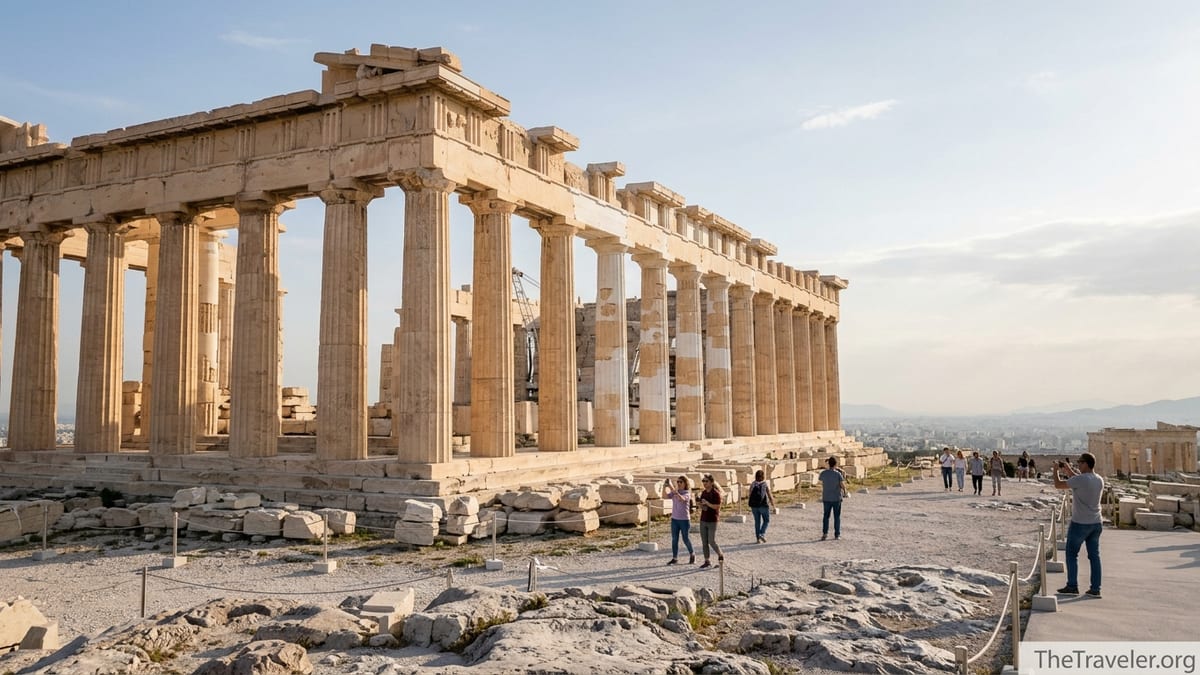
How old is the Parthenon, really?
The Parthenon most visitors photograph today was built in the mid fifth century BC, during what historians call the Golden Age of Athens. Construction began around 447 BC and the main structure was essentially complete by 438 BC, which means the building you see is roughly 2,460 years old. For context, that is about twice as old as the Colosseum in Rome and more than a millennium older than most famous European cathedrals. When you stand on the Acropolis, try to imagine that the temple was already ancient history by the time Julius Caesar was born.
One common myth you will hear on tours is that the Parthenon has “stood unchanged for 2,500 years.” In reality, while the core stone shell is that old, the building has gone through constant change in use, damage, repair, and even partial rebuilding. It has served as a pagan temple, a Christian church, a mosque, a gunpowder magazine, a ruin and now a heavily studied conservation site. Knowing this before you visit helps you see past the famous ruin and imagine its many lives.
Travelers are often surprised to learn that an earlier temple to Athena once stood on the same spot. That building, destroyed during the Persian invasion in 480 BC, left foundations that the classical Parthenon partly reused. So when your guide points out the “original” steps or foundation blocks, bear in mind that some of the stones beneath your feet may be even older than the fifth century BC superstructure.
For visitors trying to time their visit, it is also worth knowing that the Parthenon is still part of an active restoration project that has been running for decades. When you arrive in Athens, especially during the quieter winter months, you might see scaffolding or cranes on one side of the temple while other sides look almost pristine. This does not make the site less authentic. It is simply the latest chapter in a very long story.
Who actually designed the Parthenon?
Behind every famous monument there are real people, and the Parthenon is no exception. Ancient sources and modern scholarship agree that the temple’s architects were Iktinos and Kallikrates, two specialists working in the mid fifth century BC. Overseeing the whole Acropolis building program was the sculptor Phidias, who not only coordinated design decisions but also created the colossal gold‑and‑ivory statue of Athena that once dominated the Parthenon’s interior. When you see reconstructions of a gleaming goddess standing inside the temple, that is Phidias’s Athena Parthenos.
Modern visitors sometimes assume that “architecture” and “sculpture” were separate jobs, as they usually are today. In classical Athens these roles overlapped. Decisions about column spacing or the slope of the steps were closely tied to decisions about where and how sculpture would be seen. On a guided tour, when your guide points to the long processional frieze or the battle scenes on the metopes, they are showing you elements that were planned in tandem with the building’s structure rather than added afterwards as decoration.
It is also worth remembering that Pericles, the Athenian statesman, drove the political decision to build the Parthenon. He used funds from the Delian League, a naval alliance originally formed to resist Persian power, to finance an ambitious building program in Athens. Many travelers are surprised when guides quietly mention this; what feels like a pure cultural monument was also a statement of power and prestige paid for by a wider Greek world.
For today’s visitor, these human stories make the ruins less abstract. When you stand on the north side and look along the colonnade, imagine teams of stonemasons, sculptors and laborers working with hand tools in the intense Attic sun, following the plans of Iktinos and Kallikrates and answering to a demanding patron in Pericles. The temple ceases to be a generic symbol and becomes a very ambitious construction site frozen in stone.
What was the Parthenon’s original purpose?
Many tourists arrive convinced that the Parthenon was “Athens’s main temple where everyone worshipped.” The reality is more specific. The Parthenon was dedicated to Athena Parthenos, the city’s patron goddess in her aspect as a virgin warrior. It housed her monumental cult statue and functioned as an expression of civic identity and gratitude rather than as a simple local parish temple. Ordinary Athenians did not regularly file inside for weekly services the way visitors sometimes imagine.
During its classical life, the Parthenon also had a strong treasury function. Valuable offerings, tribute from allied cities and other state resources were stored within the building. When you look at the massive Doric columns and thick marble walls, keep in mind that this was not only a religious monument but also an extremely secure, visible vault towering above the city. In some ways, it combined the symbolism of a cathedral with the security of a modern central bank.
The building’s purpose kept changing with Athens’s history. By the sixth century AD, the Parthenon had become a Christian church dedicated to the Virgin Mary, complete with altars and Christian iconography. After the Ottoman conquest, it was converted again into a mosque, with a minaret rising from the southwest corner. None of these later features survives fully today, but if your guide gestures to odd scars in the walls or brick infill between marble blocks, you are probably seeing traces of these later religious phases.
Today, visitors cannot enter the interior cella of the Parthenon, a surprise to travelers expecting to walk between rows of columns. Modern access is restricted for safety and conservation reasons. Instead, you circle the monument on marked paths. When planning your visit, especially if you are traveling with children, it helps to set expectations that the experience is more about viewing and understanding the structure from outside than going inside a surviving temple space.
Pentelic marble, bright whiteness and color myths
Standing on the Acropolis on a clear afternoon, you will notice how the Parthenon’s marble glows against the Attic sky. The stone comes from Mount Pentelicus, about 15 kilometers northeast of Athens. Ancient quarrymen cut huge blocks and column drums out of the mountain, then dragged and rolled them downhill and across to the Acropolis. The fine grain and light‑reflecting qualities of Pentelic marble made it a luxury material, and modern restorers still source replacement blocks from the same mountain so that new pieces match the old as closely as possible.
A persistent myth, reinforced by centuries of neoclassical buildings in Europe and North America, is that the Parthenon was always sparkling white. Scientific analysis in recent decades has confirmed that much of its sculpture was originally painted in bright colors, with details in reds, blues and golds. Time, weathering, cannon fire and overly aggressive cleaning in later centuries stripped away most of this paint, leaving the pale stone that visitors see today. When you look at a white metope or frieze panel in the Acropolis Museum, imagine once‑vivid cloaks, horse reins and shields picked out in strong color.
Travelers sometimes worry that the “too white” parts of the Parthenon must be fake or concrete. In reality, the brighter blocks you see, especially in the upper courses and recently completed sections of the colonnade, are newly added Pentelic marble. They stand out now but will slowly weather toward the warmer tone of the original blocks. Walking around the building, you can play a kind of visual game, spotting older stones by their honey‑colored patina and newer ones by their fresh, crystalline surface.
There is also occasional confusion between the Parthenon’s own marble and the so‑called Parthenon Marbles housed in the British Museum. Those famous sculptures were removed from the temple and surrounding structures in the early nineteenth century and transported to London. Visitors to Athens often see plaster casts on the building and in the Acropolis Museum, while the originals sit abroad. You will not see those London pieces on the Acropolis itself, but understanding this history helps explain why many sculptural sections look oddly “empty” today.
Doric design, subtle curves and illusions
The Parthenon is often described as the high point of the Doric order, the most robust and spare of the three main classical Greek architectural styles. Its exterior colonnade has eight columns on the short sides and seventeen on the long sides, more than the standard pattern, which gives it an unusually elongated and harmonious profile. When you stand at the northwest corner near the main viewing platform, you can appreciate how the lines of columns draw your eye along the building in both directions.
One of the details that fascinates architects and engineers is that the Parthenon is not made of perfectly straight lines. The stylobate, the stepped platform on which the columns stand, very slightly curves upward in the middle. The columns themselves lean inward almost imperceptibly and are thicker in the middle than at the top and bottom, a refinement called entasis. For a casual visitor, these adjustments are invisible, but they were likely introduced to counteract optical effects that would have made a truly straight building look oddly sagging or unstable from a distance.
These refinements are easier to grasp with a real‑world example. If you stand near the east end and sight along the top step, you might notice a subtle rise toward the center instead of a dead‑flat horizon. Guides sometimes demonstrate this by holding a straight object, such as a pen, against the silhouette and pointing out the tiny gap in the middle. Even high‑quality replicas in museums around the world often simplify or omit these curves, which is why architects still travel to Athens with measuring equipment to study the original.
The Parthenon also married Doric and Ionic features in a way that visitors can still see. While the outer colonnade is Doric, the continuous frieze that once ran around the upper walls inside the colonnade belongs to the Ionic order. When you look at reconstructed panels in the Acropolis Museum, you are seeing this marriage of styles. For travelers used to modern buildings that stick to one “look,” this blending of orders is a reminder that classical architecture was more experimental than many schoolbooks suggest.
Sculptures, damage and what you are really seeing today
Newcomers to Athens are sometimes startled by how “ruined” the Parthenon looks compared with glossy souvenir images. The building remained relatively intact for more than two millennia, even as it changed from temple to church to mosque. The single most catastrophic event came in 1687, during a Venetian siege of Ottoman‑held Athens. The Ottomans had stored gunpowder inside the Parthenon, assuming their Christian enemies would avoid firing directly at such a revered monument. A Venetian mortar shell hit the building, ignited the powder and blew out the roof and large sections of the colonnade in a single explosion.
Understanding this event helps visitors make sense of the broken walls and missing sculptures. Much of what you see as jagged edges at the corners and shattered metopes is direct blast damage from that seventeenth‑century explosion and its aftermath, including later attempts to remove surviving sculptures as war trophies. Some of the gaps you notice in the pediments and frieze are not the result of slow decay but of very specific blows in a specific week of fighting.
Additional losses came in the early nineteenth century, when Lord Elgin’s agents removed significant portions of the Parthenon’s sculptural decoration and shipped them to Britain. Visitors to Athens often learn this only after seeing empty spaces on the building and in the Acropolis Museum, then encountering the missing pieces later in the British Museum’s galleries. When you walk around the monument, those blank patches and abrupt breaks in narrative scenes are not random; they correspond to figures and panels that now sit in London or other collections abroad.
For today’s tourist, this means that the Parthenon is best understood as a collaborative experience between the hilltop site and the nearby Acropolis Museum, which houses original sculptures, fragments and detailed models. A practical approach is to schedule your museum visit either just before or just after your time on the rock. Many travelers find that seeing the sculptures at eye level in the museum, then looking back up at their original positions on the temple, makes both experiences more vivid.
Restoration, cranes and what “authentic” means
First‑time visitors are sometimes disappointed to find cranes and metal scaffolding around parts of the Parthenon. The current scientific restoration program began in the 1970s and has been proceeding in stages ever since, addressing structural problems, earlier repair mistakes and earthquake risks. Recently completed phases have focused on the western facade and parts of the colonnade, carefully disassembling sections block by block, adding stainless‑steel reinforcements, correcting misaligned parts from earlier interventions and then re‑erecting the marble.
The guiding principle is anastylosis, a method where original blocks are put back into their documented positions whenever possible, with new marble used only to fill structural gaps or support ancient pieces. That is why you will see a patchwork effect in many areas: a weathered original block sitting directly on top of a crisp new one, or a section of entablature built from alternating ancient and modern pieces. Conservators record and number every stone; if you look closely during your visit, you may notice small engraved codes on individual blocks, a reminder that this is as much an open‑air laboratory as a monument.
Many travelers worry that all this work risks turning the Parthenon into a modern reconstruction rather than a genuine ruin. In practice, the restoration teams in Athens are very conservative. They work with detailed historical drawings, old photographs and fragments recovered from the hill, and they avoid adding conjectural elements that cannot be firmly documented. You will not, for example, see a full new roof or gaudy repainting on the monument. Instead, you will see carefully stabilized stone that is meant to survive future centuries of weather and seismic activity.
For your visit, it helps to treat the cranes and fenced‑off areas as part of the story rather than an intrusion. In a typical year, millions of people pass through the Acropolis gates, and controlling the flow is an active challenge. Booking a timed entry slot, which has become standard in recent seasons, not only reduces waiting in line on the steep approach paths but also supports the careful management of foot traffic that these ongoing projects rely on.
Tourist myths and what guides are tired of correcting
Spend an hour near any tour group on the Acropolis and you will hear the same questions repeated. One persistent myth is that the Parthenon was “destroyed by an earthquake.” While Athens is seismically active and quakes have caused damage over time, the central catastrophe was the 1687 gunpowder explosion, not a natural disaster. When guides point to tilted columns or missing corners, they are usually talking about artillery, not tectonic plates.
Another widespread misconception is that the building was left untouched for centuries until modern conservationists intervened. In fact, the Parthenon has been repeatedly modified, patched and sometimes harmed by earlier repairs. For example, nineteenth‑ and early twentieth‑century restorers inserted iron clamps between stones, which later rusted, expanded and cracked the marble around them. Modern teams have been painstakingly removing those corroding elements and replacing them with non‑corrosive materials. So when you see a temporary metal brace or a line of fresh marble, you are looking at careful correction of earlier well‑intentioned mistakes.
Visitors also often believe that a single ticket grants access to “the Parthenon” as if it were a standalone attraction. In practice, your ticket is for the entire Acropolis archaeological site, which includes several major structures such as the Erechtheion and the Temple of Athena Nike. On busy summer mornings, especially from May through September, crowd‑control measures and time‑slot entries can shape how much time you actually get near the Parthenon itself. Building in flexibility, arriving early or visiting later in the day can make the difference between a rushed shuffle in a dense crowd and a more reflective walk along the viewing paths.
Finally, many tourists assume that drones or close‑range photography are acceptable because so many images circulate online. In reality, regulations on and around the Acropolis are strict. Tripods, drones and commercial‑style shoots typically require special permission, and guards will ask visitors to move on if they block pathways or lean on fragile stone. A simple hand‑held camera or smartphone is all you need. Focus on observing details such as the way the late afternoon light rakes across column fluting or the color differences between old and new marble, rather than trying to capture the perfect, empty‑crowd shot that rarely matches reality.
The Takeaway
For travelers who take the time to look beyond the postcard image, the Parthenon is less a single monument than a dense timeline in stone. Built between 447 and 438 BC under the direction of Iktinos, Kallikrates and Phidias, it has served as a pagan temple, treasury, church, mosque, gunpowder store and global heritage symbol. Its Pentelic marble, subtle curves and hybrid Doric‑Ionic design still impress experts, while the scars of a seventeenth‑century explosion and centuries of human intervention are visible in every broken metope and patched column.
When you visit, pair your time on the Acropolis rock with a careful walk through the Acropolis Museum, pay attention to the mix of ancient and fresh marble, and remember that scaffolding, cranes and fenced‑off areas are signs that the story of the Parthenon is still being written. Understanding the building’s true age, changing functions, materials, damage and restoration efforts turns a quick photo stop into a richer encounter with one of the world’s most studied structures.
FAQ
Q1. How old is the Parthenon? The Parthenon was built between about 447 and 438 BC, so the structure visitors see today is roughly 2,460 years old, not counting older foundations beneath it.
Q2. Who designed the Parthenon? Ancient sources name the architects Iktinos and Kallikrates, with the sculptor Phidias overseeing the wider Acropolis building program and creating the colossal statue of Athena that once stood inside.
Q3. Was the Parthenon always a ruin on a hill? No. For more than two millennia it stood with a roof and walls, serving as a temple, then a church and later a mosque. It became a dramatic ruin only after a gunpowder explosion in 1687.
Q4. Why is some of the Parthenon’s marble very white and other parts honey‑colored? The warmer, honey‑colored stones are older Pentelic marble blocks that have weathered over centuries. The brighter white pieces are newly added Pentelic marble used in modern restoration to support and complete damaged sections.
Q5. Did earthquakes destroy the Parthenon? Earthquakes have caused damage over time, but the single most destructive event was a 1687 explosion when gunpowder stored inside the building detonated after being hit by a Venetian mortar shell.
Q6. Can visitors go inside the Parthenon? No. For safety and conservation reasons, access to the interior is closed. Visitors follow marked paths around the exterior and view the sculptures and reconstructions mainly in the nearby Acropolis Museum.
Q7. Was the Parthenon always white, or was it painted? The Parthenon’s sculptures and architectural details were originally decorated with bright paints and gilding. Weathering, warfare and harsh cleaning removed most of this color, leaving the pale stone surface seen today.
Q8. What happened to the missing sculptures? Many sculptures were shattered in the 1687 explosion or fell from the building over time. Others were removed in the early nineteenth century and taken abroad, most famously to the British Museum, leaving gaps and plaster casts on the structure and in Athens.
Q9. Is the ongoing restoration making the Parthenon less authentic? Modern restoration aims to be as reversible and minimal as possible, reusing original blocks whenever feasible and adding new marble only for structural needs. The goal is to stabilize and clarify the ancient fabric, not to build a speculative replica.
Q10. How much time should I plan for a visit to the Parthenon? Most travelers should allow at least two to three hours on the Acropolis itself, plus another one to two hours for the Acropolis Museum. Booking a timed entry slot, especially in high season, helps you avoid long lines and crowded peak times on the hill.