


More news on this day
Travelers heading to Philadelphia International Airport (PHL) encountered abrupt disruption Monday when an air-traffic equipment problem prompted a Federal Aviation Administration ground stop that temporarily halted departures bound for PHL from other airports, according to published coverage and FAA traffic-management advisories.
Get the latest news straight to your inbox!
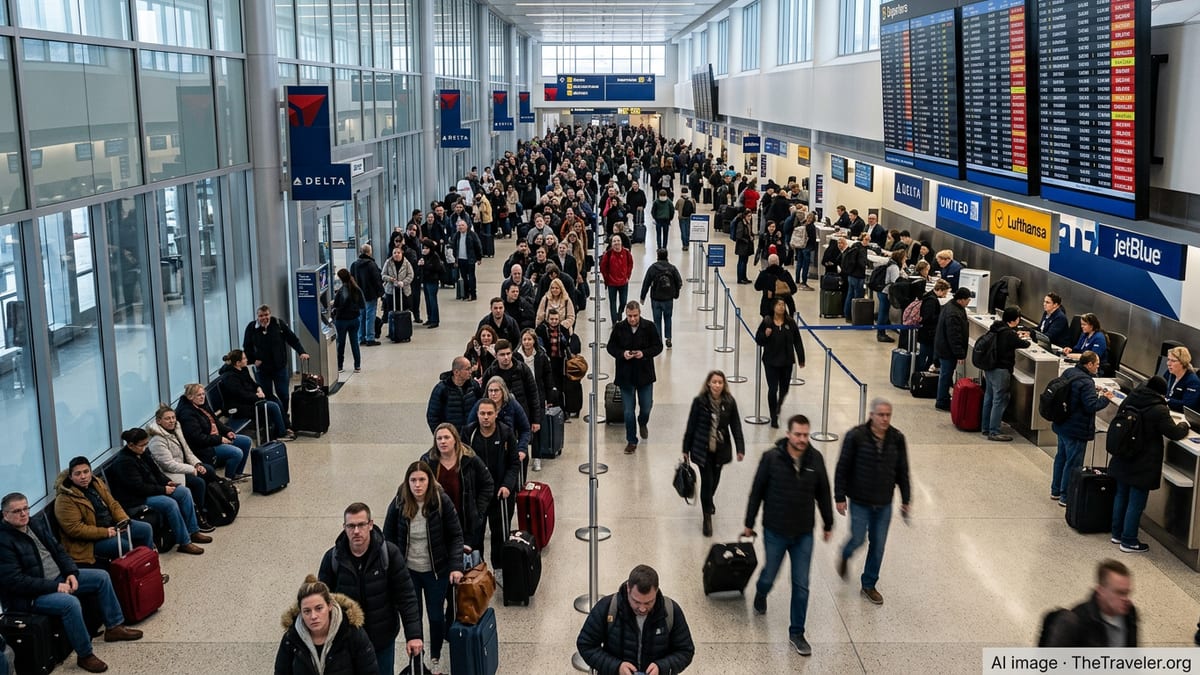
What happened and what a “ground stop” means for travelers
A ground stop is one of the FAA’s most restrictive traffic-management tools. Instead of metering flights with long departure delays or spacing out arrivals, a ground stop prevents aircraft from departing for the affected airport during the stop window, helping controllers manage an abnormal drop in capacity.
Published coverage described the disruption as tied to an equipment outage affecting the air-traffic system serving the Philadelphia region. As the problem unfolded, departures to PHL were held at origin airports and arrival flow into Philadelphia was constrained, producing long delays and a surge of cancellations across the day.
For passengers, the most visible effect is often that a flight appears “on time” until the airline receives an updated departure release or a controlled departure time. Once a ground stop is in place, flights can remain at gates or in holding areas, and crews can time out, increasing the chance of cancellation later in the day even after restrictions ease.
Why the Northeast felt it: telecom damage and air-traffic knock-on effects
Reports indicated the PHL disruption was part of broader Northeast airspace constraints linked to telecom or fiber connectivity problems, with published accounts pointing to construction-related damage to lines supporting air-traffic communications or related systems. Coverage also described complications involving backup connectivity, which can extend delays when redundancy is impaired.
When a major facility’s communications or automation systems degrade, controllers may need to reduce arrival rates to maintain safe separation. That reduced rate does not just affect one airport: aircraft routings, arrival gates, and departure streams are interdependent, so a disruption in the Philadelphia area can push delays into New York and New Jersey airspace and beyond.
Published coverage also pointed to wider regional impacts, including operational disruptions at nearby airports. In practice, this can create cascading problems as aircraft and crews fall out of position, and airlines attempt to re-sequence schedules across multiple hubs and focus cities in a narrow corridor.
How bad it got at PHL: delays, cancellations, and the “rotation” problem
Philadelphia’s schedule is tightly banked, with morning arrivals feeding midday departures and later connections. When inbound aircraft cannot arrive on time, the same airplanes often cannot operate their next legs, creating a rotation bottleneck that compounds across the day.
Published local reporting and flight-tracking summaries indicated hundreds of delays and a large number of cancellations at PHL by late afternoon, with impacts persisting even after restrictions were eased. That pattern is common after ground stops because airlines must work through aircraft on the ground, crews approaching duty limits, and displaced passengers needing seats on later flights.
PHL is also a key airport for regional connections in the Mid-Atlantic. Even travelers not ending their trip in Philadelphia can feel the effect if their aircraft is scheduled to pass through the region later in the day, or if their airline uses PHL for crew bases, aircraft maintenance routings, or spare aircraft positioning.
What to do if you’re flying to or through Philadelphia this week
Travelers with near-term itineraries to Philadelphia can reduce surprises by checking flight status frequently on the day of travel and watching for shifting departure times, gate changes, and equipment swaps. When constraints come from air-traffic limitations rather than a single airline’s internal issue, delays can be uneven across carriers and can change quickly as traffic-management initiatives are updated.
Another practical step is to assess whether an alternate arrival airport could work if rebooking options tighten. For some trips, nearby airports in the Mid-Atlantic can provide ground-transport alternatives, though availability can also be limited during regional air-traffic disruptions, and airport-to-airport ripple effects can reduce the value of switching.
For travelers already at the airport, the key is to confirm whether a flight is waiting on an FAA-controlled release time versus a mechanical issue or crew availability. Those scenarios have different outcomes: an air-traffic hold may clear without an aircraft change, while a late-arriving aircraft or expiring crew duty window can push a delay into cancellation.
What to watch next: reliability, investigations, and the next disruption
Published coverage suggested the incident will draw scrutiny because it involved critical communications infrastructure and affected multiple airports in a dense airspace. When a disruption is linked to external utility or construction activity, the immediate operational fix may arrive quickly, but a full accounting of how redundancy performed and why backups did not fully absorb the failure can take longer.
For travelers, the most useful near-term signal is whether airlines are able to restore normal aircraft and crew placement. Even after the FAA lifts restrictions, the system often needs a full day, sometimes longer, to unwind delayed inbound flights, missed crew connections, and displaced passengers.
With the Northeast entering a period where weather and airspace congestion frequently intersect, travelers flying to PHL or connecting through the region may want to build in extra time and flexibility. The takeaway from Monday’s disruption is that a single equipment-related failure can quickly affect departures far from Philadelphia when the air-traffic network is operating close to capacity.