


New Jersey has a split outdoor personality. To the south, the Pine Barrens stretch for more than a million acres of fragrant pitch pine, tea‑colored rivers, and sandy roads that feel a world away from the Turnpike. To the north, the Delaware Water Gap carves a dramatic notch through the Kittatinny Ridge, with Appalachian Trail vistas and a free‑flowing river shared with Pennsylvania. Both regions promise a deep breath of nature, but they offer very different kinds of trips. If you have limited time, which New Jersey escape delivers more for your style of travel: the Pine Barrens or the Delaware Water Gap?
Get the latest updates straight to your inbox!
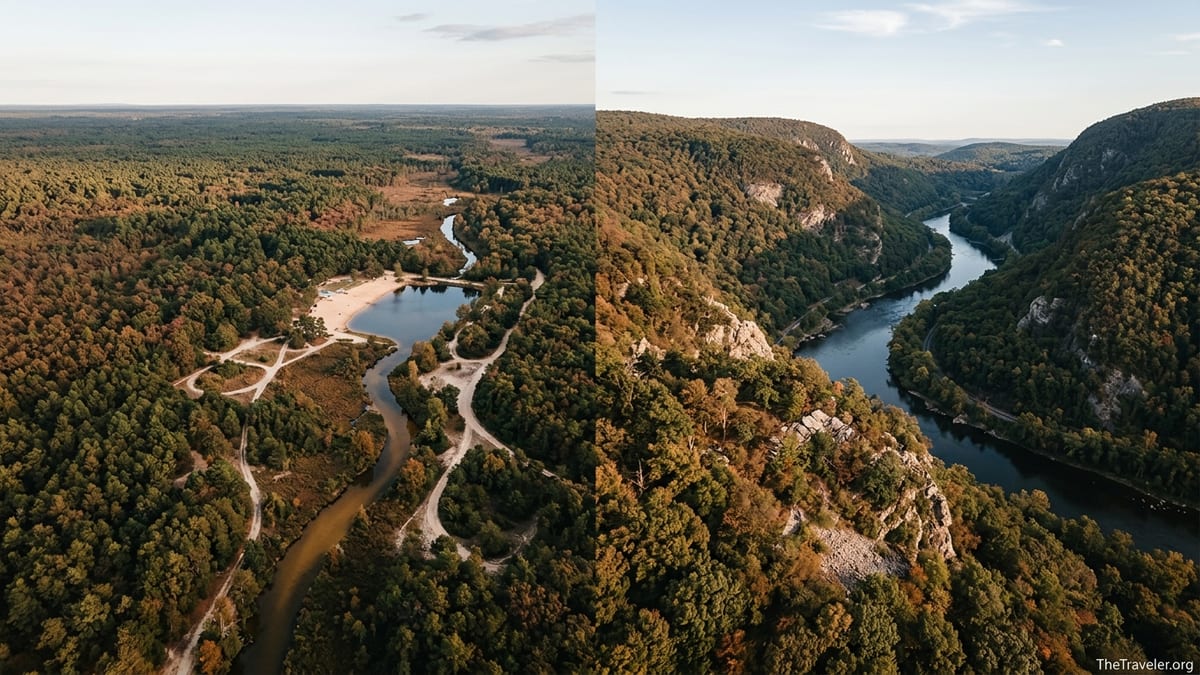
Big Picture: Two Very Different New Jersey Wilds
The Pine Barrens and the Delaware Water Gap sit in the same small state, yet feel like they belong to different countries. The Pine Barrens, anchored by Wharton State Forest, are mostly flat, sandy lowlands in South Jersey, dominated by pitch pine and scrub oak. You get long horizons of forest, cranberry bogs, cedar swamps, and slow, tea‑colored rivers like the Mullica and Batsto. It is a landscape of subtle details rather than big drama, better suited to quiet wandering, paddling, and stargazing than to summit chasing.
The Delaware Water Gap National Recreation Area, on the other hand, rises sharply along the New Jersey–Pennsylvania border. Here the Delaware River slices between Kittatinny Mountain and Blue Mountain, creating a classic “gap” with steep, rocky ridges and genuine mountain views. Within roughly 70,000 acres of protected land, you find more than 100 miles of hiking trails, sections of the Appalachian Trail, and a 40‑mile stretch of free‑flowing river that attracts paddlers, anglers, and rafters in big numbers.
For travelers, that contrast translates into two very different trip moods. The Pine Barrens feel like a slow‑burn road trip in a well‑worn 4x4, with dirt roads leading to hidden lakes and unmarked trailheads. The Delaware Water Gap feels more like a classic national park destination, where you park at named trailheads, follow blazed paths to overlooks like Mount Tammany, and stop at signed river beaches such as Smithfield or Turtle Beach.
Before choosing, it helps to get honest about what you want: solitude or scenery, easy logistics or exploration, river floating or lake swimming. The better match often depends less on which area is “best” and more on which fits your style, season, and group.
Access, Driving Time, and First‑Timer Friendliness
Many travelers decide between these two destinations based on drive time from North Jersey, New York City, or Philadelphia. The Delaware Water Gap sits just off Interstate 80, roughly 90 minutes from Midtown Manhattan in light traffic and about an hour from northern New Jersey suburbs. You can exit near the town of Delaware Water Gap on the Pennsylvania side or at Columbia and Hardwick on the New Jersey side to reach Worthington State Forest and popular trailheads. The convenience makes it a straightforward day trip: leave Jersey City by 8 a.m., climb Mount Tammany before lunch, and be home by dinner.
The Pine Barrens are closer to Philadelphia and South Jersey. The main gateways into Wharton State Forest, including Atsion and Batsto, sit along Routes 206 and 542, about 45 minutes from Center City Philadelphia and 35 minutes from Cherry Hill. From New York City, it is more like 1.5 to 2 hours depending on traffic. Once you are in the pines, paved state highways give way to an extensive web of sand roads that can confuse first‑time visitors. Many smaller trailheads are unmarked, and navigation apps sometimes underestimate how slow those roads can be.
For beginners or nervous drivers, the Delaware Water Gap is generally more user‑friendly. Trailhead parking lots are signed and paved, and there is a clear sense of where you are and what you are getting into. Walking the red‑dot or blue‑dot trails on Mount Tammany, or a section of the Appalachian Trail near Sunfish Pond in Worthington State Forest, feels intuitive for anyone used to state or national park systems with blazed trails and printed maps.
The Pine Barrens reward a bit more self‑reliance. If you stick to the main hubs like Atsion Recreation Area and Batsto Village, the experience is straightforward: you drive on paved roads, park in big lots, and follow marked trails or paddle routes. As soon as you leave those hubs, however, you are in a maze of sand roads where four‑wheel drive becomes helpful, cellphone coverage can be patchy, and a paper map or GPS app is a smart backup. Travelers who enjoy a mild sense of exploration tend to love this; others find it stressful.
Hiking: Ridge‑Top Vistas vs Quiet Forest Rambles
If hiking is your main reason for getting away, the Delaware Water Gap usually has the edge. Kittatinny Mountain rises sharply above the Delaware River, and trails make the most of that relief. The classic example is the Mount Tammany hike from the Interstate 80 parking area on the New Jersey side. In roughly 3 to 4 miles round‑trip, depending on the loop you choose, you climb steep switchbacks to open viewpoints looking directly down on the river and Interstate 80 threading through the gap. On busy spring and fall weekends, the parking lot fills early, but the payoff is one of the best short hikes in New Jersey.
Farther north, the Appalachian Trail crosses New Jersey within Worthington State Forest and the national recreation area, offering longer hikes to spots like Sunfish Pond. This glacial lake, surrounded by boulders and laurel, typically requires a 7 to 9 mile round‑trip day hike, depending on your route. On summer weekends, you may share the trail with backpackers thru‑hiking the AT, and it feels like a slice of a larger, iconic route.
The Pine Barrens are made for a different kind of walker. The terrain is almost entirely flat, so there are no big summit panoramas. Instead, the reward is immersion. Trails like sections of the Batona Trail, which runs roughly 50 miles through the heart of the pines, lead you past bogs, cedar swamps, and sphagnum moss underfoot. A half‑day out and back between trailheads such as Brendan T. Byrne State Forest and Batsto is more about noticing birds, listening to wind in the pines, and feeling far from development even though major highways are not that distant.
For families with younger children or anyone not excited about steep, rocky climbs, the Pine Barrens’ mellow grades can be a real blessing. Short loops near Batsto Village or around lakes like Pakim Pond offer the feel of backcountry without the strain. On the flip side, hikers who crave generous elevation gain and big photo‑ready views almost always come away more impressed by the Delaware Water Gap.
Water: Lakes, Tea‑Colored Rivers, and the Free‑Flowing Delaware
On the water, the choice between these destinations becomes more nuanced. The Delaware Water Gap centers on the Delaware River itself, a long, mostly gentle stretch where outfitters run canoe, kayak, and raft trips. A typical summer day might see you park at a river access like Smithfield Beach or Kittatinny Point, meet an outfitter’s shuttle, and float 8 to 12 miles downstream over the course of 4 to 6 hours. Sandbars and island campsites dot the river, and the current is usually manageable for beginners in good conditions.
River camping is a signature experience here. The National Park Service manages a string of primitive riverside campsites that paddlers can reserve or use under specific rules, allowing you to split the 40‑mile park stretch into two or three days on the water with nights spent on the riverbank. For many travelers from New York, New Jersey, and Pennsylvania, this is the closest thing to a classic multi‑day Western river trip without boarding a plane.
The Pine Barrens, by contrast, are defined by small, dark, slowly moving rivers like the Mullica, Batsto, and Wading, along with a constellation of lakes and ponds. At Atsion Lake in Wharton State Forest, a guarded swimming beach operates in summer with restrooms, showers, and a concession area. Day use fees are collected during the warm season, and on hot weekends the scene feels like an inland beach, with coolers, umbrellas, and kids playing in the sand.
Beyond the lakes, outfitters based around Atsion and Shamong rent canoes and kayaks for downstream trips. A common beginner route starts at Atsion on the Mullica River and covers a few easy miles of meandering water shaded by pines and red maples. Longer trips down the Mullica or Batsto can take most of a day, with the river just deep and wide enough to stay interesting but gentle enough to feel forgiving. Compared with the broad Delaware River, these streams feel more intimate and sheltered, ideal on windy or cooler days when a big open river would be less comfortable.
Camping and Overnight Stays: From Primitive Sites to Comfort Bases
Both regions offer camping, but the style differs. In the Delaware Water Gap, camping options cluster along the river and on the ridge. On the New Jersey side, Worthington State Forest runs car‑accessible campgrounds as well as more primitive hike‑in sites. You might drive to a riverside loop, pitch your tent near the water, and then walk right onto a trail leading toward Sunfish Pond or the Appalachian Trail. Several commercial campgrounds just outside the recreation area, especially on the Pennsylvania side, add RV hookups, cabins, and showers for travelers who want more comfort but still easy access to trails and river launches.
The river itself is a giant campground for those with boats and the right permits. Paddlers can plan a one‑ or two‑night trip using primitive riverside campsites, accessible only by water. A typical itinerary might involve putting in near Milford, paddling 15 miles on day one, then another 10 to 12 on day two, with a night spent at a simple site marked only by a sign and a fire ring. This suits self‑sufficient travelers comfortable packing in all their gear and practicing Leave No Trace.
In the Pine Barrens, camping is concentrated in and around Wharton State Forest. Family campgrounds such as the ones near Atsion Lake and Goshen Pond offer drive‑in sites close to swimming, paddling, and amenities, with rangers on duty in season. For a deeper backcountry feel, designated wilderness campgrounds along the Mullica River or at Lower Forge are accessible only by canoe, kayak, or foot. Paddlers can load boats at access points, spend several hours following the sinuous river, and pull up at sandy banks with basic clearings for tents.
There are also private campgrounds near the Pines that add creature comforts like hot showers, small camp stores, and glamping cabins. These can serve as compromise bases for families or mixed‑ability groups: part of the group can spend a morning paddling or hiking Batona Trail segments, while others relax at camp with easier access to facilities than in the state forest itself.
Crowds, Seasons, and Weather Realities
Crowd levels and weather are key factors in deciding which destination “wins” for a particular trip. The Delaware Water Gap, thanks to its proximity to Interstate 80 and its national reputation, sees very heavy use on peak summer weekends and on crisp fall foliage days. Trailhead parking at Mount Tammany and nearby river beaches can fill early, and it is common to see lines of cars along access roads by mid‑morning on holiday weekends. For some travelers, the energy feels lively; for others, it undermines the sense of escape.
The Pine Barrens, because they are more spread out and lack a single marquee viewpoint, absorb crowds differently. Atsion Lake beach and Batsto Village can be busy on hot July weekends, with families clustered at the water’s edge and picnic tables in steady use, but you can usually drive 15 minutes down a sand road and find near solitude on a lesser‑known trail or riverside sandbar. Even on warm Saturdays, paddling stretches of the Mullica or Batsto Rivers early in the morning often feels quiet, with only the occasional other boat.
Seasonally, the Delaware Water Gap shines from late April through early November, with the height of hiking season in May, June, September, and October. Summer can be hot and humid on the climbs, although the river remains inviting for swimming and paddling. Winter hiking is possible but requires cold‑weather gear and care on icy rocks. The Pine Barrens have a longer comfortable season for walking due to gentler terrain, but summer brings intense bugs. Mosquitoes and ticks are a serious consideration from late spring through early fall, and travelers should pack repellent, long clothing, and perform regular tick checks.
Weather quirks also differ. The open ridgelines at the Delaware Water Gap mean wind and sudden changes; storms can roll in quickly, and temperatures can feel significantly cooler at overlooks than in the valley below. In the Pine Barrens, sandy soils drain quickly after rain, so trails and sand roads often dry out fast, but heavy storms can flood low‑lying sections of river routes, shifting sandbars and downing branches. On marginal‑weather days, it is often easier to salvage a short walk or paddle in the pines than to risk exposed ridge hikes at the Gap.
Costs, Permits, and Practical Logistics
Budget‑minded travelers will find both areas affordable by national park standards, but the details vary. The Delaware Water Gap does not currently charge a general entrance fee, though parking and amenity fees apply at certain river access points and beaches, and outfitters charge for shuttles, boat rentals, and guided trips. A full‑day canoe or kayak rental with shuttle commonly runs in the range of what you might pay at other Mid‑Atlantic river destinations, and camping at public campgrounds is typically priced comparably to New Jersey state park standards.
In the Pine Barrens, New Jersey has reinstated seasonal day‑use fees at popular hubs like Atsion Recreation Area. These are charged per vehicle or per person depending on how you enter, with reduced rates for walk‑ins and cyclists. Campsites inside Wharton State Forest require reservations through the state system, and river or wilderness sites must be booked in advance, especially in peak seasons like late spring and early fall. Private campgrounds near the Pines and in the Poconos around the Delaware Water Gap will generally cost more per night but include showers, electricity, and sometimes amenities like pools or camp stores.
Paddling logistics differ sharply. At the Delaware Water Gap, most travelers rely on commercial outfitters for boats and shuttles. You reserve a trip, arrive at a designated base, and are transported up or downriver, with clear information about mileage and take‑out times. In the Pine Barrens, local outfitters around Atsion, Batsto, and Shamong fill a similar role along the smaller rivers, but the paddling distances tend to be shorter, and some companies also rent boats for use on lakes like Atsion for a few hours of relaxed exploration rather than a full downstream commitment.
Cell coverage is decent along the main corridors of both areas but drops off in interior sections. At the Gap, certain ravines and ridge sections lose signal, especially on the New Jersey side of Kittatinny Ridge. In the Pine Barrens, it is common to have weak or no signal once you are several miles down a sand road, so travelers should download maps offline, carry paper backups, and share their plans with someone before heading deep into the forest. Neither area is truly remote by Western standards, but both demand basic preparedness.
Who Each Destination Is Best For
With all those variables in play, the “better” New Jersey nature escape depends heavily on your group and goals. The Delaware Water Gap is usually the stronger pick for travelers who want classic mountain scenery, ridge‑top views, and a bit of national park style infrastructure. If your dream day involves bagging a rewarding summit like Mount Tammany, checking a section of the Appalachian Trail off your list, and possibly adding a half‑day river float with a commercial outfitter that handles the logistics, the Gap delivers that in a tight geographic package.
It is also a smart choice for first‑time visitors who value clear signage, paved parking lots, and obvious trailheads. Families with teens, couples on a quick weekend from New York, and photographers chasing fall foliage often find that the Gap feels like maximum reward for limited trip planning time. Just be ready to share it with other people in prime seasons and to arrive early on peak days to secure parking at the most popular spots.
The Pine Barrens, meanwhile, cater to travelers who prioritize solitude, a sense of exploration, and a distinctive ecosystem over big vistas. If you like the idea of paddling a narrow cedar‑stained river where the loudest sounds are birds and distant wind, setting up camp at a sandy riverside site that is only reachable by boat or foot, and waking up to fog lifting through a pitch pine forest, the Pines have a unique magic. They are especially appealing for South Jersey and Philadelphia residents who want a genuine wilderness feeling within an hour’s drive.
Families with younger children who prefer flat trails and easy lake swimming also tend to appreciate the Pine Barrens. A typical weekend might involve camping near Atsion, renting a canoe for a slow loop on the lake or a short downstream float, visiting Batsto Village for a taste of local history, and spending evenings around a campfire under dark skies that still surprise people used to the glow of suburban New Jersey. For that style of lightly structured, exploratory trip, the Pines usually come out ahead.
The Takeaway
When you strip it down, the choice between the Pine Barrens and the Delaware Water Gap is really a choice between subtlety and spectacle. The Gap gives you sharp relief, famous hikes, and an iconic river corridor that feels like a national park day trip scaled perfectly to long weekends from the New York and North Jersey region. The Pine Barrens offer a broader, quieter canvas where your experience is shaped more by the specific sand road you follow or the bend in the river where you decide to stop than by any single must‑see viewpoint.
If you are planning your first New Jersey nature escape and want the most obvious payoff per hour of planning, lean toward the Delaware Water Gap. Base yourself near Worthington State Forest or on the Pennsylvania side, hike Mount Tammany or a section of the Appalachian Trail, and, if weather allows, book a half‑day paddle on the Delaware River. You will leave with a mental postcard of cliffs, river, and long ridge views that is hard to beat.
If you have a little more time or a taste for quiet discovery, consider starting in the Pine Barrens instead. Reserve a campsite near Atsion or along the Mullica, rent a canoe, and follow the slow current through cedar swamps as dragonflies skim the water. Walk a small piece of the Batona Trail, visit historic Batsto, and end the day listening to pine wind and distant owls. It may not produce as many dramatic photos, but many travelers find that the memory of time in the Pines lingers longer.
For repeat visitors, the real luxury of New Jersey is that you do not actually have to choose. A long weekend could start with a Friday sunset drive through the Pine Barrens and an overnight in the pines, followed by a Saturday hike at the Delaware Water Gap and a Sunday river float. Taken together, these two landscapes show just how much wildness still hides in one of America’s most densely populated states.
FAQ
Q1. Which is better for a first‑time hiker, the Pine Barrens or the Delaware Water Gap?
For a first‑time hiker who wants clear payoffs and well‑marked trails, the Delaware Water Gap usually feels more rewarding. Routes like Mount Tammany and sections of the Appalachian Trail near Sunfish Pond are well established, clearly blazed, and offer big views that help justify the effort. The Pine Barrens are gentler underfoot and less steep, which is great for beginners, but the scenery is more subtle and some trailheads are less obviously marked, so navigation confidence matters more.
Q2. Where will I find fewer crowds on a summer weekend?
On a typical summer Saturday, the Delaware Water Gap can feel very busy at popular trailheads and river access points, especially around Mount Tammany and Smithfield Beach. The Pine Barrens have a more diffuse crowd pattern: Atsion Lake beach and Batsto get busy, but many sand roads and river sections stay quiet. If avoiding people is your top priority and you are comfortable with basic backcountry navigation, the Pine Barrens usually offer more opportunities for solitude.
Q3. Which area is better for families with young children?
Both work, but for younger kids who do not love steep climbs, the Pine Barrens are often easier. Flat trails around Batsto Village, short walks near lakes, and shallow sections of tea‑colored rivers feel approachable, and Atsion Lake’s guarded swimming area is designed with families in mind. At the Delaware Water Gap, some signature hikes are rocky and steep, which can be challenging for small children, though river beaches and shorter nature trails still work well if you pick your routes carefully.
Q4. Do I need a four‑wheel‑drive vehicle to explore the Pine Barrens?
You do not need four‑wheel drive if you plan to stick to main paved roads and popular hubs like Atsion and Batsto. However, many interior sand roads are soft, rutted, or seasonally flooded. A higher‑clearance vehicle and all‑wheel or four‑wheel drive make exploration more comfortable and reduce the risk of getting stuck. If you are in a low‑clearance car, it is wiser to park at established lots and walk in rather than push deep into unmaintained sand roads.
Q5. Which destination offers better multi‑day backpacking or paddling trips?
For classic multi‑day river trips, the Delaware Water Gap has the stronger reputation thanks to its 40‑mile stretch of free‑flowing Delaware River with primitive riverside campsites. For backpacking, the Appalachian Trail section through Worthington State Forest and the recreation area also provides clear multi‑day options. The Pine Barrens excel at shorter, more intimate overnight paddling adventures along rivers like the Mullica, with boat‑in campsites, and at section hikes on the Batona Trail that can be linked into one‑ or two‑night trips with a bit of shuttle planning.
Q6. How do bugs compare between the two areas?
Bugs are a reality in both destinations, but the Pine Barrens can feel more intense in high summer. Mosquitoes and ticks thrive in the wetlands and dense undergrowth, so repellent, long sleeves, and careful tick checks are essential from late spring through early fall. The Delaware Water Gap also has mosquitoes and ticks, especially near wetlands and along the river, but the breezier ridges and rockier terrain can make insects feel a bit less overwhelming on some hikes.
Q7. Is swimming allowed in both the Pine Barrens and the Delaware Water Gap?
Yes, but in designated places. In the Pine Barrens, guarded swimming is typically offered at developed areas like Atsion Lake when in season, with posted hours and day‑use fees. In the Delaware Water Gap, river swimming is allowed at specific beaches such as Smithfield and Turtle Beach under posted rules, and many people wade or take quick dips along river trips where conditions are safe. In both areas, swimming outside designated zones or during high water is risky, so it is important to follow current advisories and local guidance.
Q8. Which area is easier to visit without a car?
Neither destination is ideal without a car, but the Delaware Water Gap has a slight advantage due to its proximity to Interstate 80 and regional bus routes that serve nearby towns. Even then, reaching trailheads or river accesses usually requires a ride from a station or stop. The Pine Barrens are more spread out across South Jersey, with limited public transportation into the deeper forest, so most visitors realistically need a car or a ride to reach trailheads, lakes, and river put‑ins.
Q9. Are there good options for combining history with outdoor activities?
Yes, especially in the Pine Barrens. Batsto Village, a restored 18th and 19th century ironworks and glassmaking community, sits inside Wharton State Forest and pairs easily with nearby hikes and paddling routes. At Atsion, the historic mansion and remnants of early industry add context to a day of swimming or canoeing. The Delaware Water Gap area also has historic farmsteads, canal remnants, and small towns on both sides of the river, so you can mix cultural stops with hikes or paddles, but the historical interpretation is more concentrated in specific spots in the Pines.
Q10. If I only have one weekend, which should I choose?
If you want dramatic views, famous trails, and a sense of checking off a regional classic, choose the Delaware Water Gap for your first weekend. Plan one big hike and, if conditions allow, a short river trip. If you prefer quiet water, flat trails, and a slower, more exploratory pace, dedicate that weekend to the Pine Barrens instead. Camp near Atsion or along a river, rent a canoe, and give yourself time to wander. Once you have experienced one, you can use a future weekend to discover the other and decide for yourself which New Jersey wild feels like the better fit.