


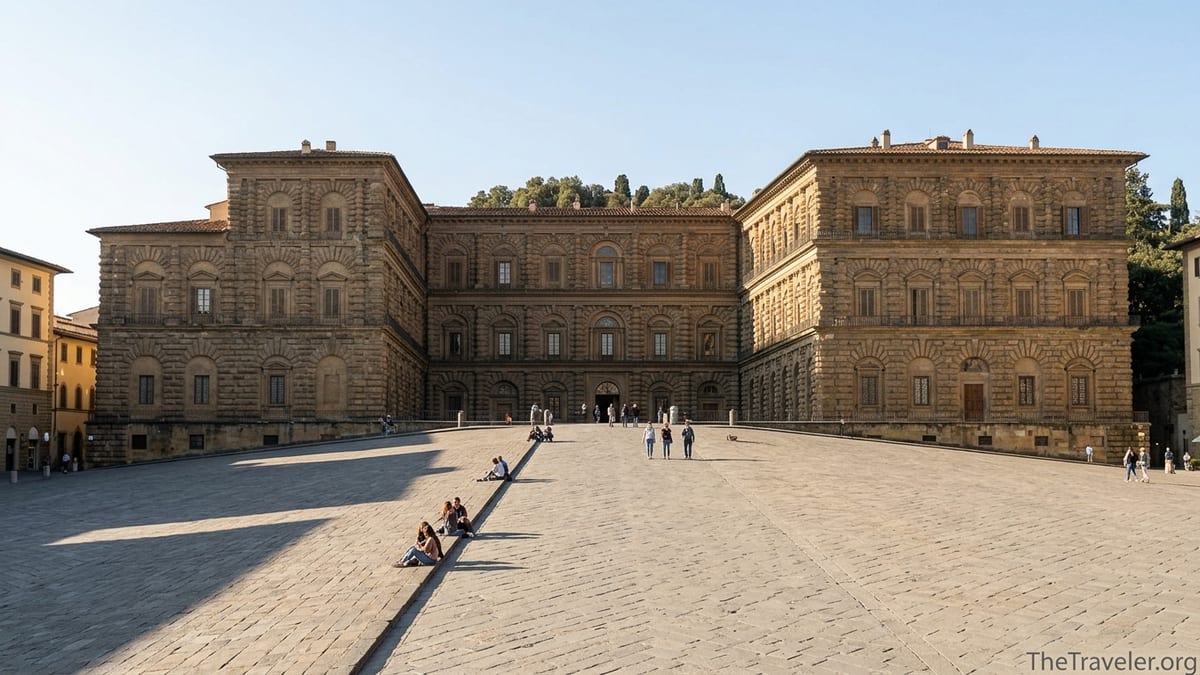
Walk across Florence’s Ponte Vecchio toward the Oltrarno and the city suddenly opens into a vast stone square dominated by a fortress-like façade. This is Pitti Palace, once the private home of a rival banker, later the official residence of the Medici grand dukes, and today one of Italy’s largest museum complexes. To understand this building is to understand how the Medici reinvented themselves from shrewd merchants into Europe’s archetypal princely dynasty.
Get the latest updates straight to your inbox!
From a Banker’s Dream to a Grand Ducal Stage
Pitti Palace began not as a royal residence but as an audacious vanity project. Around 1458, the ambitious Florentine banker Luca Pitti commissioned a palazzo on the southern side of the Arno that would outshine the Medici family’s own residence across the river. Contemporary sources describe his desire for windows larger than the Medici palace’s doors, a clear statement in stone about wealth and status. The original palace, built against the slope of the Boboli hill, was comparatively compact but already monumental in feel, with rusticated stone blocks and a stern, almost fortress-like exterior that still defines the building today.
Pitti’s fortunes faded quickly. Construction stalled by the mid 1460s and he died in 1472 without seeing his dream completed. Financial pressure forced his descendants to sell, and in 1549 Buonaccorso Pitti ceded the palace to Eleonora of Toledo, the Spanish-born wife of Cosimo I de’ Medici. For today’s visitor, that date is crucial: it is the moment when the palace shifts from a private merchant’s mansion into the ceremonial heart of a rising court culture that would transform Florence.
When Cosimo and Eleonora moved in around 1550, Florence was changing fast. Cosimo had already consolidated power, and the Medici were evolving from first citizens of a republic into hereditary rulers. Pitti Palace, with its massive yet unfinished shell and open hillside behind, offered a blank canvas on which they could project this new identity. The decision to relocate from the older Palazzo Medici near San Lorenzo to this more isolated site across the river symbolized a transition from crowded city living to princely seclusion.
The Medici Make Pitti Palace Their Power House
Under Cosimo I and his successors, Pitti Palace was systematically enlarged and reimagined as a grand ducal residence. Architects such as Bartolomeo Ammannati extended the façade, added courtyards, and created monumental staircases that could handle the movement of courtiers, ambassadors and ceremonial processions. If you enter today through the main doorway off Piazza Pitti and climb the broad interior stair, you are literally walking the route designed for the Medici to impress visitors with a rising sequence of stone, light and painted ceilings.
The palace’s location also became key to Medici control. In the 1560s, court artist and architect Giorgio Vasari was instructed to link the new residence at Pitti with the seat of government at Palazzo Vecchio. The result was the Vasari Corridor, a raised, enclosed passage that starts at Palazzo Vecchio, passes through the Uffizi, crosses the Arno above the shops of the Ponte Vecchio and then runs along the Boboli Gardens wall to reach Pitti Palace. Cosimo could move from his private quarters to his council chambers without ever stepping into the street, a practical response to assassination fears and a powerful visual reminder that Medici authority spanned both palace and government.
Visitors who book a combined Uffizi and Vasari Corridor tour today retrace this hidden route. You emerge near the Boboli Gardens, stepping almost exactly where dukes and duchesses once walked to attend audiences or escape evenings of court ritual. Modern travelers sometimes note that the corridor itself is plain compared to the more lavish interiors, but understanding that it functioned as a security device and political tool reveals why the Medici considered it essential.
Boboli Gardens: A Medici Vision of Power in Nature
Behind Pitti Palace, the Medici carved out one of Europe’s earliest and most influential formal gardens. Shortly after acquiring the palace, Eleonora of Toledo purchased land on the steep Boboli hill to create what became the Boboli Gardens, a vast outdoor extension of the court. Early designs by Niccolò Tribolo and later work by Ammannati and Bernardo Buontalenti formed a terraced landscape of gravel avenues, trimmed hedges, grottoes, fountains and theatrical spaces.
Walk up the central axis from the palace today and you reach the amphitheater carved into the hillside. In Medici times this served as an open-air stage for elaborate performances, complete with temporary scenery designed by court architects and fireworks visible across the city. The grand dukes staged mythological dramas here to celebrate dynastic marriages or visiting dignitaries. For a modern visitor sitting on the stone steps during a quiet morning, it is not hard to imagine these slopes filled with courtiers in silk watching a spectacle designed to display Medici wealth and cultural sophistication.
Farther up, near the Neptune Fountain and the statue of the Fat Knight, the garden becomes a place where power and leisure blur. The Medici used the gardens as a private retreat from formal life at court, but every aspect of the design conveyed hierarchy: axial paths emphasize the centrality of the palace, high viewpoints show Florence spread below like a possession, and secluded boschi (wooded areas) offered intimate spaces where only selected guests were invited. Today’s travelers pay a separate entry fee to wander Boboli, and many report that the real reward is not just the statues or fountains but the shifting perspectives on both palace and city that Medici planners carefully orchestrated.
Inside the Medici Residence: Palatine Gallery and Royal Apartments
While the exterior of Pitti Palace is austere, its Medici-era interiors are anything but. The Palatine Gallery, located on the first floor, occupies a suite of grand reception rooms that once formed the main ceremonial route through the residence. Beginning in the 17th century under the Medici and continuing under later dynasties, these rooms were filled with paintings arranged in dense “salon style” displays, with canvases stacked from waist height to the ornate stucco ceilings. Today visitors can still see masterpieces by Raphael, Titian, Rubens and others hung in this historic pattern rather than in modern chronological order.
For travelers comparing Florence’s museums, this is where Pitti’s Medici legacy feels most tangible. At the Uffizi, paintings are spaced out and labeled for study. At Pitti, entering a room like the Sala di Saturno, where Raphael’s Madonna of the Grand Duke hangs amid red damask and gilded frames, you experience art as a backdrop to court life. These works once formed part of the visual environment in which Medici rulers hosted ambassadors and staged public audiences. The palace ticket, currently priced in the mid-teens in euros for adults, grants access to this gallery along with several others, making it a comprehensive look at art as lived by rulers rather than displayed for tourists.
Adjacent to the Palatine Gallery, the Royal Apartments show the palace as a functioning home. These rooms, used not only by the Medici but later by Habsburg-Lorraine and Savoy rulers, preserve 17th to 19th century furnishings: carved canopy beds, inlaid chests, silk wall coverings and family portraits. On a practical level, access is usually by timed entry or small guided groups, and visitors often comment that the limited numbers make the spaces feel more intimate than the busier galleries. Historically, though, these rooms underline how thoroughly the Medici wove their image into domestic surroundings, from allegorical frescoes of virtues on bedroom ceilings to portraits that reinforced dynastic continuity.
Beyond the Medici: Lorraine, Savoy and the Birth of a Museum
The Medici male line ended in 1737 with the death of Gian Gastone de’ Medici, after which the Grand Duchy of Tuscany passed to the Habsburg-Lorraine family. Pitti Palace remained the main residence of Tuscany’s rulers, but its artistic and political identity gradually expanded beyond Medici tastes. New rooms were decorated in lighter 18th century styles, and collections grew to include scientific instruments, modern paintings and luxury objects that reflected the changing priorities of an Enlightenment-era court.
In 1860, as Italy moved toward unification, Tuscany was annexed to the new Kingdom of Italy. Pitti Palace became royal property and, for a brief period between 1865 and 1871 when Florence served as the capital, it housed King Victor Emmanuel II of the House of Savoy. Visitors walking through the later 19th century royal salons may notice portraits of the Savoy family and furnishings more in tune with the period of Italian unification than with Renaissance Florence. This layering of eras is part of what makes the palace complex feel like a living document of power in Italy, from bankers to dukes to modern monarchs.
The final shift from royal residence to public museum came in 1919, when King Victor Emmanuel III donated Pitti Palace, its square and the Boboli Gardens to the Italian state. That transfer completed a long evolution that visitors experience every day. Where once only courtiers and foreign dignitaries could admire the Medici treasures, now anyone buying a ticket at the modern booth under the arcades in Piazza Pitti can walk through rooms that were designed to overawe the few. The current opening hours, generally from early morning to late afternoon Tuesday through Sunday, reflect its status as a state-run museum complex rather than a private home.
How Today’s Visitor Encounters the Medici Legacy
Arriving at Pitti Palace in 2026, most travelers first see the enormous expanse of Piazza Pitti, a sloping stone square that functions almost like an outdoor forecourt. Children roll down the wide pavement while groups sit on the steps facing the palace, echoing in a casual way the original gatherings of retainers and petitioners waiting for audiences. The ticket office and security checks are located under the arches at ground level, a modern overlay that nonetheless funnels visitors along the same central axis the Medici used.
Standard combined tickets give access to several museums inside the palace, usually including the Palatine Gallery, Royal Apartments, Gallery of Modern Art and the Treasury of the Grand Dukes. Prices vary slightly depending on season and whether you book in advance, but adult entry typically falls in the mid to high teens in euros, with concessions for EU students and free or reduced admission on certain national culture days. Travelers using city passes that bundle major Florence attractions often find Pitti Palace included alongside the Uffizi and Accademia, which can make it a good value for those staying several days in the city.
Practical details are closely tied to the palace’s historic fabric. The main museums occupy upper floors, reached by broad but sometimes crowded staircases that once carried processions of courtiers. While there are elevators and accessible routes, visitors with mobility concerns may want to plan extra time. Inside, the dense hanging of paintings and the richness of decoration can feel overwhelming; many seasoned travelers recommend focusing on a few key rooms rather than trying to see everything. For example, you might spend one morning just in the Palatine Gallery and Boboli Gardens, then return another day for the modern art wing and decorative arts collections.
Timing also shapes the experience of Medici heritage. Mornings often see school groups filling the grand halls, while late afternoons can be quieter, especially outside peak summer months. Some travelers choose to visit Pitti Palace after a tour of Palazzo Vecchio and the Uffizi, making the walk across the river a way to physically trace the shift from public government spaces to the Medici’s private world. Others do the reverse, starting in the more intimate Royal Apartments to get a sense of the family behind the art and then heading back across the Arno to see how they projected power in civic buildings.
The Takeaway
Pitti Palace is more than just another grand building in Florence. It is a stone record of how the Medici refashioned themselves and their city, from Luca Pitti’s aborted challenge to Medici dominance to Eleonora of Toledo’s transformation of the site into a full court residence. The palace, gardens and elevated corridors that grew from that decision reshaped not only the skyline of Florence but also the way power was seen and staged in early modern Europe.
For today’s traveler, understanding the Medici legacy at Pitti Palace means paying attention to how spaces are connected: the climb from austere façade to painted ceilings, the hidden route of the Vasari Corridor, the ascent through Boboli Gardens with Florence spread below. These physical movements mirror the historical journey from banker’s house to ducal palace to royal residence and, finally, to national museum. Walk those paths with that story in mind, and Pitti Palace becomes not just a collection of galleries but a vivid narrative of ambition, art and the long afterlife of a ruling family.
FAQ
Q1. What exactly is Pitti Palace and why is it important to the Medici story?
Pitti Palace is a vast Renaissance residence on the south bank of the Arno that became the main home of the Medici grand dukes in the mid 16th century. It is important because it shows how the family moved from living like wealthy citizens in a city palace to ruling like European princes surrounded by formal gardens, hidden corridors and richly decorated state rooms.
Q2. Who built Pitti Palace before the Medici owned it?
The original palace was commissioned around 1458 by Luca Pitti, a powerful Florentine banker who wanted a residence that would rival or even outshine the Medici family home. Financial troubles halted work after a few years, and by the mid 1500s his descendants sold the unfinished building to Eleonora of Toledo, wife of Cosimo I de’ Medici.
Q3. How did the Medici change Pitti Palace after buying it?
After acquiring the palace in 1549, the Medici enlarged the façade, added new wings and courtyards, created grand staircases and developed the Boboli Gardens behind it. Under Cosimo I and his successors, Pitti Palace evolved from a private mansion into a full court residence, complete with ceremonial rooms, private apartments and the Vasari Corridor linking it to the government palace across the river.
Q4. What is the Vasari Corridor and how does it relate to Pitti Palace?
The Vasari Corridor is an elevated, enclosed passageway designed in the 1560s by Giorgio Vasari to connect Pitti Palace and the Boboli Gardens with the Uffizi and Palazzo Vecchio on the other side of the Arno. It allowed the Medici to move between their residence and the seat of government without going through the streets, reflecting both security concerns and their desire to physically tie together home and power.
Q5. Why are the Boboli Gardens important to the Medici legacy?
The Boboli Gardens, laid out behind Pitti Palace for Eleonora of Toledo and her descendants, became a model for formal gardens across Europe. For the Medici, they were an outdoor extension of the court, used for theatrical performances, diplomatic receptions and private leisure. Their terraces, fountains and viewpoints were carefully designed to emphasize the palace and the Medici’s command over the surrounding landscape.
Q6. What can visitors see inside Pitti Palace today that relates directly to the Medici?
Visitors can explore the Palatine Gallery, where paintings hang in lavishly decorated rooms much as they did in Medici times, and the Royal Apartments, which preserve the layout and atmosphere of the residence. Many of the artworks, furnishings and ceiling frescoes were commissioned or collected by the Medici, offering insight into their tastes and how they used art to project authority.
Q7. Did other ruling families live in Pitti Palace after the Medici?
Yes. After the Medici male line ended in 1737, the palace became the residence of the Habsburg-Lorraine rulers of Tuscany. In the 19th century, when Florence briefly served as the capital of the newly unified Kingdom of Italy, members of the Savoy dynasty also used Pitti Palace as a royal residence. Their presence added later layers of decoration and history that visitors can still see.
Q8. How did Pitti Palace become a public museum?
In 1919, King Victor Emmanuel III donated Pitti Palace, the surrounding square and the Boboli Gardens to the Italian state. Over time the various wings were organized into museums, including the Palatine Gallery and the Gallery of Modern Art. Today, the building functions entirely as a cultural site, but its museum layout still follows the basic structure of the former royal residence.
Q9. How much time should travelers plan for a visit to Pitti Palace and Boboli Gardens?
Many visitors find that at least half a day is needed to appreciate both the interior museums and the gardens. A focused visit to the Palatine Gallery and Royal Apartments can take two to three hours, while a relaxed walk through Boboli Gardens, with stops at the amphitheater, terraces and fountains, adds another couple of hours. Those deeply interested in art or history often spread the complex over two visits.
Q10. Is it better to visit Pitti Palace before or after seeing the Uffizi and Palazzo Vecchio?
There is no single best order, but many travelers like to see Palazzo Vecchio and the Uffizi first to understand the Medici in their roles as civic leaders and art patrons, then cross the river to Pitti Palace to experience their private and courtly world. Others start at Pitti and Boboli in the morning, when the gardens are cooler and less crowded, and then head back across the Arno for afternoon museum visits.