


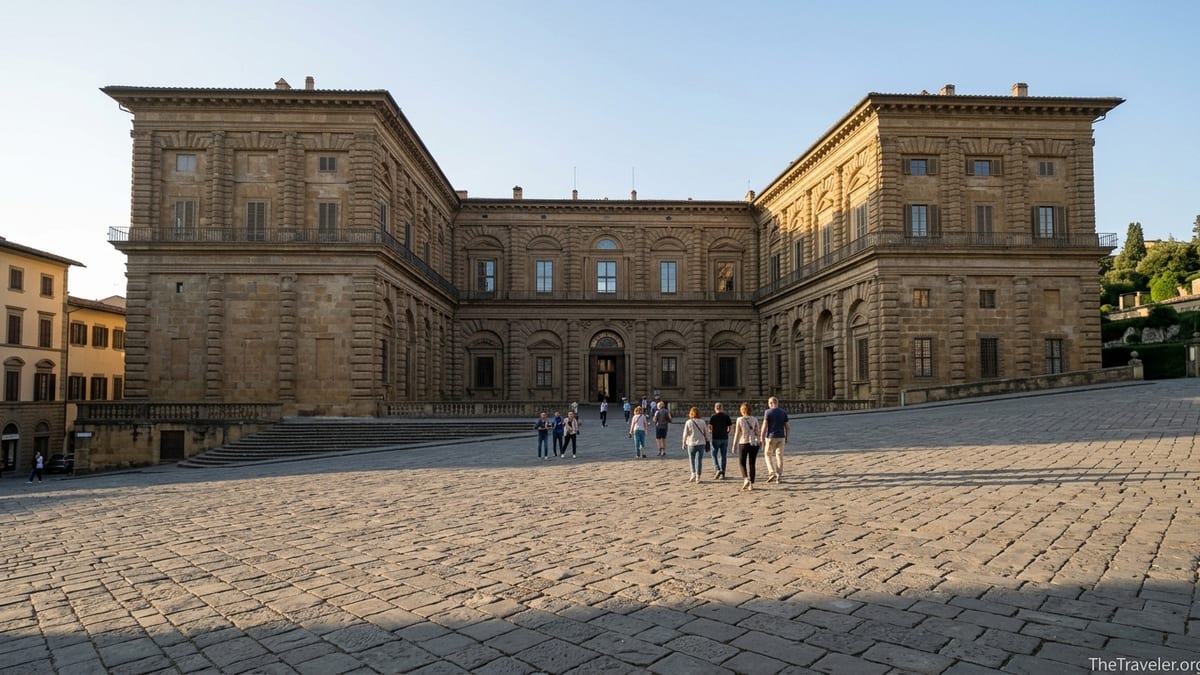
On a sunny afternoon, standing in the vast stone courtyard of Florence’s Pitti Palace with the Boboli Gardens rising behind it, it is hard to imagine that this was once just a wealthy banker’s risky vanity project. Today, Palazzo Pitti is Florence’s largest museum complex and a cornerstone of the Uffizi system, but it is also much more: a working laboratory where curators, conservators, and historians continue to redefine what we know about Renaissance power, taste, and daily life. For travelers, it offers one of the clearest windows onto how the Renaissance actually functioned on the ground, far beyond the famous images hanging across the river in the Uffizi Gallery.
Get the latest updates straight to your inbox!
From Banker’s Folly to Medici Powerhouse
Palazzo Pitti began in the mid 15th century as the residence of Luca Pitti, a rival of the Medici who reportedly wanted a façade so imposing that each window could be as large as the entire front of his enemy’s house. The design, probably by Brunelleschi and executed by Luca Fancelli, produced an austere block of rusticated stone that still dominates the Oltrarno side of the Arno today. Financial troubles forced Pitti’s heirs to sell, and by the mid 16th century Cosimo I de’ Medici had purchased the unfinished palace for his Spanish-born wife, Eleonora di Toledo, setting the stage for a transformation that would reshape Florence’s political geography.
When Cosimo I moved his court from Palazzo Vecchio to Pitti Palace, the building ceased to be a private mansion and became the stage for grand ducal power. The Medici enlarged the structure, added new wings and courtyards, and commissioned the Boboli Gardens that fan out behind it. Walking through the main courtyard today, a visitor can still read this change of function in the architecture: the heavy rustication projects strength and stability, while the scale of the arcades and windows suggests that this was no longer a merchant’s house but the seat of a dynasty with European ambitions.
For travelers interested in Renaissance history, this shift from private residence to grand-ducal court is not just an architectural curiosity. It explains why Pitti Palace matters: here you see how power relocated physically and symbolically from the medieval civic center around Piazza della Signoria to a princely court across the river. That spatial move mirrored a deeper transition in Florence from republic to dynastic state, and Pitti Palace became the physical emblem of that new order.
A Living Textbook of Courtly Life
Step into the Palatine Gallery on the first floor and the atmosphere changes immediately. Created in the early 19th century by the Habsburg-Lorraine rulers to house Medici masterpieces, the gallery preserves something of the dense, theatrical hanging style of a courtly residence. Over 500 paintings, many from the Renaissance and Baroque, cover walls lined with stucco and gilded frames, while ceilings glitter with fresco cycles that celebrate Medici virtues and victories. Visitors today often describe the experience as overwhelming, but that intensity is precisely what makes the palace invaluable for understanding Renaissance court culture.
Unlike the more didactic layout of the Uffizi, where works are grouped by school and chronology, the Palatine Gallery retains much of the logic of display of a princely collection. Raphael’s portraits and Madonnas, works by Titian, Rubens, and Andrea del Sarto hang not in sparse rows but in layered clusters, echoing how prestige objects once signaled rank and favor in court apartments. A traveler standing in front of Raphael’s “Madonna of the Chair,” for example, is seeing it not in an abstract museum context but in a room still shaped by the rituals of reception and representation that once unfolded there.
Down the corridor, the Imperial and Royal Apartments, connected to the Palatine Gallery, speak to later chapters when the Habsburg-Lorraine and then the House of Savoy used Pitti as a royal residence. Some of these rooms are periodically closed for restoration and refurbishment, but when open they still contain 19th-century furnishings from the period when Florence briefly served as capital of a newly unified Italy. For Renaissance historians, this long continuity of use matters: it shows how spaces designed for Medici ceremony adapted to new regimes without losing their aura of power.
The Boboli Gardens and the Invention of the Princely Park
Behind Pitti Palace, the Boboli Gardens climb the hillside in a carefully orchestrated sequence of terraces, avenues, grottos, and fountains. Laid out in the mid 16th century for Eleonora di Toledo and later expanded, Boboli became a model for formal gardens across Europe. Designers like Niccolò Tribolo, Giorgio Vasari, and Bernardo Buontalenti helped turn what had been a quarry into a theater of nature where politics, mythology, and leisure intertwined.
When a visitor today walks up the central amphitheater and continues toward the Fountain of Neptune, the path mirrors how Medici guests once processed through the garden. The bronze Neptune by Stoldo Lorenzi, placed on the main axis, symbolized Medici control over water and, by extension, over Florence and its territories. From there, the route might lead to the Buontalenti Grotto with its Mannerist stalactites and sculptures, or further up to the Kaffeehaus pavilion, where 18th-century rulers introduced new social rituals like coffee drinking into this Renaissance landscape.
For students of Renaissance history, Boboli matters because it makes visible ideas that are often abstract in texts. You can see how the Medici used mythological sculptures, artificial caves, and orchestrated viewpoints to present themselves as both natural rulers and learned patrons. Even ongoing conservation work, which visitors will notice in scaffolded sections or temporary fencing, underscores that this is not a frozen relic but a fragile, continuously managed artifact that shapes current debates on how to preserve historic landscapes.
Connecting Power: The Vasari Corridor and Urban Design
Perhaps the most dramatic illustration of how Pitti Palace still frames Renaissance history is the elevated passageway linking it to the seat of government. Commissioned by Cosimo I and designed by Giorgio Vasari in 1565, the Vasari Corridor runs from Palazzo Vecchio, through the Uffizi, across the top of the Ponte Vecchio, and finally into Pitti Palace near the Boboli Gardens. Conceived for the marriage celebrations of Cosimo’s son Francesco and Joanna of Austria, the corridor allowed the ruling family to move unseen and protected above the city streets.
The corridor reopened to the public in December 2024 after a major restoration. Today, visitors can book timed tickets that start inside the Uffizi, traverse the covered passage with framed views over the Arno and the Oltrarno rooftops, and exit near Pitti’s courtyard. In this current phase, the walls are intentionally bare, closer to their original state, allowing travelers to focus on the architecture and the views instead of on later portrait collections that once lined the route. That choice by curators is itself a statement about returning to the corridor’s Renaissance function as an instrument of control and surveillance.
Experiencing the corridor firsthand makes tangible how Cosimo I reshaped Florence’s urban fabric. Instead of a city where the ruler navigated the same streets as his subjects, the corridor created a private aerial spine connecting government, gallery, bridge, and residence. When you emerge in Pitti Palace after forty-five minutes of walking above shops and churches, it becomes clear why the complex still matters: few other places allow you to trace political power through architecture so physically.
A Laboratory for Rethinking Renaissance Collections
Pitti Palace is not only a monument to Medici collecting; it is a place where that legacy is being actively reinterpreted. As part of the wider Uffizi Galleries system, the palace has seen ongoing projects to restore rooms, reorganize displays, and improve lighting. Recent interventions in the Palatine Gallery, for instance, have balanced preserving the historical character of a grand-ducal collection with the needs of modern visitors, such as clearer sightlines and interpretive materials available through digital tools and on-site panels.
Travelers today move through a museum complex where choices about what to highlight, how densely to hang paintings, and how to present royal apartments all reflect current thinking about the Renaissance. For example, curators increasingly foreground works that reveal the networks behind Medici power, from portraits of bankers and diplomats to tapestries that visualize political alliances. Exhibitions related to the palace’s fashion and costume collections also show how clothing communicated status at court, connecting silk and velvet gowns in the Museum of Fashion and Costume with portraits hanging just a few minutes’ walk away in the Palatine rooms.
For Renaissance historians, these updates matter because they draw attention to topics once considered marginal: the role of women like Eleonora di Toledo in commissioning works, the presence of foreign artists at court, or the global trade routes that brought pigments, gems, and luxury textiles into these rooms. For visitors, this means that a morning in Pitti Palace is not just a look back at a finished story, but an encounter with a living research project that continues to refine how the period is understood.
Why It Still Matters for Travelers Today
For many travelers planning a short stay in Florence, Pitti Palace competes with headline sites like the Uffizi, the Accademia, and the Duomo. Yet those who cross the river discover that Pitti offers something those other landmarks cannot: the chance to stand inside a largely intact Renaissance court environment. You can move from the raw stone of the exterior façade through ceremonial staircases into frescoed reception rooms, then out into a garden that once hosted theatrical performances and grand ducal processions.
In practical terms, this makes Pitti one of the best places in Florence to connect the art you see with the people who used it. A traveler might spend a morning at the Uffizi studying Botticelli’s mythological scenes, then walk across the river in the afternoon to Pitti to see where patrons like the Medici dined, received ambassadors, and negotiated marriages that shaped European politics. The connection becomes very real when you realize that for centuries, the ruling family could have made that same journey in the opposite direction without ever touching the street, thanks to the Vasari Corridor overhead.
Visitor information reinforces how central the complex remains. As of mid 2026, Pitti Palace operates as Florence’s largest museum cluster, with combined ticketing options that often include access to the Boboli Gardens and, when available, special routes. Opening hours typically run from early morning to late afternoon, allowing travelers to pair a palace visit with an evening stroll in the Oltrarno’s artisan streets. Crowds here are generally lighter than in the Uffizi, especially outside peak summer weekends, which makes it easier to linger in front of key works and imagine the rooms filled with courtiers instead of tour groups.
The Takeaway
Pitti Palace still matters in Renaissance history because it brings together in one place the forces that defined the era: political power consolidated in a single ruling family, art deployed as a language of prestige, architecture used to reshape a city, and landscaped nature turned into a stage for authority. Unlike monuments that survive only as facades, Pitti remains a functioning complex where galleries, apartments, gardens, and corridors can still be read as parts of a single system.
For modern travelers, that system is not just something to admire from a distance. It is something you can walk through, room by room and terrace by terrace, tracing the same routes that dukes, duchesses, and visiting ambassadors once followed. Whether you arrive via the Vasari Corridor from the Uffizi, climb through the Boboli amphitheater to look back at the palace, or simply stand in the main courtyard and imagine Luca Pitti’s original dream, you are experiencing a site that continues to shape how scholars and visitors alike understand the Renaissance. In Florence, history is everywhere, but at Pitti Palace it still feels alive.
FAQ
Q1. What makes Pitti Palace so important for understanding the Renaissance?
Pitti Palace shows how the Medici turned Florence from a mercantile republic into a dynastic court, using architecture, art collections, and gardens to project power.
Q2. How is Pitti Palace different from the Uffizi Gallery?
The Uffizi is arranged like a modern art museum, while Pitti Palace preserves the feel of a lived-in court residence, with dense hanging, decorated ceilings, and adjacent royal apartments.
Q3. Why do historians care about the Boboli Gardens behind Pitti Palace?
The Boboli Gardens are an early example of a formal princely park, where avenues, fountains, and grottos were designed to convey Medici authority and culture.
Q4. What is the Vasari Corridor and how does it relate to Pitti Palace?
The Vasari Corridor is an elevated passageway that connects Palazzo Vecchio and the Uffizi to Pitti Palace, allowing the Medici to move privately between government and residence.
Q5. Can visitors today still experience the Medici court atmosphere inside the palace?
Yes. Rooms in the Palatine Gallery and some apartments retain frescoed ceilings, period-style furnishings, and dense picture hangs that evoke court ceremony and display.
Q6. How does Pitti Palace help explain Medici art collecting?
The palace shows artworks in residential spaces, illustrating how paintings, tapestries, and sculptures once functioned as status symbols rather than neutral museum pieces.
Q7. Are there ongoing changes or restorations at Pitti Palace?
Yes. Parts of the palace and Boboli Gardens periodically close for restoration and reinstallation, reflecting current research on Renaissance interiors and landscapes.
Q8. Why should a traveler include Pitti Palace on a short Florence itinerary?
Because it offers a more complete picture of Renaissance life, combining grand-ducal apartments, art galleries, and gardens in a single visit across the river from the city center.
Q9. How long should I plan to spend at Pitti Palace and Boboli Gardens?
Many visitors find that half a day allows enough time to see the key rooms in the Palatine Gallery and enjoy a walk through the main axes of the Boboli Gardens.
Q10. Is Pitti Palace suitable for visitors who are not art experts?
Yes. Even without specialized knowledge, guests can appreciate the scale of the architecture, the richness of the interiors, and the views from the gardens over Florence.