


Walking through the Pitti Palace in Florence, you realize that Medici power was never meant to be subtle. It is built into the weight of the stone facade, the climb up the grand staircase, the crush of gold-framed canvases in the Palatine Gallery and the carefully staged views toward the Boboli Gardens. To move through these rooms is to feel how a banking family turned itself into a dynasty, and how architecture, art and ceremony were the tools that made their authority feel natural and permanent.
Get the latest updates straight to your inbox!
Arriving at a Fortress of Power
The effect begins before you even step inside. Crossing the Arno from the crowded lanes around Ponte Vecchio and walking into Piazza de’ Pitti, you are suddenly facing a wall of rusticated stone that feels more fortress than home. Designed in the 15th century for the merchant Luca Pitti and later expanded by the Medici, the facade rises in massive tiers of rough-hewn pietra forte, its windows set deep like watchful eyes. Even today, with ticket booths and security lines beneath it, the building reads as a statement: whoever lives here is not merely wealthy, but unassailable.
It was Cosimo I de’ Medici who seized the chance to buy this palace in 1550 and turn it into the official residence of the grand dukes of Tuscany. From that point on, this was not just a house, but the physical seat of power, succeeding the older Palazzo Medici near San Lorenzo and outshining rival palaces along Via de’ Tornabuoni. Walking across the piazza, you can imagine how subjects and foreign envoys once approached, their view carefully framed so the palace dominated everything around it, with the newly laid-out Boboli hill rising behind as a private world of terraces, fountains and statues.
Today, practical details briefly intrude on the drama. Tickets for Palazzo Pitti and its museums, often around 16 to 20 euros for same-day entry depending on season and whether you combine them with the Boboli Gardens, are scanned at modern turnstiles. Yet even that short pause on the gravel, surrounded by stone and sky, helps you grasp how the Medici used sheer scale to dwarf individual visitors and turn every arrival into a lesson in hierarchy.
Climbing the Grand Staircase: From Public to Private
The moment you step inside, the palace starts to choreograph your experience. The route to the Palatine Gallery and the royal apartments leads up Bartolomeo Ammannati’s monumental staircase, created in the late 16th century when the Medici enlarged the palace. The climb is broad and slow, designed so processions of courtiers, ambassadors and petitioners could move upward in carefully controlled order. Standing on one of the landings, you can still feel the intended effect: those above literally look down on those below, while anyone at the bottom can see just how far they have to ascend to reach the duke.
This staircase marked the threshold between the public ground floor and the ceremonial world above. In Medici times, access to the piano nobile was limited and graded. A minor official or merchant might be stopped at a reception hall; a foreign ambassador, after formal announcements and delays, would be admitted further toward the ducal audience rooms. Today you enter with a timed ticket rather than a letter of introduction, but that progression from street to stone hall to grand stair subtly pulls you into the old system, where architecture enforced status.
Even details like wall decoration support the message. The ceilings and vaults along the ascent grew more elaborate as you approached the grand ducal spaces, using stucco, fresco and heraldic symbols to signal that you were stepping into a realm governed by a particular family and its claims to rule. On a modern visit, it can be tempting to rush to the paintings upstairs, but pausing here to picture 17th century courtiers in embroidered doublets and silk gowns helps the Medici story click: power was something you climbed toward, physically and socially.
The Palatine Gallery: A Private Collection Turned Stage Set
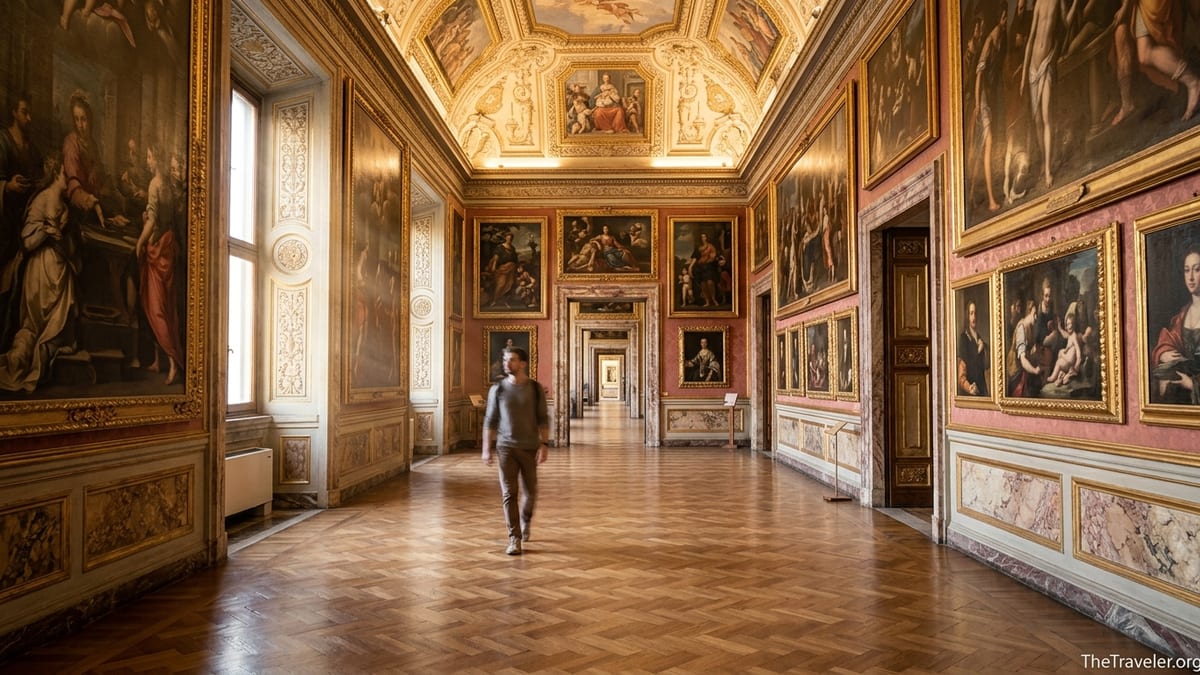
The first floor opens into the Palatine Gallery, and the atmosphere changes from fortress to theater. Unlike the Uffizi’s relatively sober chronological layout, these 28 or so rooms were arranged between the late 18th and early 19th centuries to preserve the feel of a princely collection. Walls are almost completely covered with paintings from the 16th and 17th centuries, hung in dense, overlapping ranks, framed in gilded wood that gleams against frescoed ceilings. You move not through a neutral museum, but through the preserved idea of how the Medici and their successors wanted to live with art.
Here the names from Renaissance textbooks appear on the walls, but in a different light. You turn into the Sala di Marte and there is Raphael’s “Madonna del Granduca,” intimate and serene; in nearby rooms you find his “Madonna dell’Impannata” and “La Velata,” alongside works by Titian, Rubens and Pietro da Cortona. These are not isolated masterpieces with generous breathing space; instead, they compete and converse in a visual overload that mirrors the way power functioned at court. Prestige was cumulative: more paintings, bigger frames, richer frescoes, thicker carpets. The message to every guest was clear. Only a ruling dynasty could gather, commission and display this many treasures in its home.
It helps to remember that many of these works came to Pitti not just through purchase, but through strategic marriages and inheritances. Vittoria della Rovere, who married Ferdinando II de’ Medici in the 17th century, brought with her an extraordinary dowry of paintings from Urbino, including Raphaels and Titians that still hang here. In a Palatine Gallery room where one of her dowry works faces a ceiling glorifying Medici virtues, you can read the walls almost like a contract: alliances sealed with art, art reinforcing political legitimacy. Standing shoulder to shoulder with other travelers in high season, phones raised toward the frescoes, you are essentially participating in the same choreography of admiration the Medici anticipated centuries ago.
Rooms That Scripted Power: From Audience Halls to Bedchambers
As you follow the loop of the Palatine Gallery, subtle shifts in decoration hint at changing levels of intimacy and authority. State rooms like the Sala di Giove and Sala di Venere, with their mythological ceiling cycles, once hosted official receptions and ceremonies. Ceiling frescoes by Pietro da Cortona and his workshop turn Medici history into allegory, showing gods endorsing the dynasty’s virtues. Visitors today often pause in the center of these rooms, craning their necks to decode the stories while guides explain which god stands for which family member. It was precisely this mixture of awe and narrative that made the rooms powerful tools in the 1600s.
Further along are chambers that once formed parts of the grand ducal apartments: spaces where the ruler slept, dressed and held more private audiences. The furnishings you see now often date from 19th century refurbishments under the Habsburg-Lorraine and Savoy dynasties, when Pitti became a royal residence for the kings of a newly unified Italy, but the layout still preserves the old hierarchy. The closer a room was to the ruler’s bedchamber, the higher the status required to enter it. On a modern visit, there is no guard barring your way for lack of rank, but your own sense of intrusion grows as rooms become smaller, fabrics softer, colors darker.
Details make the abstraction of “court life” feel human. A marble-topped writing desk in a corner suggests where correspondence was signed that changed fortunes across Tuscany and beyond. A ceremonial bed, surrounded by silk draperies, stands as a reminder that births, deaths and marriages in this house had political consequences from Rome to Vienna. Even the mirrors and chandeliers, reflecting crowds of modern visitors in shorts and sundresses, echo the glitter of past receptions where ambassadors watched one another’s reactions as carefully as they watched the grand duke.
Boboli Gardens: The Outdoor Manifesto
Step out behind the palace into the Boboli Gardens and you enter what many historians describe as an open-air extension of Medici ideology. Laid out in the mid 16th century and developed over generations, Boboli became a prototype for European formal gardens, with its axial avenues, terraces, grottoes and carefully framed views. From the first rise behind the palace, you can turn back and see the rusticated facade now functioning like a theater backdrop, while the slope beneath you becomes the stage on which Medici festivities and everyday promenades once played out.
The main axis climbs toward the Amphitheatre, where stone seats embedded in the hillside once hosted spectacles for court and visiting dignitaries. Walking up today, past statues and clipped hedges, you can imagine elaborate court masques or fireworks displays lighting up the terraces. The gardens were never just for leisure; they were a carefully designed setting in which guests experienced Florence’s ruling family as patrons of art, science and nature. Even the elaborate artificial grotto by Buontalenti, studded with stalactite-like forms and once containing Michelangelo’s “Prisoners” sculptures, blended artistic virtuosity with an almost alchemical control over the natural world.
For modern travelers, Boboli is also where the scale of Medici possession becomes physically tangible. The walk from the palace facade to viewpoints higher up the hill can take fifteen to twenty minutes at a steady pace, passing fountains, lawns and wooded paths that once were strictly private. Looking out from the terrace near the Kaffeehaus or the Porcelain Museum, with the Duomo dome and Palazzo Vecchio tower on the skyline, it sinks in that this family not only governed Florence but literally looked down on it from its own hillside domain. On a hot afternoon, when locals and tourists sprawl in patches of shade, the gardens still feel like the city’s green lungs, yet their original purpose was to breathe prestige into Medici rule.
Walking in the Medici’s Footsteps: Making History Personal
What makes Pitti Palace so effective at turning Medici history into something you can feel, rather than just read about, is the continuity of the spaces. The palace remained a royal residence through the Habsburg-Lorraine and Savoy periods, and only in 1919 was it finally given to the Italian state. Because of that long use, many rooms still follow the circulation patterns established in the grand ducal era. When you turn a corner to find yet another state room unfolding before you, or an antechamber that connects three other rooms, you get an embodied sense of what it meant to live and maneuver within such a court.
This helps explain why so many travelers rank Pitti among their most memorable Florence experiences, especially when combined with the Uffizi and the Medici Chapels. At the Uffizi you see how Medici collecting shaped art history; at San Lorenzo you stand by their marble sarcophagi and Michelangelo’s allegorical figures; but it is at Pitti that you see where they slept, displayed their trophies and staged their narratives of legitimacy. After a morning here, a portrait of Cosimo I in another museum stops being just a face in armor. You have walked through the staircase he commissioned, gazed up at ceilings that praise his descendants, and looked out from “his” hill over the city he ruled.
On a practical level, this is also a place where thoughtful planning can deepen that sense of immersion. Booking a morning entry around 9:00 or 9:30 often means a little more space in the Palatine Gallery before late-morning tour groups arrive. Leaving the Boboli Gardens for late afternoon, when the light softens and the crowds thin, mirrors the rhythm of historic court life, when mornings were reserved for audiences and paperwork and evenings for promenades. Breaking your day with a simple lunch or espresso in the Oltrarno, perhaps at a small bar along Via Romana or Piazza Santo Spirito instead of a tourist-packed spot near the river, can help you process what you have seen and then return to the palace with fresher eyes.
Planning Your Visit: From Tickets to Timing
The scale and complexity of Pitti Palace can be overwhelming, which is why a bit of advance planning pays off. As of 2026, the palace complex generally opens Tuesday through Sunday from around 8:15 in the morning to early evening, with last admission typically about an hour before closing. Timetables can shift seasonally or for special events, so it is wise to check the official museum information shortly before your trip and to reserve a timed ticket during busier months like May, June and September, when Florence is thick with visitors.
Standard adult tickets for the Pitti museums usually fall in the mid-teens in euros when bought on-site, with small surcharges for advance reservations. Combination tickets that include the Boboli Gardens and, in some cases, multi-day passes with the Uffizi and other state museums offer good value if you plan to see several major sites. Because reentry is typically not allowed once you leave a given museum or the gardens, structure your day so that you do not have to backtrack. Many travelers choose to explore the Palatine Gallery and the royal and imperial apartments first, then move outdoors to Boboli when they are ready for fresh air and less visual density.
If you are particularly interested in court life and interior design, consider joining a guided tour of the royal apartments, which are sometimes accessible only at set times with a group. These tours often provide front-of-line access that can save you time on busy days. For independent travelers, renting an audio guide or downloading an official app helps decode ceiling frescoes and identify key works among the hundreds on display, turning what might otherwise feel like “just another room of paintings” into a legible map of Medici aspirations.
The Takeaway
By the time you step back into Piazza de’ Pitti at the end of your visit, Medici power is no longer an abstract story about bankers and dukes. It has become the weight under your feet as you climbed Ammannati’s staircase, the hushed awe of standing beneath Pietro da Cortona’s ceilings, the shimmering density of Raphaels and Titians hung wall to wall, and the quiet moment when you looked out over Florence from a Boboli terrace and realized that for centuries this view belonged to a single family.
Pitti Palace works on you accumulatively. Individual masterpieces may blur together, but the sequence of spaces lingers. It is in the way your body remembers moving from glaring stone courtyard to dim, frescoed galleries, from formal state rooms to more intimate chambers, and finally out into a garden that still orders nature into terraces and axes. Walking through it all, you understand that Medici authority was not just written in decrees or ledgers. It was built, room by room and vista by vista, into a setting that made their dominance feel not only impressive, but inevitable.
FAQ
Q1. How long should I plan to spend at Pitti Palace and the Boboli Gardens?
Most visitors spend about two to three hours inside the palace museums and another one to two hours in the Boboli Gardens, depending on pace and interest. Art lovers who stop to linger over paintings and frescoes can easily fill most of a day.
Q2. Is it better to visit Pitti Palace before or after the Uffizi Gallery?
Many travelers like to visit the Uffizi first to follow the chronological story of Renaissance art, then experience Pitti Palace as the lived-in culmination of Medici collecting. However, visiting Pitti first can make the Medici feel more personal before you meet them again in portraits and documents across the river.
Q3. Are the royal and imperial apartments included in the standard ticket?
Access to the royal and imperial apartments is usually included with entry to the Palatine Gallery, although some specific rooms may be open only on guided tours. Always check current details at the ticket office or official museum information when you arrive.
Q4. Do I need a guided tour to appreciate the Palatine Gallery?
You can certainly enjoy the lavish rooms and major masterpieces on your own, but a guided tour or audio guide helps decode the dense arrangement of paintings and the symbolism of the ceiling frescoes, especially if you are interested in how the Medici used art to reinforce their status.
Q5. What is the best time of day to visit the Boboli Gardens?
Early morning and late afternoon are generally the most pleasant times, with softer light and cooler temperatures in warm months. Late afternoon is especially atmospheric, as shadows lengthen across the terraces and viewpoints over Florence become more photogenic.
Q6. Are there places to eat near Pitti Palace?
Yes, the surrounding Oltrarno neighborhood has plenty of cafes, wine bars and trattorias within a few minutes’ walk, especially along Via Romana, Via Maggio and around Piazza Santo Spirito. Many travelers step out for a simple lunch or coffee nearby and then return to the palace or gardens the same day.
Q7. Is Pitti Palace suitable for children?
Families do visit Pitti Palace, and older children often enjoy the more theatrical rooms and the open space of the Boboli Gardens. Younger children may tire in the dense galleries, so planning breaks, focusing on a few highlight rooms and allowing time to run around outside can make the visit more enjoyable.
Q8. Can visitors with limited mobility enjoy Pitti Palace and Boboli?
Inside the palace, there are elevators and accessible routes to many museum areas, though historic architecture can mean some sections are more challenging. The Boboli Gardens involve slopes, gravel paths and uneven ground, which can be difficult for those with mobility issues. Checking current accessibility information before your visit is recommended.
Q9. Are photography and video allowed inside the palace?
Non-flash photography is generally allowed in many areas for personal use, but tripods, flashes and commercial shoots are usually prohibited. Rules can vary by room and exhibition, so always follow posted signs and staff instructions.
Q10. Is Pitti Palace worth visiting in winter when the gardens are less green?
Yes. In winter, the palace museums themselves are the main draw, with fewer crowds and a more contemplative atmosphere. While the Boboli Gardens are less lush, their structure, sculptures and views of Florence remain impressive even without full foliage.