


Cannes is usually sold as a glossy postcard of La Croisette: superyachts lined up in the bay, designer storefronts, and private beach clubs where a sunbed can cost more than a hotel room. Yet walk just ten minutes west from the Old Port and the city changes. On Plages du Midi, the sand is mostly public, the prices drop, and Cannes starts to feel less like a movie set and more like a Mediterranean town where people actually live. Skipping these beaches means missing a side of Cannes that rarely makes it into the festival photos, but often becomes the highlight of a trip.
Get the latest updates straight to your inbox!
From Red Carpet Riviera to Everyday Riviera
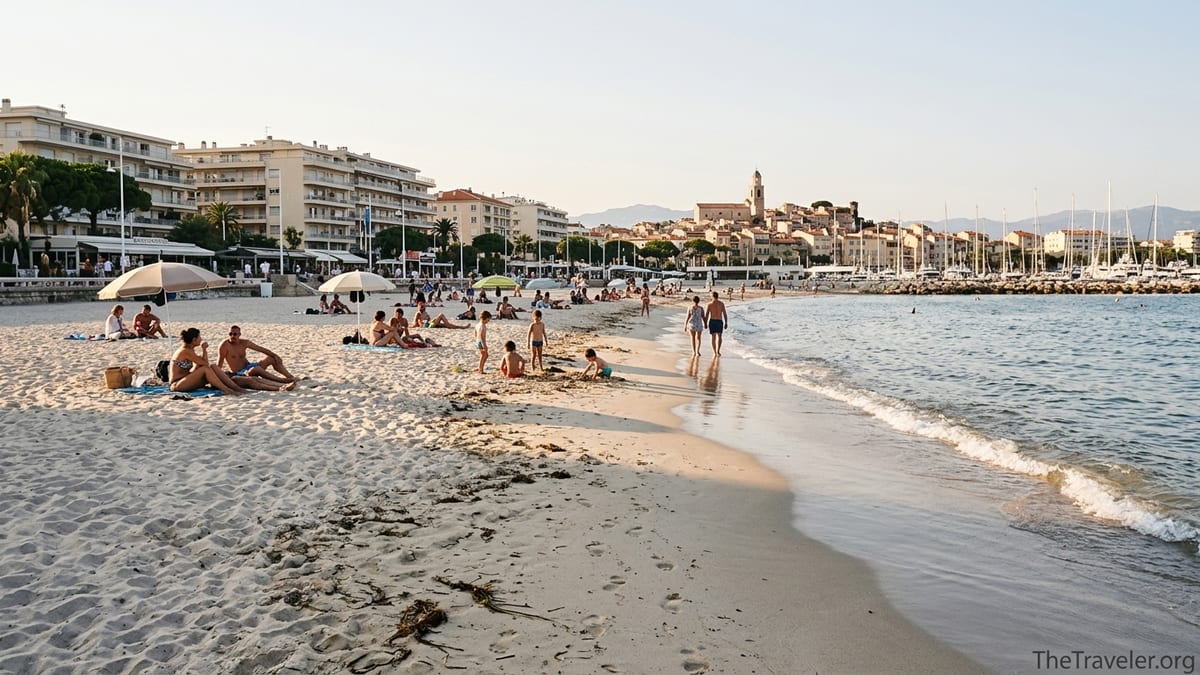
Stand at the Palais des Festivals, where the film stars climb those famous red steps, and look west. Beyond the Vieux Port’s forest of masts, the coastline softens into a long crescent of pale sand that curves under the hill of Le Suquet. This is where Plages du Midi begin, stretching for roughly two kilometres along Boulevard du Midi Jean Hibert toward the quieter district of La Bocca. Here, instead of velvet-roped beach clubs, you find free public sand, kids learning to paddleboard, and locals unpacking Tupperware picnics under striped parasols.
That contrast is at the heart of Cannes. Along La Croisette, many of the most photogenic beaches are leased to luxury hotels and private operators, where a front-row sunbed can cost upward of 80 to 100 euros in peak summer and lunch easily doubles that. By comparison, on Plages du Midi you can lay your towel wherever you like on most of the shoreline, pay a few euros for a cold drink from a kiosk, and still have the same aquamarine sea and view of the Lérins Islands. The experience is less choreographed, but far closer to how residents actually enjoy their coastline.
For travellers, especially those visiting Cannes for the first time, it is easy to get pulled into the La Croisette orbit and assume that this is simply how the city works: glamorous, expensive, and curated. Spending an afternoon or a full day at Plages du Midi punctures that illusion. You start to see Cannes as a walkable, lived-in place, where the old fishing quarter of Le Suquet, the Forville market and the Midi beaches link together as one continuous landscape instead of isolated attractions.
What Plages du Midi Actually Look and Feel Like
Physically, Plages du Midi have a different rhythm to the more famous ribbon of sand along La Croisette. Here the beach is broad enough in many sections to fit two full rows of towels before the waterline, even at higher tides. The sand is soft and golden, machine-raked in the early morning by the city services during the main season, and dotted with communal freshwater showers and simple changing cabins. On summer mornings you will see retirees swimming laps close to shore while delivery vans unload bread and vegetables for the seafront restaurants that are allowed to operate on a few concessions along the boulevard.
There are private beach sections on Plages du Midi, but they are fewer, generally smaller, and tend to have a more relaxed, family-minded atmosphere than their Croisette counterparts. A pair of sunbeds with an umbrella might start around 30 to 40 euros in shoulder season, climbing in July and August yet still often under La Croisette’s headline rates. Many travellers simply skip them altogether, preferring a supermarket picnic on the public sand. The point here is choice: you are not forced into a pay-to-sit model just to be on the front row facing the sea.
The promenade backing the beach is another part of the charm. Boulevard du Midi carries traffic, but there is a separate pavement where joggers, parents pushing strollers and office workers on their lunch break share space. Instead of flagship boutiques, you pass small apartment buildings, a few modest hotels and neighbourhood cafés advertising formule du midi lunch deals aimed at locals. The soundtrack is more likely to be French or Italian chatter and clinking coffee cups than curated DJ sets.
Access, Affordability and Simple Logistics
Reaching Plages du Midi is straightforward, which is one reason locals favour it. From the Vieux Port, you simply cross Quai Saint-Pierre, pass the Radisson Blu, and the first section of beach appears almost immediately. Travellers arriving by train can walk from Cannes station to the Old Port in about ten minutes, then continue along the seafront. For those staying farther out, local Palm Bus routes stop on Boulevard du Midi, connecting the Midi strip with residential neighbourhoods and the centre, usually for a single-ride fare that costs less than a takeaway espresso on La Croisette.
Once at the beach, costs remain manageable. You can buy fresh fruit and picnic supplies at Marché Forville in the morning, a short walk uphill behind the port, and be sitting on the sand with a market-made socca or slice of pissaladière for the price of a single cocktail in a Croisette beach club. Basic espresso at a café along Boulevard du Midi tends to stay in the low single digits, while a plat du jour at a simple seafront brasserie is often comparable to a mid-range restaurant in Nice rather than a luxury resort.
This affordability reshapes how you use your day. On La Croisette, visitors often feel pressure to “get their money’s worth” from an expensive lounger rental, staying in one place for hours. On Plages du Midi, you can come and go freely: take a swim before breakfast, retreat into Le Suquet’s shaded streets during the strongest midday sun, then return for a sunset dip. Nothing ties you to a minimum spend, which is surprisingly liberating on a coast known worldwide for high prices.
Connecting Beach Time with Cannes’ Old Town and Market Life
One of the greatest advantages of Plages du Midi is how seamlessly they connect with Cannes’ historic core. Directly above the eastern end of the beach rises Le Suquet, the original settlement on the hill, its narrow lanes twisting up toward the medieval tower and the church of Notre-Dame de l’Espérance. From the sand, you can look up and see the old stone ramparts and terracotta roofs. That visual link makes it easy to build a day that moves between sea level and old town rather than treating them as separate excursions.
A typical route for travellers who want to see beyond the luxury postcard might start early with a climb through Le Suquet, when the light is soft and the stone steps still cool. You pass shuttered houses, a few cats stretching on balconies, and arrive at the viewpoint near the former Château du Suquet for a wide-angle panorama of the bay, the Lérins Islands, and the full arc of Plages du Midi. After visiting the Musée des Explorations du Monde inside the old castle, you can descend via Rue Saint-Antoine, which is lined with restaurants that become lively in the evening.
By mid-morning, the Forville market below Le Suquet is in full swing, alive with stalls selling local goat cheeses, olives, sun-warmed tomatoes and ready-to-eat socca. Buy provisions here, then walk a few minutes back to Boulevard du Midi and spread out your feast on the sand. This loop condenses centuries of Cannes history into a few hours: medieval hilltop, 19th-century port and 21st-century beach life, all without needing a taxi or a tour bus.
How Plages du Midi Change Your Idea of “Luxury”
Spending time at Plages du Midi has a way of subtly altering what travellers think of as luxury on the Riviera. Instead of white-glove service and branded sun loungers, the pleasures here are quieter: swimming in clear water without music thumping from speakers, reading under your own parasol as local families set up a game of beach volleyball nearby, or walking the shoreline at dusk as the lights come on along the port and the scent of bouillabaisse drifts from the restaurants behind you.
For many visitors, this slower rhythm ends up feeling like an upgrade. You might still choose a nightcap on La Croisette, perhaps at a hotel bar with a polished cocktail list, but the memories that linger often come from a mid-afternoon nap on the public sand, the sound of pétanque balls clinking from a nearby square, or the friendly conversation struck up with a local couple who have been coming to the same section of beach for decades. It is a version of luxury measured in time and space rather than in logo density.
There is also an aesthetic shift. From Plages du Midi, you look back at Cannes instead of being inside the highly produced streetscape. The skyline is a mix of Belle Époque facades, modest apartment blocks and the outline of Le Suquet rather than a tight row of palace hotels. On a clear day, the Esterel hills glow pink in the late sun to the west, and ferries glide past toward the islands. It feels like a real Mediterranean town layered against its geography, not just a resort strip.
Designing a Day That Balances Glamour and Groundedness
The advantage of staying in Cannes is that you do not have to choose one face of the city over the other. With a bit of planning, you can easily craft a day that starts with Croisette glamour and ends with your feet in the sand at Plages du Midi. One pragmatic approach is to explore La Croisette in the late morning, when its boutiques and terraces are at their most photogenic. Window-shop past luxury hotel facades, take a photo on the festival steps, or indulge in a single high-end coffee on a hotel terrace to sample the atmosphere without committing to an all-day bill.
By early afternoon, when the heat intensifies and the private beach clubs are filling up, walk or take a short bus ride toward the Old Port and continue west along Boulevard du Midi. Within minutes the mood shifts. Drop your towel on the sand, cool off in the water, and use the public showers to rinse off. If you are travelling with children, this can be far more practical than negotiating loungers and formal seating arrangements, and there is usually enough space for sandcastle building without encroaching on neighbours.
In the evening, you can either stay by the beach for a casual dinner at one of the simpler restaurants or climb back into Le Suquet to eat on a terrace overlooking the bay. From up there, the shining line of La Croisette becomes part of the view rather than the whole story. The day reads like a narrative of Cannes, from its most famous images to its everyday rituals, anchored by the simple fact that you spent part of it on the same sand locals choose when they are not working the season.
The Takeaway
Skipping Plages du Midi means accepting a narrow version of Cannes, one framed almost entirely by La Croisette’s high-gloss surface. For some travellers, that may be enough. Yet for anyone curious about how this city works beyond festival week, the Midi shoreline is essential. It is where you feel the daily rhythms of a community that swims before breakfast, shops at the market, and ends the day watching the light soften over the harbour walls.
By carving out even a few hours on these mostly public sands, you gain a more balanced sense of place and often a more relaxed holiday. You discover that the Riviera’s true luxury can be as simple as free access to the sea, a picnic sourced from local producers, and a view that costs nothing more than the climb up to Le Suquet at sunset. Cannes will always trade on its image of red carpets and private beaches, but its soul is easier to find with a little sand from Plages du Midi still between your toes.
FAQ
Q1. Where exactly are Plages du Midi in Cannes? Plages du Midi begin just west of the Vieux Port and run along Boulevard du Midi Jean Hibert toward the La Bocca district, about a ten-minute walk from the Palais des Festivals.
Q2. Are Plages du Midi free to access? Yes, most of Plages du Midi consist of free public sand where anyone can lay a towel without paying, alongside a few smaller private beach sections.
Q3. How do Plages du Midi differ from the beaches on La Croisette? La Croisette is dominated by private beach clubs linked to luxury hotels, while Plages du Midi are more open, with larger public areas, lower prices and a more local, relaxed atmosphere.
Q4. Can I rent sunbeds and umbrellas on Plages du Midi? Yes, several concessions rent sunbeds and umbrellas, generally at lower prices than La Croisette, though exact rates vary by season and front-row placement.
Q5. Is the water clean and safe for swimming at Plages du Midi? The water quality is regularly monitored along this part of the Cannes coastline, and in normal conditions it is considered suitable for swimming, especially during the main bathing season.
Q6. What is the best time of day to visit Plages du Midi? Early mornings and late afternoons are particularly pleasant, with softer light, milder temperatures and fewer crowds than the midday peak in July and August.
Q7. Are there showers, toilets and food options near the beach? Yes, Plages du Midi have public freshwater showers, seasonal toilets and a mix of simple kiosks and seafront cafés, as well as easy access to restaurants in the streets behind the boulevard.
Q8. Is Plages du Midi suitable for families with children? The gently shelving sand, relatively calm water, and generous public areas make Plages du Midi a popular choice for local families and visitors with young children.
Q9. How can I combine a visit to Plages du Midi with other sights in Cannes? Many visitors pair beach time at Plages du Midi with a morning visit to Le Suquet’s hilltop viewpoints and the Forville market, all within walking distance of each other.
Q10. Do I need a car to reach Plages du Midi? No, the beaches are easily reached on foot from central Cannes and the train station, and local buses also serve Boulevard du Midi for those staying farther away.