


Ask ten New Yorkers where the real heart of the city is, and you will get ten different answers. Some will argue for a Brooklyn waterfront bar at sunset, others for a Queens food hall or a Bronx block party. Yet when most visitors step off a plane with “New York” in mind, the image in their heads is almost always Manhattan: Times Square’s neon, Midtown’s skyscrapers, Central Park’s canopy of green and the canyons of downtown finance. Even as the outer boroughs grow more magnetic every year, Manhattan still feels like the center of New York. For travelers, understanding why helps you decide how to spend limited days in a city that now sprawls with competition for your attention.
Get the latest updates straight to your inbox!
The Numbers: Manhattan Still Sets the Pace
New York City welcomed roughly the mid-60 millions in visitors in 2024, close to its all-time record, and the majority of those hotel rooms and marquee attractions are on the island of Manhattan. Exact breakdowns by borough shift year to year, but visitor spending data consistently show that Manhattan captures the largest share of tourism dollars, particularly on lodging, shopping and entertainment. That is what you feel on a Saturday night when you step into Midtown and see sidewalks as busy as a stadium exit.
On a practical level, first-time visitors still overwhelmingly book their stays in neighborhoods like Times Square, Midtown East, the Theater District and around Central Park South. A basic business-class chain hotel near Bryant Park might start around 250 to 350 dollars per night outside peak holidays, while classic properties along Fifth Avenue can easily top 700 dollars or more for a standard room. Those prices reflect demand as much as prestige: people pay a premium because they want to be in what they perceive as the city’s core.
Even as new tourism hubs emerge in Brooklyn’s Williamsburg or Queens’ Long Island City, Manhattan’s hotel pipeline keeps growing. Around Hudson Yards on the West Side and in Lower Manhattan’s Financial District, factories and warehouses have turned into boutique hotels and extended-stay properties that serve both leisure and business travelers. For visitors, that means you can stay in parts of Manhattan that did not feel like “tourist neighborhoods” twenty years ago and still be a short subway ride from nearly anywhere else in the city.
Crucially, Manhattan is where many trips into the city begin and end. Major transit hubs like Penn Station, Grand Central Terminal and the Port Authority Bus Terminal all sit within Midtown, while the new Moynihan Train Hall has made long-distance rail arrivals feel less like a chore and more like a gateway moment. Before a traveler ever sees a brownstone in Brooklyn or a mural in the Bronx, they have usually walked into Manhattan’s energy first.
Iconic Images: The Global Mental Picture of New York
When people around the world picture New York, they are usually picturing Manhattan. Times Square’s over-bright billboards, the Empire State Building poking above the skyline, the New Year’s Eve ball drop, Wall Street’s charging bull and the green sweep of Central Park are the city’s global shorthand. For a visitor stepping out of the Times Square subway station, that instant recognition is part of the thrill: the feeling that you have walked straight into a postcard or a movie scene.
Walk from Times Square down to the New York Public Library on Fifth Avenue and up through Bryant Park, and you will pass locations you have seen in hundreds of films, from superhero blockbusters to romantic comedies. Grand Central Terminal’s Main Concourse, with its celestial ceiling and rush of commuters, is another space that feels instantly familiar even if you have never visited before. That sense of “I know this place already” is powerful, and Manhattan holds more of those touchstone images than any other borough.
Even Manhattan’s newer developments quickly become part of the mental map. The rebuilt World Trade Center complex and the memorial pools in Lower Manhattan are now key stops for many visitors planning just two or three days in the city. A typical first-timer’s itinerary might stack them alongside the Statue of Liberty, the Brooklyn Bridge, Central Park, Times Square and a Broadway show. Notice how many of those moments involve crossing, looking at or returning to Manhattan, even when they branch into the harbor or Brooklyn.
For travelers, that concentration of icons makes Manhattan the natural anchor for a visit. You can spend a morning in Central Park, grab a quick slice of pizza on Eighth Avenue, catch a matinee on Broadway, then ride the subway ten minutes downtown for sunset at the One World Observatory. The sheer density of famous sights keeps pulling you back into the island’s orbit, even if you sleep across the river.
Transit, Walkability and the Pull of a Dense Island
Part of what keeps Manhattan at the center of New York’s story is old-fashioned geography. It is a narrow island with a gridded core, surrounded by bridges, tunnels and ferry routes that converge like spokes on a wheel. The subway network reflects that: nearly every line you ride from Brooklyn, Queens or the Bronx eventually dives under the East River and surfaces somewhere under Manhattan’s streets. For visitors hopping between boroughs, transfers often happen in stations like Times Square, Union Square or Canal Street, which re-centers your day on the island almost by default.
Once you are on the ground, Manhattan’s walkability is hard to beat. North-south avenues and east-west streets are mostly straightforward, and distances between blocks are compact enough that many visitors find they can comfortably walk from, say, the Flatiron Building to SoHo to the Lower East Side over the course of an afternoon. That kind of seamless walking experience is harder to replicate in parts of Brooklyn where industrial zones, expressways or irregular street grids break up the flow.
Transit improvements have also reinforced Manhattan’s pull. The extension of the 7 subway line to the Hudson Yards station on the far West Side, for example, turned what was once a stretch of rail yards into a district that now hosts a luxury shopping center, public art and a major cultural venue. Meanwhile, new protected bike lanes up and down avenues like First, Second and Eighth have made it easier for confident cyclists to commute and sightsee without relying solely on taxis or ride-hail apps.
For travelers, this ease of movement matters. If you are staying in a Midtown hotel, you can reach the Museum of Modern Art, the High Line, Times Square and Rockefeller Center on foot or by a single subway ride, then be back at your room within minutes. Even if you base yourself in Brooklyn or Queens, your fastest cross-city journeys usually involve passing through Manhattan at some point, whether you are changing from the A to the 7 train at Times Square or hopping between express lines at 14th Street.
Culture, High Finance and Everyday Life in One Place
Manhattan’s enduring centrality also comes from the way it layers worlds that are often separate in other cities. In a comparatively small area, you find the headquarters of major banks, global media companies and fashion houses alongside neighborhood playgrounds, dive bars and corner delis. Wall Street and the World Trade Center area still function as major financial engines during weekdays, while just a few subway stops away the Theater District powers an entire tourism universe of musicals and plays.
Along Museum Mile on the Upper East Side, the Metropolitan Museum of Art, the Solomon R. Guggenheim Museum and smaller institutions like the Neue Galerie draw locals and tourists into the same stretch of Fifth Avenue that weekend joggers and dog walkers use as a regular route. On the West Side, Lincoln Center’s opera, ballet and symphony performances sit beside public plazas where families with strollers and teenagers snapping photos mix before and after shows.
Even where Manhattan has become sharply expensive, slices of everyday life remain visible. In neighborhoods like Washington Heights, Inwood and parts of the Lower East Side, you can still find small Dominican, Mexican, Chinese and Jewish eateries where a filling meal might cost around 10 to 15 dollars, and where regulars greet the staff by name. Walk a few blocks, and you might hit a cocktail bar charging triple that for a single drink. That extreme layering of audiences and price points within tiny areas is part of what travelers sense as uniquely “New York.”
New developments have added new layers rather than replacing old ones entirely. Hudson Yards may feel sleek and corporate, but a short walk south along the High Line leads into Chelsea’s gallery district, where converted warehouses host contemporary art openings, and then into the Meatpacking District, where cobblestone streets house everything from designer boutiques to late-night clubs. For visitors willing to walk or ride just a couple of subway stops between these worlds, Manhattan still offers unmatched variety within a day’s itinerary.
Rivals Rising: Brooklyn, Queens and the Bronx Come Into Their Own
At the same time, it would be a mistake to ignore how strongly the outer boroughs now compete for visitors’ time and money. Brooklyn’s waterfront neighborhoods, especially Williamsburg and DUMBO, have evolved from industrial precincts into some of the city’s most photographed streetscapes, complete with cobblestone blocks, converted lofts and postcard views back toward the Manhattan skyline. In DUMBO, for instance, you can stand on Washington Street and frame the Manhattan Bridge between brick warehouses, a shot that fills social media feeds daily.
Queens has quietly become one of the most exciting places to eat in the United States. Neighborhoods like Jackson Heights, Flushing and Astoria offer clusters of Tibetan momo stalls, Filipino bakeries, Greek tavernas, Colombian arepas and much more within a few blocks of each subway station. A traveler curious about food can easily spend an entire day eating their way through Queens without ever crossing into Manhattan, spending perhaps 5 to 15 dollars per snack or meal at informal spots while hearing a dozen different languages on the sidewalks.
The Bronx, too, has increased its profile, with Yankee Stadium drawing sports fans, the Bronx Zoo and New York Botanical Garden attracting families, and neighborhoods along the Grand Concourse and in the South Bronx highlighting street art and hip-hop history. Staten Island’s free ferry, departing from the southern tip of Manhattan, has long been a budget traveler favorite for harbor views, but new waterfront development around the St. George terminal has added restaurants and small attractions that keep more visitors on that side of the harbor a bit longer.
All of this means that travelers in 2026 are far more likely to split their time across boroughs than visitors in the 1990s or early 2000s. A three-day trip might include a full afternoon wandering through Williamsburg’s boutiques, another exploring Flushing’s food courts and yet another at a Bronx ballgame. Yet even in those diversified itineraries, Manhattan still usually frames the experience: guests might stay in Midtown, start each day in a Manhattan cafe, then fan out across the subway map.
Why Manhattan Still Feels Like the Center for Visitors
If the outer boroughs now offer so much, why does Manhattan still feel like the center of gravity? One reason is that different kinds of trips prioritize different things. Business travelers attending a conference at the Javits Center, for instance, tend to stay as close as possible to Midtown, because they need quick access to meeting rooms, client dinners and transit back to the airport. The same goes for delegates at United Nations events near Turtle Bay or media visitors working out of offices in and around Times Square.
Short leisure trips also naturally gravitate toward Manhattan. Many visitors from elsewhere in the United States or Europe squeeze New York into a long weekend, often combining it with another East Coast city. In three or four days, they want to hit a “greatest hits” list: at least one observation deck, a walk through Central Park, a Broadway or Off-Broadway show, shopping along Fifth Avenue or in SoHo, a visit to a major museum and possibly a harbor cruise. The simplest way to do that without losing time in transit is to base themselves on the island and build outer-borough excursions as half-day side trips.
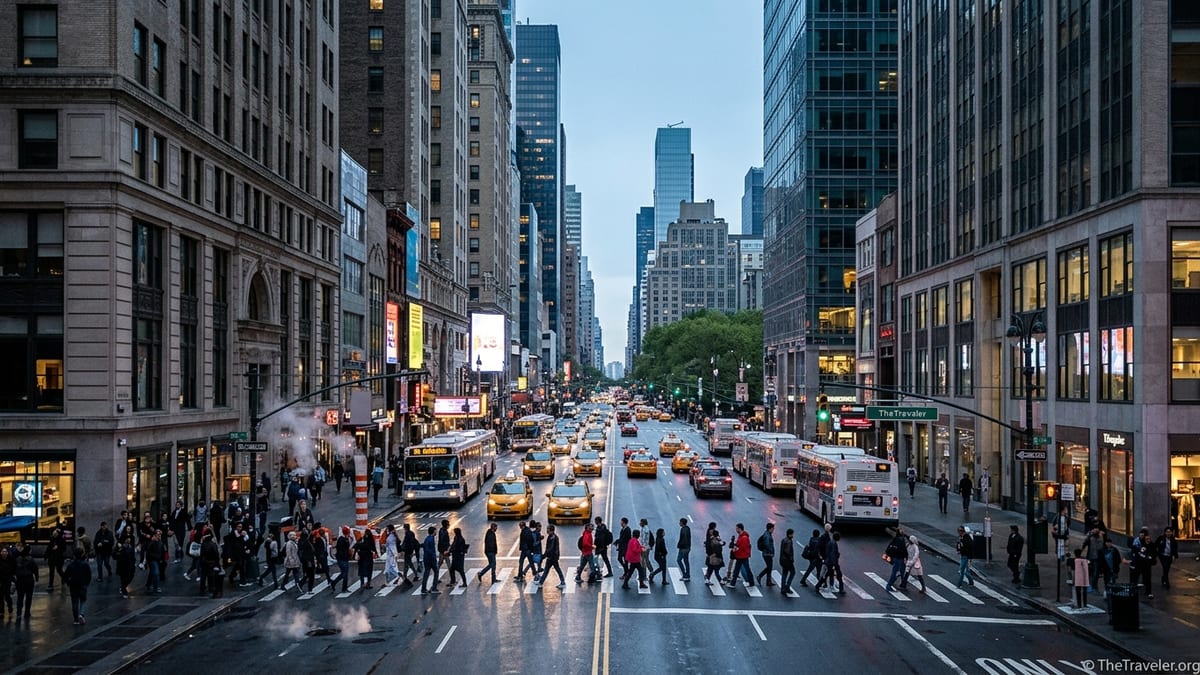
There is also a psychological factor. Walking out of a Midtown hotel into a canyon of skyscrapers, hearing a dozen accents at the crosswalk and seeing yellow taxis stacked at every light matches what many people have been sold as “New York City” since childhood. Even if they later discover the pleasures of a Queens night market or a Brooklyn brownstone block, that first impression sticks as the city’s core in their memory.
Importantly, Manhattan functions as a shared reference point between locals and visitors. A New Yorker who lives in the Bronx and works in Queens may rarely go to Midtown for fun, but if a friend from abroad texts to say they are in town, they might suggest meeting at a bar near Penn Station or a cafe in the East Village, simply because it is straightforward for everyone to reach. That habit keeps reinforcing the idea of Manhattan as neutral ground, a place where paths cross.
How Travelers Can Balance Manhattan With the Rest of the City
For visitors, the question is not whether to choose Manhattan or its competitors, but how to use Manhattan as a base while making space for what the other boroughs do best. One practical strategy is to plan your accommodation and “must do” list around Manhattan, then designate at least one full day and a couple of evenings for outer-borough exploring. For example, you might stay in a Midtown hotel so that reaching Central Park, Broadway and major museums is effortless, then dedicate a Saturday to Brooklyn’s DUMBO and Williamsburg, including dinner at a neighborhood restaurant and sunset from the East River waterfront.
Another approach is to look at your main interests and let them dictate which boroughs get more of your time. If you are an art lover, you might split your days between Manhattan museums and smaller galleries in Bushwick or Long Island City. If you are focused on food, consider centering lunch or dinner in Queens several times, perhaps scheduling an early Central Park walk or a Rockefeller Center visit in the morning and then riding the E, F or 7 trains out to explore different neighborhoods each afternoon.
Budget also plays a role. Manhattan’s centrality comes with higher average prices, from hotel rates to sit-down meals. Many travelers now pair one or two splurge experiences on the island, such as a fine-dining tasting menu or premium Broadway seats, with more casual, lower-cost meals and activities in the other boroughs. A family might spend on tickets to a hit musical, then look to the Bronx Zoo or Queens parks for more relaxed, inexpensive time outdoors.
Crucially, plan your days with transit in mind. New York’s subway runs twenty-four hours, but not every late-night transfer is equally pleasant or efficient. Cluster your Manhattan activities together geographically so you are not zigzagging from Harlem to the Financial District and back again, and when you do cross into another borough, give yourself enough time there that the ride feels worthwhile. Manhattan will still be waiting when you return; its streets, for better or worse, are rarely quiet.
The Takeaway
In 2026, New York is far larger, more diverse and more decentralized as a travel destination than it was even a decade or two ago. Brooklyn’s creative neighborhoods, Queens’ unmatched food scenes, the Bronx’s cultural landmarks and Staten Island’s harbor views all command more attention than ever before. Yet, despite this competition, Manhattan still feels like the center of New York, particularly through the eyes of visitors experiencing the city over a few compressed days.
That feeling is not just nostalgia or marketing. It reflects the island’s dense layering of global icons, business power, transit connectivity and everyday life, along with the simple fact that so many journeys into and across the city pass through its streets. The challenge for travelers is not to decide whether Manhattan deserves its central role, but to recognize it as a starting point rather than a full picture.
Use Manhattan as your anchor: stay there if it fits your budget, let its skyline, parks and theaters provide the backdrop, then deliberately step off the island to see how the rest of New York now challenges its dominance. When you ride the subway back at night, emerging into the glow of Midtown or the quiet of a village side street, you will better understand why this narrow island still feels like the city’s beating heart, even as the rest of New York grows louder all around it.
FAQ
Q1. Is it still worth staying in Manhattan, or should I base myself in another borough?
It depends on your priorities and budget. Staying in Manhattan puts many major sights within a short walk or quick subway ride, which is helpful on short trips, but hotels are often more expensive than in parts of Brooklyn or Queens.
Q2. How many days should I devote to Manhattan versus other boroughs?
On a first visit of about four or five days, many travelers spend roughly two to three full days focused on Manhattan and one or two days exploring areas like Brooklyn, Queens or the Bronx.
Q3. Are Manhattan’s classic attractions overcrowded year-round?
Popular spots such as Times Square, the High Line and major museums are busy most of the year, especially afternoons and weekends, but visiting early in the morning or on weekdays can make the experience more comfortable.
Q4. Can I experience “real New York” if I only stay in Manhattan?
You will certainly get a strong sense of the city’s energy, but many locals feel that everyday New York life is easier to see when you also visit residential neighborhoods in Brooklyn, Queens, the Bronx and Staten Island.
Q5. Is it easy to commute from Brooklyn or Queens into Manhattan for sightseeing?
Yes. Subway lines from areas like Williamsburg, Long Island City and Astoria reach Midtown or downtown Manhattan in about 15 to 30 minutes, though travel times can be longer late at night or on weekends with service changes.
Q6. Are Manhattan restaurants much more expensive than in other boroughs?
Average prices tend to be higher in central Manhattan, especially in Midtown and near major attractions, but you can still find affordable diners, pizzerias and neighborhood spots if you walk a few blocks away from the busiest areas.
Q7. Is Manhattan safe to walk around at night for visitors?
Busy areas of Manhattan remain active late into the evening and are generally safe for visitors who take normal city precautions, such as staying on well-lit streets, being aware of belongings and avoiding deserted areas.
Q8. Do I need a car if I am staying in Manhattan?
No. Parking is expensive and traffic is heavy. Most visitors rely on the subway, buses, yellow taxis, ride-hail apps and walking, which are usually faster and less stressful than driving.
Q9. What is a good neighborhood in Manhattan for a first-time visitor to stay in?
Areas around Midtown, Times Square, Bryant Park and parts of the Upper West Side are popular because they offer many hotel options, easy transit connections and a central location for sightseeing.
Q10. How can I avoid feeling overwhelmed by Manhattan’s crowds and pace?
Build quieter moments into your day, such as walks in Central Park, breaks in smaller neighborhood cafes or visits to less famous museums, and try to explore early in the morning when streets and attractions are calmer.