


The National Park Service typically announces its official cherry blossom peak bloom forecast only a few weeks before the season, and in mid to late winter rather than in the preceding autumn. That means that in November 2026 there is no responsible way to guarantee an exact 2027 peak bloom date, even though many travelers are already trying to book March and April trips. A smart 2027 cherry blossom plan needs to embrace that uncertainty, use recent bloom history as context rather than prediction, and build in flexible dates, transport strategies and backup viewing locations.
Get the latest updates straight to your inbox!
Understanding peak bloom and what 2026 can (and cannot) tell you
The National Park Service defines peak bloom for Washington’s iconic Yoshino cherry trees as the day when about 70 percent of the blossoms around the Tidal Basin are open. That technical definition matters, because it is the number you see quoted in news stories and on the Park Service’s Bloom Watch page, but it does not mean the show only lasts for one day. In most years there are several days before and after peak when the trees still look spectacular, and many visitors are thrilled even if they miss the exact 70 percent threshold.
Historically, peak bloom most often falls between the last week of March and the first week of April. National Park Service records show a long term average around the first days of April, but with huge variation. In some years, like 1990, warmth drove peak bloom as early as mid March, while in a cold year like 1958 the trees did not peak until April 18. Recent data have continued to swing: in 2026, Park Service horticulturists forecast a peak between March 29 and April 1, but a spell of warmer than expected weather pushed the blossoms to hit peak on March 26 instead. That kind of shift of several days is common and can go in either direction.
For 2027, the safest conclusion in November 2026 is that you should think in terms of a window rather than a day. If you want the highest odds of seeing the Tidal Basin near its best, target a stay that covers several days sometime between roughly March 25 and April 7, understanding that actual conditions will depend heavily on the late winter and early spring weather pattern. Even then there are no guarantees, so it is essential to plan flexible reservations and think about backup activities that will make the trip worthwhile regardless of bloom status.
It is also worth remembering that not all cherry trees in Washington are Yoshinos. Other varieties, such as the deeper pink Kwanzan cherries in East Potomac Park, tend to bloom about one to two weeks after the Tidal Basin’s main grove. That staggered timing means that even if you just miss the famous ring of trees at peak, you may find excellent color further down the peninsula or at alternative spots like the National Arboretum later in the season.
Festival calendar and key 2027 cherry blossom events
The cherry trees are a living natural phenomenon, but your trip will likely revolve as much around the National Cherry Blossom Festival calendar as the weather. For 2027, festival organizers have already announced that the official festival season will run from March 20 to April 11, 2027. Within that three week window are marquee events that draw major crowds and may influence when you want to be in town.
The festival’s opening is scheduled for March 20, with an indoor ceremony that typically features cultural performances and remarks from Japanese and American officials. Exact lineups for 2027 have not yet been published, but recent ceremonies have mixed J-pop artists, traditional drumming and orchestral performances, so you can expect a similar blend. Further into the season, the popular Blossom Kite Festival is usually held on a weekend on or near the National Mall, filling the grassy areas near the Washington Monument with families, elaborate kites and food vendors. Because those specific 2027 dates can shift to match both wind conditions and the broader events calendar, it is important to recheck closer to travel.
The highest profile single-day event is the National Cherry Blossom Festival Parade along Constitution Avenue, which traditionally takes place on the festival’s last Saturday. Planning documents for 2027 refer to a parade date in early April and a fallback date one week later, tied to grandstand ticket offers, but as of November 2026 the festival has only publicly confirmed that the parade will occur within the March 20 to April 11 window. Expect signature elements such as giant helium balloons, marching bands, parade floats featuring visiting celebrities, and dance troupes. Watching from the curb is free, but grandstand seats require advance purchase and will sell out quickly once the exact date is fixed.
Around these headline events, the festival layers many free or low cost activities that can be important fallback plans if blossoms run early or late. Past years have included outdoor concerts at The Wharf and on the Tidal Basin stage, waterfront fireworks, lantern walks, and daily cultural programs at museums and embassies. As 2027 schedules are finalized, look for a spread of weekday evening events and family days, which can be very useful if you are trying to avoid the heaviest weekend midday crowds at the monuments themselves.
Tidal Basin seawall work and what will be open in 2027
One complicating factor for 2027 that did not exist a decade ago is heavy construction along parts of the Tidal Basin and West Potomac Park. The National Park Service’s multiyear seawall rehabilitation project began in 2024 and has involved cofferdams, work barges and closed sections of the waterside path while crews repair and raise the failing stone walls. Federal construction notices projected that in-water work would largely wrap up by late 2026, with the overall contract scheduled to conclude by early 2027. By the spring 2026 bloom, major segments of the wall between the Jefferson Memorial and the southwest portions of the Tidal Basin were already rebuilt and reopened to pedestrians.
For the 2027 blossom season, this timing suggests that most, if not all, of the core loop path around the Tidal Basin should be open to visitors, with final landscaping work such as new railings, grading and plantings still possible in localized areas. Because contractors sequence work to keep at least some routes open for safety and emergency access, you can assume that headline sites like the Martin Luther King Jr. Memorial, Franklin Delano Roosevelt Memorial and Jefferson Memorial will remain accessible. What may change is the exact alignment of the paved trail, temporary fencing in areas where newly planted trees or turf need protection, and short detours where equipment is still staged.
To translate that into real-world planning, do not rely on an old paper map that shows an uninterrupted shoreline path. In recent seasons, visitors have encountered short pinch points where the path narrows around equipment zones, and occasional closures of small overlooks that once offered popular photo angles. If your priority is a relaxed stroll rather than a comprehensive loop, you might focus on walking from the Jefferson Memorial clockwise toward the MLK Memorial, where many of the most photogenic trees stand and the rebuilt wall has created more level, less flood-prone space. Be prepared, however, for the Park Service to adjust barricades and wayfinding signs right up to and during the 2027 festival as work winds down.
Another detail to watch is boat access. The Tidal Basin paddle boats, which are operated under concession in warm months, sometimes adjust their opening hours or season start date because of both construction and water conditions. If you imagine your dream blossom photo from one of these boats, treat it as a pleasant bonus rather than a guarantee for March 2027 and verify their operating status once closer to arrival.
Best 2027 blossom viewing areas and less crowded alternatives
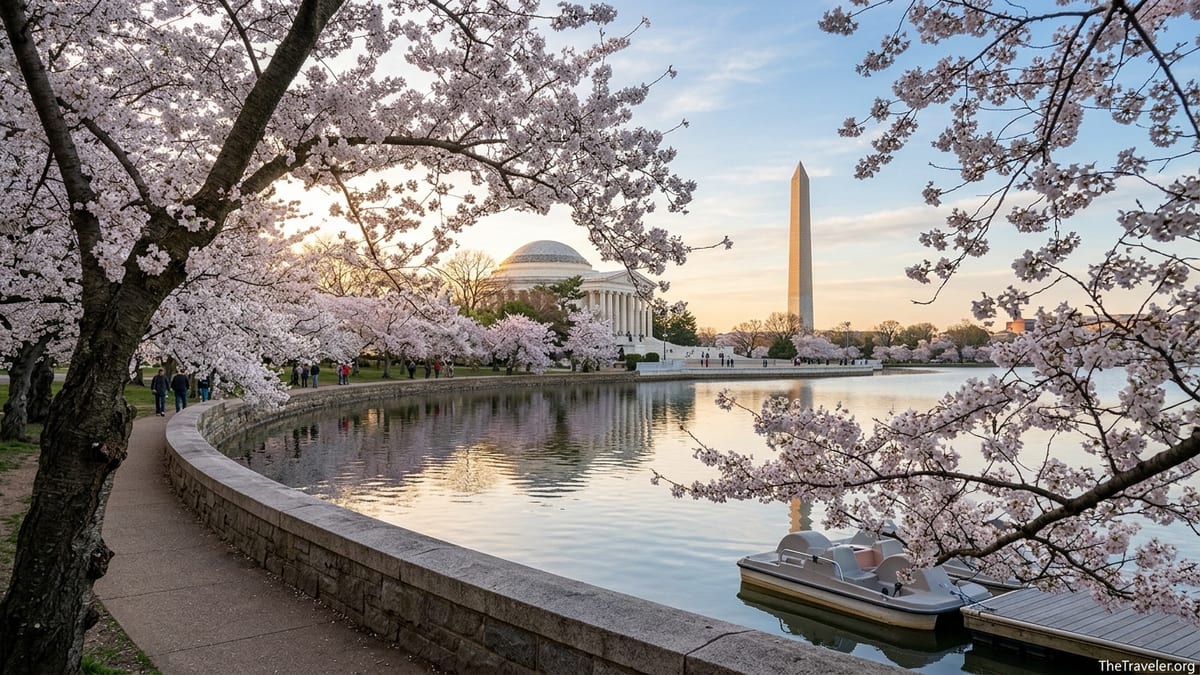
Most first time visitors imagine cherry blossoms as synonymous with the Tidal Basin, and there is good reason for that. The ring of Yoshino trees hugging the waterline between the Jefferson Memorial and the MLK Memorial, with views that frame the Washington Monument in a blur of pink and white, is still the iconic Washington image broadcast worldwide. On a clear morning when the water is calm enough for reflections, you can capture postcard worthy views from the southwest corner of the Basin looking back toward the obelisk. The tradeoff is density: at peak bloom during festival weekends the narrow waterfront path here can slow to a shuffle, and families with strollers or mobility devices will find maneuvering difficult.
Just beyond this core, the land around the Jefferson Memorial and West Potomac Park offers more breathing room. The slopes above the memorial steps, the lawn between the memorial and the Potomac River, and the groves near the George Mason Memorial all carry significant plantings. These areas give up a bit of the classic ring arrangement but make up for it with open lawn where kids can run and adults can sit for a picnic. As seawall work wraps up, expect some young replacement trees here; they may not yet form full canopies but can still be attractive foreground elements for photos of the river and bridges.
To escape the tightest crowds while remaining on the same peninsula, walk or bike further south into East Potomac Park and toward Hains Point. The main roadway here is lined with cherries on both sides, and later blooming varieties extend the season into mid April. This is one of the best places for a longer blossom jog or bike ride, and because it is farther from the Metro and the Mall, it tends to feel more local even on busy weekends. Be aware that road closures for runners and permitted events are common on festival Saturdays and Sundays, so if you plan to drive you may be diverted or required to park and walk from the park entrance.
Beyond the immediate monument area, several sites reliably offer beautiful blooms with more manageable foot traffic. The National Mall has clusters of trees between the Smithsonian museums, especially around the Constitution Gardens and near the Washington Monument, which can be a good compromise if you want quick museum access. Further afield, the U.S. National Arboretum in Northeast Washington has one of the country’s broadest collections of cherry varieties scattered through its hills and meadows. Travel time from downtown by rideshare or car is longer, but in return you get wider paths, rolling terrain and a more relaxed pace, even when the Tidal Basin feels shoulder to shoulder.
Metro access, walking routes and avoiding transit bottlenecks
During cherry blossom season the Washington Metro is usually the smartest way to reach the Mall and Tidal Basin, but you need to know which stations work best under crowd pressure. Smithsonian station on the Blue, Orange and Silver lines sits directly on the National Mall and is closest to the Washington Monument grounds. It offers the most straightforward walk to the Tidal Basin, roughly 10 to 15 minutes south across the Mall lawn and toward the Washington Monument, but at peak times the platforms and escalators can become heavily congested and Metro staff may impose crowd control measures that slow entry and exit.
To avoid the tightest pinch points, many local riders prefer to use the larger L’Enfant Plaza station, which serves the Blue, Orange, Silver, Green and Yellow lines. From L’Enfant it is about a 15 to 20 minute walk to the Tidal Basin via Independence Avenue or through the tree shaded paths around the Department of Agriculture and Smithsonian Castle. The route is mostly flat and includes curb ramps, making it more manageable for strollers and wheelchairs than the stair heavy memorial steps. Other viable alternatives are Archives and Federal Triangle stations, each adding a few minutes of walking in exchange for a calmer transfer experience.
If you are staying in Virginia, stations like Pentagon City or Arlington Cemetery can also serve as starting points for a blossom walk. From Arlington Cemetery, fit walkers sometimes choose to cross the Memorial Bridge toward the Lincoln Memorial and then continue on foot along the river toward the cherry trees. This route offers dramatic skyline views but involves more distance and some hills, so it is not ideal for families with young children. Regardless of which station you choose, allow extra time during festival weekends and be prepared for occasional train holds as Metro manages increased spring ridership, which recently surpassed half a million weekday trips systemwide.
Consider practical details like SmarTrip cards and station exits as well. During recent festivals, Metro has sold limited edition cherry blossom themed fare cards at major hubs including Metro Center, L’Enfant Plaza, Smithsonian and the two Washington area airports. Purchasing or loading a card well before you approach the turnstiles avoids queues. Once off the train, follow temporary signage and staff instructions: on the busiest Saturdays, Metro police and station managers sometimes dedicate specific escalators to one direction or ask riders to use alternative exits to keep people moving safely.
Three practical 2027 itineraries: dawn photos, families and full days
If your priority is photography with minimal crowds, design an early morning route that reaches the Tidal Basin just after nautical or civil dawn. From a downtown hotel, walk or take the first train of the day to Smithsonian or L’Enfant Plaza and head first to the northwest corner of the Basin near the Washington Monument view line. In 2026, sunrise in late March was just before 7 a.m., and in 2027 it will be similar, so aim to be in position by about 6:30 a.m. on your chosen day. Work clockwise along the path, catching reflections and side light on the Yoshino blossoms before the majority of tour buses and group tours arrive around 9 a.m. After two to three hours you can retreat to a cafe north of the Mall for breakfast, review your shots and then decide whether to continue exploring or return to your hotel for a rest.
Families might favor a gentler afternoon plan centered around open lawns and bathrooms. One practical approach for 2027 is to ride Metro to L’Enfant Plaza late morning, walk across the Mall to enjoy picnic style lunch on the grass near the Smithsonian Castle, then continue toward the Tidal Basin via the Freer Gallery and the National Museum of African Art, which share a quiet courtyard garden. Spend an hour around the MLK and FDR memorials, where paths are wider than the tightest curves of the Basin, and let children climb the gentler slopes while adults enjoy the blossoms. On the way back, reward everyone with ice cream or snacks from vendors near the Washington Monument before returning to the Metro ahead of the evening rush.
For visitors who want to combine peak nature and museum time in one full day, a realistic schedule starts with blossoms and ends indoors. Arrive by Metro around 8 a.m., tour the Tidal Basin and nearby memorials for three to four hours, then around lunchtime pivot north to the Mall and choose one or two Smithsonian museums to focus on. In late March and early April 2026, for example, the National Museum of American History and the National Museum of Natural History both operated from late morning to early evening, hours likely to be similar in 2027. A family could spend the afternoon with dinosaurs and interactive science exhibits out of the wind, then exit in the golden hour to catch cherry trees on the Mall glowing against the sunset. This sequence also gives you indoor backup if a passing rain shower interrupts blossom viewing mid day.
Whichever itinerary you choose, keep flexibility at the center of your 2027 plan. If forecasts show peak bloom sliding earlier than your trip, you might front load outdoor time in your first days and add more museum visits at the end. If cold weather delays the blossoms, you can flip that order, focusing first on cultural attractions and leaving your Tidal Basin and East Potomac Park walks for the end of the stay.
Crowds, driving limits, parking and when to go
Cherry blossom season has become one of Washington’s busiest tourism periods, with festival organizers reporting well over a million people attending events in recent years. That crush is not evenly distributed. Weekday mornings usually offer the calmest experience on the Tidal Basin paths, especially before 10 a.m., while festival Saturdays around peak bloom can feel at capacity. Plan for lines at restrooms, portable toilets and food vendors, and expect it to take longer than map apps suggest to walk short distances when paths are at their narrowest.
Driving into central Washington during the peak window is strongly discouraged unless you are familiar with local detours and comfortable parking in a garage and walking. Temporary road closures, one way restrictions and heavy pedestrian crossings near the Lincoln Memorial, Independence Avenue and 17th Street can snarl traffic. On peak weekends, authorities sometimes close streets around the Tidal Basin to private vehicles entirely, reserving space for shuttle buses and emergency access. Public parking lots near the memorials fill extremely early; a more realistic strategy is to leave your car in a commercial garage downtown or in Arlington and rely on Metro or shared bikes to reach the blossoms.
Choosing when to visit in 2027 is therefore a balance between bloom odds and crowd tolerance. If your schedule is flexible and you prefer thinner crowds, consider aiming for a weekday centered trip, such as arriving on a Sunday or Monday and leaving Thursday. This framing gives you several mornings with manageable paths even if one day is lost to rain. If you are set on attending a major festival event like the parade or fireworks, you will need to accept heavier weekend congestion but can mitigate it by visiting the Tidal Basin very early in the morning and then shifting to less crowded spots like the Arboretum or neighborhood parks in the afternoon.
As your trip approaches, track both the Park Service’s bloom stage updates and local news coverage, which often combines NPS data with on the ground photography. Watching photos from Washington based outlets and residents over a week or two gives you a more nuanced sense of conditions than a single forecast date. If you see that petals are already falling heavily or that buds are still tight a week before your arrival, lower your expectations for perfect timing and lean into the city’s many non blossom attractions.
Costs, accommodation strategies and budgeting around uncertainty
By late 2026, hotel searches for late March and early April 2027 in downtown Washington show that midrange national brand hotels near the Mall commonly price standard rooms somewhere in the low to mid 300 dollar range per night before taxes on peak blossom weekends, with some properties around Metro Center and Penn Quarter listing higher Friday and Saturday rates. Just across the river in Arlington neighborhoods like Rosslyn, Crystal City and Pentagon City, similar chains often post rates that can be 50 to 100 dollars per night lower on comparable dates. In Old Town Alexandria, waterfront boutique hotels may charge similar nightly prices to downtown DC during peak weekends, but budget friendly properties along the Metro corridor north of King Street tend to be more affordable.
Local tax is a meaningful component of the final bill. In the District itself, combined hotel and occupancy taxes add roughly 15 to 15.5 percent to the base room rate, while Arlington and Alexandria levy their own lodging taxes that bring totals into a similar mid teens percentage. On top of that, some hotels charge nightly destination or amenity fees, especially near the Wharf or convention center, so it is important to factor these into your cherry blossom budget. Metro fares are distance and time based, but as a planning example a short off peak ride from Crystal City or Pentagon City to Smithsonian in 2026 cost on the order of a few dollars per person each way with a SmarTrip card, rising modestly during peak hours.
One way to manage both cost and bloom uncertainty is to book fully refundable or flexible hotel reservations spanning a longer window than you ultimately intend to stay, then cancel extra nights once the National Park Service announces its 2027 peak bloom forecast, likely in late February or early March. Some travelers also reserve two overlapping weekends, one in late March and another in early April, and then keep the one that best aligns with the forecast and the emerging weather pattern. Airline tickets and long distance trains such as Amtrak may be less flexible, but many carriers now offer date change options with modest fees, which can provide limited wiggle room if the forecast shifts dramatically.
For a concrete sense of 2027 budgets, consider a couple planning a four night weekday stay in Arlington during the festival window. If they find a hotel at about 220 dollars per night before roughly 15 percent tax, their lodging might total around 1,000 to 1,050 dollars. Add SmarTrip cards and daily Metro fares for two at perhaps 8 to 12 dollars per person per day, meals that range from casual food trucks on the Mall to one or two sit down dinners, and occasional rideshares on late evenings, and a realistic overall trip budget may land in the low to mid 2,000 dollar range excluding airfare. A family of four staying in a single room or suite downtown at 350 dollars per night plus tax for the same length of stay could see lodging around 1,600 dollars, with higher transit and food costs but many free activities balancing the total.
Bad weather planning is part of that financial picture. A raw, rainy spring day can make the Tidal Basin feel miserable even when blossoms are at their best. Having timed entry reservations or free tickets to indoor museums and attractions gives you value even if you barely see the trees. Places like the National Museum of Natural History, the Air and Space Museum and the National Gallery of Art are free and can easily absorb half or more of a day, as can indoor markets and aquariums in the region. Building these into your itinerary ahead of time ensures your trip remains worthwhile whatever the sky delivers.
How to monitor 2027 bloom progress and where to go if it is too crowded
Once you have airfare and accommodation in place, the best way to refine your 2027 cherry blossom plan is to track live updates. The National Park Service maintains an official Bloom Watch page every spring that posts bud stage photos and announces both forecast windows and the actual peak bloom date. Follow their updates starting in February 2027 to see whether the season appears early, late or close to average. The National Cherry Blossom Festival’s own channels, together with local television weather segments and newspapers, often repackage this information with practical explanations, including warnings about weekend congestion and Metro advisories.
While you are monitoring the trees, also keep an eye on park access notices related to the seawall work and any temporary closures. The Park Service and local emergency management agencies sometimes publish special event calendars detailing road closures, security zones and recommended transport routes for major parade and festival days. Reviewing those in the week before you arrive lets you determine whether to approach the Tidal Basin from the north, the west along Ohio Drive, or via walking paths from the Mall.
If you reach the Tidal Basin in 2027 and find it too crowded to enjoy, be ready to pivot quickly. One immediate alternative is to step back toward the Washington Monument grounds, where the trees are more dispersed and you can still capture skyline views framed by blossoms. Another is to shift to East Potomac Park, using a shared bike or scooter to cover the longer distance down the peninsula. On extreme peak weekends, when paths feel uncomfortably packed, you might opt instead for a half day at the U.S. National Arboretum, neighborhood parks in Capitol Hill, or riverfront trails like those in Navy Yard, all of which incorporate cherry trees without the claustrophobic feeling of the Basin’s narrow loop.
In the end, a satisfying 2027 cherry blossom trip will come from combining realistic expectations with flexible planning. No one can promise that your chosen days will match the exact peak, especially from the vantage point of November 2026, but by building in several days of potential blossom viewing, choosing Metro over driving, keeping budgets and reservations flexible, and knowing where to shift if one area is overwhelmed, you give yourself multiple chances to experience Washington in full spring color. Even if the weather or bloom timing does not deliver textbook perfection, the combination of historic monuments, free museums and festival energy can still make your early spring visit memorable.