


Oslo Airport Gardermoen is Norway’s main international gateway, handling tens of thousands of passengers every day and serving as the hub for travel across Scandinavia. Whether you are visiting the country for fjords and northern lights or simply changing planes on your way elsewhere in Europe, a bit of preparation will make your time at Gardermoen calmer, cheaper and far more predictable. This guide walks you through what to know before you fly, using practical, real world examples that match how the airport actually works in 2026.
Get the latest updates straight to your inbox!
Understanding Oslo Airport Gardermoen and Its Layout
Oslo Airport Gardermoen sits about 45 to 50 kilometers north of central Oslo and is the country’s largest airport. It uses the IATA code OSL, which you will see on boarding passes, baggage tags and departure boards. The airport is compact compared with major hubs like Frankfurt or Heathrow, but it has been expanded in recent years and now handles well over 30 million passengers in a typical year. For travelers, that means it can feel busy at peak times, but walking distances are still manageable for most people.
Most passengers experience Gardermoen as a single large terminal building with two main zones: one for Schengen flights and one for non Schengen flights. In practice, you will see this as separate gate areas and passport control points. For example, a morning SAS flight from Oslo to Copenhagen will usually depart from the Schengen pier, while a Norwegian or Qatar Airways flight to Bangkok will leave from the non Schengen gates. When connecting, you may need to pass through passport control even if you do not leave the airport, so allow time for that if you are switching between a European destination and a long haul one.
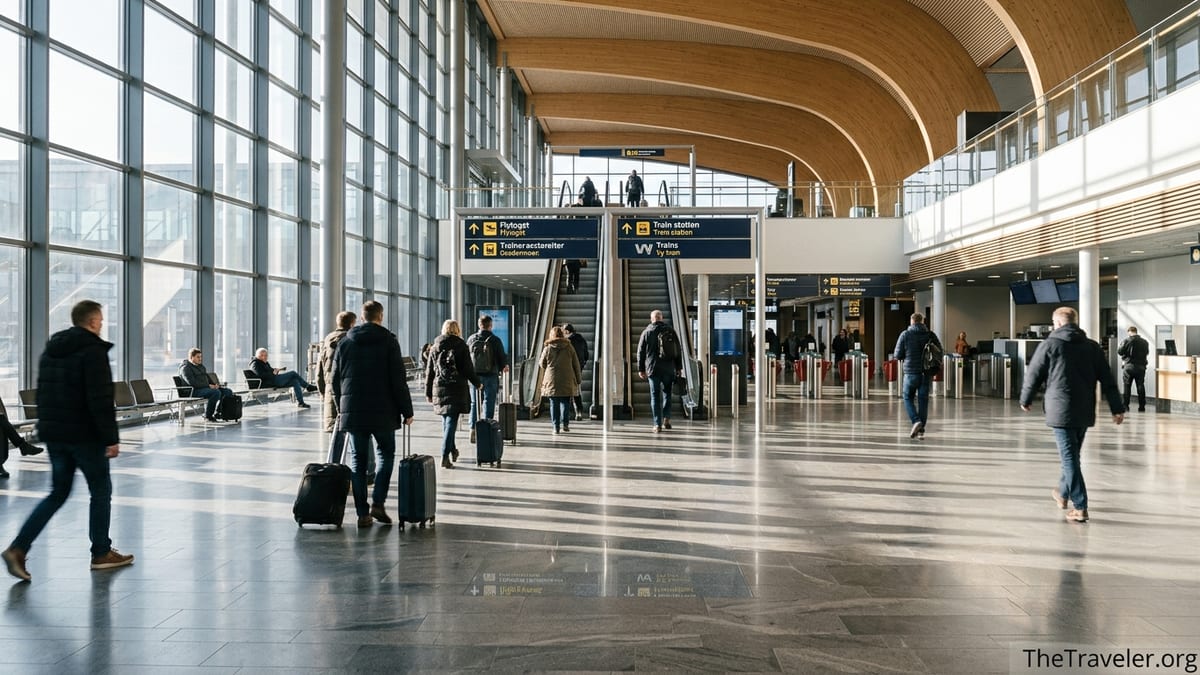
The train station is directly underneath the arrivals hall, which is a major advantage compared with many other airports. After clearing customs you walk straight ahead for a minute or two and reach escalators down to the platforms that serve both the Flytoget Airport Express and the regular Vy trains. This design makes public transport the default choice for many travelers, especially solo visitors with a suitcase or backpack who want to avoid the cost of taxis.
Shops, cafes and services are scattered on both sides of security. There is a cluster of convenience stores and quick service food outlets in the arrivals area, including places where you can grab a coffee and a simple sandwich while you wait for a train. Airside, in the departure areas, you will find duty free, pharmacies, upscale coffee bars and Norwegian snack chains like Joe & The Juice and various kiosks that sell salad boxes, wraps and hot dogs. Prices are typical for Norway, which means noticeably higher than in southern Europe, so budget travelers often prefer to buy snacks in Oslo before heading to the airport.
Getting To and From Oslo: Trains, Buses and Taxis
The biggest practical decision for most travelers is how to get between Oslo Airport and the city center. The two main options are the Flytoget Airport Express train and the regular Vy trains that share the same tracks. Flytoget usually takes about 19 minutes between the airport and Oslo Central Station and runs as frequently as every 10 minutes during the day. The trade off is price. A one way adult ticket on Flytoget typically costs around 230 Norwegian kroner in 2026, roughly twice the cost of a regular Vy train ticket on the same route, which is often in the 115 to 135 kroner range depending on fare type.
For a solo traveler arriving in the afternoon, the Vy train will be the best value in most cases. You walk to the same set of escalators, go down to the platforms and simply follow the signs for Vy or look for the regular regional trains heading toward Oslo S. The journey is only a few minutes slower than Flytoget, so the savings are significant. You can buy Vy tickets in apps such as Vy or Entur, at ticket machines or on some trains. Locals often use a Ruter public transport ticket that covers the airport zone plus Oslo’s urban zones, which lets them continue from Oslo Central Station onto the metro, tram or bus without buying a second ticket.
Flytoget has its own advantages that some travelers willingly pay for. Families with children benefit from the rule that kids under 16 travel free when accompanied by a paying adult, which can make Flytoget cheaper than Vy for a couple traveling with two children. Business travelers value the frequent departures, the relatively quiet carriages and Flytoget’s travel guarantee, which can cover expenses if a delay caused directly by the train leads to a missed flight. A common real world pattern is a consultant flying to Oslo for meetings who takes Flytoget straight to the Nationaltheatret station, which is closer to the western business district, and back again in the evening.
Night owls and very early morning travelers need to plan ahead. Train services thin out late at night, and between roughly 1:00 and 4:00 in the morning there may be no train at all on some days. In that window, your choices are an airport express bus service or a taxi. Dedicated airport buses link Gardermoen with parts of Oslo and other towns, and their schedules are timed to early and late flights, but they take longer than the train. A metered taxi from the airport to central Oslo can easily cost the equivalent of 100 to 150 US dollars, depending on traffic and time of day, so it is best reserved for groups that can split the fare or for travelers whose flights leave before the public transport network is fully awake.
Check In, Security and Norwegian Travel Norms
Check in at Oslo Airport is dominated by self service. On a typical weekday morning you will see lines of self service kiosks and automated bag drop machines in the departures hall for airlines like SAS, Norwegian and Widerøe. Most carriers open bag drop about two hours before European departures and three hours before long haul flights, but you should always check your specific airline’s guidance. If you are flying Norwegian from Oslo to London, for example, you can usually check in on your phone the day before, print your bag tag at a kiosk when you arrive, and drop the suitcase on a belt without ever visiting a staffed desk.
Security at Gardermoen is generally efficient, although early weekday mornings and Sunday evenings can be crowded with commuters and weekend travelers. Norway has been rolling out next generation scanners at some airports that allow liquids and laptops to stay in bags, but you should not count on this and be prepared to remove electronics and follow the normal rules. Travelers connecting from outside the Schengen area sometimes underestimate how long security and passport control can take. A safe rule of thumb for a self made connection, such as arriving with a low cost carrier and departing on a different airline, is to allow at least two hours between flights, and more if you need to collect and recheck luggage.
Norwegian travel norms can be helpful to understand before you get in line. Local passengers tend to arrive with their boarding passes already on their phones, minimal hand luggage and liquids packed in advance, which helps keep queues moving. At the same time, staff are used to international visitors who may be less familiar with the process and are typically patient as long as you are prepared to follow instructions. If you are unsure about whether an item can go through security, it is better to ask a staff member before you reach the scanners than to have to unpack and repack at the belt.
Fast track lanes are available for eligible passengers, including many business class ticket holders and those with airline status. Some airlines sell access to these lanes as an optional add on, and at busy times this can significantly reduce waiting time. A real world example: a traveler taking an early Monday morning flight to Brussels for work may choose to pay for fast track, breeze through security in 10 minutes instead of 30, and then have time for breakfast and emails in the lounge or at a quiet cafe instead of shuffling in a long queue.
Making Connections and Handling Delays
Oslo Airport is designed to work as a transfer hub for both domestic and international flights, particularly for Norwegian and SAS passengers who live in smaller Norwegian cities. A common itinerary might involve flying from Tromsø to Oslo and then onward to London, Copenhagen or New York. If both flights are on the same ticket and airline, your baggage is typically checked through to your final destination, and you follow clearly signed transfer routes to your next gate. Domestic to Schengen connections are usually straightforward, while domestic to non Schengen connections will require passport control.
Self connecting passengers need to be more careful. Low cost carriers occasionally arrive at remote stands, requiring a bus ride to the terminal, which adds 10 to 15 minutes compared with a regular jet bridge arrival. If your onward ticket is on another airline, you must clear passport control if relevant, collect your bags, pass through customs and then check in again from scratch. A traveler flying in from Reykjavik on a low cost carrier and then continuing on a separate ticket to Berlin with another airline should consider a minimum connection window of three hours to feel comfortable, especially in winter when snowy conditions can cause de icing delays.
When things go wrong, knowing who is responsible is essential. For missed connections on a single ticket, the airline generally has to help rebook you and may provide hotel and meal vouchers when the cause is within their control. For self connections, you bear most of the risk. Some travel insurance policies explicitly cover missed onward travel when a first leg runs late, but you need to read the fine print before you rely on that. On the ground side, Vy promotes a travel guarantee for passengers heading to the airport, promising help, including covering a new flight within defined limits, if their train’s delay leads directly to a missed departure. The conditions are specific, so check them before planning a very tight schedule.
Short term disruptions at Oslo Airport can arise from weather, technical issues or even drone activity in restricted airspace around the runways. Norwegian media have reported cases where illegal drones forced incoming aircraft to divert temporarily or circle until the police located the operator. For most passengers this translates into moderate flight delays rather than cancellations, but it is another reason to plan generous buffers for important same day commitments. If you are connecting to a long haul flight from Oslo that only runs a few times a week, it is often worth traveling to Gardermoen earlier in the day and working or relaxing airside rather than cutting things close with a last domestic flight.
Food, Shopping and Airport Services
Gardermoen offers a mix of Nordic and international brands, with enough choice for most tastes but not the overwhelming variety of a megahub. Before security in the departures hall and arrivals area you will find convenience style shops selling snacks, drinks and travel essentials such as chargers and adapters. These are useful if you land late at night and need a bottle of water and a quick bite before catching a train. Prices are higher than in regular supermarkets, so many locals buy a simple meal deal in Oslo before heading to the airport and then top up with a coffee once they are airside.
After security, the selection broadens, especially in the international departure zone. There is a large duty free store where travelers stock up on cosmetics, perfume and Norwegian chocolate brands, and a range of bars and cafes offering pastries, sandwiches and hot dishes. Beer and wine are widely available, reflecting Scandinavian travel culture, but alcoholic drinks are expensive. A draft beer in one of the airport bars can easily run to 130 kroner or more, which surprises some first time visitors. Many travelers choose a more budget friendly option such as a filter coffee and cinnamon bun from a bakery style outlet while they wait for boarding.
Oslo Airport has several lounges, including airline operated ones such as the SAS Lounge and contract lounges that serve multiple carriers and cardholders. Access may be included with a business class ticket or available as a paid add on, often costing the equivalent of 40 to 60 US dollars for a visit. For a traveler facing a long layover before a transatlantic flight, that fee can feel worthwhile, offering quieter seating, free hot food and a chance to shower. Day rooms at nearby airport hotels are another option if you need real rest between flights; some travelers arriving from Asia early in the morning book a day room from 9:00 to 15:00 and then return to the terminal refreshed for an evening departure north to Tromsø.
Other services include currency exchange desks, ATMs from major Norwegian banks, and a range of car rental counters in the arrivals area. Norway is now heavily cashless, and it is entirely possible to visit the country and the airport without ever withdrawing physical currency, paying for everything by card or mobile wallet instead. That said, if you are continuing beyond Oslo to rural areas where small shops might not accept foreign cards, withdrawing a small amount of cash at Gardermoen while you wait for luggage can be convenient.
Practical Tips for Families, Budget Travelers and Special Situations
Families traveling through Gardermoen will find the airport relatively child friendly. There are dedicated play areas in some gate zones, and many restrooms include baby changing facilities. The rule that children under 16 travel free on Flytoget when accompanied by an adult can dramatically cut ground transport costs for parents. For example, two adults and two kids going from the airport to Oslo Central Station would pay only for the adults on Flytoget. When compared with buying four separate Vy tickets, the price difference can narrow or even tilt in Flytoget’s favor, especially when you factor in the shorter travel time and frequent departures that make it easier to match nap schedules and mealtimes.
Budget travelers should think about costs across the entire journey, not just the plane ticket. Norway is consistently ranked as one of the more expensive destinations in Europe, and airport prices reflect that. Choosing the Vy train instead of Flytoget, bringing a reusable water bottle to fill after security, and packing a sandwich from a supermarket in the city can quickly save the equivalent of 30 to 50 US dollars on a round trip compared with always taking the most convenient option and eating full meals at the airport. Backpackers and students often purchase a 24 hour or multi day Ruter ticket that covers both city transport and the airport zone, giving them unlimited use of metro, trams, buses and regional trains, including the ones that run to Gardermoen.
Travelers with reduced mobility should notify their airline in advance so that assistance can be arranged. Gardermoen offers wheelchair support and help getting to and from gates, but these services work best when the airport knows about them before you arrive. Elevators and ramps are widely available, and the terminal layout is relatively flat, which reduces the need for long stair climbs. If you are connecting and have a tight schedule, requesting a wheelchair escort can help ensure you are moved efficiently between gates and that staff are aware you are coming if a flight is slightly delayed.
Finally, winter conditions are a reality in Norway, and Gardermoen is no exception. From November through March temperatures can be below freezing, with snow and ice on the ground. The airport is well equipped for these conditions, with systematic de icing procedures and snow clearing of runways, but travelers should still build extra time into their plans. A realistic scenario is a February morning where departures are delayed by 20 to 40 minutes as each aircraft is de iced before takeoff. For someone connecting to a long distance train or ferry in Oslo later in the day, leaving an extra hour in the schedule is a sensible precaution.
The Takeaway
Planning a trip through Oslo Airport Gardermoen is less about memorizing obscure rules and more about understanding a few core realities. The airport is compact but busy, public transport links are excellent yet priced at a premium, and winter weather and occasional disruptions can stretch travel times more than you might expect from looking at timetables alone. If you decide in advance whether Flytoget or the Vy train suits your budget and schedule, allow generous connection windows, and understand the basics of self service check in and security, you will remove nearly all of the stress that typically accompanies flying.
For most visitors, a smooth journey through Gardermoen looks like this in practice: checking in online the day before, arriving at the airport about two hours before a European departure, dropping tagged luggage at an automated belt, passing through security with time to spare, grabbing a light snack airside, and then boarding a train into central Oslo that aligns with your budget and your tolerance for waiting. With those pieces in place, the airport becomes a relatively frictionless gateway rather than a destination in itself, freeing you to focus on the Norwegian landscapes, culture and experiences that lie beyond.
FAQ
Q1: How long does it take to get from Oslo Airport Gardermoen to the city center?
The fastest option, Flytoget, takes around 19 minutes to Oslo Central Station, while regular Vy trains usually take about 23 to 27 minutes depending on the service.
Q2: Is Flytoget worth the higher price compared with Vy trains?
Flytoget costs roughly twice as much as Vy but offers more frequent departures, slightly faster travel times, a travel guarantee and free travel for accompanied children under 16, which can make it good value for families and business travelers.
Q3: How early should I arrive at Oslo Airport before my flight?
For most European flights, arriving about two hours before departure is usually enough, while long haul flights often warrant arriving around three hours early, especially at busy times.
Q4: Are there overnight public transport options between Oslo and the airport?
Train services are very limited between roughly 1:00 and 4:00 in the morning, so in that window you may need to rely on airport buses or taxis, which take longer or cost more.
Q5: Can I pay for everything at the airport with a card?
Yes, Norway is highly cashless and cards are widely accepted at shops, cafes, ticket machines and in many taxis, so most travelers do not need to withdraw local currency at the airport.
Q6: Is Oslo Airport easy to use for flight connections?
Yes, the terminal is fairly compact and well signposted, and connections on a single ticket are straightforward, but self made connections require extra time for baggage reclaim, security and possibly passport control.
Q7: What is the cheapest way to travel between the airport and Oslo?
Regular Vy trains are typically the cheapest rail option, with fares that are often about half the price of Flytoget, and some travelers further reduce costs by using regional public transport tickets that cover the airport zone.
Q8: Are there good food options at Oslo Airport for people on a budget?
Food and drink prices at Gardermoen are relatively high, but you can keep costs down by buying snacks in the city beforehand and then opting for simple items like filter coffee and pastries at airport cafes.
Q9: What should I do if bad weather or a disruption delays my flight?
Stay in close contact with your airline via its app or information screens, allow extra time for de icing in winter, and if you miss a connection on a single ticket, speak to the airline staff promptly about rebooking and assistance.
Q10: Is Oslo Airport suitable for travelers with reduced mobility?
Yes, the airport offers assistance services, elevators and step free routes, but it is important to inform your airline in advance so that appropriate help can be arranged for check in and transfers.