


For many travelers landing at Oslo Airport Gardermoen, the bright silver Flytoget trains are their first real taste of Norway. The Airport Express Train is often the fastest and most convenient way to reach Oslo and several key suburbs, but understanding its routes, ticket options and how it compares with regular trains can save you both money and stress. This guide brings together the latest practical information so you can step off the plane and onto the right train with confidence.
Get the latest updates straight to your inbox!
What Is Flytoget and Where Does It Run?
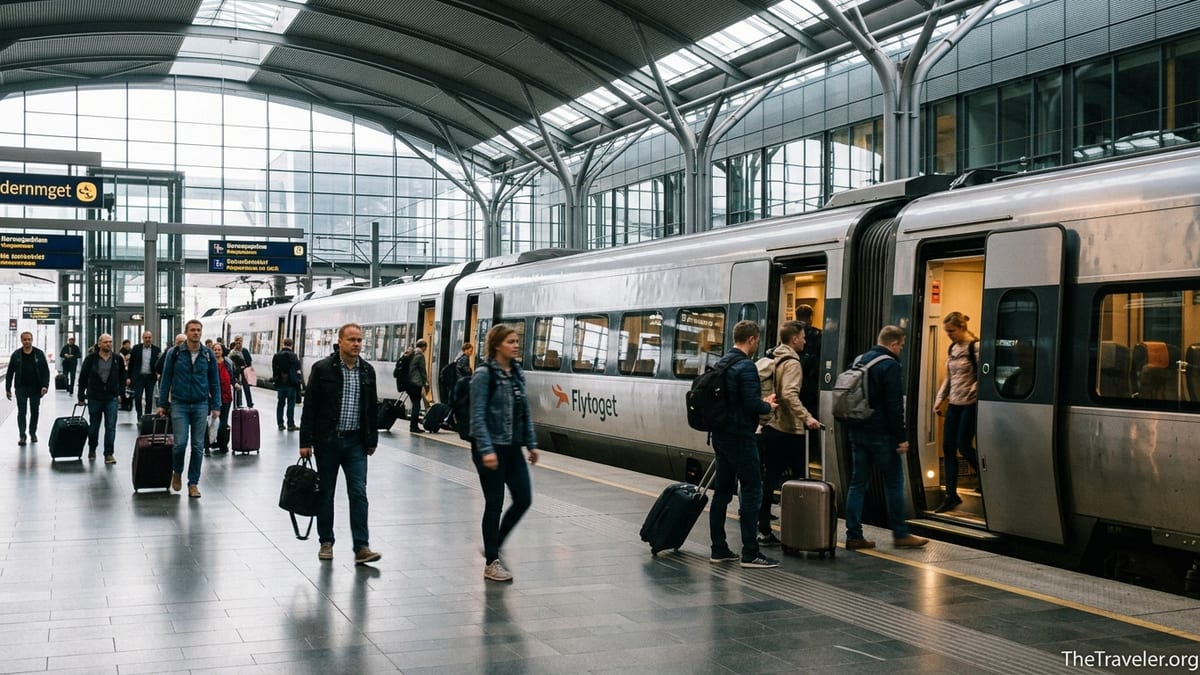
Flytoget is Norway’s dedicated Airport Express Train, running on the Gardermoen Line between Oslo Airport (Oslo Lufthavn Gardermoen) and a series of stations in and around Oslo. Trains link the airport with Oslo Central Station (Oslo S) in about 19 to 22 minutes, making it one of the quickest ways into the city. Several services continue beyond the city center toward Lillestrøm to the east, and westward through Nationaltheatret, Skøyen, Lysaker, Sandvika, Asker and all the way to Drammen, a regional hub on the Drammensfjord.
As of 2025, Flytoget has been integrated into Vy, Norway’s main passenger rail operator, but the Airport Express Train still runs as a distinct premium service with its own pricing and branding. The trains themselves are high-speed Class 71 electric units designed with spacious luggage areas and wide doors. You will see them signed simply as “Flytoget” on departure boards, sometimes with line designations such as FLY1 for services running airport–Drammen and FLY2 for services terminating at Stabekk.
From the perspective of a first-time visitor, the most important thing to remember is that Flytoget is a separate product from regular regional and commuter trains to and from the airport. The platforms are in the same area of Oslo Airport station, but Flytoget has its own logo, ticket machines and gates. This distinction matters because ordinary Oslo public transport tickets and passes are not valid on Flytoget, and Flytoget tickets are not valid on the cheaper Vy trains, even though they run over the same tracks.
In practical terms, Flytoget offers a high-frequency, point-to-point airport connection. Trains to Oslo Central Station usually run six times per hour during the day, with some of those continuing through the city center to the western suburbs and to Drammen. In the late evening and early morning, the frequency is lower but still designed to connect with early and late flights. Schedules do change seasonally, so it is worth checking your exact departure time shortly before you travel.
Key Flytoget Routes and Travel Times
Most international visitors will use the core route between Oslo Airport and Oslo Central Station. On this stretch, Flytoget typically takes about 20 minutes. You board at Oslo Airport station, which is directly beneath the terminal building, and arrive at Oslo S, the city’s main railway hub and a short walk from areas like the Opera House and the central bus terminal. For example, a traveler landing at 13:00 on a weekday can usually expect to clear arrivals and be on a Flytoget departure around 13:20, reaching Oslo S before 13:45.
Several trains continue past Oslo S to Nationaltheatret station, which sits under central Oslo near the Royal Palace and the Aker Brygge waterfront. For a business traveler staying at a hotel near the palace, taking a Flytoget service that continues to Nationaltheatret can cut out one change of train or tram. However, not every departure runs beyond Oslo S, and operational changes mean that, at times, trains advertised to go to Nationaltheatret may terminate at Oslo S instead. It is wise to check the onboard announcements and platform screens when you board.
Further west, Flytoget services operate to stations including Skøyen, Lysaker, Sandvika, Asker and Drammen. This is especially convenient if your hotel or meeting is outside central Oslo. For instance, someone attending a conference at a business park in Lysaker can stay in a local hotel and take Flytoget directly from the airport to Lysaker without going via Oslo S. Travel time from the airport to Lysaker is typically around 30 minutes, while reaching Drammen from the airport involves about one hour of travel with stops along the way.
On the eastern side, Flytoget serves Lillestrøm, a town that has become a practical base for some visitors, particularly during big events at the nearby Norges Varemesse exhibition center. A traveler whose conference is based in Lillestrøm can simply get off there instead of going all the way into Oslo S and back out again. From the airport, the run to Lillestrøm is significantly shorter than to Oslo S, often taking around 10 to 12 minutes, which can be a small but welcome time saver.
Flytoget Tickets, Prices and How to Buy
Flytoget positions itself as a premium but straightforward service, and that is reflected in its pricing. A standard adult ticket from Oslo Airport to Oslo S is currently around 230 Norwegian kroner. Fares are higher for longer journeys such as airport to Sandvika, Asker or Drammen, and slightly lower for shorter hops like airport to Lillestrøm. Ticket prices can change, and Flytoget sometimes runs campaigns or adjusts fares, so consider the figures approximate rather than fixed.
Buying tickets is uncomplicated. At Oslo Airport station, you will find dedicated Flytoget ticket machines right by the entrance to the platforms. These have an English language option and accept major credit cards. Many travelers, especially Norwegians, simply tap a contactless bank card directly on the Flytoget gate without pre-buying a ticket. The system calculates the correct fare for the stations you travel between and charges your card automatically. For visitors who like to plan ahead, Flytoget also offers a mobile app where you can buy and store digital tickets before your trip.
Flytoget operates a flexible approach to timing: tickets are generally valid on any departure on the chosen date and route rather than locking you into a specific train. This is helpful if your flight is delayed. For example, a family booked on a morning flight that lands 45 minutes late can still use the same Flytoget ticket they had expected to use on an earlier departure. Since trains run frequently, you are rarely waiting long; at busy times, another train is usually along within 10 minutes.
A practical financial example illustrates the cost balance. Imagine two friends landing at Oslo Airport and heading to a hotel near Jernbanetorget, right next to Oslo S. If they each take Flytoget at roughly 230 kroner per person, their combined cost is about 460 kroner. If they instead choose the regular Vy train, which costs roughly half as much per person for the same journey, they could save around 200 kroner between them at the price of only a few extra minutes of travel and slightly less luggage space. Whether that premium is worth paying will depend on your budget and how much you value frequency and dedicated luggage areas.
Discounts, Families and Luggage Check-in
Flytoget offers a range of discounts that can make a real difference to what you pay. Students with valid identification can often travel at roughly half price on Flytoget, no matter their age. Seniors and some other groups may also be eligible for reduced fares. For a 23-year-old exchange student living in Oslo, this can mean paying close to the same as a regular Vy ticket while keeping the benefits of the Airport Express Train’s frequency and comfort. The key is to have your student ID ready if a conductor performs a ticket check.
Families with children can benefit as well. At the time of writing, children below a certain age travel free when accompanied by a paying adult on Flytoget, up to a set number of children per adult. For example, a couple traveling with two small children from Oslo Airport to Drammen pays only the adult fares, which can make the premium service surprisingly good value compared with a taxi. Older children and teenagers may qualify for discounted youth tickets. Since exact age limits and terms can change, it is wise to check Flytoget’s latest rules before travel, especially if you are planning a multi-generational trip.
An unusual perk that occasionally surprises visitors is Flytoget’s role in baggage handling with some airlines. At times, certain airlines have allowed passengers to check their luggage at Oslo Central Station or even on board specific Flytoget trains, sending bags directly to the airport. While this is not a universal or permanently guaranteed service, it illustrates the tight integration between Flytoget and the airport experience. If you see staffed check-in counters in the Flytoget area at Oslo S for your airline, it is worth asking whether train check-in is available for your particular flight.
Luggage generally is easy to manage on Flytoget. Each carriage has dedicated luggage racks near the doors and additional overhead space for smaller bags. This can be a real advantage compared with some regional trains where bicycle racks, strollers and baggage all compete for the same floor space. A traveler with two large suitcases flying in from North America will likely find it simpler to roll their bags straight from the arrival hall, onto the platform and into the wide doors of the Airport Express Train than to navigate a crowded commuter service.
Flytoget vs Regular Trains, Buses and Taxis
For route planning, it helps to understand Flytoget in the context of all the ways you can travel between Oslo Airport and the city. Alongside the Airport Express Train, regular Vy regional and commuter trains run between the airport and Oslo S, often continuing beyond to destinations such as Lillehammer, Skien or Kongsberg. On the core airport to Oslo S stretch, the Vy trains usually take only a few minutes longer than Flytoget, and a one-way ticket is typically around half the price of the Airport Express fare.
Public transport tickets in the wider Oslo area are managed through Ruter, the regional transit authority, and selected Vy trains between the airport and Oslo are integrated into this system. This means that with a valid Ruter ticket for the correct zones, you can sometimes travel on a Vy service from the airport to the city for the same price as a metro or bus ride of similar length. However, Ruter tickets are not valid on Flytoget. Confusing these services is a common mistake among first-time visitors: people see a shiny train to Oslo and tap their Ruter travel card at the gate, only to be told on board that they need a Flytoget ticket instead.
Buses and taxis provide alternatives at very different price points. Airport buses run from Oslo Airport to various districts in and around Oslo, including routes that serve residential areas not directly on the train line. For example, a traveler staying near Majorstuen might find an airport bus that drops them a short walk from their hotel, avoiding a change between Flytoget and the metro. Fares on these buses are usually similar to, or slightly higher than, Vy train tickets but still often below Flytoget prices. Travel time, however, can be much longer, especially in peak traffic, sometimes stretching to an hour or more.
Taxis and private transfers are the most flexible option but also the most expensive. Many Oslo taxi companies offer fixed airport fares to central districts, but even these can easily reach or exceed the equivalent of several Flytoget tickets. A solo traveler on a tight budget is unlikely to choose a taxi over the train. In contrast, a family of four staying far from a train station might find that, by the time they add up four Airport Express or Vy fares plus a secondary taxi or metro ride, a single pre-booked transfer straight to their apartment door is comparable in price and considerably less hassle.
Practical Tips for Using Flytoget Smoothly
At Oslo Airport, Flytoget is clearly signposted from the arrivals hall. Once you pass customs, you follow the signs for “Train” and then for “Flytoget.” The station is only a short walk from the terminal, and escalators or elevators take you directly down to the platforms. The Flytoget area is easy to recognize by its branding and the ticket gates that separate the paid area from the concourse. If you are unsure which train to board, look for departure screens overhead that show “Flytoget” alongside the final destination, such as Oslo S or Drammen, and the departure time.
It is important not to confuse Flytoget with the regular Vy trains departing from the same station. Where possible, the platforms are split into different zones and color-coded signage helps. Staff in Flytoget uniforms are usually present during busy periods, and they are used to English-speaking visitors asking where to go. If you have a paper or mobile Flytoget ticket, or plan to tap your card at the gate, make sure you enter through the Flytoget-validated section. Boarding a Vy train with a Flytoget ticket, or vice versa, can result in being asked to buy a new ticket on board.
When planning your journey, allow some buffer time for airport procedures. While Flytoget itself is quick and frequent, security lines and baggage claim timings can be unpredictable. A good rule of thumb for arriving passengers is to assume it might take 30 to 45 minutes from landing to reaching the train platform, especially on long-haul flights. For departures, many travelers aim to arrive at Oslo Airport at least two hours before a European flight and three hours for long-haul. If you know your check-in desk closes 45 minutes before departure, plan your Flytoget arrival to leave you a comfortable margin.
Real-life examples can help with timing decisions. Suppose you have a 08:30 flight to London. You might aim to be at the airport by 06:30. From Oslo S, that means taking a Flytoget around 05:50 or 06:00, arriving before 06:25. If you are staying in Drammen, you would probably choose a Flytoget service around 05:00, giving you roughly an hour on the train and the same comfortable arrival window at Gardermoen. In winter, when snow and ice can affect road traffic, sticking with the Airport Express or regular trains is often the most reliable option.
The Takeaway
Flytoget has become more than just a way to get from Oslo Airport to the city. For many visitors, it frames their first and last impressions of Norway: clean, efficient, quietly understated and easy to use once you understand the basics. The Airport Express Train offers rapid, frequent services directly into Oslo’s main railway stations and out to suburbs like Lysaker and Drammen, with trains designed around the needs of travelers carrying luggage.
At the same time, it is not the only option. Regular Vy trains provide a slower but significantly cheaper route on the same tracks, and buses or taxis may suit travelers whose hotels sit far from rail lines. Whether Flytoget is “worth it” depends on your schedule, budget and destination in the Oslo region. A solo backpacker heading to a hostel near Oslo S might choose the Vy train to save money, while a family with young children and multiple suitcases could gladly pay the Flytoget premium for a direct, low-stress ride.
Whichever option you pick, a bit of advance planning goes a long way. Check whether your route is served directly by Flytoget, confirm the latest prices and discount rules, and give yourself enough time for connections at the airport. With those details in place, traveling by rail to and from Oslo Airport can be one of the most straightforward parts of your trip to Norway.
FAQ
Q1. How long does Flytoget take from Oslo Airport to Oslo Central Station?
The journey usually takes about 19 to 22 minutes, depending on the specific departure and any intermediate stops.
Q2. How much does a Flytoget ticket from the airport to Oslo S cost?
An adult one-way ticket is typically around 230 Norwegian kroner, though prices can change and may be higher for longer routes.
Q3. Can I use my Ruter public transport ticket on Flytoget?
No. Ruter tickets and passes are not valid on Flytoget. You must buy a separate Flytoget ticket or tap a bank card at the Flytoget gate.
Q4. How often do Flytoget trains run from Oslo Airport?
During the day, trains often run up to six times per hour between the airport and Oslo, with reduced frequency early in the morning and late at night.
Q5. Does Flytoget go beyond Oslo S to other stations?
Yes. Many services continue to stations like Nationaltheatret, Skøyen, Lysaker, Sandvika, Asker and Drammen, and some run to Lillestrøm in the other direction.
Q6. Is Flytoget much faster than regular Vy trains?
On the core stretch between the airport and Oslo S, Flytoget is only a few minutes faster than Vy trains, but it runs more frequently and has more luggage space.
Q7. Are there student or family discounts on Flytoget?
Yes. Students with valid ID often get around half-price tickets, and children below a certain age may travel free with a paying adult, subject to Flytoget’s current rules.
Q8. Do I need to book Flytoget tickets in advance?
No. Tickets are flexible and can be bought at the airport, in the app or by tapping a card at the gate. Advance booking is optional rather than required.
Q9. What should I do if my flight is delayed?
Flytoget tickets are generally not tied to a specific departure, so you can usually board the next available train on the same route when you arrive.
Q10. Is Flytoget a good option if I am staying outside central Oslo?
Often yes, especially if you are staying near stations like Lysaker, Sandvika or Drammen, which are directly served by Flytoget and save you a change in Oslo.