


More news on this day
Manchester Airport has been hit by major disruption today after a power outage led to widespread flight cancellations and delays, leaving passengers facing long queues, diversions and extended waits across multiple terminals.
Get the latest news straight to your inbox!
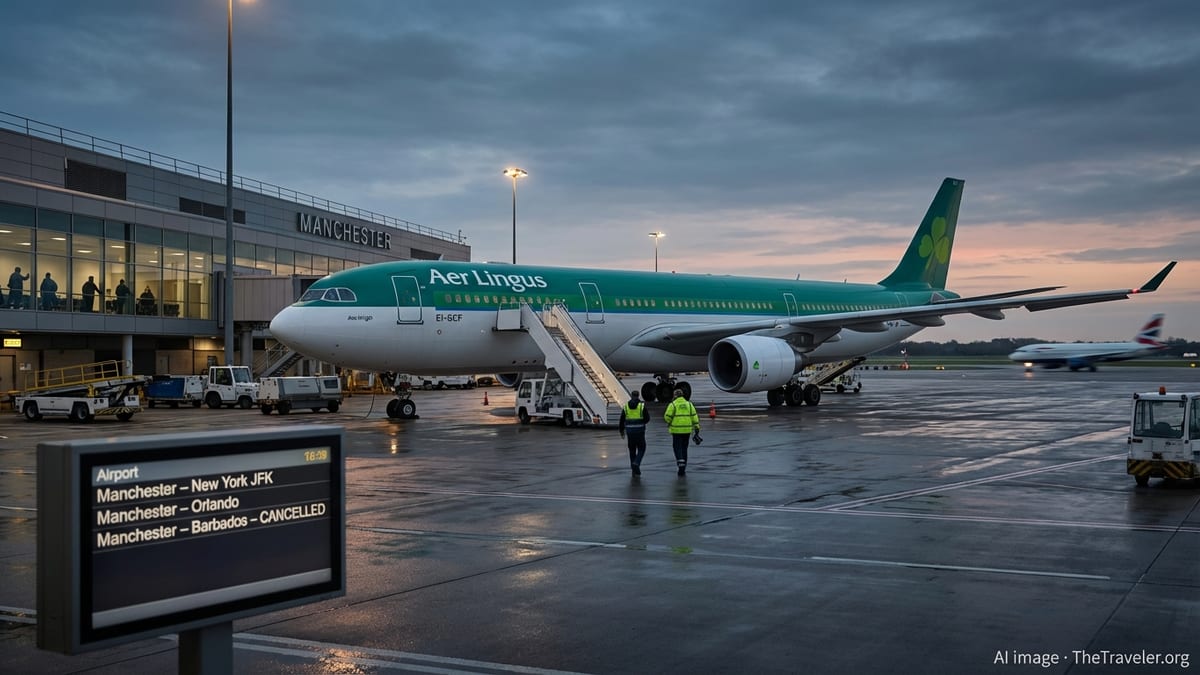
Power failure triggers widespread flight disruption
Reports indicate that a significant power cut in the area around Manchester Airport early this morning caused systems to fail across parts of the airfield and terminal complex. As backup systems came online, departures and arrivals were halted or severely restricted, creating an immediate backlog of flights waiting to use the runway and stands.
Publicly available information shows that numerous early-morning departures were cancelled outright, while many others were pushed back by several hours. Some inbound aircraft were diverted to other UK airports as ground handling and passenger processing at Manchester were temporarily unable to operate at normal capacity.
The incident has affected services across a range of airlines and destinations, from short-haul European routes to leisure flights to long-haul holiday markets. Airport information boards have shown a mix of cancellations, significant delays and rescheduled departure times as operations have gradually restarted.
As power and key systems have been restored, flights have begun to move again, but residual delays are continuing into the day as aircraft and crew are repositioned and airlines attempt to re-balance their schedules.
Terminals crowded as queues build for rebooked flights
Scenes inside the terminals have been described as extremely busy, with long queues forming at airline check-in desks and customer service counters as affected passengers seek alternatives. Many travellers whose flights were cancelled earlier in the day have been rebooked onto later services where seats are available, adding pressure to already crowded departures areas.
According to published coverage, security lanes and bag drop points have also seen heavy congestion, as passengers whose flights are still scheduled attempt to navigate the airport amid the disruption. Some travellers have reportedly spent several hours in queues, uncertain whether their rearranged flights will depart as planned.
The disruption has been particularly challenging for families starting holidays during the busy summer travel period and for those with onward connections from other hubs. With seat availability limited on popular routes, some passengers have been offered alternative dates or routings, while others are waiting to see if additional capacity can be provided later in the day.
Airport staff and airline ground teams are working to move passengers through the terminals as quickly as possible, but capacity constraints and the volume of rebookings mean that conditions remain crowded and slow-moving in parts of the airport.
Knock-on impact across airline schedules
Today’s disruption is creating a ripple effect across wider airline networks that use Manchester as either a base or a key regional station. When aircraft and crew are out of position at the start of the day, delays can spread through subsequent rotations, influencing flights many hours after the original incident.
Data from flight-tracking services shows a pattern of rolling delays on multiple routes, with some aircraft arriving late into Manchester and then leaving behind schedule for their next sector. In some cases, airlines have opted to cancel individual services to prevent further cascading disruption, consolidating passengers onto remaining flights where possible.
Published reporting notes that some inbound flights bound for Manchester were diverted during the height of the power issues, contributing to congestion at other airports and complicating efforts to return operations to normal. Once the immediate technical constraints eased, those aircraft required new slots and handling arrangements, prolonging the recovery period.
Industry guidance indicates that after a mass disruption event of this scale, it can take many hours for airlines to fully restore normal running, even when the underlying technical issue has been resolved. Today’s problems at Manchester are therefore expected to have consequences for evening and potentially overnight rotations.
What passengers can expect if flying today
Travellers due to fly from Manchester Airport today are being advised, through airline channels and publicly available guidance, to check the latest status of their flight before setting off. Many carriers are encouraging passengers to use mobile apps or online tools to confirm whether their departure is running, delayed or cancelled, and to explore rebooking options where necessary.
Those already at the airport are being urged by available travel advice to pay close attention to information screens and any email or text updates sent by their airline. With departure gates and timings subject to rapid change, staying close to the relevant terminal and allowing ample time to move through security remain important.
Passengers whose flights have been cancelled may be offered alternative travel dates, rerouting via other airports, or refunds, depending on the airline and ticket type. Some carriers have introduced temporary flexibility policies for affected customers, allowing changes without additional fees, although specific arrangements vary between operators.
Given the scale of the disruption, travellers are also being reminded by consumer advocates to keep records of boarding passes, booking confirmations and any written communication about delays or cancellations, which can be important later when seeking refunds or additional support.
Travel rights and practical steps for affected flyers
European and UK consumer regulations provide certain protections for airline passengers when flights are heavily delayed or cancelled, although entitlements differ depending on the cause of the disruption. Legal guidance notes that when problems stem from issues within an airline’s control, travellers may be eligible for compensation as well as rerouting or refunds. When events are classed as extraordinary circumstances, such as severe weather or broader infrastructure failures, compensation rules can be more limited.
In situations like today’s power-related disruption, specialists often recommend that passengers first focus on securing an alternative way to reach their destination, then gather documentation to support any later claim. Receipts for essential expenses, such as meals during long waits, can be useful where airlines are required to provide care and assistance.
Consumer organisations regularly advise travellers not to make assumptions about eligibility, as individual cases vary and assessments depend on detailed operational data. Passengers can check airline websites for formal policies, and some may choose to seek independent guidance if they believe their rights have not been fully respected.
With Manchester Airport now working to restore full operations, the priority for many passengers remains simply to depart as close to schedule as possible. However, today’s events are likely to prompt further discussion about resilience planning and communication during major disruptions at one of the UK’s busiest regional hubs.