


School choice is one of the most consequential decisions for relocating families in Germany. The country’s strong, predominantly public education system coexists with a growing private and international school sector that targets globally mobile households. Understanding how public and private options differ in structure, access, language, costs and academic pathways is critical for expats evaluating a move or planning long term education strategies for their children.
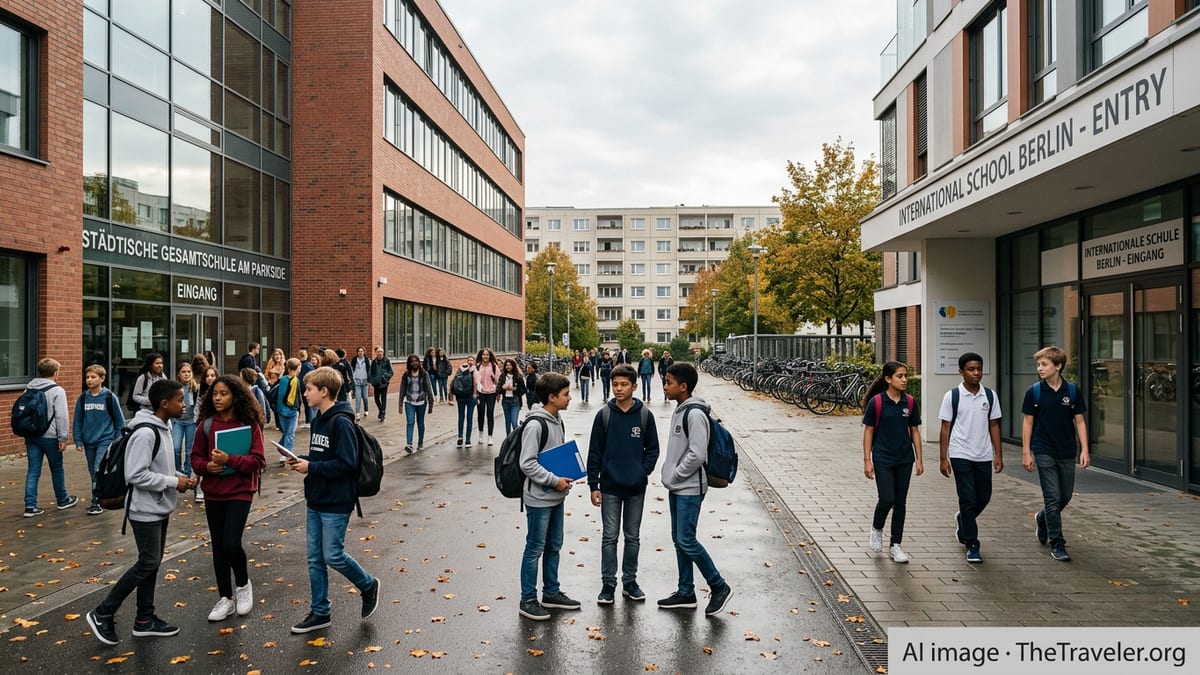
Overview of Public and Private Schooling in Germany for Expats
Germany is a high-education-investment country where the default for resident families is publicly funded schooling. Public schools educate the vast majority of children, with private schools accounting for under 10 percent of total enrolments, although the share has risen steadily since the early 2000s. Most private institutions are either faith-based, pedagogical alternatives such as Waldorf or Montessori, or international schools serving mobile professionals and diplomats.
For expat families, the first structural distinction is that public schools are almost entirely state-funded and free at the point of use, while private and international schools charge tuition and a range of additional fees. Public schools deliver the curriculum of the individual federal state (Bundesland) primarily in German. Private schools are more heterogeneous. Some follow the German curriculum with alternative teaching methods, while others offer foreign or international curricula, such as International Baccalaureate (IB), British IGCSE and A-levels, or US-style high school diplomas, usually in English or bilingual formats.
All resident children are subject to compulsory schooling requirements regardless of nationality or residence status. This means that newly arrived expat children will be placed in some form of school, public or private, from roughly age 6 to at least 15 or 16 depending on the state. Public schools are guaranteed but often oversubscribed in large cities. Private and international schools offer an additional layer of choice but also introduce capacity constraints and high costs that must be factored into relocation planning.
The key decision for many expat households is therefore not whether education will be available, but whether they prioritize rapid integration into the German system through public schools, or curriculum continuity and instruction in their home language through private and international schools. Each route involves distinct implications for language acquisition, academic pathways and future mobility.
Access, Admissions and Language Considerations
Public primary schools (Grundschulen) are zoned by catchment area in most federal states. Children are assigned to a local school based on registered address, and newcomers are generally entitled to a place, although exact procedures vary by municipality. For non-German-speaking children, many cities operate preparatory or welcome classes to build language skills before full integration into mainstream classes. Support levels, class sizes and wait times can differ significantly between regions and urban versus rural areas.
Public secondary education is tracked after Grade 4 or Grade 6 depending on the state, channeling students into different school types leading toward vocational qualifications or the Abitur university entrance certificate. Placement decisions are strongly influenced by teachers’ recommendations and academic performance in the local language. For expat children arriving after the tracking point, language proficiency can heavily shape the level of school they are offered. Families planning long-term residence and possible entry into German universities need to pay close attention to how quickly their children can acquire academic German.
Private and international schools control their own admissions processes subject to general regulatory oversight. Entry usually involves an application, school reports, and often interviews or assessments. International schools commonly assess English proficiency and may also evaluate German, mathematics and general aptitude, especially at secondary level. Waiting lists are common in major hubs such as Munich, Frankfurt, Hamburg and Berlin, particularly in popular grades and high-stakes exam years.
Language of instruction is one of the most decisive differences. Public schools teach predominantly in German, although bilingual or European schools exist in some larger cities. Private schools may be fully German, bilingual or primarily English-speaking. International schools usually deliver core subjects in English and offer German as a foreign or second language. For families who expect to repatriate or move to another international posting, continuity in English-medium or other home-country curricula can be a strong argument in favour of private options. Conversely, families seeking deep integration into local society and the German higher education pipeline may lean toward public or bilingual schools.
Cost Structures and Financial Considerations
Public schooling in Germany is tuition-free from primary through secondary level for all resident children, including expats. Ancillary costs such as school supplies, excursions, lunch programs and after-school care are typically modest compared to tuition fees and are partly subsidised for lower-income households in some states. This cost profile makes public schooling the default financially sustainable option for most middle-income families, especially those with multiple children.
Private and international schools operate on a fee-paying basis with wide cost variation. Published data from international school fee schedules for the 2025–2026 academic year suggests that annual tuition in Germany ranges roughly from 7,000 to 13,000 euros for budget primary options to about 15,000 to 21,000 euros at mainstream international schools, rising to 21,000 to 26,000 euros at upper secondary and IB Diploma level in premium institutions. Additional expenses typically include registration fees, capital contributions, examination fees, school lunches, transportation and sometimes mandatory building levies.
Some mid-range bilingual schools in regional cities may charge between 4,000 and 10,000 euros per year, while high-end international schools in Frankfurt, Munich or Berlin can exceed 20,000 euros annually per child for upper secondary grades. Certain schools also apply income-based fee scales, where monthly tuition bands vary according to verified household income. Families need to scrutinize fee regulations carefully to understand not only headline tuition but total cost of attendance, including application fees and annual increases that commonly run around 3 to 5 percent.
Corporate education allowances are a critical factor for many expat assignments. International employers often cover a large share of international school tuition for transferred staff, but policy caps, eligible grade levels and school lists vary. Where corporate support is partial or absent, the cumulative cost of private education for multiple children over several years can rival or exceed housing expenditure. In contrast, choosing public schools preserves household budget capacity but may increase investment required in tutoring, language courses or extracurricular support.
Academic Quality, Class Sizes and Pedagogical Approaches
Germany’s public school system benefits from a long tradition of academic rigor, centralized curriculum frameworks at state level and relatively favourable student-to-teacher ratios by OECD standards. National statistics indicate average primary class sizes in the mid-teens per teacher, although actual class sizes in urban areas can be larger. Academic performance comparisons show that once socio-economic background is controlled for, German public schools perform at least as well as private schools on standardized assessments.
Private schools are diverse in mission and quality. Many confessional and long-established private Gymnasien match or exceed public academic outcomes and have strong reputations in their regions. Alternative schools such as Waldorf or Montessori place more emphasis on holistic development, arts and project-based learning, which may or may not align with the expectations of families accustomed to more traditional academic systems. International schools often promote small class sizes, with typical teacher to student ratios around 1:15 or lower in primary school, and place emphasis on inquiry-based learning and continuous assessment.
For expat families, the perceived advantages of private and international schools include more individual attention, robust pastoral care and greater experience dealing with students who enter mid-year or mid-cycle due to family relocations. In schools where a large share of the student body is internationally mobile, systems for integrating newcomers, evaluating foreign transcripts and supporting transitions to universities abroad are usually well developed. Public schools, while experienced with immigration, may vary more in their capacity to support high academic performance among non-native speakers, particularly in schools serving socially disadvantaged catchment areas.
At the same time, there are public schools with dedicated international streams, bilingual programs or enhanced STEM and arts profiles that offer competitive or superior academic environments at no tuition cost. Access to such schools often depends on residence location, selection criteria or prior language ability. Families need to evaluate specific institutions rather than assuming inherent superiority of either public or private providers.
Language Integration, Social Environment and Long-Term Pathways
Public schools tend to accelerate functional German acquisition due to full immersion in German-speaking classrooms, playgrounds and extracurriculars. Children who arrive at younger ages often reach near-native fluency within two to three years if supported adequately at home and in school. This integration supports access to the full range of German secondary school tracks and, ultimately, to German universities via the Abitur. It also facilitates participation in local apprenticeship and vocational training pathways, which remain central to the German labour market.
However, immersion in public schools can present significant short-term academic risks for older children. Entering the tracked secondary system without strong academic German can lead to placement below prior learning level or into more vocationally oriented tracks that do not automatically lead to university entrance. In such cases, families sometimes resort to additional years of schooling, bridge programs or private tutoring to reach desired qualifications. The social environment in certain urban public schools, where the majority of students may speak a language other than German at home, can also shape language exposure and peer networks in ways that differ from local middle-class norms.
Private and international schools, particularly those with English or bilingual instruction, can offer smoother academic continuity for children who already study in international curricula. IB and British curriculum schools provide widely recognised qualifications that support university applications in multiple countries. This flexibility is valuable for globally mobile families who may relocate again before children complete secondary education, or who aim for anglophone universities without relying on German Abitur or language certificates.
On the other hand, students in English-dominant international schools may achieve less depth in German, especially if German is treated as a foreign language with a few lessons per week. This can limit options in the local higher education system and labour market. Some international schools mitigate this by offering dual-qualification pathways, such as IB plus a state-recognised German school-leaving certificate, or by providing extended German programs. Families must assess whether their primary priority is integration into German society, international mobility, or a blend of both, and choose accordingly.
Regulation, Recognition and Qualification Portability
Both public and most private schools in Germany operate within a tightly regulated legal framework. Private schools that replace compulsory public education are usually designated as Ersatzschulen and must broadly adhere to the relevant state curriculum, teacher qualification standards and assessment regimes. Tuition fees in such schools are restricted so that attendance is not limited to children from high-income families only, and schools receive a degree of public subsidy. This regulatory model aims to maintain educational standards and prevent the emergence of deeply stratified parallel systems.
International schools may fall partly outside the Ersatzschulen category, especially if they do not award German state school-leaving certificates. These schools focus on international or foreign qualifications, such as IB Diploma, IGCSE and foreign high school diplomas, which can lead to university admission abroad and, subject to recognition rules, in Germany. Families planning for German university entry through non-German qualifications must verify recognition requirements with credential evaluation bodies and higher education admission offices, particularly regarding subject combinations and language requirements.
German public secondary schools culminate in several types of qualifications, the most academically demanding of which is the Abitur. This credential is generally recognized across Germany and widely accepted by universities in other European countries. Students in private German-curriculum schools can also earn Abitur or equivalent state-recognised certificates, provided the school is accredited. International schools offering dual pathways may enable students to graduate with both an international qualification and a German-recognised certificate, expanding options.
For expats considering onward moves, the portability of qualifications should be a central planning criterion. Public German schools provide a strong pathway into German-speaking higher education and the domestic labour market, but qualifications may require translation and comparative evaluation elsewhere. International curricula offer higher portability in anglophone and international contexts but can entail trade-offs in local recognition and depth of national curriculum knowledge.
The Takeaway
For expat families, the choice between public and private schools in Germany hinges on a balance of cost tolerance, language strategy, academic risk appetite and long-term mobility plans. Public schools offer high-quality, tuition-free education within a structured, state-regulated system that supports deep integration into German society and higher education. Their main challenges for newcomers are language acquisition, regional disparities in support for non-native speakers and the impact of early academic tracking.
Private and international schools provide smaller classes, curriculum continuity and bilingual or English-medium instruction designed for mobile, international student populations. They can significantly de-risk academic transitions for older children and support global university ambitions, but at a substantial and recurring financial cost. Limited places and selective admissions also mean that securing spots requires early planning, particularly in major metropolitan areas.
Decision-grade evaluation requires families to analyze specific schools rather than relying on broad labels of “public” or “private.” Key due diligence points include language support structures, qualification pathways, class sizes, teacher stability, school climate, fee regulations and the alignment of each school’s profile with the family’s anticipated length of stay and future relocation trajectory. A well-chosen school can make Germany a highly attractive long-term base for internationally mobile professionals and their children.
FAQ
Q1. Are public schools in Germany free for expat children?
Yes. Public schools do not charge tuition for resident children, regardless of nationality or residence permit type. Families should still budget for books, supplies, excursions, meals and after-school care.
Q2. How much do private and international schools in Germany typically cost?
Annual tuition usually ranges from around 7,000 to more than 20,000 euros per child, depending on city, grade level and school profile, with premium upper secondary programs at the top end of that band.
Q3. Do expat children need to speak German before entering a public school?
No prior German is legally required, but lack of language skills can affect placement and initial academic performance. Many regions provide preparatory or welcome classes focused on German as a second language.
Q4. Is academic quality higher in private schools than in public schools?
Not systematically. Many public schools perform as well as or better than private schools when socio-economic factors are controlled. Quality varies by individual institution rather than sector label.
Q5. Which option is better if a family plans to move again after a few years?
International or bilingual private schools can offer more curriculum continuity and globally recognised qualifications, which often makes later transfers to schools or universities in other countries easier.
Q6. Can children from international schools access German universities?
Yes, but they must hold a qualification recognised as equivalent to the German Abitur and meet language requirements. Some international schools offer dual pathways designed specifically to satisfy these conditions.
Q7. How early should families apply to private or international schools?
In major cities it is prudent to start applications 9 to 18 months before the intended start date, especially for key transition years such as Grade 1, Grade 5 and the first years of exam programs.
Q8. Are there bilingual public schools available to expats?
Yes, some cities operate state or semi-state bilingual schools and European schools, but places are limited and admissions criteria can be competitive. Access often depends on residence location and language background.
Q9. What are the main risks of choosing a public school for a non-German-speaking teenager?
The main risks are delayed language acquisition relative to curriculum pace, potential placement into lower academic tracks and pressure during the crucial years that determine access to the Abitur and university pathways.
Q10. Can school fees be tax-deductible in Germany?
For taxpayers in Germany, a portion of private school tuition may be treated as a special expense up to a capped amount per child, but families should seek individual tax advice for precise applicability.