


More news on this day
China’s push to turn railways into rolling attractions has taken a vivid new turn in Guizhou, where a purple-liveried tourist train has begun offering panoramic journeys through one of the country’s most spectacular yet still-underexplored provinces.
Get the latest news straight to your inbox!
A New Tourist Train for China’s “Colorful Guizhou” Campaign
Recent coverage in Chinese transport and tourism media indicates that the new purple tourist train has been introduced as part of broader efforts to brand Guizhou as “Colorful Guizhou,” a province where elaborate karst landscapes, terraced hillsides and ethnic villages are increasingly packaged for domestic and international visitors. The vividly painted consist, styled in shades of violet and magenta with graphic motifs inspired by local embroidery patterns, is designed to be instantly recognizable on station platforms and social media feeds.
Public information suggests the service operates on existing passenger lines but with a customized timetable and ticketing model that focuses on sightseeing rather than simple point to point travel. Instead of rushing through the mountains at the highest possible speed, the train schedules allow longer station stops at key gateways, giving passengers time to transfer to local buses, park shuttles or short excursions before continuing along the route.
The launch also reflects a broader shift in China’s rail strategy, in which themed trains are used to stimulate regional tourism rather than solely to move travelers between major cities. Similar concepts have appeared in other provinces on dedicated tourist lines and seasonal trains, but Guizhou’s purple train stands out for linking a cluster of well known scenic sites that previously required separate bus journeys or self drive itineraries.
For Guizhou’s tourism authorities, the new service is expected to complement existing high speed corridors that already connect Guiyang with Guangzhou, Nanning and Chengdu, by adding a slower, more experiential layer of rail travel focused on views and culture rather than pure efficiency.
Scenic Route Linking Waterfalls, Canyons and Karst Landscapes
According to available route descriptions, the purple tourist train focuses on a loop through western and central Guizhou, one of China’s densest concentrations of waterfalls, gorges and karst peaks. The line is structured so that travelers can reach major natural attractions such as the Huangguoshu waterfall area near Anshun using rail for the main leg of the journey, before switching to scenic shuttle buses for the final approach.
Huangguoshu, recognized as one of East Asia’s largest waterfalls and ringed by side cascades and limestone caves, has long been a flagship stop on Guizhou tour itineraries. The new rail service positions Anshun and surrounding towns as hubs for independent travelers, who can now arrive by themed tourist train instead of joining a fully packaged coach convoy from distant gateway cities.
Beyond Huangguoshu, the route is reported to trace valleys and plateaus that connect to canyon viewpoints, river terraces and lesser known karst parks, many of which were previously reached through slower provincial buses. By bundling these stops within a recognizable tourist train product, planners aim to create a coherent “rail plus scenic area” corridor that encourages visitors to spend several nights moving gradually across the province rather than treating it as a brief detour between coastal cities.
The composition of the journey also underscores Guizhou’s attempt to balance classic drawcards with emerging sites. Established destinations feature alongside newer scenic areas that have been upgraded with visitor centers, walking trails and internal shuttle systems, in line with China’s broader trend of building tourism infrastructure deep into mountainous regions.
Onboard Design Focused on Sightseeing and Comfort
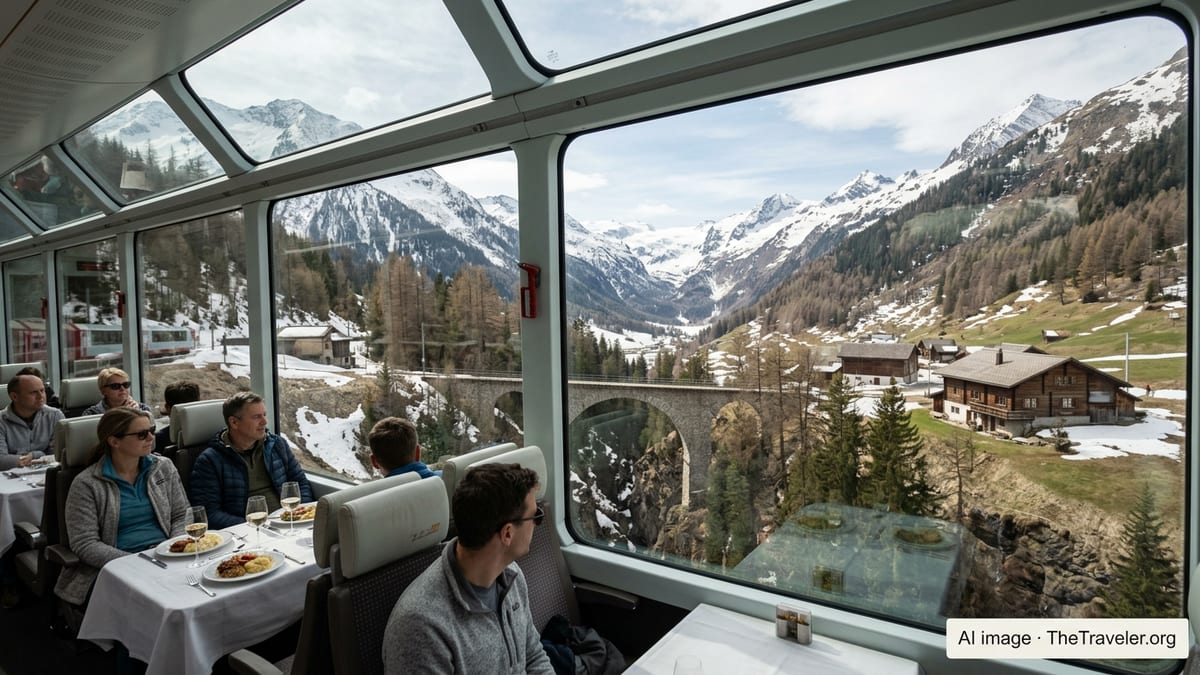
The purple tourist train’s interiors, as described in domestic travel reports, emphasize large picture windows, soft seating and informal social spaces instead of maximum capacity. Coaches are typically arranged with forward facing seats and small tables, allowing passengers to move easily between their places and window sides as the scenery changes outside.
Color and pattern play a central role in the design. Upholstery and wall panels echo the purple exterior with accent colors drawn from traditional textiles of Guizhou’s Miao and Dong communities. While not a full scale cultural museum on rails, the train uses this palette to create a sense of local character, distinct from standard green or white long distance units that operate elsewhere on the network.
Available photographs and descriptions suggest that service elements also cater to sightseeing habits. Overhead racks and luggage spaces are configured to handle the bulkier suitcases that leisure travelers carry, and lighting is kept relatively soft to prevent reflections from interfering with photography through the windows. Some departures are reportedly timed to traverse particular valleys around mid morning or late afternoon, when conditions are more favorable for both visibility and camera shots.
Unlike overnight luxury trains that rely on full cabin service and elaborate dining, the purple Guizhou train focuses on daytime comfort and practicality. Snacks and simple regional specialities are sold from trolleys or small counters, while passengers are encouraged to step off at selected stations where local vendors sell fruit, baked goods and souvenirs on the platforms.
Boost for Regional Tourism and Rail Based Itineraries
Industry commentary suggests that Guizhou’s purple tourist train is intended not only as a standalone attraction but also as a bridge between traditional group tours and fully independent rail travel. By offering reserved seating, clear branding and a focused scenic route, the service lowers the barrier for first time visitors who might be hesitant to navigate multiple standard train changes in mountainous territory.
Tour operators are already incorporating the train into multi day itineraries that combine high speed rail access from hubs such as Guangzhou or Chongqing with slower scenic segments within Guizhou. In these packages, travelers often arrive on a high speed service, transfer to the purple tourist train for two or three days of sightseeing stops, and then rejoin the national network for onward journeys, effectively using Guizhou as a rail based detour within a longer China itinerary.
For local communities along the route, the purple branding is expected to bring more consistent visitor flows, especially outside peak summer and national holiday periods. Station towns that previously saw mainly transit traffic may benefit from longer stays, as passengers opt for guesthouses, homestays and small hotels close to the line rather than returning nightly to a provincial capital.
Travel planners note, however, that success will depend on the integration of last mile transport and crowd management at popular scenic spots. With well known attractions already drawing significant numbers, the challenge for the new train will be to disperse visitors across a broader set of viewpoints and lesser known trails, maintaining the appeal of Guizhou’s landscapes while accommodating rising interest in rail based tourism.
What the Launch Means for International Travelers
For overseas visitors looking beyond China’s major coastal cities, the purple Guizhou tourist train offers a new way to explore a province that has often been described in guidebooks and online forums as both spectacular and logistically challenging. By anchoring itineraries around a single recognizable service, the train simplifies planning for those unfamiliar with the language or ticketing platforms.
Travel information available in English remains limited, and most booking channels and schedules are currently presented in Chinese. However, the train’s connection to established high speed lines and well known hubs like Guiyang and Anshun makes it relatively straightforward to incorporate into a broader route with the help of local agencies or translation tools.
For independent travelers, the key advantage lies in flexibility. Rather than committing to a fixed coach tour, visitors can use the purple train as a backbone, choosing where to linger for extra nights and which scenic areas to prioritize. Combined with Guizhou’s expanding network of boutique guesthouses and homestays, the service opens up more granular, slow travel experiences across the province.
As China continues to experiment with themed and tourist oriented rail services, Guizhou’s purple train may serve as a template for other inland regions seeking to convert transit lines into attractions in their own right, turning what was once simply the journey between destinations into a central part of the travel story.