


Landing at Queenstown Airport for the first time can feel both thrilling and slightly intimidating. You fly in between snow-dusted peaks, the runway seems to end in Lake Wakatipu, and the small terminal suddenly has to handle hundreds of people off a Sydney, Auckland or Melbourne flight at once. This guide walks you step by step through what to expect at Queenstown Airport (ZQN), how to get into town, and how to connect on to the ski fields or Wānaka without stress.
Get the latest updates straight to your inbox!
Understanding Queenstown Airport at a Glance
Queenstown Airport sits in Frankton, about 8 kilometers from central Queenstown, serving domestic flights from major New Zealand cities and international services from Australia. The airport is compact, with a single main terminal that handles all arrivals and departures. That small scale works in your favor as a first-time traveler: walking distances are short, signage is clear, and you can usually step from baggage claim to your chosen transport in a couple of minutes.
On arrival, you will come through immigration and biosecurity if you are on an international flight. New Zealand’s biosecurity rules are strict, so expect questions about outdoor gear, hiking boots, and food. After clearing checks, you walk straight into the combined arrivals hall, where baggage carousels, rental car counters, shuttle desks and an information desk sit in the same general area. There is no train station or complex multi-level roadway to navigate, just one ground-level forecourt with separate areas for buses, taxis, rideshare and private pick-ups.
The terminal opens early in the morning to accommodate first departures and remains busy into the evening, especially during the ski season from June to September and the summer peak from December to February. At these times, queues for rental cars and taxis can build shortly after large flights land, so it helps to know your preferences and book ahead where possible.
Inside the terminal you will find basic services: cafes, a bar, ATMs, currency exchange, souvenir and outdoor gear shops, and free Wi-Fi. If you need to catch your breath after a long-haul trip, it is realistic to grab a coffee, connect to Wi-Fi and confirm your accommodation and transport plans before stepping out into the forecourt.
Arrivals Flow and Airport Layout for First-Timers
The basic layout is straightforward: planes park on the apron in front of the terminal, passengers walk via airbridges or short outdoor walks into the departures / arrivals level, and then you follow signs either to baggage claim or directly to the public area if you have only carry-on. Domestic and international baggage areas are clearly separated but both exit into the same public arrivals space.
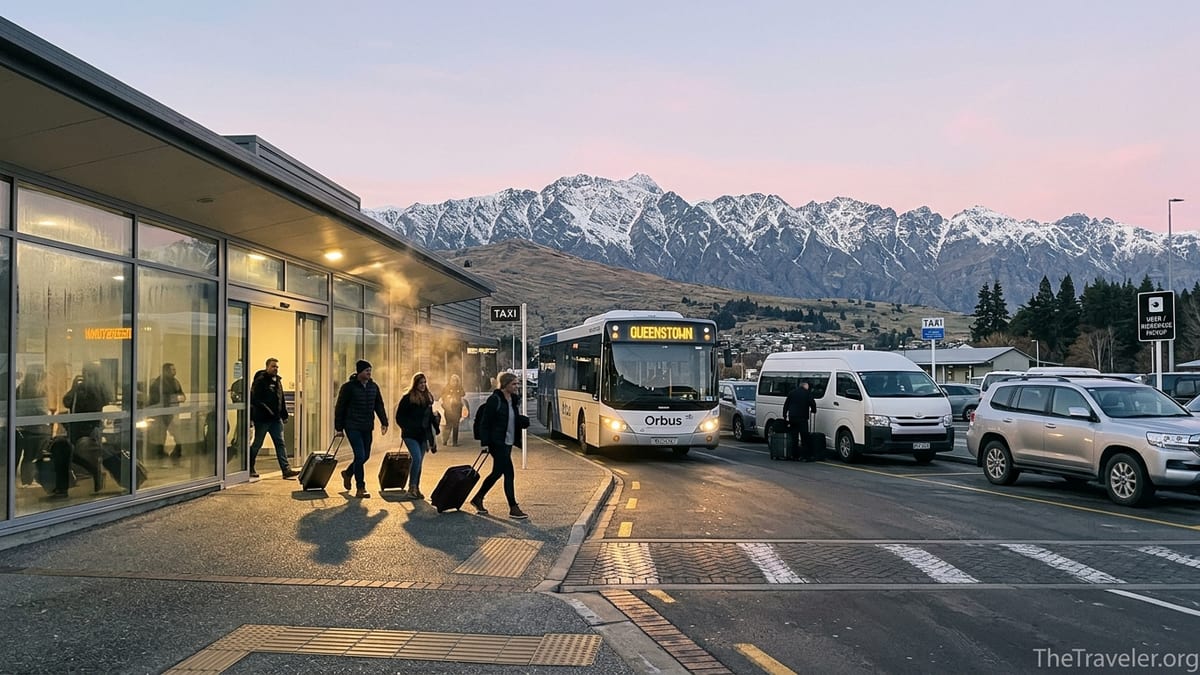
As you exit baggage claim, the first things you are likely to see are the rental car counters lined up along one side, information boards with live bus and shuttle details, and the automatic doors leading out to the main forecourt. To your right, just beyond the doors, are the taxi and rideshare zones. Ahead and slightly to the left are the bus stops used by the Orbus public bus and airport shuttles. It is entirely feasible to walk from the baggage carousel to any transport option in under three minutes if you are not delayed by queues.
Security screening only applies on departure, so arriving passengers are free to move through the public areas. If members of your group are arriving on different flights, it is easy to choose a meeting point like the main café beside the windows facing the runway. Families with children often appreciate the large windows where kids can watch aircraft movements while adults finalize transport or ski hire arrangements.
If you are connecting to a same-day ski trip, it is worth understanding the layout in advance. The exits to car parks and shuttle pick-up zones are all at ground level. That means if you have pre-booked a ski shuttle or rental car, you can get from plane to vehicle quickly by following the signs for “Ground Transport” and then either “Shuttles,” “Taxis & Rideshare,” or “Car Rentals.” In busy winter mornings, you will see many travelers in ski jackets heading straight to those signs with boot bags and ski bags in tow, which is a good visual cue that you are heading the right way.
Getting into Town: Orbus, Taxis, Uber and Shuttles
For most first-time visitors, the main question is how to get from Queenstown Airport to central Queenstown. The main options are the Orbus public bus, taxis, Uber rideshare, dedicated airport shuttles, and rental cars. Your choice will depend on the size of your group, how much luggage you have, your budget, and how comfortable you feel driving on New Zealand’s mountain roads.
The Orbus public bus service (operated under the Orbus brand) runs a frequent route between the airport, the Frankton bus hub and Queenstown town center. Route 1 serves the airport, typically running every 15 to 30 minutes during the day, with slightly reduced frequency in the early morning and at night. The bus stop is just outside the terminal in the designated public transport area. Fares are relatively low compared with taxis, and using a Bee Card (the regional transport smart card) usually gives a cheaper fare than paying cash. As a rough guide, a single adult trip from the airport to central Queenstown on the Orbus service tends to be priced in the low single digits in New Zealand dollars when using a Bee Card, making it one of the best-value airport transfers in the country.
Taxis wait in a rank immediately outside arrivals. Several local companies operate here, and vehicles range from standard sedans to larger people movers. A typical metered fare from Queenstown Airport to a central hotel near the lakefront often lands somewhere around NZD 35 to NZD 50 depending on traffic, time of day and exact address, with late-night or early-morning trips sometimes costing a little more. For example, a couple arriving on an evening Sydney flight with two suitcases might expect to pay in the mid-40s NZD to reach a hotel close to Steamer Wharf, and the ride usually takes around 15 to 20 minutes.
Uber is authorized to pick up and drop off at Queenstown Airport, and there is a clearly marked rideshare pick-up zone near the terminal. In quiet periods, you may find that an UberX ride into town undercuts local taxis by a modest amount, while in peak demand times such as mid-afternoon in ski season, surge pricing can erase that saving. A family of four staying at an apartment in Queenstown Hill, for instance, might compare the Uber estimate and a shuttle quote and find the shuttle offers a fixed price that is more predictable when luggage and skis are factored in.
Airport shuttles are a popular middle ground. Shared shuttles run set routes and will drop you at major hotels and apartments, while private shuttles offer door-to-door transfers. Shared airport transfers are usually priced per person but cap at a maximum for families or groups, making them good value if you are traveling with three or more people and plenty of bags. It is common to pre-book a shared shuttle that meets your specific flight, with the driver waiting in the arrivals hall holding a sign. For skiers, some operators offer combined airport and ski-field transfers, so you could feasibly land in the morning and be on the slopes at Coronet Peak or The Remarkables by late morning or early afternoon.
Renting a Car at Queenstown Airport
Queenstown Airport is a major hub for car rentals, and most of the big brands you would expect in New Zealand have desks in or near the terminal. International chains like Avis, Budget, Hertz and Europcar operate alongside local companies. Many renters choose to pick up at the airport and drop off in Christchurch, Dunedin or elsewhere in the South Island as part of a longer road trip, so one-way rentals are common, although they may attract additional fees.
Rental car desks are located in the arrivals area; after completing the paperwork, you walk a short distance to the car parks where vehicles are stored. For a compact car in the shoulder season, you might see daily rates in the range of NZD 60 to NZD 90, while in peak ski season and around New Year rates climb notably higher, especially for SUVs with all-wheel drive. Families planning to visit ski fields frequently often pay extra for a mid-size SUV with good ground clearance and winter-rated tyres, as it makes mountain access roads more manageable.
If you are arriving in winter or planning to drive over the Crown Range Road between Queenstown and Wānaka, check your rental contract regarding snow chains. Some companies automatically include chains when you book a vehicle advertised as suitable for ski trips; others offer them as a paid add-on. Staff will usually demonstrate how the chains work in the car park before you leave if you ask. It is common for locals to advise visitors not to attempt mountain passes without chains during icy conditions, so having them in your boot provides both compliance with any road signs and peace of mind.
First-time drivers in New Zealand should allow extra time to get used to driving on the left, many one-lane bridges in rural areas, and winding roads with no shoulder. Queenstown’s streets can be narrow, and parking is often tight in the town center. Before leaving the airport, key your accommodation address into your navigation app and set expectations in your group that you will take it slowly. Do not feel pressured by impatient local drivers behind you on the road; it is widely accepted that visitors will drive cautiously.
Ski Season Logistics: From Airport to the Slopes
During winter, Queenstown Airport feels like a ski terminal. You will see ski bags on the baggage belt, rental outlets advertising ski and snowboard hire, and shuttle desks promoting ski transfers to Coronet Peak, The Remarkables, Cardrona and Treble Cone. If you are visiting specifically to ski, it pays to think through your arrival day plan in detail.
Coronet Peak is the closest major ski field to Queenstown, taking roughly 25 to 30 minutes to reach from town in clear conditions, while The Remarkables sits higher in the mountains roughly 40 to 50 minutes away. Cardrona and Treble Cone are over the range in the Wānaka direction and require a longer drive. Visitors who land on a mid-morning flight often book a same-day ski transfer to Coronet Peak or The Remarkables, aiming to pick up rental gear either at the airport or in town and then ride a pre-booked bus up the mountain. This avoids driving on potentially snowy access roads on your first day.
Several operators run dedicated ski buses that depart from central Queenstown and pick up at designated stops, with some offering add-ons that connect from the airport. In practice, many first-time visitors choose to take a shuttle or taxi from the airport to their hotel, check in or store bags, and then join an afternoon ski bus for a shorter first session on the slopes. For example, a group arriving from Auckland at 9 a.m. might be checked into a central hotel by 11 a.m., on a midday shuttle to Coronet Peak, and skiing by 1 p.m. if conditions cooperate.
Road conditions can change quickly in winter. The access roads to ski fields often require chains after fresh snow or in icy early morning conditions. Signs at the base of the mountain and updates from ski field websites or social media channels will tell you if chains are required for 2WD vehicles or if 4WD is mandatory. Renting an all-wheel drive vehicle does not exempt you from these rules; you may still need to fit chains on certain days. New arrivals should not hesitate to ask local staff at the airport or your accommodation whether the roads are currently suitable for drivers unfamiliar with winter mountain driving.
For visitors not used to snow and ice, booking a seat on an official ski bus is often the least stressful choice. Buses are driven by experienced local drivers and are timed to match lift opening hours. They also free you from having to find scarce parking on busy powder days. The trade-off is less flexibility compared with self-driving, but most first-time Queenstown visitors find the predictability a fair exchange, especially on their first couple of days.
Getting to Wānaka: Crown Range vs Cromwell Route
Wānaka lies roughly an hour to an hour and a half’s drive from Queenstown Airport, depending on the route and conditions, and many travelers use Queenstown as their entry point before heading there. There are two main driving routes: over the Crown Range Road or via Cromwell through the Kawarau Gorge. Each has its own character and suitability for different weather and driver confidence levels.
The Crown Range Road is the shorter distance option, often quoted at around 70 kilometers between Queenstown and Wānaka. It is New Zealand’s highest sealed main road, climbing with tight switchbacks out of the Arrowtown and Cardrona valleys. In clear summer conditions, this route offers spectacular views and is a favorite for self-drivers who enjoy mountain roads. In winter, however, it is more challenging, with potential for snow, ice and reduced visibility. Local authorities sometimes require chains to be carried or fitted on this route, and on occasion it is closed entirely during storms or heavy snowfall.
The alternative is to drive via Cromwell, largely on State Highway 6 and State Highway 8A, following the Kawarau Gorge and then the upper Clutha River. This route is longer in distance but often similar in travel time, particularly in winter or for less confident drivers, because it avoids the steepest climbs and tightest curves of the Crown Range. For a family with children arriving on a late-afternoon flight in July, for example, many locals would recommend taking the Cromwell route to Wānaka instead of tackling the Crown Range in the dark.
Several shuttle and transfer companies provide Queenstown Airport to Wānaka services, including options that will meet specific flights and drop you at your accommodation in Wānaka. These are popular with solo travelers and couples who do not want to rent a car for a ski-focused trip. Prices are usually set per person, with possible discounts for return bookings or larger groups. When booking, it is sensible to confirm which route they typically use in winter and how they handle road closures; established operators will monitor conditions daily and adjust routes accordingly.
Whichever route you choose, always build in extra time. Scenic pullouts such as viewpoints over the Crown Range or stops near Cromwell’s vineyards can tempt you to linger, and traffic can slow behind heavy vehicles or tourist coaches. Carry water and snacks, and remember that cell coverage can be patchy between towns, so download offline maps before leaving Queenstown Airport.
Queenstown Airport to Town: Real-World Transfer Examples
To understand how these options work in practice, it helps to look at a few real-world arrival scenarios. Imagine a solo backpacker from Wellington landing at Queenstown at midday with only a hiking pack. They walk straight out to the Orbus stop, tap a Bee Card they picked up from a local outlet, and pay a low single-digit NZD fare to reach the central bus stop near the lakefront in about 20 minutes. Their total transfer cost is less than a café lunch in town.
Contrast that with a couple in their 50s arriving from Melbourne on a weekend evening in August with two large suitcases and a ski bag. They want a straightforward, no-change transfer to an apartment up Queenstown Hill. They head to the taxi rank, join a short queue that moves quickly, and are at their apartment door within 25 minutes. The meter shows a fare in the mid-40s NZD, plus a small surcharge for luggage. For them, the convenience of door-to-door service justifies the higher cost compared with the bus.
A family of five arriving from Auckland at 9 a.m. during school holidays might have pre-booked a private shuttle van. The driver meets them in the arrivals hall holding a sign with their surname, helps with bags and child seats, and drives them directly to a lakeside holiday home in Frankton, a short ride from the airport. The fare, perhaps around NZD 80 to NZD 120 depending on provider and distance, works out only slightly more per person than a shared shuttle, and significantly cheaper than booking two separate taxis.
Finally, consider a ski group flying in from Sydney with four adults, four large bags, and four ski bags. They have arranged a rental SUV with snow chains included. After collecting the vehicle in the airport car park, they drive the 15 to 20 minutes into Queenstown, drop luggage at their hotel, and then head straight to a ski hire shop in town before moving on to the ski field the next day. The ability to store skis in the vehicle overnight and travel on their own schedule makes the higher rental and fuel cost worthwhile.
First-Time Arrival Tips: Money, Timing and Weather
First-time Queenstown travelers often underestimate how quickly mountain weather can affect their plans. It is wise to check the forecast not just for your arrival day but also for the following 48 hours, especially in winter. If a front is forecast to bring snow or high winds, allow for possible road restrictions to ski fields and mountain passes like the Crown Range Road, and avoid booking non-refundable activities too tightly around your arrival time.
Have a rough transfer plan before you land, but stay flexible. For example, you might intend to take Orbus into town, but if your flight arrives late at night or your luggage takes longer than expected, you may find the next bus is a longer wait than you want. In that case, being prepared to switch to a taxi or Uber is sensible. Conversely, if you walk out of customs to find a bus waiting at the stop, it can be an easy decision to hop aboard and save money.
New Zealand dollars are the norm everywhere, and while many services accept cards and mobile payments, having a small amount of cash can be handy for buses or smaller shuttle operators. ATMs are available in the terminal, and most taxis, rideshares and shuttle companies accept major cards. Gratuities are not expected in the same way as in North America; rounding up a taxi fare or offering a small tip for exceptional service is appreciated but not required.
Allow generous connection times if you are flying into Queenstown and then planning to drive on to Te Anau, Wānaka or the West Coast on the same day. Fatigue after long flights, unfamiliar roads, and the temptation to stop for photos can all slow you down. Many seasoned travelers prefer to spend at least their first night in Queenstown or nearby Frankton, pick up groceries, adjust to the time zone, and then hit the road fresh the next morning.
The Takeaway
Queenstown Airport may be small, but its role as a gateway to some of New Zealand’s most dramatic landscapes means your choices on arrival matter. Understanding the simple terminal layout, the range of transport options into town, and the implications of winter weather on roads and ski access can turn a potentially stressful first few hours into a smooth introduction to the Southern Alps.
Whether you roll your bag straight to the Orbus stop, slide into the back of a waiting taxi, meet a pre-booked shuttle driver, or collect a rental car for a bigger South Island loop, a little advance planning pays off. Think through your group size, budget, and confidence with left-side mountain driving, and do not be afraid to change plans if conditions or energy levels shift.
Queenstown rewards those who give themselves time. Build in buffers on arrival day, stay flexible about how and when you travel over the passes toward Wānaka or the ski fields, and you will be better placed to enjoy the region’s lakes, vineyards and mountains instead of worrying about logistics.
FAQ
Q1. How far is Queenstown Airport from central Queenstown?
The airport is roughly 8 kilometers from central Queenstown, and the drive usually takes around 15 to 20 minutes depending on traffic and exact location.
Q2. What is the cheapest way to get from Queenstown Airport into town?
The Orbus public bus is generally the cheapest option, with low single-digit New Zealand dollar fares when using a regional transport card, making it very budget friendly.
Q3. Are taxis readily available at Queenstown Airport when flights land?
Yes, there is a taxi rank directly outside the terminal, and cabs are usually waiting for arriving flights, though short queues can form during peak ski season and holiday periods.
Q4. Does Uber operate at Queenstown Airport?
Yes, Uber is authorized to pick up and drop off at Queenstown Airport, with a designated rideshare pick-up area close to the terminal forecourt.
Q5. Should I rent a car at Queenstown Airport if I am visiting in winter?
Renting a car can be convenient, but winter driving involves potential ice and snow. If you are not confident with mountain roads, consider shuttles or ski buses instead.
Q6. How long does it take to drive from Queenstown Airport to Wānaka?
In good conditions, driving via the Crown Range can take about an hour, while the route via Cromwell is a little longer in distance and often similar or slightly longer in time.
Q7. Is the Crown Range Road safe for first-time visitors to drive?
In summer and good weather it is manageable for cautious drivers, but in winter it can be challenging, and many visitors choose the less steep Cromwell route instead.
Q8. Can I reach the ski fields without renting a car?
Yes, dedicated ski buses and shuttle services run between Queenstown and major ski fields such as Coronet Peak, The Remarkables, Cardrona and Treble Cone.
Q9. How early should I plan to arrive at Queenstown Airport for departure?
For domestic flights, arriving around 60 to 90 minutes before departure is usually advised, while for international flights, two hours is a sensible guideline.
Q10. Do I need cash for transport from Queenstown Airport?
Most taxis, shuttles and rideshare services accept cards, but carrying a small amount of New Zealand cash is useful for buses or smaller operators that may prefer it.