


Queenstown in winter is one of the most spectacular places to drive in New Zealand, but it also brings some of the country’s trickiest road conditions. If you are picking up a rental car at Queenstown Airport and planning to explore ski fields, the Crown Range or road trips to Wānaka and beyond, it pays to understand how airport car hire works here, what to expect with snow chains and winter driving, and where you will actually park once you reach town.
Get the latest updates straight to your inbox!
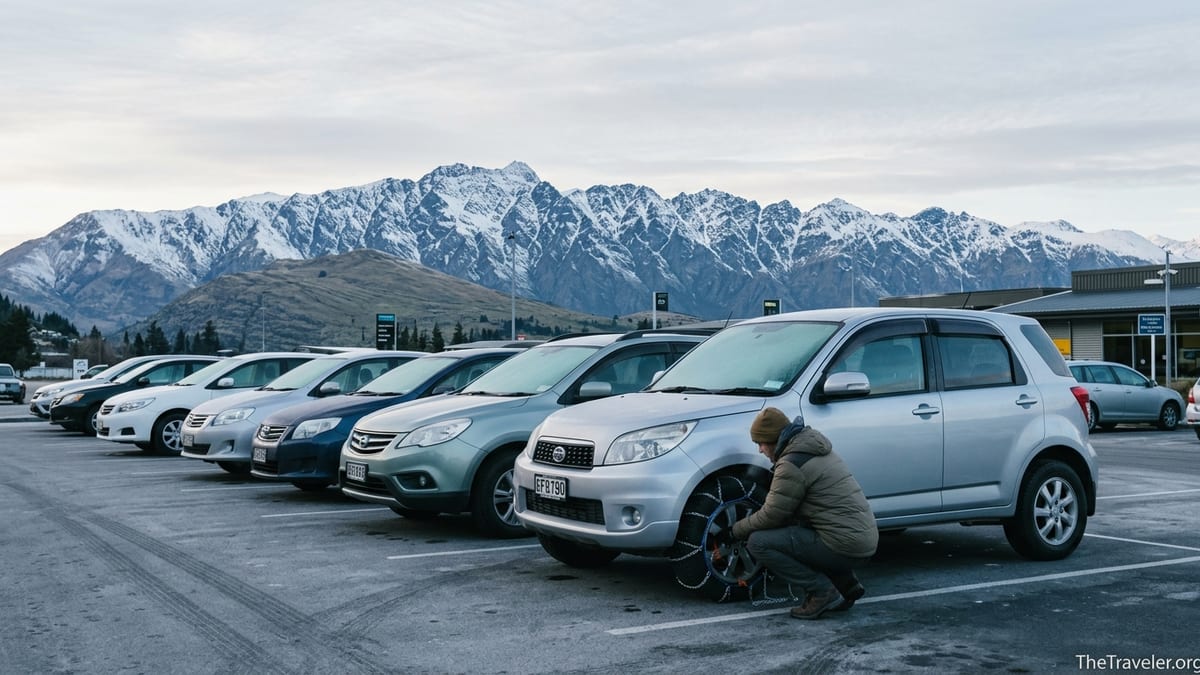
On-airport vs off-airport car rentals at Queenstown Airport
Queenstown Airport is compact, but it has an outsized choice of rental car companies compared with other regional airports in New Zealand. Inside or directly beside the terminal you will typically find the big global brands such as Avis, Budget, Hertz, Europcar, Enterprise, Sixt, Ezi and Thrifty, plus New Zealand-owned firms like Go Rentals. These on-airport desks usually operate from early morning to late evening to match flight arrivals, and cars are parked a short walk from baggage claim, which makes pickup straightforward after a long flight.
Off-airport operators are also common in Queenstown, particularly budget-focused brands such as Omega, Snap, Rad and Discount Car Rentals. These companies generally keep their depots in nearby Frankton or along the main road toward Queenstown and use free shuttle vans to move customers between the airport and their yards. In practice, you collect your bags, phone the depot or follow instructions in your confirmation email, then wait outside the terminal for a branded minivan that arrives every 10 to 20 minutes in busy seasons.
Price is usually the main difference. In winter, a compact car from an on-airport brand might run from around 90 to 150 New Zealand dollars per day, depending on demand and how far ahead you book, while off-airport companies often advertise similar cars for roughly 30 to 40 percent less. The trade-off is convenience. After a late-night arrival in July, walking straight to an on-airport counter can feel worth the extra cost, while budget-conscious travelers with day-time flights often do not mind the short shuttle ride.
Availability can also push you one way or the other. For school-holiday weeks in July and August, on-airport fleets aimed at skiers sometimes sell out early, especially SUVs and all-wheel-drive models. Checking off-airport companies can uncover extra stock or older vehicles that are still perfectly adequate for winter driving, provided you are comfortable without the very latest model or tech features.
Driver requirements, deposits and insurance basics
To rent a car at Queenstown Airport you need a valid driver’s licence in English and a credit card. Travellers from most countries can use their home licence for up to 12 months in New Zealand, as long as it is in English or accompanied by an official translation or an International Driving Permit. Most rental companies require drivers to be at least 21, and some charge extra fees or restrict vehicle categories for drivers under 25.
Deposits in Queenstown are commonly taken as a pre-authorisation on your credit card rather than a cash payment. With a standard insurance excess, that hold can easily sit between 2,000 and 5,000 New Zealand dollars, depending on the company and vehicle. For example, a mid-range SUV with a large international brand might have an excess of about 4,000 dollars. The rental firm will ring-fence this amount on your card when you pick up the car and release it a few days after you return the vehicle without damage or unpaid tolls or tickets.
Most New Zealand rentals include basic insurance by default. What catches many visitors is the size of the excess, which is the amount you must pay if the car is damaged or stolen. At Queenstown Airport counters, you will almost always be offered an “excess reduction” or “zero excess” package for an added daily fee. For instance, you might be quoted around 30 dollars per day to reduce a 4,000 dollar excess down to 0 or a few hundred dollars. Multiplied over a 10-day ski trip, this can add hundreds to the bill, so it is worth checking in advance if your travel insurance, credit card benefits or an independent rental-car excess policy already give you similar cover.
Winter introduces extra fine print. Some policies exclude damage that occurs on unsealed roads, on ski field access roads or when snow chains are not used correctly. In the Queenstown region, many popular routes, such as the roads to The Remarkables and Coronet Peak ski areas, include steep, sometimes unsealed sections and can be icy. It is important to read the terms that mention “alpine roads” or “ski field roads” and confirm with the staff at pick-up where you are allowed to drive and whether any extra conditions apply if you are heading to places like Cardrona or up the Crown Range.
Snow chains in Queenstown: when you need them and how to get them
Snow chains are part of winter life in Queenstown, especially from June through September. Officially, whether chains are required depends on current road conditions and signage. The Queenstown Lakes District Council publishes daily winter road reports that note where chains must be carried or fitted, and on days when cold fronts sweep through it is common to see “Chains required” signs on the Crown Range Road, on the access roads to ski fields, and occasionally on other higher or shaded routes.
In practice, most rental companies in Queenstown will offer chains as an optional extra, either included in a “ski pack” or priced per day. A typical rate might be around 10 to 15 dollars per day, capped at a maximum per rental. Some off-airport firms choose to include chains for all winter hires of SUVs or larger vehicles, while charging extra for small hatchbacks. When you book, it is wise to reserve chains in advance rather than waiting until you arrive, as supplies can be limited during peak winter weeks.
If you plan to drive over the Crown Range between Queenstown and Wānaka, or up to Cardrona, Coronet Peak or The Remarkables, you should consider chains essential, even if you hope not to use them. Local advice is consistent: carry them, and know how to fit them before you are on a dark mountain road in a snow shower. Many rental counters will show you the correct size and sometimes offer a brief demonstration. A useful habit is to practice putting the chains on one wheel in the car park in daylight, so you understand how the tensioners and hooks work and can do it quickly later with cold hands.
Authorities and locals also emphasise that chains are only for when snow or compacted ice is settled on the road or when directed by signage or police. You do not drive long distances on bare tarmac with chains fitted, as this damages both the road and the equipment. In the Queenstown region, a typical scenario might be driving up a mostly clear access road early in the morning, reaching a “Fit chains from here” sign just below the snow line, fitting them as directed, and then removing them at the same point on the way down once you are back onto clear pavement.
Winter driving conditions around Queenstown
Winter driving around Queenstown is not extreme by global alpine standards, but it can be very unforgiving for visitors who are unused to icy roads and short daylight hours. Temperatures overnight from June to August often drop below freezing, which means black ice can form on shaded corners, bridges and high passes even on days when the sky is clear and the town centre feels mild. The region also includes some of New Zealand’s highest main roads, such as the Crown Range, where altitude amplifies wind, snow and ice.
One common itinerary is Queenstown to Wānaka via the Crown Range. On a fine winter afternoon, this is a spectacular 1.5-hour drive over continuous switchbacks and views down to Arrowtown and the Cardrona Valley. Yet on a snowy morning, the same road can have chain restrictions in place and, at times, be closed altogether for ploughing. The alternative route via Cromwell and the Kawarau Gorge takes about half an hour longer but sits at lower altitude and is generally less exposed to snow, which is why locals often recommend it when conditions deteriorate.
Access roads to the major ski fields are another key concern. The Remarkables road includes a long climb with sections of gravel and can be particularly exposed to wind and drifting snow. Coronet Peak’s sealed access road can still collect ice in its upper corners, and staff frequently post chain requirements after overnight snowfalls. Cardrona’s road on the Wānaka side has its own steep, winding section that demands caution for inexperienced winter drivers. In each case, if you are uncertain, you can leave your rental car in the base car park or at designated chain-fitting areas and take mountain or private shuttle buses instead.
Time of day matters too. Midday often brings the best road conditions, with the sun having had time to soften frost and any early-morning sheet ice. Very early starts to “catch first lifts” at a ski field often mean driving in the coldest part of the day, sometimes in low cloud or fog. For longer trips in winter, many locals set out a little later in the morning, checking the latest road reports first, rather than pushing to leave at dawn. Planning flexible schedules with spare time in case of weather or road closures is one of the most practical winter driving tips you can follow in Queenstown.
Parking at Queenstown Airport and in town
If you are renting and parking at Queenstown Airport itself, you will encounter a mix of short-term, long-term and rental-specific zones. On-airport rental cars are typically parked in clearly signed bays close to the terminal, and you simply return the vehicle to that zone at the end of your hire. For travellers leaving their own car there while flying elsewhere, the airport operates paid outdoor and covered car parks, usually priced by the hour for short stays and on a daily basis for longer periods. These fill quickly in peak school-holiday periods, so advance booking is often recommended if you are departing during July or August.
Once you drive into Queenstown, parking becomes more complex. The town centre is compact and heavily visited, with a patchwork of paid on-street spaces and council-run car parks. Time limits and tariffs can change, but as a general rule you should expect to pay for most central parking between morning and early evening on weekdays and Saturdays, with evenings after about 6 pm and public holidays typically free in council-managed spaces. Dedicated all-day parking areas such as Boundary Street or Ballarat Street car parks can be a better bet for leaving a rental while you take a day trip on the lake or join a tour.
Overnight and long-stay parking needs particular attention. In recent years, lakeside streets and some residential roads near the centre have gained new overnight restrictions to discourage campervans and long-term parking. This means you cannot assume that a space that is free at 10 pm will still be legal at 8 am. Always read the roadside signs carefully, as they may specify bans between certain hours, maximum stays or resident-permit requirements. Many hotels and apartment complexes in and around Queenstown include limited off-street parking; when you book accommodation, confirm whether a dedicated space is included, whether it is suitable for an SUV or van, and whether height restrictions apply if it is an underground garage.
For day trips to popular spots like Arrowtown, Glenorchy or the wineries of the Gibbston Valley, parking is usually easier, though it can be busy on sunny winter weekends. Arrowtown has several free public car parks close to the historic main street, while Glenorchy’s lakefront area has informal gravel parking that can become muddy after rain or snow. Ski field parking is a separate challenge, with large, usually free car parks at the tops and bases of the access roads that can involve walking on packed snow and ice. Good footwear and a willingness to carry gear a short distance are as important as finding a space itself.
Is renting a car in Queenstown worth it in winter?
Whether a rental car is worthwhile in winter depends on what you plan to do and how comfortable you are driving in cold conditions. If your main aim is to stay in central Queenstown, walk the lakefront, join organised tours to Milford Sound or Mt Cook, and perhaps take shuttles to nearby ski fields, you can arguably skip the car altogether. The airport is linked to town by regular buses and taxis, and many tour operators will pick you up from major hotels. For visitors on short three- or four-day stays centred on sightseeing and nightlife, going car-free avoids the stress of winter driving and daily parking costs.
On the other hand, a car unlocks a lot of the region’s best experiences. Self-driving lets you stop at viewpoints on the way to Glenorchy, detour through vineyards in Gibbston, or explore historic Arrowtown at sunset after the tour buses have left. For families with ski gear, a rental makes it easier to leave boots and equipment in the boot rather than hauling everything on and off buses. For a typical week-long winter trip including at least two different ski fields and side trips to Wānaka or Cromwell, many travellers find the flexibility of a car easily justifies the daily hire cost, especially when shared among two or more adults.
Your personal tolerance for winter roads should guide the decision. Confident drivers from snowy countries often regard Queenstown’s winter conditions as moderate, as long as they respect local speed limits, carry chains and avoid rash overtaking on mountain passes. Visitors from tropical climates or cities where they have never driven on ice sometimes find the same roads intimidating. If you fall in the latter group but still want a car for flexibility, consider planning your itinerary mainly on lower routes such as the highway to Cromwell and Wānaka via the gorge, while booking shuttle buses for ski field access and being willing to postpone or reroute if the road reports look poor.
Cost comparisons also help. Add up the total price of a week’s rental, chains, fuel and parking and compare it with airport transfers plus a handful of day tours or shuttle services. In many real-world cases, couples or small groups find the sums come out similar either way, which means the decision turns more on convenience and confidence than on pure dollars. Solo travellers, especially those staying right in the town centre and focused on guided activities, are the ones most likely to save money by skipping the car altogether in winter.
Practical tips for a smooth Queenstown winter rental experience
A little preparation goes a long way to keeping your Queenstown winter road trip relaxed. One of the simplest steps is to book early, particularly if you want an all-wheel-drive SUV or a larger vehicle for a family. These sell out first for the July and August school holiday periods. When comparing options, look closely at what is included: some companies bundle unlimited kilometres, chains, an extra driver and roadside assistance into the base price, while others add each as a separate fee. Knowing the real total cost before you arrive will help avoid surprises at the counter.
When you collect the car, take your time with the inspection, especially in low winter light. Walk around the vehicle, photograph each side and any existing scratches, and confirm that the fuel level and odometer are correctly recorded. Ask staff to point out where the jack, spare wheel or repair kit, and snow chains are stored, and clarify which roads are off-limits under the rental agreement. Locals working behind the counter are also a valuable source of current advice on which passes or ski routes are affected by recent storms or overnight ice.
Once you are on the road, adopt a conservative driving style. Allow extra stopping distance on wet or frosty surfaces, use gentle acceleration and braking, and look ahead for shaded corners where black ice might linger. If you are unsure, watch what local drivers and shuttle buses are doing and do not hesitate to pull into a safe lay-by to let faster traffic pass. In winter in Queenstown, you are never criticised for being cautious; overconfidence is what usually leads to trouble.
Finally, build flexibility into your plans. On some days a cold front will sweep through, the Crown Range will require chains or close temporarily, and ski field access roads may have strict controls. Treat these as part of the alpine experience rather than an inconvenience. Having a backup plan that might involve a lake cruise, a winery lunch in Gibbston, or a walk around Arrowtown allows you to enjoy Queenstown even when the weather takes driving certain roads off the table for a few hours or a day.
FAQ
Q1. Do I really need snow chains for a rental car in Queenstown in winter?
Yes, if you plan to drive to ski fields or over alpine roads such as the Crown Range, you should carry chains and know how to fit them. For lower routes like the highway through the Kawarau Gorge to Cromwell, chains are less often required but can still be useful during major cold snaps.
Q2. Which rental car companies operate directly at Queenstown Airport?
Major brands such as Avis, Budget, Hertz, Europcar, Enterprise, Sixt, Thrifty, Ezi and Go Rentals have desks at or beside the terminal, with vehicles in nearby car parks so you can walk to your car shortly after landing.
Q3. Are off-airport rental companies in Queenstown hard to use?
No. Off-airport firms like Omega, Snap, Rad and Discount Car Rentals typically run free shuttles that collect you from the airport within about 10 to 20 minutes. The process usually adds only a short delay compared with on-airport pickup, but can feel longer after a late-night arrival.
Q4. How big is the insurance excess on Queenstown rental cars?
It varies by company and vehicle, but standard excesses around 2,000 to 5,000 New Zealand dollars are common. You will usually be offered an optional daily fee to reduce this amount significantly, which can be worth considering if you are driving on alpine roads in winter.
Q5. Is parking in central Queenstown difficult in winter?
Parking in the compact town centre can be tight and mostly paid during the day, but spaces usually free up in the evenings. Council car parks such as Boundary Street and Ballarat Street are popular for longer stays, and many accommodations include their own guest parking which is worth confirming when you book.
Q6. Can I drive my Queenstown rental car to all ski fields?
Most rental companies allow driving to nearby ski areas such as Coronet Peak, The Remarkables and Cardrona, but some have conditions around unsealed or alpine roads. Always check your rental agreement and ask staff to confirm that your chosen ski field is permitted and whether chains are mandatory when road signs require them.
Q7. Do I need a four-wheel-drive vehicle for Queenstown in winter?
A four-wheel-drive or all-wheel-drive vehicle can provide extra confidence on snowy access roads, but many locals and visitors manage with two-wheel-drive cars plus good chains. Your driving experience and planned routes matter more than the badge on the back of the car.
Q8. Is it cheaper to rely on shuttles instead of renting a car?
For solo travellers or couples staying centrally and mainly joining guided tours or ski shuttles, using buses and transfers can work out cheaper than a rental car plus parking and fuel. For families or groups planning multiple day trips and ski days, the flexibility of a car often balances or outweighs the extra cost.
Q9. What should I do if the road reports say the Crown Range is closed or chains are required?
If the Crown Range is closed, you must use an alternative route, typically via Cromwell and the Kawarau Gorge. If signs say chains are required, fit them at the designated area or choose a lower, chain-free route. Do not attempt to ignore closures or chain requirements, as it is unsafe and can invalidate your rental insurance.
Q10. Are there any special rules for overnight parking of rental cars in Queenstown?
Yes. Some lakeside and residential streets near the centre have overnight restrictions to discourage long-term or campervan parking, and time limits still apply in many areas. Always read the signs closely and, when in doubt, use council car parks or accommodation parking to avoid fines.