


Landing at Queenstown Airport and heading into town by public bus is one of the best-value airport transfers in New Zealand. The Orbus service connects the terminal with Queenstown’s compact town centre and the Frankton Bus Interchange, and with a little preparation you can pay as little as NZ$2.50 for the journey instead of NZ$10 in cash. This guide walks you through exactly how the system works, what to expect at the stops, how to use a Bee Card, and the common mistakes that catch out first-time visitors.
Get the latest updates straight to your inbox!
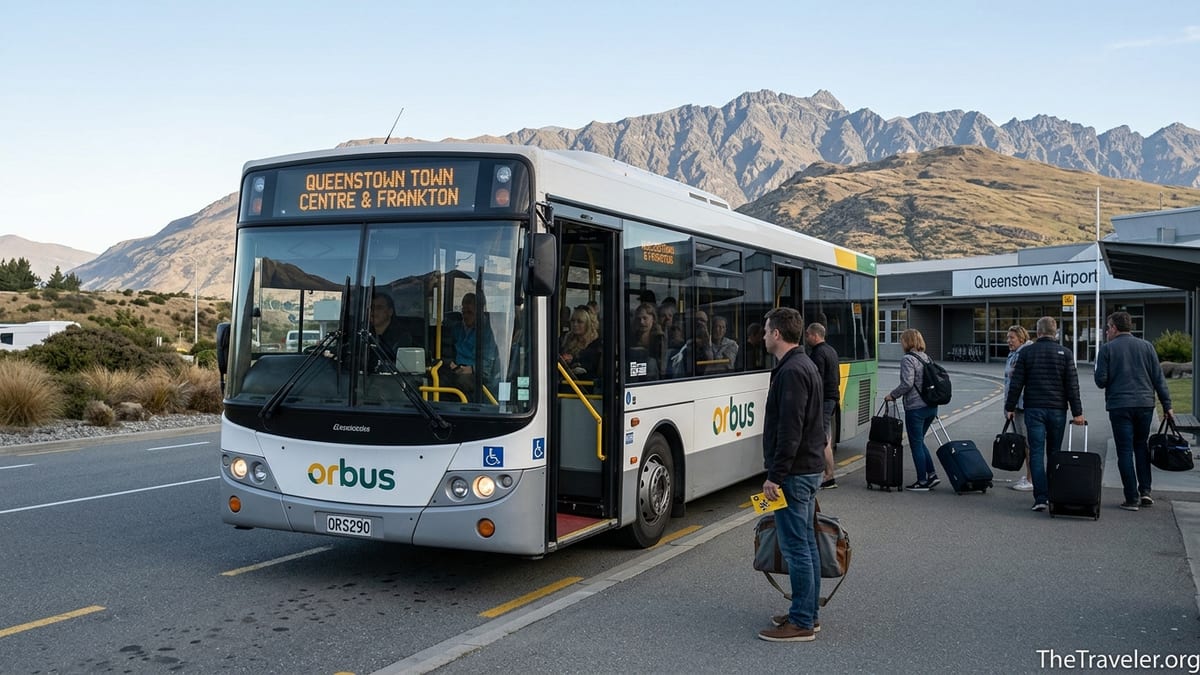
Orbus from Queenstown Airport: How the Service Works
Queenstown Airport sits in Frankton, about 8 kilometres from central Queenstown, and is directly served by the Orbus network. The key service for arrivals is Route 1, which runs between Queenstown Airport, the Frankton Bus Interchange and Queenstown town centre. Buses typically run every 15 minutes during the day, with less frequent services early in the morning and later at night. In normal traffic the ride from the airport to the centre of town takes around 20 to 25 minutes, but at busy times such as Saturday afternoons in ski season it can push closer to 35 minutes, so allow extra time if you are heading to a time-sensitive activity.
The airport bus stop is directly outside the terminal on Sir Henry Wigley Drive. When you leave the arrivals hall, follow the signs for "Public Buses" and you will see a clearly marked Orbus stop with timetable information. The same stop is used for buses heading both to Frankton Bus Interchange and on to the town centre. Drivers are used to dealing with visitors fresh off long-haul flights, so if you are not sure whether the bus goes where you need, simply tell the driver the name of your hotel or street and they will confirm the best stop.
Real-world example: if you land at 10:30 in the morning and walk out of the terminal by 10:45, you will usually find a Route 1 bus within 10 to 20 minutes. By the time you load your bags, tag on with your Bee Card and sit down, you can reasonably expect to be getting off near the Queenstown waterfront around 11:15 if traffic is flowing well. For many visitors this works out faster and far cheaper than waiting in the taxi queue or for a rideshare driver to reach the airport in peak times.
It is worth knowing that Orbus is a regular city bus, not a dedicated airport shuttle. That means locals and workers will be using it alongside visitors, and there are multiple stops between the airport and town. If you are expecting door-to-door service to your accommodation, you may prefer a taxi or a private shuttle, but for most budget-conscious travellers the small trade-off in convenience is well worth the savings.
Bee Card vs Cash: Understanding Fares from the Airport
The single biggest factor in how much you pay for the airport bus is whether you use a Bee Card or pay cash. As of mid-2026, an adult fare from Queenstown Airport on Orbus with a Bee Card is around NZ$2.50, while the adult cash fare from the airport is NZ$10. Children and youth also pay much less with a Bee Card compared with the cash price. In practice this means a family of two adults and two teenagers can ride into town for roughly NZ$8 total with Bee Cards, compared with NZ$36 or more in cash for the same journey.
The Bee Card is a reusable pre-pay smart card used across multiple regions in New Zealand, including Queenstown. You load credit on to the card and "tag on" when you board the bus and "tag off" when you get off. The correct fare is deducted automatically. With a cash ticket you simply tell the driver your destination, pay the fare in notes and coins, and receive a paper ticket. Cards and contactless bank payments are not accepted on Orbus at the time of writing, which is a surprise to many international visitors who are used to tapping a credit card to ride public transport.
For example, imagine you have just arrived from Sydney and did not have time to organise a Bee Card beforehand. If you pay NZ$10 cash each for two adults from the airport to town, that is NZ$20 one way. If instead you buy a Bee Card at the airport for NZ$5, add a NZ$5 minimum top-up, and repeat for your partner, your upfront cost is NZ$20 in total for two cards with NZ$10 of stored value. Your first two adult bus trips at NZ$2.50 each will only use NZ$10, and you will still have working cards that can be used all over Queenstown and in other New Zealand regions later in your trip.
Because the fare difference is so large on the airport route, using cash quickly becomes a false economy. Even if you are staying just one night in Queenstown, a Bee Card still often pays for itself after a single return trip between the airport and town, especially for more than one traveller. The only time cash really makes sense is when you genuinely only need a single one-way ride and have no plans to use buses again in New Zealand.
Where and How to Get a Bee Card in Queenstown
There are three main ways most visitors get a Bee Card in Queenstown: at the airport, at the Otago Regional Council office in Frankton, and from bus drivers. The most convenient option if you are flying into Queenstown is usually to buy your card inside the terminal before you walk out to the bus stop. Look for signage for public transport information desks or general airport information. Staff can sell you a Bee Card, load your initial credit, and answer basic questions like "How much do I need for four days of buses?" so that you are ready to tag on when you reach the bus.
If you forget to buy one in the terminal or arrive when internal desks are closed, you may still be able to purchase a Bee Card directly from the Orbus driver using cash, although this depends on stock and is not guaranteed during very busy periods. Drivers can also top up existing cards with cash on board. This is a very practical option if you are already on the bus or you want to add a small amount without hunting for a retailer. Just keep in mind that cash top-ups are slower at busy stops, so it is courteous to have the exact amount ready and step aside briefly after you pay.
For travellers staying in Frankton or passing through later, the Otago Regional Council office near the airport area is another place to buy and manage Bee Cards. Some local convenience stores and service stations in the wider Otago region also act as Bee Card retailers, although availability in Queenstown itself can shift over time. Online top-ups via the Bee Card website are useful once you have the card, especially for longer trips that also include cities like Dunedin or Hamilton where the same card works on local buses.
One practical example: a solo traveller arriving in the evening who cannot see a Bee Card retailer inside the airport could simply board the bus, tell the driver "I need a Bee Card and a top-up," pay NZ$10 in cash to cover the card cost and initial credit, then tag on with the new card. Their adult airport fare will be deducted at the cheaper Bee Card rate on that very first ride. This is usually better than paying the NZ$10 cash fare and planning to get a card later.
Frankton Bus Interchange: The Hub Between Airport and Town
The Frankton Bus Interchange, sometimes called the Frankton Bus Hub, is the main transfer point for the Orbus network between the airport and the rest of the Queenstown area. It sits near the Queenstown Events Centre and major retail areas in Frankton. Nearly all Orbus services, including those to Arrowtown and the residential suburbs, pass through this interchange, so even if you are ultimately heading somewhere beyond the town centre you will likely pass Frankton along the way.
On the airport route, buses usually stop at Frankton within about 5 to 10 minutes of leaving the terminal. You can stay on the same bus if you are continuing into central Queenstown, or hop off and transfer to another route if you are heading to places such as Arrowtown, Fernhill or some of the newer suburbs. Transfers between Orbus services are typically free within a set window when you are using a Bee Card, as long as you tag off one bus and tag on to the next within the allowed time limit. The exact transfer rules can change, so it is wise to check current signage at the hub or ask the driver if you are unsure.
The interchange is open-air and functional rather than scenic, but it is well signposted. Each platform has electronic displays with route numbers and estimated arrival times, which helps if you are juggling luggage and trying to work out where to stand. There are basic shelters to duck into during Queenstown’s frequent winter showers. If you have a longer wait between services, you will find supermarkets and food outlets a short walk away, making it easy to pick up groceries on your way from the airport to a rental apartment.
Consider a real itinerary: you land in Queenstown, ride Route 1 from the airport to Frankton, then switch to a bus towards Arrowtown. With a Bee Card, your total fare for that combined journey can still be around the standard adult rate rather than two separate full fares, provided you transfer within the free-transfer window. If you paid cash, you would pay the higher airport cash fare and then another cash fare for the second leg, which can quickly outweigh the cost of acquiring a Bee Card at the start.
Where to Get Off in Queenstown Town Centre
The compact size of Queenstown’s centre makes the bus especially practical once you understand where to hop off. Route 1 threads along Frankton Road beside Lake Wakatipu before entering the town centre, with several stops that work well for different types of accommodation. Many visitors staying near the waterfront choose to get off near the Queenstown Memorial Centre or Stanley Street, which leaves them a short downhill walk to hotels clustered around Shotover Street, Beach Street and the lakefront.
Hotels and hostels slightly uphill from the lake, such as those near Gorge Road or Robins Road, may be closer to stops as the bus approaches from Frankton, so checking a map before you travel is worth the small effort. If in doubt, tell the driver the name of your hotel when you board at the airport. They are used to pointing out "This is your stop" for guests staying at popular properties around town. Missing your ideal stop is not a disaster, since the centre is walkable, but getting off one or two stops earlier can mean avoiding a steep uphill slog with heavy luggage.
As an example, a traveller staying at a hostel on Shotover Street might ride the bus from the airport to the stop near the Village Green. From there it is about a five-minute walk along relatively flat streets to the hostel door. Someone booked into a lakeside apartment towards the eastern edge of the town centre may prefer to get off one stop earlier on Frankton Road to avoid backtracking. Because of Queenstown’s hilly topography, even a small adjustment like this can make a noticeable difference when you are carrying skis, snowboards or oversized backpacks.
Remember that the bus will pick you up at largely the same points when you are heading back to the airport. Allow generous time for the return journey, especially in the late afternoon and early evening when traffic around Frankton can be heavy. It is sensible to board a bus at least one full departure earlier than the last possible option that would theoretically get you to check-in. This builds in a buffer for roadworks, boarding delays or slow-moving traffic along Frankton Road.
Luggage, Ski Gear and Practical Onboard Tips
Orbus is designed as a city bus, but the Queenstown routes see a high volume of travellers with luggage and ski equipment. Drivers generally allow suitcases, backpacks and gear bags provided they are manageable and do not block aisles or doors. Smaller suitcases can usually be tucked under seats or held upright beside your legs. Larger bags and ski gear are often placed in the standing area near the front or the multi-purpose space that would normally be used for prams or wheelchairs when this area is free.
That said, there are limits. Very large or numerous items that noticeably obstruct movement can be refused, particularly at busy times when the bus is close to capacity. If you are arriving with two gigantic hard-shell suitcases, a ski bag and hand luggage between two people, there is a realistic chance you may be asked to wait for the next bus or arrange alternate transport. Think of Orbus as best suited to travellers with one main bag and a cabin bag each, and consider a taxi or shuttle if your luggage pile looks like an expedition.
On board, you tag on your Bee Card at the reader near the front door and tag off at the same type of reader near the exit when you leave. Forgetting to tag off is a very common mistake and usually results in being charged a maximum fare for the trip instead of the shorter distance you actually travelled. This is particularly annoying if you plan to transfer at Frankton where the system expects both a tag-off and a new tag-on. One good habit is to keep your card in hand as the bus approaches your stop rather than burying it in your bag.
If you are travelling with children, you can ask the driver to tag on multiple passengers with a single Bee Card. For instance, a parent might hold a registered card and request that the driver tag on one adult and one child from the same card balance. The driver will manually adjust the machine and may print a small ticket for the second passenger. This is handy if you do not want to manage separate cards for each family member, though frequent bus users often find individual cards easier in the long run.
Common Tourist Mistakes and How to Avoid Them
Despite the system being relatively simple, a few recurring mistakes cost visitors time and money. The first is arriving with no cash and assuming you can tap a credit card on board. At present Orbus only accepts cash or Bee Cards, and you cannot buy a cash ticket using a card on the bus. A common scenario sees a visitor step on with luggage, present a bank card, and then have to rush back into the terminal to find an ATM while the bus departs without them. To avoid this, withdraw a small amount of local currency at an airport ATM or plan to buy and top up a Bee Card inside the terminal using card payment before you head to the stop.
The second major mistake is paying the full cash fare from the airport when a Bee Card would pay for itself almost immediately. Many travellers assume buying a transport card is only worthwhile for long stays, but in Queenstown the fare difference for the airport route is especially stark. A couple on a short weekend break who catch the bus in both directions can easily spend NZ$40 in cash fares for four rides, compared with roughly NZ$20 total including the cost of two Bee Cards and discounted fares. For a family, the gap is even wider.
Another regular pitfall is misjudging timing and cutting it too fine for flights. While the trip from town to the airport can take as little as 20 minutes in light traffic, Queenstown is notorious for congestion near Frankton at school run times, in ski season and during major events. Visitors sometimes board a bus an hour before their scheduled departure, expecting a smooth ride, only to find themselves crawling along Frankton Road in bumper-to-bumper traffic. A safer strategy is to aim for a bus that gets you to the airport at least 90 minutes before domestic flights and two hours before international flights, which generally means leaving the town centre two services earlier than the last theoretically possible option.
Finally, some people unintentionally block the aisles with luggage or lean skis across seats during busy times. This can slow boarding and inconvenience other passengers. To keep things smooth, stand close to your bags, stack them vertically where possible, and follow any instructions from the driver about where to place gear. Being considerate about space will make the ride more comfortable for everyone and reduces the chance of delays that could cause you to miss a connection.
The Takeaway
For budget-conscious travellers, Queenstown’s Orbus service offers an excellent-value link between Queenstown Airport, the Frankton Bus Interchange and the compact town centre. With a little planning around Bee Cards, luggage and timing, you can move between the runway and the lakefront for a fraction of the price of taxis and private shuttles, without sacrificing too much convenience.
The most important steps are straightforward: pick up a Bee Card as early as possible, load enough credit for your stay, and keep it handy to tag on and off. Learn the key stops near your accommodation, allow buffer time for traffic, and be realistic about how much luggage you can comfortably manage on a regular bus. If you do that, the airport bus becomes more than just a cheap transfer. It turns into a reliable everyday tool for exploring Queenstown’s lakeside walks, nearby suburbs and even outlying spots like Arrowtown, all while keeping your transport budget firmly under control.
FAQ
Q1. How much does the Orbus from Queenstown Airport to town cost?
With a Bee Card, an adult typically pays around NZ$2.50 for a one-way trip from the airport into Queenstown. Paying in cash costs significantly more, around NZ$10 for the same journey. Bee Card fares for children and youth are lower again, so a family can save a substantial amount by using cards instead of cash.
Q2. Where can I buy a Bee Card at Queenstown Airport?
You can usually buy a Bee Card inside the terminal at information or transport desks before you exit to the bus stop. If those are closed or busy, some Orbus drivers can sell you a Bee Card directly on board if they have stock, and you can load initial credit using cash. There is also an Otago Regional Council office in the wider Frankton area where Bee Cards are available.
Q3. Can I pay for the bus with my credit card or phone?
At the time of writing, Orbus in Queenstown only accepts Bee Cards or cash for fares. You cannot tap a contactless bank card, mobile wallet or foreign transport card on the bus. If you do not have a Bee Card, you will need cash in New Zealand dollars to pay the driver or to buy a card and top it up before boarding.
Q4. How often do airport buses run and how long is the journey?
Route 1 between Queenstown Airport, Frankton and the town centre generally runs every 15 minutes during the daytime, with less frequent services early in the morning and late at night. In light traffic the ride to town takes about 20 to 25 minutes. During busy periods, especially ski season or long weekends, the trip can be closer to 30 to 35 minutes, so it is smart to allow extra time.
Q5. What is the Frankton Bus Interchange and do I have to change there?
The Frankton Bus Interchange is the main hub where most Orbus routes meet. If you are simply travelling between the airport and central Queenstown, you normally stay on the same Route 1 bus as it passes through Frankton. You only need to change there if you are heading to destinations like Arrowtown, some residential suburbs or connecting to other services. With a Bee Card, transfers at Frankton are often free within a set time window.
Q6. Is it easy to take luggage and ski gear on the Orbus?
Yes, within reason. Suitcases, backpacks and ski bags are generally allowed as long as they do not block aisles or doors. Smaller bags can go under seats or beside you, while larger pieces are usually placed in the standing area. Very bulky or numerous items might be refused at busy times, so if you are travelling with multiple large suitcases and sports gear, a taxi or private shuttle may be more practical.
Q7. How do I know where to get off in Queenstown town centre?
Queenstown’s centre is compact, with several bus stops that work well for different hotels and hostels. The easiest approach is to tell the driver the name of your accommodation when you board at the airport and ask which stop is best. They will usually call it out as you approach. You can also check a map before you travel to pick the closest stop, keeping in mind that some streets are quite steep.
Q8. What happens if I forget to tag off my Bee Card?
If you forget to tag off, the system usually charges a higher default fare, treating your trip as longer than it actually was. This can also interfere with free transfers if you are changing buses at Frankton. If you realise immediately, you can sometimes mention it to the driver, but in most cases the extra charge will simply come off your card balance. Getting into the habit of tagging off as soon as you stand up to leave the bus helps avoid this.
Q9. How early should I leave town to catch a flight from Queenstown Airport?
Because of variable traffic, it is prudent to leave more time than the bare minimum. For domestic flights, aim to board a bus that will get you to the airport at least 90 minutes before departure. For international flights, allow about two hours. This usually means catching a bus from the town centre one or even two scheduled services earlier than the last one that might theoretically get you there in time.
Q10. Is the airport bus still worth it for a short stay or late arrival?
For most travellers, yes. Even on a one- or two-night stay, the savings from using a Bee Card on the airport route and any extra local trips normally outweigh the cost of the card. For very late arrivals when services are less frequent or for groups with lots of luggage, it may be more convenient to choose a taxi or shuttle in one direction and the bus in the other. Checking the latest timetable for your arrival time is the best way to decide.