


Planning a Lapland escape and stuck between Ranua Resort and Levi? You are not alone. Both promise snow, northern lights and husky sleds, yet the feel on the ground could not be more different. One is a quiet forest retreat wrapped around a wildlife park, the other Finland’s liveliest ski resort with a small-town buzz. This guide breaks down how each destination actually feels, what you can realistically do there, how much it might cost, and which type of traveler is likely to be happier in Ranua or Levi.
Get the latest updates straight to your inbox!
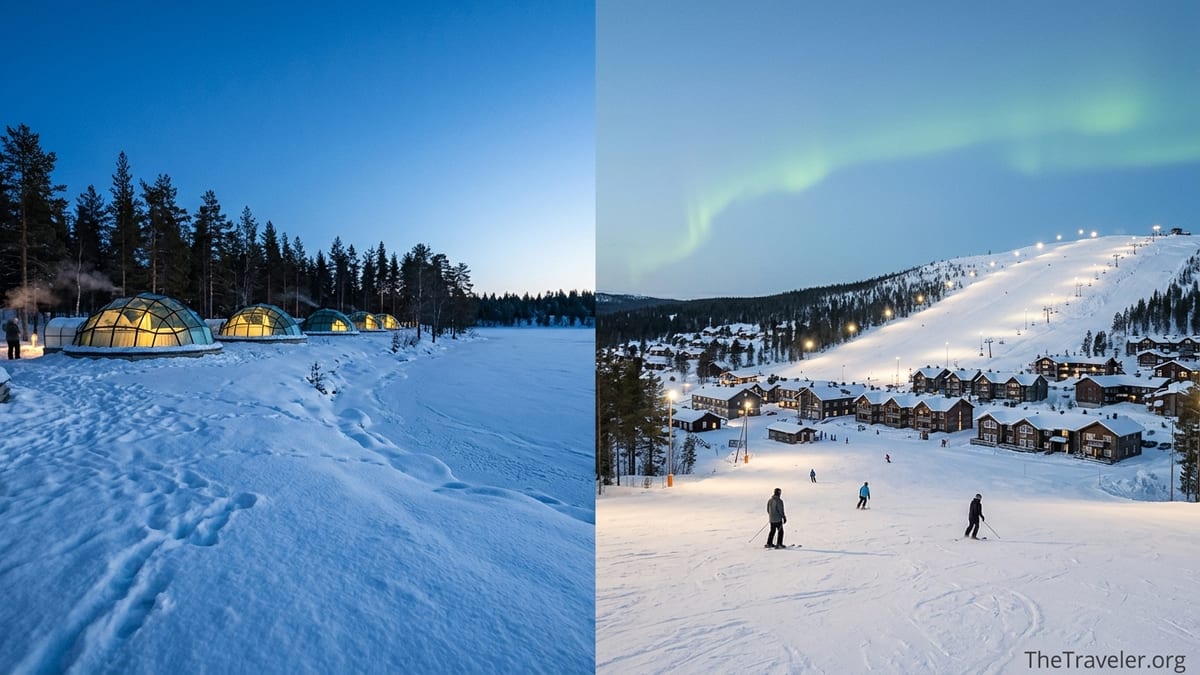
Setting & Atmosphere: Wilderness Hideaway vs Alpine Village Buzz
Ranua Resort sits in the small municipality of Ranua, about a 1 hour 10 minute drive south of Rovaniemi along Route 78. Surrounded by boreal forest and a lakeshore, the resort feels like a self-contained bubble in the woods. Once you check into a villa or an Arctic glass igloo on Lake Ranuanjärvi, your world shrinks to snow-laden trees, a frozen lake and the nearby wildlife park. Outside the peak Christmas and New Year weeks, evenings are quiet; you might walk to the on-site restaurant, then return to your igloo to watch the sky in near-total silence.
Levi, by contrast, is Finland’s biggest and most developed ski resort, built around the fell of Levi in Kittilä municipality. The compact village has streets lined with restaurants, ski shops, bars, supermarkets and activity offices. During the main winter season from roughly December to April, the center stays busy well into the evening, especially on weekends and during Finnish winter school holidays. You can finish a day on the slopes, head straight into a bar with live music, then walk a few minutes back to your apartment.
Think of Ranua as a wilderness lodge experience with some family attractions attached, and Levi as a full-service resort town. If your ideal Lapland trip involves silence, starry skies and minimal light pollution right at your door, Ranua has the edge. If you prefer to step out of your accommodation into a buzzing main street with several dinner options and nightlife, Levi will feel more natural.
Access & Getting Around: Transfers, Convenience and Car-Free Options
Ranua is easiest to reach via Rovaniemi. Most international visitors fly into Rovaniemi Airport, then continue by pre-booked transfer or rental car to Ranua. The drive is roughly 80 kilometers and takes around 1 hour 10 minutes in winter conditions. Plenty of tour operators based in Rovaniemi package stays at Ranua Resort, so you may be picked up directly from the airport or city hotels and dropped at your villa or igloo. Once you arrive, you can manage without a car because the wildlife park, main reception, restaurant and many activities cluster around the resort area.
Levi is served by Kittilä Airport, around 15 kilometers away, with winter charter flights from many European cities and domestic flights from Helsinki. Airport transfers to Levi village typically take around 15 to 20 minutes and are often bundled into ski packages. There is also a ski bus system and local taxis within Levi, so you can remain car free all week if you wish. Accommodation, lifts, rental shops and many restaurants sit within walking distance in the village center.
If your priority is an ultra-simple journey with minimal time on icy roads and you are arriving in peak ski season, Levi scores higher. The short Kittilä transfer means you can step off your flight and be on the slopes or in a sauna the same afternoon. Ranua involves slightly more logistics and time, but it pairs naturally with a stay in Rovaniemi. Travelers who want to visit Santa Claus Village or Santa Park then retreat somewhere quieter for a few nights often choose Rovaniemi plus Ranua as a two-stop itinerary.
Accommodation Style & Comfort: Glass Igloos vs Ski Apartments and Spa Hotels
Ranua Resort is known for its Arctic glass igloos on Lake Ranuanjärvi, placed in rows so that each has an unobstructed view over the lake and sky. Each igloo is around 36 square meters with heated glass panels, a double or twin bed, small kitchenette, private sauna, shower and toilet. Breakfast, bed linen and final cleaning are typically included. Recent price lists for winter 2025–2026 show that igloos can easily run into several hundred euros per night in high season, especially around Christmas and New Year, with somewhat lower rates in January and March. The resort also has holiday villas and apartments next to the wildlife park, which work well for families who want more space and separate bedrooms.
Levi offers a full spectrum of places to stay: chain-style hotels in the center, high-end spa hotels with pools and saunas, slope-side cabins, and straightforward self-catering apartments. You can book compact studios above ski shops, larger chalets with private saunas a short bus ride from the center, or design-led boutique hotels. Typical mid-range apartments in central Levi in January or March might run in the low- to mid-hundreds of euros per night for a small family, while top-tier spa hotels and luxury cabins cost significantly more. Because there are many beds in Levi, it is often easier to find availability outside of the absolute peak holiday weeks.
Choose Ranua if you like the idea of a single, coherent resort that you rarely leave, and especially if you want the bucket-list experience of sleeping beneath heated glass in a remote-feeling setting. Choose Levi if you want flexibility: maybe a budget apartment with self-catering, or a hotel with half board and a spa, or an upmarket chalet for a group ski trip. Levi’s variety also makes it easier to match your budget by trading location and amenities up or down.
Activities & Experiences: Wildlife and Quiet Adventures vs Skiing and Action
Ranua’s standout attraction is its wildlife park, which focuses on Arctic and northern species. The park has around 50 species and roughly 150 individual animals in forested enclosures, including brown bears, lynx, wolves, wolverines and polar bears, along with moose and reindeer. You can walk the park’s loop in a couple of hours and easily combine it with a guided visit or feeding time. Families with children often appreciate that it is a clear, self-contained outing directly next to the resort.
Beyond wildlife, Ranua Resort offers a typical Lapland winter menu at a quieter scale: husky safaris, reindeer sleigh rides, snowmobile excursions and snowshoeing in the surrounding forest. Many of these leave straight from the resort, so you do not waste time shuttling between providers. On a three-day stay you might spend one morning in the wildlife park, one afternoon on a short husky ride, and one evening on a small-group northern lights snowmobile safari, before returning to your igloo to watch the sky.
Levi is built around downhill skiing and snowboarding. It is Finland’s largest ski area, with a network of gondolas, chairlifts and surface lifts serving a ring of pistes on the fell, plus extensive cross-country trails. The ski season is long and often begins as early as October thanks to snowmaking. Equipment rental shops line the village streets and can kit you out in under an hour, whether you are a complete beginner or an advanced skier. Non-skiers will also find plenty to do: snowshoe tours, fat-biking on snow, ice karting, snowmobile safaris, reindeer and husky experiences, and spa days at hotels.
If downhill skiing, snowboarding or structured action from morning to after-ski is important to you, Levi clearly wins. If you are not interested in skiing and mainly want a few carefully chosen experiences in a tranquil base, Ranua might suit better. A practical example: a couple who want to ski five days, join one snowmobile safari and then enjoy après-ski will almost certainly be happier in Levi; a family with small children who are unsure about skiing but excited about animals and igloos will likely find Ranua easier and less pressured.
Northern Lights & Nature: Where Your Chances Feel Best
Both Ranua and Levi sit well within the northern lights belt, and both can deliver spectacular aurora displays from roughly September to early April when the sky is clear and dark. Realistically, your odds depend more on the length of your stay and luck with weather than your exact village. However, local conditions do shape how you experience the sky.
Ranua’s big advantage is low light pollution directly at your accommodation, particularly in the lakefront glass igloos. You can lie in bed or sit at your window and watch for activity without leaving your cabin. When faint bands appear, the darkness makes them easier to see. On still nights the frozen lake and surrounding forest amplify the sense of wilderness, with reflections and silhouettes creating a truly immersive backdrop.
Levi’s village is brighter, with streetlights, building lights and illuminated slopes. Strong aurora will still be clearly visible above the fell, and many visitors watch from the edges of the ski area or join organized northern lights tours that drive them away from lights into the surrounding forest or onto frozen lakes. For photographers, the combination of a lit village and glowing sky can be attractive, but you will usually need to move a little away from the main streets for the darkest skies.
If your dream is to watch the aurora in silence from your bed or private sauna without suiting up for long drives, Ranua’s glass igloos offer the more natural setup. If you do not mind joining a guided northern lights hunt in a minibus or snowmobile and like the idea of combining aurora chasing with a more active day, Levi will work well. In both cases, aim for at least three nights to improve your odds of catching a clear-window in the often changeable Lapland weather.
Food, Nightlife & Overall Vibe
Ranua’s dining scene is small and tied closely to the resort. Expect one or two main restaurants serving hearty Scandinavian and international dishes, a café near the wildlife park entrance, and limited options beyond that unless you drive into the nearby village. Menus typically feature salmon, reindeer, soups and buffet-style breakfasts. Evenings tend to be low key: perhaps a drink by the fireplace or a simple bar area, but no real bar-hopping route. If you are traveling with children or prefer early nights, this can be perfect.
Levi, on the other hand, feels like a compact alpine town during winter season. You will find pizzerias, burger spots, Lappish fine-dining restaurants, sushi, Tex-Mex and cafes, all within walking distance. Après-ski scenes appear around the base lifts in the afternoon, with music and drinks as skiers finish their last runs. At night, several bars and a couple of clubs stay lively, especially on weekends and during Nordic holiday periods. You can easily dine somewhere different each evening and grab groceries from supermarkets for breakfasts or snacks.
For travelers who want variety and social energy, Levi is clearly more satisfying. Groups of friends, couples who enjoy bar culture and younger skiers often prefer it. Ranua is better suited to those who view their resort largely as a restful base, perhaps with one restaurant they return to repeatedly, and who are more interested in early-morning silence than late-night music drifting through the snow.
Costs, Crowds & When to Go
Both Ranua and Levi can be expensive in December around Christmas and New Year, when demand is highest and many international package trips run. Prices tend to soften in mid-January and again in late March and early April, though exact rates vary year by year. Ranua’s glass igloos are a premium product, so expect to pay accordingly; you might balance that by spending only one or two nights in an igloo and the rest in a more affordable villa or apartment on the resort grounds.
Levi’s broader accommodation stock means you have more levers to pull on cost. Ski apartment deals in January can sometimes be competitive, especially if you are flexible on exact dates and stay slightly outside the busiest weeks. Lift passes, equipment rental and lessons will add a significant amount on top of accommodation if you ski every day, while non-skiers may spend more selectively on individual excursions.
In terms of crowds, Ranua almost always feels calmer. While the wildlife park can be busy during daytime in holiday weeks, evenings at the lake igloos or villas are generally peaceful. Levi has distinct waves: Christmas and New Year are lively, then early January can feel surprisingly quiet, followed by a very busy period during Finnish and other Nordic winter holidays from roughly mid-February onwards. If you want Levi’s full buzz, travel during these busy weeks; if you want its facilities with fewer people, aim for early January or late March.
For many travelers, a hybrid strategy works well: a few nights in Levi for active skiing and nightlife, followed by two nights in Ranua or another quiet spot for a wind-down focused on nature, wildlife and aurora watching.
The Takeaway
Ranua Resort and Levi both deliver that archetypal Lapland mix of snow, northern lights and Arctic experiences, but they suit different travel personalities. Ranua is a compact, nature-focused retreat with a wildlife park and glass igloos on a quiet lake. It excels for couples and families who want a tranquil base, easy access to huskies and reindeer, and a high chance of dark skies right outside their window. Nightlife is minimal, and costs concentrate in a few high-value experiences like igloo stays and private excursions.
Levi is Finland’s flagship ski destination: a small town wrapped around a fell, with long seasons, many lifts and pistes, and a wide menu of non-ski activities. It is ideal for travelers who want to mix sport, social energy, varied dining and structured excursions, all without needing a car. Prices can vary more widely depending on your choice of lodging and how intensively you ski.
If you imagine your perfect Lapland evening as a quiet walk on a frozen lake, then sinking into a sauna before watching the aurora from bed, Ranua is probably your match. If you picture carving pistes by day, grabbing an après-ski drink, sampling a new restaurant each night and maybe ending with live music, Levi will likely feel right. Whichever you choose, book early for festive weeks, pack properly for Arctic cold and give yourself at least three nights to improve your odds of northern lights and unhurried exploration.
FAQ
Q1. Which is better for first-time visitors to Lapland, Ranua Resort or Levi?
For a classic mix of skiing, restaurants and easy logistics, Levi usually suits first-timers better. If you care more about wildlife, igloos and quiet nature than ski mileage or nightlife, Ranua Resort is an excellent first Lapland base.
Q2. Is Ranua Resort suitable if I do not plan to ski at all?
Yes. Ranua works very well for non-skiers. Its focus is the wildlife park, husky and reindeer activities, snowmobile tours and northern lights watching from your accommodation, so you will not feel like you are “missing” the main attraction.
Q3. How long should I stay in Levi versus Ranua?
For Levi, many travelers choose 4 to 7 nights to make the most of skiing and activities. For Ranua, 2 to 4 nights are often enough to visit the wildlife park, enjoy one or two safaris and have at least a couple of good northern lights chances.
Q4. Can I visit both Ranua and Levi on the same trip?
Yes, but you will need to factor in ground travel between them and via airports in Rovaniemi or Kittilä. A common pattern is a few days in Levi for skiing and then a shorter stay in Ranua or around Rovaniemi for wildlife and igloos.
Q5. Which destination has better chances for seeing the northern lights?
Both lie beneath the auroral oval and offer good chances in winter, provided the sky is clear. Ranua has darker surroundings right at the resort, while Levi often requires a short tour or walk away from village lights for the best viewing.
Q6. Is Levi too busy or noisy for families with children?
Levi is busier than Ranua, but it is still a family-oriented resort. If you want quieter surroundings, you can choose accommodation slightly outside the absolute center and visit restaurants and shops when you wish.
Q7. Are the glass igloos at Ranua Resort worth the higher price?
For many travelers the igloos are a once-in-a-lifetime splurge, especially if they catch a clear northern lights night. A good compromise is to book one or two nights in an igloo and the rest in more affordable villas or apartments.
Q8. Do I need a rental car in Levi or Ranua?
In Levi, you can manage without a car thanks to airport transfers, ski buses and the compact village layout. In Ranua, many packages include transfers and most activities start at the resort, so a car is optional unless you want to explore widely.
Q9. When is the best time to avoid crowds in both places?
Early to mid-January and late March often bring fewer crowds and somewhat better value than Christmas or mid-February holiday weeks. Weather can be very cold in January, so pack proper winter clothing.
Q10. Which destination is more budget friendly overall?
Levi usually offers more budget flexibility because of its range of apartments and hotels, though daily ski costs add up. Ranua’s headline igloo stays can be pricey, but shorter stays and self-catering villas can keep overall costs manageable.