


More news on this day
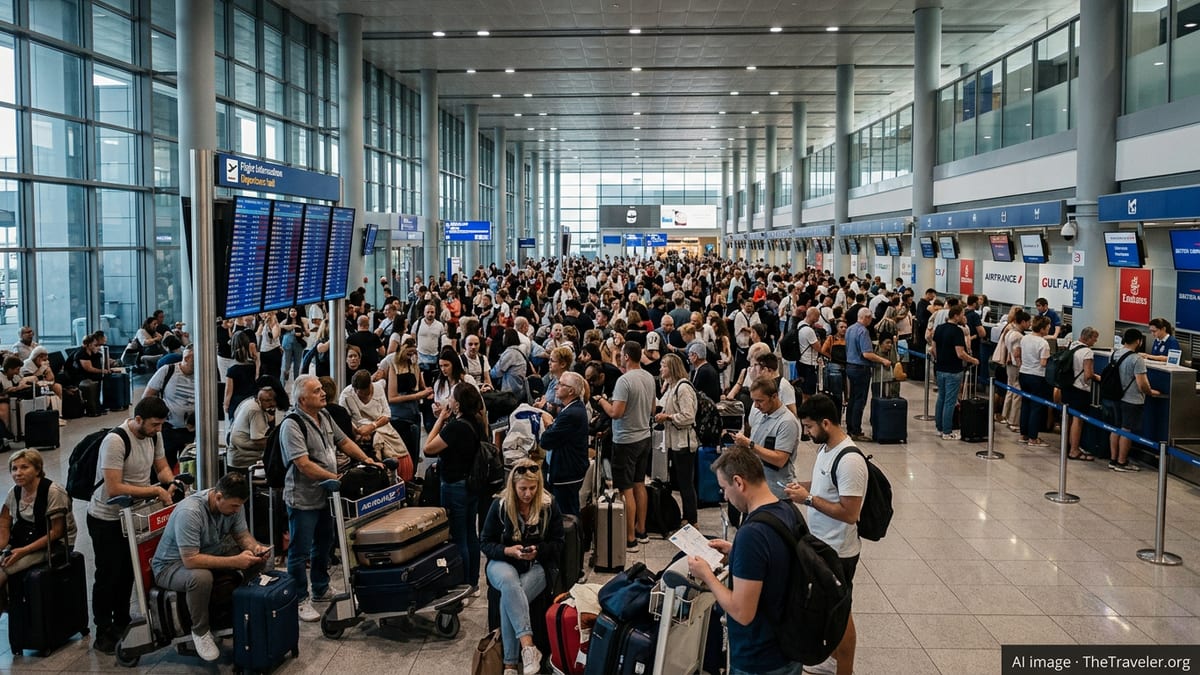
Athens International Airport is entering the peak of the 2026 tourism season with record traffic levels across Greek airspace, straining an already stretched air traffic system and leaving many passengers facing longer waits on the ground and in the air.
Get the latest news straight to your inbox!
Record volumes as Greece hits new traffic highs
Publicly available data from the Hellenic Civil Aviation Authority and Eurocontrol show that flight activity over Greece has climbed to unprecedented levels this summer, with daily movements surpassing previous records set in 2025. Recent figures indicate that on the first weekend of July 2026, flights in Greek airspace exceeded 4,900 in a single day, edging past last year’s high and underscoring the intensity of demand.
Athens International Airport, the country’s main gateway, sits at the heart of this surge. The hub has posted solid growth for several consecutive years, with airport statistics and airline reports pointing to steady increases in both passenger numbers and aircraft movements through 2024 and 2025. As Greece’s tourism industry expands and new long-haul connections are added, Athens has been positioning itself as one of Europe’s fastest growing transfer hubs.
Industry analyses describe the airport as climbing the European rankings in connectivity, helped by the network growth of Aegean Airlines and other carriers that use Athens as a base. Additional capacity and new routes have generated more options for travelers but have also tightened the margin for error in the airport’s daily operations, particularly at peak hours in summer.
This season’s traffic growth comes on top of already elevated volumes recorded last year, leaving limited headroom in airspace and terminal capacity. As a result, even modest operational disruptions can quickly ripple through the system, creating clusters of delays around Athens and other busy Greek destinations.
Delays ease on paper but remain visible to travelers
Official statistics for June 2026 paint a nuanced picture. According to recent Hellenic Civil Aviation Authority updates, average air-traffic-related delays per flight at Athens International Airport declined compared with the same month in 2025, with the mean delay reported at a little over four minutes. Network-wide delays in Greek airspace also showed a reduction in total minutes compared with the previous summer.
Despite this improvement in aggregate figures, anecdotal reports from travelers and airlines highlight a different reality during peak days. Social media posts and traveler forums describe long queues at check-in and security during early morning bank departures, as well as aircraft holding patterns on approach to Athens at busy evening waves. While not every delay is attributable to the airport or air traffic control, the overall experience for passengers can feel increasingly unpredictable.
Operational data compiled by independent aviation trackers indicate that a notable share of flights to and from Athens in recent months have experienced significant delays. These records show that while many services still depart close to schedule, a non-trivial minority encounter disruptions exceeding 30 or 60 minutes, enough to trigger missed connections and last-minute rebookings for connecting passengers.
For travelers, the apparent disconnect between improving averages and persistent bottlenecks comes down to concentration. Delays are heavily clustered in specific time windows, particularly on peak summer weekends when arrivals and departures are tightly packed, magnifying the impact of even minor slowdowns in the system.
Structural constraints in Greece’s air traffic system
The pressure on Athens Airport is closely linked to broader limitations in Greece’s air navigation infrastructure. Eurocontrol’s latest network briefings identify Greece among the European states contributing a notable share of en-route delay minutes, with the Athens Area Control Center repeatedly mentioned as a hotspot affected by capacity constraints and staffing pressures.
Public documents from European institutions and the Hellenic Civil Aviation Authority describe ongoing challenges in modernizing systems and fully staffing critical control centers. Parliamentary questions at EU level and recent technical reports point to long-standing concerns about aging surveillance and communication equipment used to manage traffic in and out of Athens, as well as the high reliance on overtime to cover peak periods.
In the past two years, several technical incidents have highlighted those vulnerabilities. Published coverage has documented radar and communication glitches affecting Greek airspace, including disruptions that temporarily limited the ability of controllers to manage normal traffic flows. Even when quickly resolved, such events tend to create hours of knock-on delays at Athens and other airports, as aircraft are rerouted, spaced further apart or held on the ground.
Sector observers note that these issues are not unique to Greece, with many European states contending with the simultaneous challenges of outdated infrastructure, staff shortages and rising demand. However, the rapid rebound of tourism in Greece, combined with the country’s geographic role as a bridge between Europe, the Middle East and North Africa, has made Athens particularly exposed to network stresses.
Airport and airlines race to keep pace with demand
While air navigation capacity is largely outside the airport operator’s control, Athens International Airport and its airline partners have spent recent seasons preparing for heavier loads. Investor reports and airline statements describe targeted terminal upgrades, process changes and expanded summer schedules designed to smooth passenger flows during peak hours.
Aegean Airlines, the airport’s largest carrier, has reported record annual passenger numbers and continues to introduce new destinations, including long-haul and regional routes that feed through Athens. The airline has added capacity for the 2025 and 2026 seasons, with millions of additional seats offered compared with pre-pandemic levels. This growth supports Greece’s tourism sector but also increases the complexity of daily operations at the hub.
Airport statistics released for 2025 show that both domestic and international traffic through Athens continued to climb, with double-digit growth in some months compared with the prior year. To accommodate this demand, the airport has relied on its satellite terminal during the busiest periods, along with schedule coordination efforts intended to distribute movements more evenly across the day.
Industry analysts say that these measures have prevented a more severe deterioration in on-time performance, but that they may not be sufficient if traffic continues to outpace infrastructure investments. As more airlines add services to Athens, competition for gate space and runway slots is intensifying, leaving fewer options to reassign aircraft when disruptions occur.
What travelers can expect for the rest of the summer
With the main holiday weeks still ahead, forecasts from Eurocontrol and Greek aviation authorities point to sustained high traffic levels over and around Athens International Airport. Network projections indicate that European air traffic in July and August 2026 will remain at or above previous records, keeping pressure on capacity-constrained regions, including Greek airspace.
For passengers planning to travel through Athens in the coming weeks, publicly available guidance and recent traveler experiences suggest a cautious approach. Recommendations commonly include allowing extra time at the airport, particularly for early morning and late evening departures, and building longer connection windows where possible to reduce the risk of missed onward flights.
Weather patterns, regional geopolitical developments and ongoing modernization work in European air traffic control centers could all influence the exact scale of delays as the season progresses. Even on days when Athens records relatively modest average delay minutes, local peaks can still arise if storms, technical issues or staffing constraints intersect with already dense schedules.
Looking beyond this summer, policy discussions at national and European level indicate a growing focus on bolstering the resilience of Greece’s aviation system through technology upgrades and staffing measures. Until those changes translate into day-to-day operations, however, Athens International Airport is likely to remain a case study in how record traffic volumes and mounting delays can test the limits of a popular Mediterranean gateway.