


More news on this day
A passenger ship became stranded on a section of the Rhine River this week after prolonged dry weather and an early-summer heat wave drove water levels so low that navigation margins all but disappeared, underscoring how climate-linked extremes are increasingly reshaping both holiday travel and European inland shipping.
Get the latest news straight to your inbox!
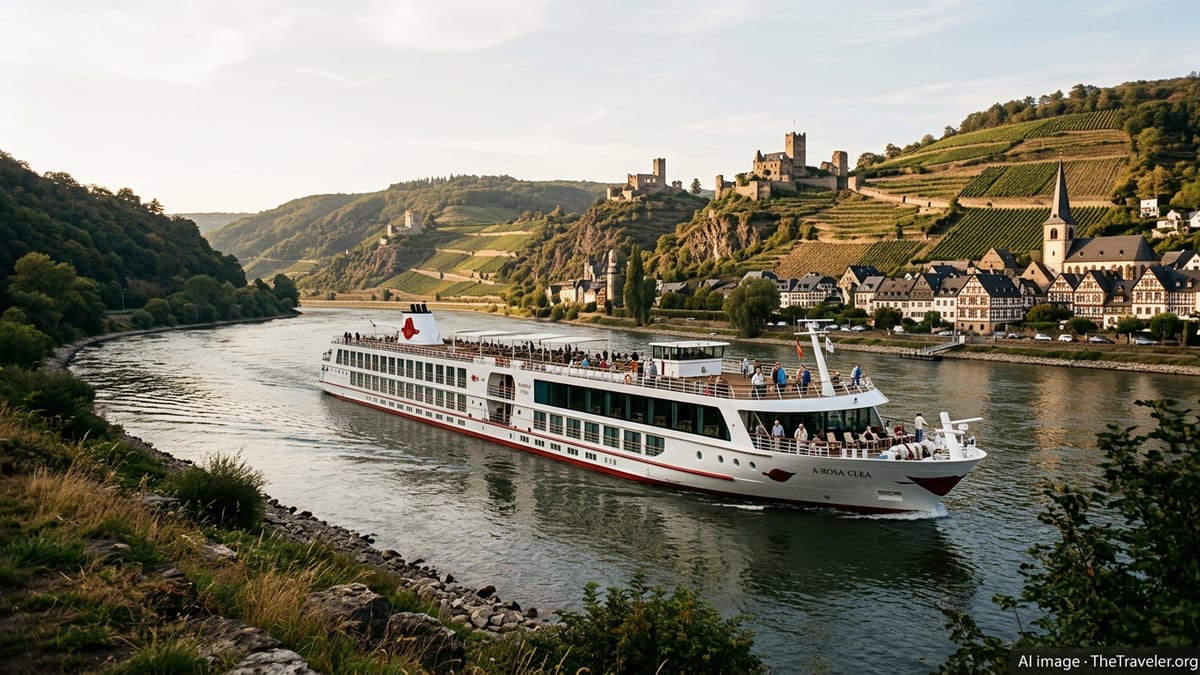
Stranding highlights vulnerability of Rhine passenger traffic
Initial local reports indicate that the vessel, operating a multi-day cruise itinerary on a central stretch of the Rhine frequently used by river ships, was forced to halt operations when gauges dropped below safe thresholds and a shallow section became impassable. No injuries were reported and there has been no indication of pollution, but passengers faced delays and improvised onward travel while the ship awaited assistance and a navigable water level.
According to publicly available river-monitoring data, the incident coincides with a sharp decline in measurements at key Rhine gauges in late June, including Kaub, a bottleneck reach that often governs whether larger river cruise ships can safely continue. Forecasts compiled by German hydrological agencies in recent days have pointed to a continued downward trend, with probabilities increasing for levels that significantly constrain vessel draft and maneuverability.
River-cruise specialists tracking conditions for travelers have been flagging the Rhine as an area of concern since early June, noting a growing number of shallow "benches" that require careful navigation and, in some cases, itinerary changes. While cargo operators can sometimes respond by loading less freight, passenger vessels have far less flexibility once a voyage is underway, particularly in narrow, rock-lined sections where turning or reverse maneuvers are limited.
The stranded vessel was eventually stabilized and secured while authorities evaluated refloating options aligned with updated water-level outlooks. Passengers were offered alternative arrangements including coach transfers and hotel stays ashore, in line with common contingency practices among European river-cruise operators when sections of the Rhine become unnavigable.
Heat wave and dry spell drive rapid level plunge
The grounding comes during an intense heat wave spanning parts of western and central Europe, with daytime temperatures climbing well above seasonal norms across the Rhine basin. Hydrological analyses published in recent days describe a combination of limited spring precipitation, above-average evaporation and soil moisture deficits that has curtailed inflows into the river system.
Industry-focused coverage has charted a step-by-step decline in Rhine levels through June, particularly between Koblenz and Bingen, where the fairway narrows and the riverbed is more exposed to low-flow extremes. At Kaub, a widely watched reference point for both freight and passenger operators, gauges have been trending from late-May highs toward thresholds historically associated with draft restrictions and added surcharges for cargo movements.
Energy and logistics publications have already linked this low-water phase to reduced barge loading and more complex fuel supply chains for inland refineries and depots, indicating that the current episode is affecting far more than leisure traffic. The passenger ship stranding is emerging as a visible symbol of pressures that have been building quietly in freight schedules and industrial planning throughout the month.
Hydrologists note that, while individual low-water events are not new on the Rhine, their timing and intensity are increasingly interacting with higher summer temperatures. For travel operators, that means shorter lead times between normal navigation and critical low-water conditions, leaving less margin to adjust itineraries before a disruption such as a stranding occurs.
Impacts for river cruise passengers and summer tourism
For those on board the affected ship, the sudden halt to the voyage meant missed ports, revised excursion schedules and an abrupt shift from river cruising to overland travel. Passenger accounts shared on social platforms describe coach transfers to maintain access to key sightseeing stops along the Middle Rhine, including castle towns and vineyard villages that rely heavily on cruise traffic at this time of year.
Travel advisors and cruise forums had already been cautioning prospective Rhine guests in 2026 to build flexibility into plans, pointing to previous seasons when low water forced “ship swaps,” overnight hotel stays or partial itinerary cancellations. The latest stranding is likely to reinforce that message and may prompt operators to communicate contingency scenarios even more clearly during the booking process.
Local businesses along the riverbanks face a dual effect. While a stranded ship can generate a short-lived spike in spending by passengers housed ashore, sustained low-water episodes typically reduce the total number of vessels passing through, with knock-on impacts for restaurants, guides and attractions that count on predictable call patterns. Tourism boards in Rhine towns have increasingly been emphasizing rail and road access in their promotions to buffer against river-related volatility.
For international travelers choosing between Europe’s major rivers, the current conditions may temporarily tilt some demand toward itineraries on the Danube or Seine where water levels are presently more stable. However, operators note that similar extremes have affected those rivers in past years as well, reinforcing a broader message that river cruising is more weather-sensitive than ocean cruising and that conditions can vary sharply from one season to the next.
Freight and energy supply chains under renewed strain
The same hydrological squeeze that stranded the passenger ship is reverberating through Rhine freight corridors that move fuel, chemicals and raw materials between North Sea ports and inland industrial centers. Recent analyses by shipping and energy outlets describe barges carrying less than half their typical loads on certain segments, a strategy that maintains service but requires more individual trips, higher costs and, ultimately, a greater vulnerability to further drops in water level.
Logistics briefings over the past month have highlighted a pattern familiar from previous low-water crises: as the river becomes shallower, transport capacity tightens, freight rates rise and companies begin to consider shifting part of their flows to rail or road. For refineries and power plants that depend on the Rhine, this means drawing more heavily on stockpiles and contingency contracts, particularly for oil products and coal.
Infrastructure operators on the Rhine have been emphasizing the role of dredging, fairway management and targeted river engineering to preserve minimum navigation depths, but technical limits remain. When levels sink below key gauge thresholds, there is little that can be done in the short term beyond adjusting loads, accepting delays and waiting for significant rainfall across the catchment.
With the latest stranding adding a high-profile example from the passenger sector, the current episode may accelerate existing discussions about how to invest in more resilient inland logistics, including stronger multimodal links that can absorb sudden reductions in river capacity.
Climate change pushes Rhine planning to new edge
Researchers and cross-border navigation bodies have been warning in recent years that climate change is altering the Rhine’s flow regime, increasing the frequency of both low-water and high-water extremes. An annual report issued earlier this year pointed to stretches of 2024 that saw unusually benign conditions, but emphasized that this should not be taken as a new normal, given modeling that shows a likely rise in hydrological volatility over coming decades.
Policy discussions documented by regional river commissions focus on a mix of structural and operational responses: deepening critical channels, refining water-level forecasting, and improving information sharing with ship operators so that routing decisions can be made earlier. The stranding of a passenger vessel in the current low-water phase is likely to be examined as a case study in how quickly conditions can deteriorate even with modern monitoring tools.
For the travel industry, climate-linked shifts are translating into practical decisions about when and how to schedule Rhine itineraries. Some river-cruise brands have already begun adjusting shoulder-season dates, diversifying to other European waterways or adding overland extensions that can operate independently of river depth. Others are investing in ship designs with shallower drafts and enhanced maneuvering systems tailored to increasingly capricious water levels.
In the near term, attention remains fixed on the Rhine’s gauges and weather forecasts. A sustained period of rain across the river’s headwaters could restore safer margins for navigation and allow the stranded vessel’s route to reopen. Until that happens, the incident stands as an early-summer warning that Europe’s signature river is entering another season where every centimeter of water can reshape journeys for both tourists and critical cargo.