


More news on this day
Shenzhen’s rapidly expanding metro network has taken another step forward with the opening of Line 13’s Phase II northern extension, a 19 kilometer segment that strengthens links between the city’s western tech corridor and its fast-growing Guangming district.
Get the latest news straight to your inbox!
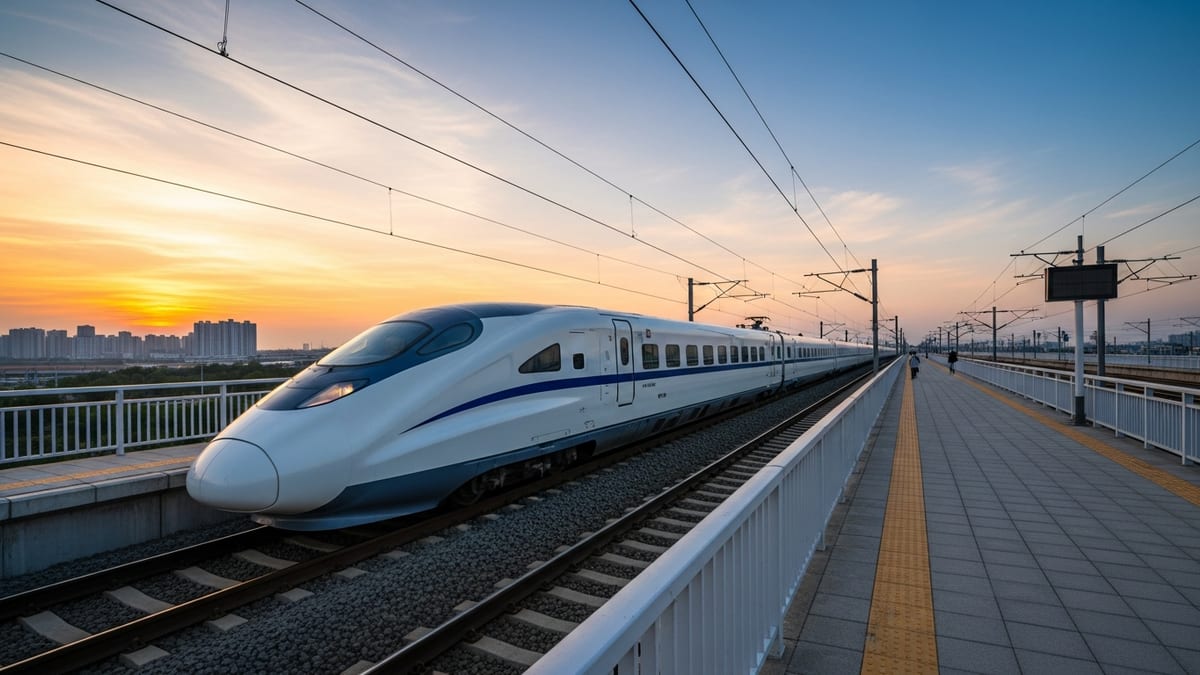
New section connects Shangwu with Lisonglang
According to publicly available project information, the newly opened Phase II northern extension of Line 13 adds around 19.25 kilometers of track running north from Shangwu to Lisonglang, all in underground alignment. The opening follows trial operations and safety inspections that were completed earlier this year, paving the way for full passenger service.
The extension introduces 11 new stations, bringing additional coverage to neighborhoods in Bao’an and Guangming that previously relied more heavily on buses and road traffic. Reports indicate that the new segment has been integrated directly with the existing Line 13 alignment, allowing through services from the southern terminus at Shenzhen Bay Checkpoint up to the new northern endpoint at Lisonglang.
With the start of initial operations on June 28, Line 13 in its current form now functions as a continuous north–south spine across Shenzhen’s western side. The project forms part of the city’s Phase IV urban rail expansion program, which has focused on closing network gaps and serving new residential and industrial zones.
Shorter journeys between tech hubs and Guangming
Coverage in English-language local media notes that the completed Line 13 corridor now links Nanshan’s high-tech cluster with Bao’an’s manufacturing areas and Guangming’s emerging innovation zone. For commuters, the new journey pattern significantly shortens cross-city trips that previously required transfers and circuitous routes.
Reports on the opening describe travel times of around 45 minutes between Shenzhen Bay Port, near the coastal tech and commercial belt, and central Guangming using Line 13. This is expected to make the northern district more attractive for residents working in Nanshan and Bao’an, and to ease pressure on several existing east–west and orbital lines that had been handling a share of north–south demand.
As with other recent Shenzhen metro expansions, the new section is equipped with modern signaling and passenger information systems to support relatively short intervals between trains during peak hours. Public information shows that Line 13 typically runs from early morning to late evening, with headways around five minutes or less during the busiest periods.
Network length and station count reach new milestones
Data released around the launch of the extension indicate that Shenzhen’s operational urban rail network has now reached approximately 653.7 kilometers in length, served by more than 450 stations. The Line 13 Phase II northern extension alone accounts for 11 of those stations and forms a substantial addition in the western part of the city.
Line 13 itself has grown rapidly in a short period. Phase I, linking Shenzhen Bay Checkpoint with Shangwu, began full operation in late 2025 after its north section came online, and the new Phase II now pushes that corridor deeper into Guangming. Metro mapping services show that the line intersects with multiple other routes, offering transfer options that knit the new neighborhoods into the broader system.
The expansion fits within Shenzhen’s long-term ambition to maintain one of the largest and densest metro networks in China, supporting both daily commuting and regional integration within the Greater Bay Area. Each successive extension has contributed incremental gains in connectivity and helped distribute passenger flows across a wider set of corridors.
Engineering features and construction background
Public project documents trace the northern extension’s origins to a contract awarded in 2020 for the second phase of Line 13, with construction responsibilities divided among several large domestic engineering firms. The scope covered tunneling, station fit-out and systems installation across roughly 19 kilometers of fully underground route.
Local coverage highlights Hong’ao Park Station as one of the notable engineering showcases on the extension. The site has been cited as a pilot for prefabricated metro station construction in Shenzhen, using factory-produced structural components and extensive digital project management to reduce on-site disruption, shorten timelines and improve quality control.
As with the rest of Line 13, the Phase II section is operated under a public–private partnership structure involving Shenzhen Metro and an MTR-affiliated consortium. This arrangement, already in place for Phase I, is intended to bring experience from other high-frequency urban rail systems while keeping the assets under municipal oversight.
Greater Bay Area integration and future developments
Commentary in local business and transport media frames the Line 13 Phase II northern extension as part of a broader push to deepen connectivity within the Guangdong–Hong Kong–Macao Greater Bay Area. By improving access between Shenzhen’s coastal technology parks, inland industrial hubs and new residential clusters, the corridor is expected to support more balanced urban growth.
The line’s southern terminus at Shenzhen Bay Checkpoint positions it close to one of the key cross-border gateways to Hong Kong, while the northern stretch serves Guangming, which is being promoted as a strategic innovation and advanced manufacturing node. Observers note that recent rail investments on both sides of the boundary are steadily tightening travel links across the metropolitan region.
Further changes to Line 13 are still anticipated. Planning information indicates that additional works, including a southern Phase II element and the completion of the Xili high-speed railway station as an infill stop, are scheduled to follow in the coming years. For now, the opening of the Phase II northern extension marks a significant step in turning Line 13 into a full-length backbone route serving Shenzhen’s western corridor.