


For budget-conscious travelers landing at Rio de Janeiro’s Galeão International Airport (GIG), the alphabet soup of BRT, VLT, metro and the new Terminal Gentileza can be confusing. Used well, this network can get you from the airport to downtown, Copacabana or even Santos Dumont Airport for a fraction of a taxi fare. Used badly, it can mean long walks with heavy bags and multiple crowded transfers. This guide breaks down how the system works today, what it really feels like in practice, and when public transport in Rio is not worth the savings.
Get the latest updates straight to your inbox!
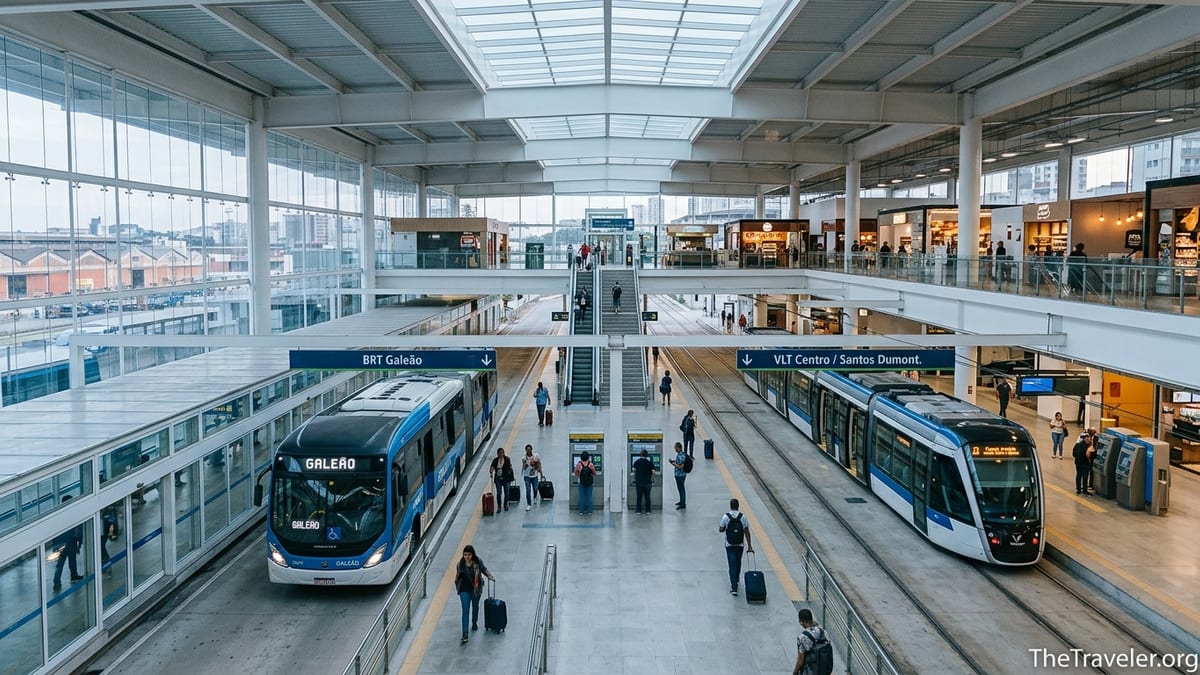
Understanding Rio’s Airport Transport Network in 2026
Galeão International Airport sits on Ilha do Governador, north of Rio’s main tourist areas. There is no metro station at the airport itself. Instead, the backbone of public transport here is the BRT system, especially the TransCarioca corridor, which directly serves the airport. From BRT, you connect to the metro and to the city’s light rail network, the VLT.
In recent years Rio has reconfigured much of its transit network, and the key piece for airport passengers is Terminal Intermodal Gentileza. This large hub near the city’s main long-distance bus station concentrates BRT lines, regular buses and two VLT lines that continue into the historic center, business district and Santos Dumont Airport. If you hear locals talking about “pegar o BRT pro Gentileza,” this is what they mean.
For visitors, the most useful idea is that you can think of your journey from Galeão in two stages. First, you get off the island using a BRT service from the airport. Second, you decide where to change: either at a metro interchange on the TransCarioca corridor or at Terminal Gentileza for connections by VLT and bus. Which one makes sense depends on your budget, destination and how much luggage you are carrying.
Prices and timetables change regularly, but as of mid 2026 you should expect BRT and VLT single rides to be in the same ballpark as regular city buses, while executive or express services cost a bit more. Always check the most recent fare at ticket booths or machines before boarding, and keep some small cash or a contactless card ready in case you need to buy or recharge a local transit card.
From Galeão by BRT: Regular, Express and “Not Quite Airport Bus” Options
The most important service for passengers at Galeão is the TransCarioca BRT, which runs across the north of the city and links the airport with areas like Madureira, Fundão and Barra da Tijuca. At Galeão’s terminals you will see clearly signed BRT platforms, usually with separate boarding areas for services heading toward Terminal Alvorada / Barra and services heading toward Terminal Gentileza and Deodoro. In practice, the BRT feels more like a metro on wheels, with high platforms and off-board payment.
From the airport, most budget travelers either take a regular TransCarioca BRT toward Vicente de Carvalho station, where there is a direct connection to Metro Line 2, or they choose the BRT that runs directly to Terminal Gentileza. The first option is usually cheaper and makes sense if you are going straight to neighborhoods like Botafogo, Flamengo, Catete, Centro or Zona Norte along the metro. The second is increasingly popular with travelers heading to the long-distance bus station, Praça XV ferries or Santos Dumont Airport using the VLT.
There is also a dedicated executive BRT linking Galeão and Terminal Gentileza, operating as an express line that runs non-stop between the airport and the terminal. Locals often refer to it as an executive or airport BRT because it is faster and a bit more comfortable, with fewer standees and luggage space near the doors. The fare is higher than regular BRT, but still significantly below a taxi or app car for the same route. This line is a strong option if you are changing to VLT or buses at Gentileza and you value a shorter, smoother ride off the island.
In normal weekday daytime traffic, the ride from Galeão to Terminal Gentileza by express BRT can take around 25 to 35 minutes, while the all-stop TransCarioca services might take closer to 40 minutes if you stay on until a metro or rail interchange. At night and early mornings, the BRT is usually faster because it benefits from dedicated lanes and avoids most of the traffic that slows down taxis and ride-hailing cars on the access roads.
Terminal Gentileza: Rio’s New Airport Gateway
Terminal Intermodal Gentileza, inaugurated in 2024 and expanded through 2025, is now one of Rio’s main transport hubs. Strategically located near the Novo Rio bus station, it brings together the TransBrasil BRT corridor, TransCarioca connections, more than twenty municipal bus routes and the VLT’s Line 1 and Line 4. For airport passengers it effectively works as a giant front door to the city, especially if you need to connect to regional buses, ferries or the domestic airport.
Upon arrival from Galeão on the BRT, passengers are dropped inside the terminal’s enclosed platforms. Escalators and elevators lead up to the main concourse, which houses ticket offices, restrooms, convenience shops and waiting areas, including a dedicated waiting room for the Galeão service. This upper level is useful if you want a brief pause to buy water, a SIM card or a snack before continuing to the city center, especially after a long overnight flight.
From the concourse, it is a short, signposted walk to the VLT platforms. Line 1 runs from Terminal Gentileza through the Porto Maravilha area and downtown to Santos Dumont Airport, while Line 4 connects Gentileza directly with Praça XV near the ferries to Niterói. If you are arriving from another Brazilian city by bus, you can also use the VLT from the Rodoviária stop right beside the terminal, following signs for VLT / VLT Carioca as soon as you leave the bus station’s doors.
In practical terms, Terminal Gentileza lets you do things that were once far more complicated on public transport. If you land at Galeão and need to reach Santos Dumont for a connection to São Paulo or Belo Horizonte, you can now ride the express BRT to Gentileza and simply board VLT Line 1 all the way to the domestic airport. If you are taking a ferry to Niterói, you can switch to VLT Line 4 and get off at Praça XV, a short walk from the ferry terminal. And if you are catching an overnight coach to places like Paraty, Búzios or Belo Horizonte, you simply walk or take the VLT one stop to the bus station.
Riding the VLT: From Gentileza to Centro, Praça XV and Santos Dumont
Rio’s VLT (Veículo Leve sobre Trilhos) is a modern light rail system serving the city’s central areas, waterfront and airport. For Galeão passengers, the most relevant lines are Line 1 and Line 4. Both start at Terminal Gentileza and then branch across downtown: Line 1 heads toward the waterfront and Santos Dumont Airport, while Line 4 heads toward Praça XV along the historic center. Stops are close together and the vehicles are low-floor, which makes them fairly convenient with cabin luggage or a backpack.
If you are heading to a hotel in Centro, Lapa or Cinelândia, you can often stay on the VLT for only a few stops. For example, someone staying near Cinelândia square could take VLT Line 1 from Gentileza, ride through the Porto Maravilha area and disembark at the Cinelândia or Carioca stop, then walk five to ten minutes to their accommodation. A traveler catching a ferry to Niterói might choose Line 4 and get off at Praça XV, right by the colonial-era square and ferry terminal.
For airport-to-airport transfers between Galeão and Santos Dumont, the VLT is now the backbone of a nearly continuous rail-like journey. In practical terms the trip looks like this: from Galeão terminal, you board the executive BRT to Terminal Gentileza, climb to the concourse and then descend to the VLT platform for Line 1. You remain onboard as the VLT glides past the redeveloped port district, passes Central do Brasil rail station and continues along Avenida Rio Branco, eventually depositing you right at the Santos Dumont terminal doors. The whole journey can take around one hour during off-peak times and is usually consistent, compared with unpredictable traffic by road.
One important detail is ticketing. The VLT uses contactless validators inside the vehicles and relies heavily on local smartcards such as the Jaé card. While inspectors occasionally check tickets, there are no turnstiles, so you need to validate correctly even if you see others skipping it. At Gentileza and downtown stops you will find ticket machines and counters where you can buy or recharge cards. If you are staying several days and plan to use the system daily, consider loading a reasonable amount on your card to avoid queuing after each long trip.
Metro Connections: When to Change at Vicente de Carvalho or Central
Although the metro does not reach Galeão directly, it remains one of the fastest and safest ways to cover long distances across Rio, especially toward the South Zone beaches. The most straightforward BRT-to-metro interchange on the way from the airport is Vicente de Carvalho station, where TransCarioca meets Metro Line 2. Here, high-level BRT platforms sit next to the metro station, and clearly signposted walkways lead passengers from one system to the other.
In practice, a traveler landing at Galeão at midday and heading to Copacabana might do the following: board a TransCarioca BRT from the airport, get off at Vicente de Carvalho, tap into Metro Line 2 toward Botafogo, and then stay on the train as it becomes Line 1 at Central and continues to stations such as Flamengo, Catete, Glória and eventually Siqueira Campos or Cantagalo in Copacabana. This involves just one change from busway to metro, and the rest of the trip is underground, unaffected by traffic or most weather conditions.
Another important connection point is Central do Brasil, which is served by both the metro and the VLT. Travelers who have already taken the BRT to Terminal Gentileza and then boarded a VLT can get off at the Central VLT stop and enter the metro network there, switching between Lines 1 and 2 depending on their final destination. For example, someone heading to Maracanã stadium from the airport might take BRT to Gentileza, VLT to Central, then metro Line 2 to Maracanã station for an evening football match.
MetroRio operates from early morning to around midnight on most days, with slightly shorter hours on Sundays and holidays. Stations such as Botafogo, Carioca, General Osório and Jardim Oceânico are especially popular with visitors. Many of them have restrooms and better lighting and security than some surface bus stops. If you are arriving late at night and feel uneasy about walking through deserted downtown streets, it is often worth staying on the metro until a station close to your accommodation and then taking a short taxi or app ride from there.
Tickets, Payment and Luggage: What to Expect on Board
Rio’s public transport system uses a mix of ticketing methods, but the common thread is the smartcard. The Jaé card has gradually become the standard across BRT, VLT and many buses, replacing older cards like the Bilhete Único Carioca. You can usually buy a card and load credit at airport kiosks, terminal ticket offices like those at Gentileza, and some metro stations. Machines often accept banknotes and cards, but they may not support foreign credit cards reliably, so carrying some Brazilian reais is wise.
On BRT, you typically validate your card at the station entrance rather than inside the bus. This means that platforms can feel like small metro stations, with gates or validators you must tap before boarding. At Galeão, the BRT platforms are integrated into the airport, with elevators and escalators from the arrivals level. When boarding the executive line to Gentileza, expect staff presence and possibly a separate validator area marking the different fare category.
Luggage is an important consideration. The BRT buses running to and from Galeão are designed with extra standing space and limited racks near the doors, but they are not full-scale airport coaches. During peak times you may find yourself sharing space with commuters carrying backpacks and shopping bags, so large suitcases can be awkward. On the VLT, there are no dedicated luggage compartments; instead, passengers place suitcases beside their seats or stand with them in the open sections between doorways. Because of this, public transport in Rio works best for travelers with one rolling suitcase and a small backpack, rather than multiple oversized bags.
Security-wise, treat BRT, VLT and metro services as you would any big-city transit system. Keep bags closed, avoid displaying expensive electronics near open doors and be cautious in crowded sections, especially between Central and downtown stations. Many travelers use these services daily without issues, but petty theft can occur. When in doubt, keep backpacks on your front and avoid placing valuables in external pockets while standing near exits.
When Public Transport Is Not Worth It
While BRT, VLT and metro can dramatically cut costs, they are not always the smartest choice. A key factor is time of day. If your flight lands at Galeão after 22:30, you may find reduced frequencies on BRT and metro, fewer staff in stations and emptier platforms, especially on weekends. In such cases the savings from public transport might not justify the longer travel time and potential discomfort, particularly if you are unfamiliar with the city or carrying bulky luggage.
Another consideration is your destination. If you are staying in a hilltop part of Santa Teresa, a narrow side street in Vidigal, or a more distant residential area without easy metro access, you will likely face a complex connections chain: BRT or VLT, then metro, then a bus or app car up a steep hill. In these scenarios a door-to-door taxi or ride-hailing service from the airport might cost more but save you an hour or more of dragging bags over cobblestones and stairs.
Group size also matters. For a solo backpacker, paying a modest BRT and VLT fare to reach a hostel in Lapa can be a great trade-off. For a family of four with two large suitcases apiece, the combined public transport fares plus the effort of transferring at Gentileza, Central and a final metro station may equal or exceed the price of a single app car, especially during off-peak times when dynamic pricing is low. Many families end up choosing a rideshare simply because it is easier to keep everyone and everything together.
Lastly, think ahead if you have tight connections. If you land late at Galeão with only ninety minutes to catch a domestic flight from Santos Dumont, relying on a perfect BRT and VLT connection can be risky. Any delay at immigration, baggage claim or the ticket machines at Gentileza can eat into your margin. In such cases, a direct taxi or app-based ride using the main expressways will usually be the safer option even in heavy traffic, and some airlines explicitly recommend this in their connection guidance.
Real-World Itineraries: What Works Best for Common Routes
To make the network feel more concrete, it helps to visualize a few typical journeys. Imagine an arriving passenger staying at a hotel near Copacabana Beach. During daytime on a weekday, a sensible route is to take TransCarioca BRT from Galeão to Vicente de Carvalho, transfer to Metro Line 2 toward Botafogo, stay on as the service becomes Line 1, and then get off at Siqueira Campos or Cantagalo station. From there, most hotels along Avenida Nossa Senhora de Copacabana are a short walk away.
Another common scenario is a traveler heading from Galeão to Santos Dumont Airport for a domestic connection. In this case, the most straightforward public transport journey is often to take the executive BRT from Galeão to Terminal Gentileza, then switch to VLT Line 1 all the way to the Santos Dumont stop at the airport doors. The transfer at Gentileza is fully within the terminal complex, which means you avoid crossing major roads with luggage.
For those connecting to long-distance buses at Novo Rio, such as coaches to Paraty, Búzios or Minas Gerais, the route is similar. You ride BRT from the airport to Terminal Gentileza, then either walk across to the Novo Rio bus station or take the VLT one stop to the Rodoviária station, depending on your luggage and comfort level. Many Brazilian travelers now choose this combination instead of older, slower city buses that used to link the airport and the bus station.
Finally, consider someone arriving at Galeão for a stay in Lapa, known for its nightlife and arches. One option is to use the same BRT plus metro route via Vicente de Carvalho and exit at Cinelândia or Carioca station, then walk or take a quick taxi to Lapa. Another is BRT to Terminal Gentileza followed by VLT to a central stop like Carioca or Cinelândia. In both cases, the last few blocks through Lapa’s streets are often easier by short taxi ride, especially late at night or with heavy backpacks.
The Takeaway
Rio de Janeiro’s evolving public transport network offers budget travelers from Galeão a set of realistic, money-saving options. The combination of TransCarioca BRT services, the increasingly important Terminal Gentileza and the VLT and metro connections into Centro, the South Zone and Santos Dumont can be efficient and surprisingly straightforward when you understand the basic geography and where to change.
At the same time, these systems were designed primarily for residents, not for tourists with oversized bags and jet lag. Stations can be crowded at peaks, escalators and lifts sometimes fail, and signage may favor Portuguese speakers. Public transport shines when you travel light, have time to spare and are heading to well-connected districts like Centro, Lapa, Botafogo or Copacabana. It is less attractive late at night, for complex hilltop addresses, or when tight flight connections leave no room for delay.
Before you land, take a few minutes to map your exact accommodation and decide whether your priority is saving money or saving energy. If you are comfortable with a BRT ride to Gentileza and a smooth glide on the VLT or metro, you can arrive in the heart of Rio having spent only a small fraction of what a taxi would cost. If not, there is no shame in ordering a car and using the public network later, when you explore the city with a lighter load.
FAQ
Q1. Can I go directly from Galeão Airport to the metro?
Not directly. There is no metro station at Galeão. You must first take a BRT service, typically along the TransCarioca corridor, and then connect to the metro at stations like Vicente de Carvalho or via VLT and metro at Central.
Q2. How do I get from Galeão to Santos Dumont Airport on public transport?
The most practical route is usually BRT from Galeão to Terminal Gentileza, then VLT Line 1 from Gentileza directly to the Santos Dumont stop at the domestic airport.
Q3. Is Terminal Gentileza safe and easy to use with luggage?
Terminal Gentileza is modern, well-lit and busy throughout the day, with escalators, elevators and shops. Like any big hub, you should keep an eye on your belongings, but most travelers find it manageable with one suitcase and a backpack.
Q4. Do I need a special card to use BRT, VLT and metro in Rio?
Most services accept a common smartcard such as the Jaé card. You tap in at station gates or on board the VLT. You can buy or recharge cards at airport kiosks, terminal ticket offices and many metro stations.
Q5. How much does it cost to go from Galeão to downtown by public transport?
Fares change frequently, but as a rough guide you can expect to spend only a small fraction of a typical taxi fare when using a combination of BRT and VLT or metro for a Galeão to Centro trip.
Q6. Is public transport from Galeão safe at night?
Services continue into the late evening, but frequencies drop, stations are quieter and you may feel less comfortable if traveling alone. Many visitors choose taxis or app cars at night, especially after 22:30 or if carrying valuable items.
Q7. What is the best route from Galeão to Copacabana on a budget?
A common choice is TransCarioca BRT from Galeão to Vicente de Carvalho, then Metro Line 2 and Line 1 through downtown to stations like Siqueira Campos or Cantagalo in Copacabana.
Q8. Can I reach the Novo Rio bus station from Galeão by public transport?
Yes. Take BRT from Galeão to Terminal Gentileza, then either walk or ride the VLT one stop to the Rodoviária station, which sits right by the Novo Rio bus terminal.
Q9. What if I have very large or multiple suitcases?
BRT, VLT and metro are not designed for heavy luggage. You may struggle in crowded vehicles and stations. In this case, a taxi or ride-hailing service from Galeão is usually more comfortable and can be cost-effective for groups.
Q10. How early should I leave for Galeão if I use public transport?
It is wise to leave at least two to three hours before check-in closes, allowing time for walking between platforms, buying or reloading cards and unexpected delays on BRT or VLT, especially during rush hours.