


Landing or connecting at Riyadh’s King Khalid International Airport can be confusing, especially since a major reshuffle of airlines and terminals in early 2026. National carriers, foreign airlines, domestic and international flights are now split across four active terminal zones, and showing up at the wrong building can easily cost you a flight. This clear, up to date guide walks you through exactly which terminal you need, how the recent changes work in practice, and how to avoid the most common real world mistakes travelers make at RUH.
Get the latest updates straight to your inbox!
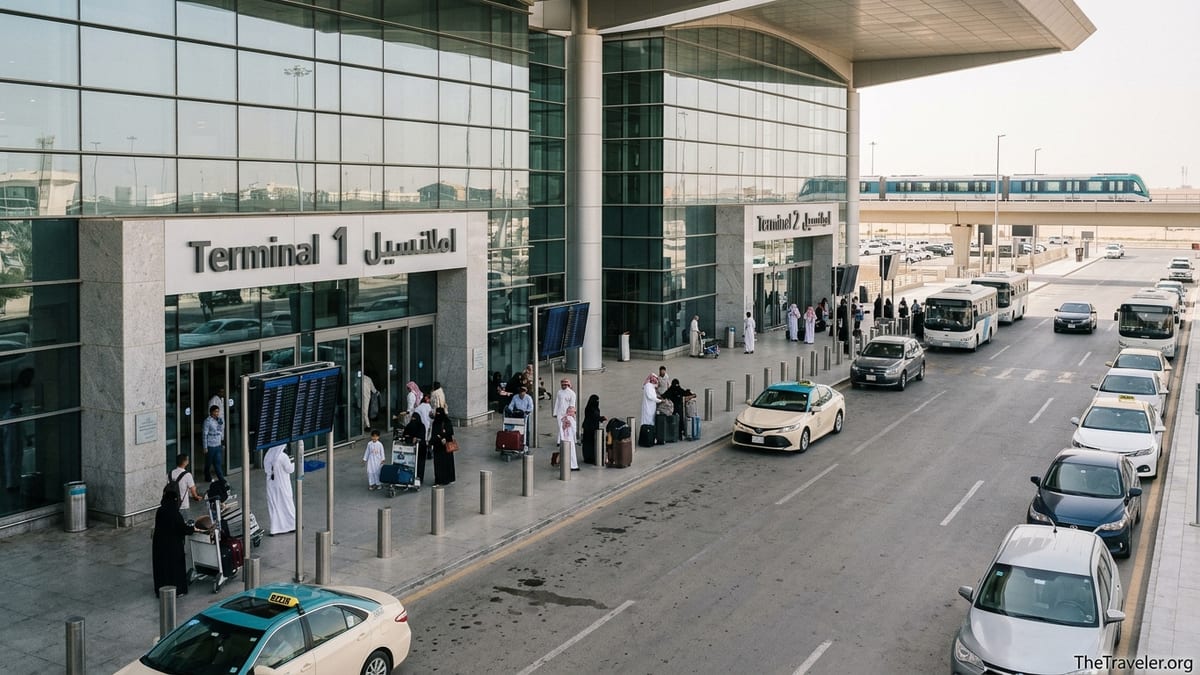
How Riyadh’s Terminals Are Organized After the 2026 Shake Up
Riyadh’s King Khalid International Airport (RUH) has five numbered terminals, but passengers now effectively use four zones: Terminal 1, Terminal 2, the combined Terminal 3/4 complex, and Terminal 5. In February 2026, airport operator Riyadh Airports Company began a terminal transfer project that reassigned flights across these buildings over a 10 day period. From mid February 2026, Terminals 1 and 2 serve international flights operated by Saudi Arabia’s national carriers, Terminals 3 and 4 handle most domestic flights for those same airlines, and Terminal 5 has become the main hub for foreign international carriers.
In practice that means Saudia, flyadeal, flynas and Riyadh Air now split their operations between two areas. If you are flying internationally on one of these Saudi based airlines, you will usually depart from Terminal 1 or 2. If you are flying domestically on them, expect to use Terminal 3 or 4. Most non Saudi airlines, from major European carriers such as British Airways and Lufthansa to regional names like EgyptAir, IndiGo, Pegasus and Ethiopian Airlines, have been grouped into Terminal 5 for both arrivals and departures.
The result is a more functional layout than in the past, when Terminal 2 and later Terminal 3 or 4 handled a constantly shifting mix of international airlines. For connecting passengers this matters a lot. Someone flying Saudia from Jeddah to Riyadh, then on to Dubai with Saudia, is now likely to arrive into Terminal 3 or 4 and then connect at Terminal 1 or 2. A traveler flying Lufthansa from Frankfurt and connecting onward on British Airways to London will probably remain within Terminal 5 for the whole connection, simplifying security and baggage handling.
Even with this restructuring, there are still exceptions, codeshares and occasional operational changes, so your boarding pass and the airport’s own “Find your terminal” tool should be treated as the final word. However, knowing the general pattern makes it much easier to sanity check your plans and spot unexpected terminal changes before you leave home.
Terminal 1: Renovated National Carrier International Hub
Terminal 1 is one of the original crescent shaped terminals at RUH and has recently undergone a major expansion and upgrade program. The renovation, highlighted by Riyadh Airports Company, has focused on modernizing the interior, improving passenger flows, and adding more check in counters and security lanes. From 2026 it is once again a frontline facility, used primarily for international flights of Saudi based carriers, especially Saudia and flyadeal, and for some codeshare flights operated by partner airlines.
A concrete example: if you book a Saudia flight from Riyadh to Paris or Cairo, your booking should now list Terminal 1 or 2 for both departure and arrival in Riyadh, rather than the older pattern of using Terminal 2 or 4. A traveler on flyadeal heading from Riyadh to Istanbul will also generally check in at Terminal 1. Some foreign airlines may appear in Terminal 1 through codeshare arrangements. For instance, a ticket sold under Etihad’s code but operated by a Saudi carrier could see you checking in at Terminal 1 even though most Etihad marketed flights use Terminal 5.
Inside Terminal 1 the feel is that of a modern Gulf hub but on a smaller scale than airports like Dubai or Doha. Travelers who have passed through recently report a limited but improving selection of cafes and fast food outlets, including familiar Saudi chains and at least one branch of the hugely popular fried chicken brand Albaik. Seating and charging points are better than in the past, and security queues are usually manageable outside peak evening departure banks to destinations such as London, Istanbul and major South Asian cities.
Operationally, Terminal 1 now pairs closely with Terminal 2. Arrivals and departures share transport links, parking and, in places, security infrastructure. If you land in Terminal 1 and have a tight self connect to a flight from Terminal 2, walking between the two is realistic in around 10 to 15 minutes for a fit traveler with hand luggage, though you still need to respect any immigration or security requirements depending on your routing.
Terminal 2: Saudia, Riyadh Air and International Growth
Terminal 2, which for several years saw partial closures and refurbishment, is now again central to RUH’s operations. Together with Terminal 1 it forms the international home for Saudi Arabia’s national carriers. The February 2026 reallocation confirmed that from that point, Terminals 1 and 2 would host international flights of Saudia, flyadeal, flynas and the new flag carrier Riyadh Air. This is a notable shift from the period when many foreign airlines used Terminal 2 instead.
For example, a passenger flying Riyadh Air nonstop from Riyadh to Mumbai or Rome now typically departs from Terminal 2. A Saudia night flight from Riyadh to London or Jakarta will also often run from this terminal, sharing check in islands and departure gates with Riyadh Air and flynas international services. Discussion among frequent travelers in Riyadh since the reopening of T2 mentions new lounges, including a showcase Riyadh Air lounge, as well as refreshed duty free and food offerings that feel significantly more up to date than the pre renovation era.
From a practical perspective, Terminal 2 is where many long haul services depart in the late evening and early morning, especially to Europe and Asia. If you are taking the Riyadh Metro to the airport, the Airport T1–2 station serves both terminals, and signage inside the station directs you to the correct building. This is useful for passengers who are not entirely sure which of the two their flight uses; you can follow overhead signs and confirmation screens without needing a taxi or bus between them.
Because T2 is in high demand for international departures, security and immigration queues here can build quickly during peak periods. To avoid stress, many seasoned travelers aim to arrive at least three hours before departure for long haul flights and two hours for regional ones, especially if traveling in economy on busy weekend evenings when flights to destinations such as Istanbul, Cairo, Dubai and major Pakistani or Indian cities can depart within minutes of each other.
Terminals 3 and 4: The Domestic Heart of RUH
Terminals 3 and 4 form a connected complex that now serves as the main domestic hub for Saudi airlines. The 2026 terminal transfer plan specifies that from late February 2026, national carriers’ domestic flights would move into T3 and T4. In everyday terms, that means if you are flying Saudia, Riyadh Air, flyadeal or flynas between Riyadh and another Saudi city such as Jeddah, Dammam, Abha or Tabuk, you are likely to depart from these terminals.
To visualize this, imagine a traveler flying from Riyadh to Jeddah on Saudia for a weekend. Their boarding pass will typically show Terminal 3 or 4. When they return and continue the same evening to London with Saudia, they will arrive into T3 or 4, collect any checked baggage if it is not through checked, and then transfer across the airside or landside connection to T1 or T2 for their international leg. Domestic only trips, such as a business commuter shuttling between Riyadh and Dammam on flynas, will begin and end entirely within the T3/4 complex.
Terminals 3 and 4 were in the past associated with international carriers, including a period when many European and Asian airlines used Terminal 3 and Saudia operated international flights from Terminal 4. That history is important because older blog posts or forum threads still describe T4 as a Saudia international terminal. Those references are now outdated. If you are seeing conflicting advice online about whether your Saudia flight to Europe uses Terminal 4 or Terminal 2, always trust the latest airport or airline communications, not a three year old itinerary.
Facilities in T3/4 mirror those in the international terminals but with a stronger focus on short haul needs. You will find fast food options, small cafes and prayer rooms, but duty free is limited compared with international areas. Domestic lounges, including Saudia’s Alfursan domestic lounge, are particularly useful for frequent business travelers who may pass through these terminals several times a week. Baggage reclaim is generally quick due to the high frequency of shuttle flights and the shorter minimum connection times often scheduled between domestic services.
Terminal 5: Foreign International Airlines and Mixed Arrivals
Terminal 5 is a more modern standalone building, set slightly apart from the original crescent terminals. Since the 2026 reshuffle it has become the primary home of foreign international airlines at RUH. Most non Saudi carriers, including large European names like British Airways, Air France, KLM and Lufthansa, Gulf and regional airlines such as Emirates, Qatar Airways, Kuwait Airways and EgyptAir, as well as South Asian and African carriers like IndiGo, PIA, Ethiopian Airlines and Royal Air Maroc, are now allocated to Terminal 5 for both departures and arrivals.
For instance, a leisure traveler flying Turkish Airlines from Riyadh to Istanbul, then connecting onward to Rome, would check in and depart from Terminal 5. Someone arriving on Lufthansa from Frankfurt and transferring to an IndiGo flight to Hyderabad can usually remain within Terminal 5 throughout the connection, re clearing security but not needing to change buildings. Etihad’s own website lists Terminal 5 as the main terminal for its operations at Riyadh, even though some codeshare itineraries may involve other terminals depending on the operating carrier.
One quirk of Terminal 5 is that its roadway layout historically placed arrivals and departures on the same level, unlike the split level kerbsides at many large airports. Local travelers have raised questions about how this will cope with the increased traffic from consolidating nearly all foreign carriers there. At busy times, such as late evening when multiple wide body flights arrive from Europe and Asia, curbside congestion can be noticeable, so arranging a pickup slightly away from the main doors or using official parking for short stays can be less stressful than having your driver circle the terminal repeatedly.
Inside the building, Terminal 5 offers a good spread of international style cafes, grab and go outlets and retail, reflecting its role serving a mainly international clientele. Travelers often note the presence of familiar Saudi brands, including branches of Albaik, which can be a welcome treat on arrival or before a long overnight flight. Lounge access is reasonable for premium cabin or status passengers, but holders of generic lounge memberships should check carefully which specific lounges their card covers, as access varies by airline and contract.
Domestic vs International Flights: Getting It Right
At Riyadh the first question you should ask yourself when figuring out your terminal is whether your journey is domestic or international and whether you are flying with a Saudi based or foreign airline. For domestic flights within Saudi Arabia, almost all services now operate from the Terminal 3/4 complex, regardless of whether you are flying on Saudia’s full service product or a low cost carrier such as flyadeal or flynas. Typical domestic routes from T3/4 include Riyadh to Jeddah, Dammam, Madinah, Abha, Gassim and coastal destinations like Yanbu.
For international flights on Saudi based carriers, expect to use Terminals 1 or 2. That covers popular routes such as Riyadh to Dubai, Doha, Cairo, Amman, London, Paris and Kuala Lumpur when operated by Saudia, Riyadh Air or their low cost sister brands. Keep in mind that some very short international hops, for example to Gulf Cooperation Council cities, may be scheduled in ways that blur the domestic vs international feel, but they still use the international terminals due to passport control requirements.
For international flights on foreign airlines, Terminal 5 is almost always the correct answer. This includes not only large global airlines but also smaller regional carriers flying to South Asia, North Africa and Central Asia. A traveler booked on IndiGo from Riyadh to Delhi, on EgyptAir to Cairo, or on British Airways to London will all usually check in at Terminal 5. If your ticket shows a codeshare flight number from a Saudi airline but another carrier is operating the aircraft, look carefully at the operating airline’s details to understand whether Terminal 5 or Terminal 1/2 applies.
Because airline allocations can change with new routes and schedule seasons, you should always verify your terminal the day before travel. Many real world complaints about RUH involve passengers assuming “all Saudia flights use Terminal 4” or “all foreign airlines use Terminal 5” based on outdated information, then arriving at the wrong building. A two minute check in your airline’s app, combined with the airport website’s terminal finder, is far more reliable and can save you an expensive rebooking at the check in desk.
Baggage Claim, Pickups and Moving Between Terminals
Baggage and landside arrangements vary slightly by terminal cluster, but there are some general patterns that help you plan. All terminals have clearly signed baggage reclaim halls immediately after immigration or domestic arrivals, with carousels grouped by flight and electronic display boards indicating belt numbers. In Terminals 1 and 2, carousels for busy Saudia and Riyadh Air flights from major cities such as London, Istanbul or Karachi can become crowded at peak hours, so families or large groups sometimes designate one person to wait at the belt while others position trolleys closer to the exit doors.
If you are connecting between domestic and international flights on one ticket with the same airline group, your baggage is often tagged through to your final destination. For example, on a single Saudia ticket from Abha to Riyadh to Paris, your bags will usually be checked through at Abha, and in Riyadh you follow transfer signs rather than exiting to landside and reclaiming luggage. However, if you book two separate tickets, such as a low cost flynas domestic flight to Riyadh and then an international sector on British Airways from Terminal 5, you will almost certainly need to collect your bags in Terminal 3/4 and then recheck them at Terminal 5.
Ground transport and pickups are organized around the terminal groups. The Riyadh Metro’s Airport stations serve T1/2, T3/4 and T5 separately, allowing you to step off at the station closest to your departure terminal rather than relying solely on taxis or buses. Passengers report journeys of a few minutes between terminals by metro, with tickets costing only a few Saudi riyals per person, which can be more predictable than the sometimes congested airport road. Within each cluster, walking distances are reasonable for most travelers, with covered walkways and clear signage connecting T1 with T2 and T3 with T4.
For car pickups and drop offs, official short term parking is available near each terminal, and regulated taxis and ride hailing services use designated lanes. Because Terminal 5’s arrivals and departures share the same ramp, peak period congestion can make it harder for drivers to stop right outside the doors. A practical tip is to agree a specific column number or entrance marker slightly away from the busiest section so you and your driver can find each other even in heavy traffic. When picking up elderly relatives or families with a lot of luggage, paying for an hour of short term parking can be more relaxing than racing security enforcement at the curb.
Wrong Terminal Mistakes and How to Avoid Them
With multiple terminals and a recent reshuffle, arriving at the wrong building is one of the most common problems travelers face at RUH. Examples from local forums include passengers who took the metro to the Airport T3/4 station assuming “international flights use Terminal 4,” only to discover their Saudia flight to Europe had moved to Terminal 2, or travelers who told taxi drivers simply “Riyadh airport, Saudia flight” and were dropped at the wrong crescent terminal because the driver relied on outdated habits.
The consequences can be serious. On an evening with heavy traffic, a traveler dropped at T5 for a flynas domestic flight must either take the metro or a shuttle back to T3/4, re enter security and reach the gate. If they arrive only 75 minutes before departure, check in may already be closed. Missed flights due to wrong terminals are usually treated as passenger responsibility, leading to same day change fees or fully new tickets, which can be expensive on long haul routes.
The best protection is a simple checklist before leaving home. First, confirm your departure terminal in your airline app or booking confirmation the day before travel and again on the day if there is disruption in the region. Second, communicate the exact terminal number to your driver, not just “international.” Say “Terminal 5 for British Airways” or “Terminal 2 for Saudia.” Third, if you use the metro, pay attention to station names: Airport T1–2 serves Saudi international flights, Airport T3–4 serves domestic, and Airport T5 serves most foreign international airlines.
On arrival, check your baggage tag and arrival screens to confirm which terminal you have landed at, especially if someone is meeting you. There are repeated stories of families standing at the arrivals exit in Terminal 3 while their relatives walk out in Terminal 5. Sharing your live location through a messaging app and agreeing a backup meeting point in the correct terminal’s arrivals hall can prevent frustrating delays late at night when flights and ground transport are both busy.
The Takeaway
Riyadh’s King Khalid International Airport is in the middle of a long term transformation from a cluster of somewhat dated terminals into a more streamlined, carrier focused hub. The 2026 terminal reshuffle, which moved Saudi national carrier international flights into Terminals 1 and 2, concentrated domestic operations into the Terminal 3/4 complex, and grouped nearly all foreign airlines into Terminal 5, is a big step toward clarity, but it also means that older online advice is often wrong.
If you remember only a few rules, make them these. Domestic flights on Saudi based airlines use Terminals 3 and 4. International flights on those same airlines use Terminals 1 and 2. Almost all foreign airlines, whether European, Asian, African or regional, use Terminal 5. Double check this pattern against your ticket the day before you travel, factor in enough time to move between terminals if you are self connecting, and communicate the exact terminal number to your driver or when choosing your metro stop.
By combining an understanding of the new layout with a few practical habits about baggage, pickups and terminal transfers, you can turn what might be a stressful multi terminal airport into a fairly straightforward experience. For most travelers, that means shorter queues, smoother connections and a better first or last impression of Riyadh as Saudi Arabia continues to position its capital as a major regional aviation hub.
FAQ
Q1. Which terminal do Saudia international flights use at Riyadh now?
Most Saudia international flights now use Terminals 1 and 2, following the 2026 terminal reallocation. Always confirm on your ticket or in the Saudia app before traveling.
Q2. I am flying flynas from Riyadh to Jeddah. Which terminal should I go to?
Flynas domestic flights generally use the Terminal 3/4 complex, since T3 and T4 are now the main domestic terminals for Saudi based airlines.
Q3. My British Airways flight departs from Riyadh. Is it Terminal 4 or Terminal 5?
British Airways and most other foreign international airlines have been consolidated into Terminal 5 for both departures and arrivals at Riyadh.
Q4. How do I transfer between Terminal 5 and Terminal 1 or 2 on a self connection?
You can use the Riyadh Metro stations serving Airport T5 and Airport T1–2 or take airport shuttles or taxis. Allow at least 2 to 2.5 hours between flights on separate tickets.
Q5. Do I need to collect my bags in Riyadh if I am connecting on one ticket?
If your flights are on a single ticket and within the same airline group, bags are usually tagged through to your final destination. Follow transfer signs and check your baggage tag rather than going to arrivals.
Q6. Are arrivals and departures on separate levels at Terminal 5?
Terminal 5 historically used the same ramp for both arrivals and departures, which can cause curbside congestion at busy times. Plan an exact meeting point and consider short term parking for pickups.
Q7. Which terminal should I choose on the metro if I am unsure?
If your ticket shows Saudia, flyadeal, flynas or Riyadh Air on an international route, use the Airport T1–2 station. For domestic flights on those airlines, use Airport T3–4. For foreign airlines, use Airport T5.
Q8. I arrived at the wrong terminal. Can I still make my flight?
It depends on your timing. If you arrive more than two hours before departure, the metro or shuttle may still get you to the correct terminal in time. When in doubt, speak to airport staff immediately.
Q9. Are there good food options like Albaik in all terminals?
Popular Saudi chains such as Albaik are reported in at least Terminal 1 and Terminal 5, alongside international style cafes and fast food outlets. Choice is generally better in the international terminals.
Q10. Has the terminal reshuffle at Riyadh finished, or will allocations change again?
The major 2026 reshuffle is in effect, but airlines can still adjust allocations as new routes launch. Treat the current pattern as a guide and always verify your terminal close to your travel date.