


Rome’s Leonardo da Vinci – Fiumicino Airport is Italy’s busiest hub and the main gateway to the Eternal City. If you know how the terminals, transport links, and formalities work before you land or take off, the experience can be smooth and surprisingly efficient. This guide walks you through what to expect in 2026, with concrete examples and practical tips you can apply on your very next trip.
Get the latest updates straight to your inbox!
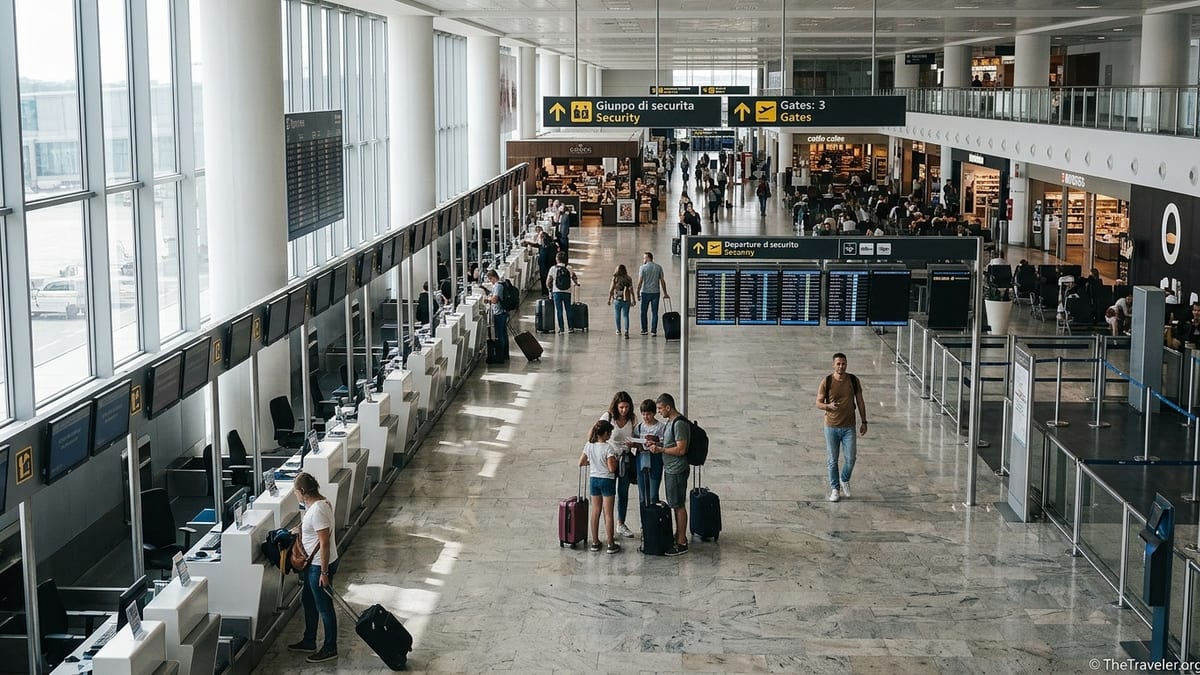
Rome Fiumicino at a Glance
Rome Fiumicino Airport, often written as FCO on tickets, sits about 30 to 35 kilometers southwest of central Rome. It handles more than 50 million passengers a year and serves over 100 airlines, from Italy’s flag carrier ITA Airways to major US and European brands. The airport is open 24 hours, but most shops and services follow roughly 06:00 to 23:00 schedules, so plan late-night or very early morning connections accordingly.
As of 2026, the passenger area is essentially organized around two main terminals, Terminal 1 and Terminal 3, within a single interconnected building. You may still see references to Terminal 2 and Terminal 5 on older blogs or in ride-hailing apps, but day-to-day most travelers will only interact with T1 and T3. Terminal 3 is the larger and busier side, handling a big share of intercontinental and non-Schengen flights, while Terminal 1 focuses more on ITA Airways, domestic Italian routes, and many Schengen services.
Because of its size, distances inside Fiumicino can surprise first time visitors. Walking from a check-in desk in Terminal 3 to a far non-Schengen gate in the E area can easily take 15 to 20 minutes at a normal pace, even longer at peak times. Give yourself extra margin for these walks, especially if you are traveling with children, have reduced mobility, or want to grab a coffee or use the restroom before boarding.
The airport consistently ranks among Europe’s better large hubs for its mix of modern infrastructure and shops. Travelers often compare it favorably with Paris Charles de Gaulle or London Heathrow when it comes to signage and natural light, although queues at security or passport control can still build up at busy hours, particularly early morning and late afternoon waves of departures to North America.
Understanding Terminals, Airlines, and Connections
The key to navigating Fiumicino is knowing which terminal your airline uses. ITA Airways, for example, now checks in primarily at Terminal 1, even for many of its long-haul flights, before directing passengers through internal corridors to the right gate area. Many other full-service European carriers flying within the Schengen Area also use Terminal 1. Terminal 3, by contrast, hosts a mix of Schengen and non-Schengen airlines, including many flights to the United States, United Kingdom, Middle East, and Asia.
If you are flying from New York to Rome on a US carrier and then onward to Florence with ITA Airways on a single ticket, there is a good chance you will arrive into Terminal 3 and connect through to a domestic ITA flight boarding from a gate in the Terminal 1 side. Once you clear passport control and security where required, simply follow the yellow “Transfer / Connecting Flights” signs rather than exiting to arrivals. Electronic departure boards marked “Voli in coincidenza” show gate numbers and walking times. Airport design means you can normally walk between the active terminals without going outside or using a bus.
However, connections are not always automatic. If you bought separate tickets, such as a low-cost European airline into Rome and a separate long-haul ticket out, you will likely need to collect checked luggage, pass customs, and re-check-in at the appropriate terminal. In a practical example, arriving from Barcelona on a budget carrier into Terminal 3 at 10:00 and catching a 13:00 transatlantic flight from Terminal 3 on a different airline is possible, but you should still allow the full three hours in case of queues at baggage claim and security.
Terminal labels can also affect services like lounges and priority security. Some independent lounges sit airside in both T1 and T3, but airline-operated lounges may only be in one area. A frequent flyer traveling business class with a US airline, for instance, may depart from Terminal 3 but find that a partner lounge is only accessible from certain gates. Always check your boarding pass and lounge information in advance to avoid trekking to the wrong side and back.
Arriving in Rome: Immigration, Baggage, and Getting Out
On arrival from outside the Schengen Area, you will pass through passport control before reaching baggage claim. At busier morning waves, such as banks of flights arriving from North America between 06:00 and 09:00, passport queues can build, although automated e-gates usually speed things up for eligible EU and some non-EU biometric passport holders. Families with young children or travelers needing assistance can use staffed lanes, which may be slower but are often better for questions and document checks.
Baggage reclaim halls are clearly marked by flight number, with large electronic screens listing belt assignments. For example, an ITA Airways flight from New York might show “Belt 10” alongside an estimated start time. If you are connecting, keep an eye on both the baggage belt screens and transfer signage. On most through tickets your luggage will be tagged to its final destination, such as Naples or Catania, so in that case you simply follow transfers and skip baggage reclaim entirely.
Once you pass customs into the public arrivals area in Terminal 1 or 3, you will see taxi stands, train and bus ticket machines, and kiosks for private transfers. To reach central Rome, many travelers choose between the Leonardo Express train, regional FL1 trains, airport buses, and fixed-rate taxis. The nonstop Leonardo Express runs between Fiumicino and Roma Termini, the main central station, typically in about 32 minutes and at a noticeably higher price than local trains but with the advantage of a simple, direct journey and dedicated luggage space.
The official white city taxis posted at the rank outside arrivals operate on a fixed city-regulated fare for the ride between Fiumicino and anywhere inside Rome’s historic Aurelian Walls. Travelers in 2026 report this flat rate in the mid-fifties in euros, which covers up to four passengers and standard luggage. This can make a taxi good value for a family of three or four heading directly to an address near Piazza Navona or Trastevere, especially late at night when train and bus frequencies thin out. Always confirm the flat fare with the driver before setting off, and avoid unlicensed drivers approaching you in the arrivals hall.
Departing from Fiumicino: Check-in, Security, and Boarding
For departures, the most common question is how early to arrive. Local transport and airport guides generally suggest at least 1 hour 30 minutes before departure for domestic flights inside Italy and short Schengen hops, about 2 hours for other European routes, and around 3 hours for intercontinental flights. If you are flying to North America in the summer peak or during holiday periods, adding another 30 minutes is sensible, especially if you need to check in bags, return a rental car, or claim tax refunds.
Check-in halls in both Terminal 1 and 3 are modern and spacious, with airline clusters. ITA Airways, for example, has a large footprint in T1 with self-service kiosks and staffed counters, often with separate queues for business class and SkyPriority customers. Low-cost carriers in T3 typically run leaner operations, so a queue can build quickly if several morning departures leave close together. Whenever possible, check in online before you arrive so you can use baggage drop desks or head straight to security with cabin baggage only.
Security screening areas vary in crowding depending on time of day. Early morning between roughly 06:00 and 09:00 and late afternoon between about 16:00 and 19:00 tend to be busiest, reflecting waves of European and long-haul departures. At quieter mid-day times, travelers often report clearing security in 10 to 20 minutes, while peaks can see much longer waits. Fiumicino has introduced services like online bookable “QPass” time slots at certain checkpoints, along with dedicated fast-track lanes for eligible premium passengers, which can significantly cut waiting if your ticket or airline status allows.
Boarding gate areas are divided between Schengen and non-Schengen zones. Schengen flights typically depart from A and some B/C gates, while most non-Schengen and long-haul flights use E gates, especially E31 to E61 in Terminal 3. Before a flight to the United States, for example, you may find an extra layer of security checks at the gate, including interviews and more in-depth screening of carry-on bags. Boarding frequently starts 40 to 50 minutes before departure for widebody aircraft, so do not wait until the last announcement to leave the shops or lounge, especially if your gate is at the far end of a pier.
Transport Options Between Fiumicino and Central Rome
One of the main reasons travelers stress about Fiumicino is choosing the right transport into town. In practice, the options break down into four main categories: dedicated airport trains, regional trains, buses, and taxis or private cars. The right choice depends on your arrival time, budget, and where in Rome you are staying. For a solo traveler staying near Roma Termini with a medium suitcase, the Leonardo Express train is often the easiest. You walk from arrivals to the well-signposted train station attached to the terminal complex, hop on the non-stop service, and roll off directly into Termini’s concourse, with metro lines and taxis right there.
Regional FL1 trains cost less than the Leonardo Express and connect Fiumicino with other stations like Trastevere, Ostiense, and Tiburtina, which can be more convenient if your accommodation is in those neighborhoods. For example, a couple staying in Testaccio might take the FL1 to Ostiense and then transfer to the Metro B line for a short ride or simply grab a taxi for the last stretch. Total travel time is slightly longer than the express, but overall door-to-door time can be similar or better if your final destination is not near Termini.
Airport bus companies operate to several city points, typically clustering around Roma Termini or Tiburtina with a few stops near the Vatican or other central areas, depending on the operator. Buses are often the cheapest choice and can be attractive for budget travelers or backpackers, though they are more affected by traffic on the highway into town, especially at rush hour or during road works. Luggage is stored underneath, and tickets are easily bought at counters in the arrivals hall or online in advance.
Taxis and pre-booked private transfers remain the most comfortable and straightforward option, especially late at night or for groups and families with multiple bags. A family of four landing at 23:00 and staying near Campo de’ Fiori, for instance, may find that ordering a pre-arranged car at a fixed fare offers peace of mind, doorstep service, and a reasonable per-person cost once divided. Private vehicles typically meet guests in the arrivals hall with a sign and help with luggage, a small but welcome detail after an overnight transatlantic flight.
Airport Facilities, Lounges, and Practical Services
Fiumicino has invested heavily in its passenger facilities, and it shows in the range of shops, dining, and services. Airside in both Terminal 1 and 3 you will find international fashion brands, Italian designers, duty-free stores, travel pharmacies, bookshops, and gourmet food outlets selling everything from espresso and fresh cornetti to vacuum-packed cheese and cured meats suitable for export. Prices are broadly in line with other large European hubs: a cappuccino at a counter bar might run a few euros, while a sit-down meal at a mid-range restaurant in the E-gates area can cost similar to a medium-priced trattoria in central Rome.
For longer waits, independent and airline lounges provide quieter spaces with seating, Wi-Fi, snacks, and drinks. In Terminal 1, lounges such as Plaza Premium, Prima Vista, and others welcome passengers flying in premium cabins or holding certain memberships, and several also participate in pay-per-use networks like Priority Pass. Terminal 3 has its own cluster of lounges, including locations near the E gates that serve many long-haul departures. Travelers frequently comment that the newer lounges compare well with those at other major European airports, though they can become crowded at peak departure banks.
Other useful services for travelers include currency exchange counters, ATMs, baby-care rooms, children’s play corners, and baggage wrapping providers located near check-in areas. Families will notice that strollers are often available airside in T1 and T3, and many restrooms include changing facilities. Passengers with reduced mobility or medical needs can pre-book assistance through their airline, which then coordinates with the airport to provide wheelchairs, escorts through security, and priority boarding where needed.
One interesting recent addition is the “Airport in the City” style service in central Rome, which allows certain ITA Airways passengers to check in and drop bags in advance at a location near Roma Termini. While this service is still limited to specific routes and fare types, it illustrates how Fiumicino and its main carriers are experimenting with ways to reduce congestion in the terminal check-in halls and make the journey smoother for frequent flyers and business travelers.
Tips for Smooth Connections and Common Pitfalls
Transfers at Fiumicino are generally well signposted, but a few practical tips can save headaches. First, always check whether your luggage is tagged to your final destination when you first check in. A traveler going from Boston to Palermo via Rome on a single ticket usually has bags checked through, meaning that at Fiumicino they only need to follow the “Transit / Connection” signs and pass security or passport control as directed. If you hold separate tickets, assume you must reclaim and re-check your bags, and avoid tight layovers of less than three hours.
Second, pay careful attention to the Schengen versus non-Schengen distinction. A passenger flying London to Rome and then onward to Athens, for example, will arrive as a non-Schengen passenger and then join the Schengen zone for the connecting flight. That means passing passport control in Rome before heading to the gate for Athens. The reverse is true when connecting from a Schengen city to a non-Schengen destination; you will likely clear exit passport control in Fiumicino en route to your departure gate. Allow extra time for these checks, particularly around morning and evening peaks.
Third, be realistic about walking distances and internal transfers. Connections involving the far E gates, especially E51 to E61, routinely involve lengthy walks and multiple escalators or moving walkways. If you are traveling with heavy hand luggage, consider using trolleys landside and packing a small foldable bag for essentials airside. Passengers with tight connections can approach airport staff at transfer desks, who can sometimes arrange faster routing or at least confirm gate locations and estimated walking times.
Finally, watch out for unofficial “helpers” around arrivals and public transport points. Official taxi drivers wait at signed taxi ranks, and official train and bus tickets are sold at marked counters and vending machines. If someone without identification offers to take you to the city for a vague price or insists that trains have stopped running when displays show otherwise, politely decline and walk to an official counter instead. Most visits to Fiumicino are uneventful, but this simple caution helps you avoid unnecessary stress or inflated fares.
The Takeaway
Rome Fiumicino Airport can look intimidating on a terminal map, yet it is surprisingly manageable once you understand how its two main terminals and transport links fit together. For most travelers, the key decisions revolve around how early to arrive for departures, which transfer option into Rome best suits their budget and hotel location, and how much time to allow for potential queues at security or passport control.
Think of your journey in clear stages: arrival or check-in, security and passport checks, time at the gate or in a lounge, and the last leg into or out of the city. Checking in online where possible, building in sensible buffer time for long-haul flights, and choosing straightforward transport options like the Leonardo Express or official fixed-fare taxis go a long way toward making the experience predictable rather than stressful.
With realistic expectations and a few practical details in mind, Fiumicino becomes not a hurdle but a convenient gateway. Whether you are starting a grand tour of Italy, connecting between European capitals, or flying home after a Roman holiday, knowing how the airport works before you fly allows you to focus on the trip itself rather than the logistics of getting through the terminal.
FAQ
Q1. How early should I arrive at Rome Fiumicino Airport before my flight?
For domestic and short Schengen flights, plan to arrive about 1 hour 30 minutes before departure if you have checked in online and have only cabin baggage, and closer to 2 hours if you need to check bags. For non-Schengen and long-haul flights, aim for at least 3 hours before departure, and consider 3 hours 30 minutes in busy summer periods or holidays, especially if you are flying to North America or have to return a rental car.
Q2. Which terminal will my flight use at Fiumicino?
Most travelers use either Terminal 1 or Terminal 3. Terminal 1 handles many ITA Airways flights along with a large share of domestic and Schengen routes, while Terminal 3 serves a mix of European and long-haul airlines including many flights to the United States, United Kingdom, Middle East, and Asia. Your airline and booking confirmation will list the terminal, and departure screens at the airport will confirm it on the day.
Q3. What is the easiest way to get from Fiumicino Airport to central Rome?
The easiest option for many visitors is the Leonardo Express train, which runs non-stop between the airport and Roma Termini station in about 30 minutes. If your hotel is not near Termini, you might prefer a regional FL1 train to stations like Trastevere or Ostiense, or an official fixed-fare taxi from the airport to any address inside the Aurelian Walls, which can be especially convenient for families or late-night arrivals.
Q4. Are there fixed taxi fares from Fiumicino Airport into Rome?
Yes. Official white city taxis operate on a fixed, city-regulated fare between Fiumicino Airport and destinations inside Rome’s historic Aurelian Walls. The flat rate, which is posted at the taxi rank and may vary slightly over time, covers up to four passengers with standard luggage. Always use the official taxi queue outside the terminal, confirm the fixed fare before leaving, and avoid unlicensed drivers approaching you in the arrivals hall.
Q5. How long does it take to clear security and passport control at FCO?
Waiting times vary by time of day and season. At quieter hours some travelers clear security in 10 to 20 minutes, while during busy morning and late afternoon peaks queues can be much longer, especially for non-Schengen passport control. Booking an earlier arrival at the airport, using fast-track lanes if your ticket includes them, and having documents ready all help to keep the process smooth and reduce the stress of unexpected delays.
Q6. Is it easy to connect between flights at Fiumicino?
Yes, most connections are straightforward because Terminal 1 and Terminal 3 are part of a single, interconnected building with clear signage. If your flights are on a single ticket and your luggage is checked through, you usually just follow “Transit / Connecting Flights” signs, pass security or passport checks as directed, and walk to your next gate. The main thing to watch is connection time, as long walks to far E gates and potential queues can make tight connections risky.
Q7. Does Fiumicino Airport have good lounge options?
Fiumicino offers a range of lounges in both active terminals, including independent lounges such as Plaza Premium and airline-operated spaces. Access depends on your ticket class, frequent flyer status, or membership in pay-per-use networks like Priority Pass. Lounges generally provide Wi-Fi, snacks, drinks, and quieter seating, and are particularly useful for early arrivals, long layovers, or freshening up before an overnight flight.
Q8. What should I do if I arrive late at night?
If you land late, such as after 23:00, check in advance which transport options are still running. Some airport buses and trains operate reduced late-night schedules, so an official fixed-fare taxi or pre-booked private transfer is often the most reliable choice. Inside the terminal, shops and cafes may be closed or operating with limited hours, but basic facilities like restrooms, ATMs, and taxi ranks remain available for arriving passengers.
Q9. Can I sleep at Fiumicino Airport during a long layover?
The terminals remain open 24 hours, and some travelers do rest airside or landside during overnight layovers. However, seating is not specifically designed for sleeping, and cleaning or security staff may occasionally ask passengers to move. For comfort and privacy, many people book an airport hotel or a nearby property offering shuttle service. This can be particularly worthwhile if you have more than six to eight hours between flights or are traveling with children.
Q10. Is Fiumicino safe and easy to navigate for first-time visitors?
Fiumicino is generally safe and well signposted, with clear bilingual Italian and English signage pointing to baggage claim, trains, taxis, and connecting flights. As in any large international airport, keep an eye on your belongings, be cautious of unofficial taxi offers or unsolicited helpers, and follow instructions from uniformed staff. With those basic precautions, most first-time visitors find the airport straightforward to navigate and a convenient entry point to Rome.