


Ronda is one of Andalusia’s most dramatic towns, and you can see its headline sights in a single, well organised day trip from Málaga or Seville. Yet an overnight stay transforms the experience: the viewpoints around Puente Nuevo are calmer, sunset and blue hour photography become possible, and the historic streets empty once day tours leave. This guide uses current 2026 transport and opening information to help you decide whether to visit Ronda as a day trip or to spend one or two nights in town.
Get the latest updates straight to your inbox!
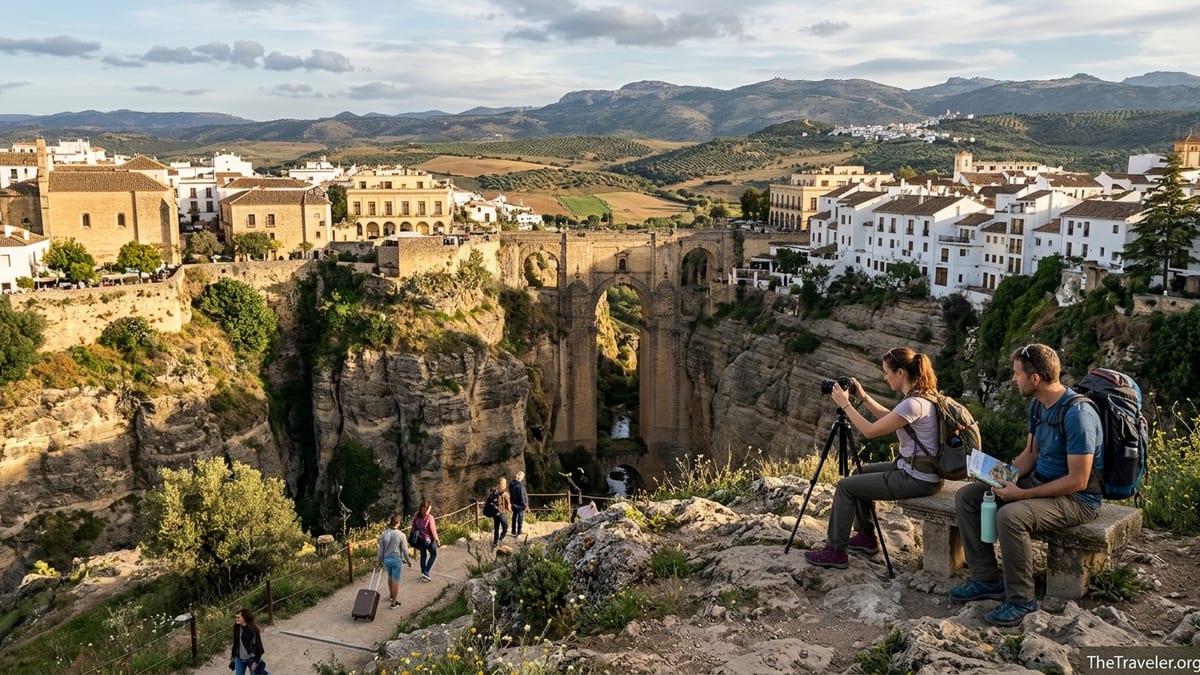
Day trip or overnight: the practical bottom line
If your aim is simply to see Ronda’s iconic Puente Nuevo, walk the gorge edge, visit Plaza de Toros and stroll the old town, a day trip is enough. With a morning arrival and late afternoon return you can cover Plaza de Toros and Alameda del Tajo, Puente Nuevo and Plaza de España, the main streets of the old town, Casa del Rey Moro gardens, Puente Viejo and at least one lower gorge viewpoint without rushing dangerously.
Staying one or two nights, however, changes how and when you see Ronda. Tour buses and large groups are thickest around Puente Nuevo and Plaza de España from roughly 11.00 to 16.00. Once they leave, viewpoints like the Mirador de Aldehuela and the balconies of Alameda del Tajo grow far quieter, restaurants have space, and you can frame the bridge under sunset or blue hour light. Recent investment in the Desfiladero del Tajo walkway has also been designed specifically to encourage overnight visits, with some time slots better aligned with guests already in town than with day trippers.
For most travellers the decision comes down to priorities. If you are based in Málaga with limited days and mainly want a single dramatic stop in the hills, a day trip by bus or rental car usually makes sense. If you are a photographer, travelling in high season, or want to enjoy Ronda at a slower pace with evening tapas and quieter cobbled streets, plan at least one night, ideally two if you also hope to visit nearby white villages.
Current transport from Málaga and Seville
In late 2026 train travel to Ronda is disrupted. Regional guides and the local tourism information confirm that since September 2026 no passenger trains currently reach Ronda and services are not expected to resume before around autumn 2027. Renfe sells replacement bus connections between Antequera-Santa Ana and Ronda, but they are limited and mainly intended to maintain the long-distance Algeciras corridor rather than to serve day trippers. From Málaga this would mean a train to Antequera-Santa Ana followed by a Renfe coach to Ronda, with total journeys typically over three hours one way. For most visitors this is less practical than simply taking a direct intercity bus or driving.
From Málaga, direct buses operated by companies such as Damas, Avanza and Sierra de las Nieves connect Málaga bus station with Ronda. Recent timetables published through regional information portals show several daily departures, often around 08.00 or 08.30 in the morning and additional services later in the day, with journey times usually between two and two and a half hours depending on route and intermediate stops. Recent examples include an Avanza service leaving around 08.00 and arriving after 11.00 and a Damas coach at about 08.30 that arrives closer to 10.30, with single fares commonly in the 12 to 18 euro range booked directly at Málaga bus station.
From Seville, the picture is similar. Before the current engineering works, regional trains linked Sevilla-Santa Justa with Ronda in roughly two and a half to three hours, sometimes with a change at Antequera-Santa Ana. In 2026, travellers looking up Seville to Ronda connections often find that Renfe’s journey planners show complex, long itineraries combining train and replacement bus with total travel times reported around five hours. Several recent travel resources instead recommend direct buses from Seville’s San Bernardo bus station towards Ronda, operated under brands including Comes or Interbus, with typical journey times in the region of three hours. Because schedules are subject to change, it is wise to check departures for your exact date a few weeks ahead or to confirm at the bus station when you arrive in Seville.
Stations, arrival logistics and luggage
Málaga’s main bus station sits beside María Zambrano train station, close to the city centre. It is well connected by the local EMT bus network and suburban trains, and there are ticket counters for Damas and Avanza where you can buy tickets to Ronda a day or two in advance. For a day trip, this makes a very early start manageable: for example, staying near Málaga’s centre you could walk or take a short local bus to catch an 08.00 coach and still be in Ronda by late morning.
Ronda’s bus and train stations are located next to each other on Avenida de Andalucía, slightly north of the Mercadillo commercial district. Walking from the stations to Plaza de Toros or the Puente Nuevo viewpoints takes around 15 to 20 minutes at a moderate pace along level streets. For travellers with wheeled luggage, this is a straightforward walk, and taxis usually wait outside to take you directly to hotels near the bridge or in the old town for a modest fare. The station area has cafés and basic services, but luggage storage facilities are limited. Travellers staying overnight should plan to go straight to their accommodation to drop bags rather than expecting left luggage at the station.
In Seville, long-distance buses to Ronda typically leave from San Bernardo bus station, located south of the historic core and connected to tram and local rail services. The walk from Ronda’s stations to the historic centre is shorter and less complicated than negotiating major terminals in Seville or Málaga, so arrival in Ronda itself is not usually the stressful part of the journey. The main limitation is the return schedule. Evening buses towards Málaga or Seville are relatively frequent but not hourly. If you are on a day trip you will need to keep one eye on the clock, especially if you walk down into the gorge or join a late afternoon slot on the Desfiladero del Tajo walkway.
A practical walking route through Ronda’s main sights
Starting from Ronda’s modern centre, most visitors first reach Plaza de Toros, the historic bullring often cited as one of Spain’s most important. It sits right beside the Alameda del Tajo park, whose clifftop balconies give immediate views over the surrounding countryside without any steep walking. From the outer ring of the bullring it is a short stroll to Plaza de España and the northern side of Puente Nuevo. This route is level and suitable for families with strollers or travellers who prefer to avoid steep lanes.
Crossing Puente Nuevo itself puts you into the older part of town. The bridge carries vehicles as well as pedestrians, but pavements on both sides allow you to stop briefly and look into the gorge. On the south side of the bridge you can loop through the streets of the old town, visiting churches and viewpoints around the Parador and the Jardines de Cuenca. From here it is easy to continue downhill towards the Casa del Rey Moro, whose terraced gardens have long been one of the most atmospheric places to look back at the bridge.
From Casa del Rey Moro you can continue downward towards the old Arab bridge, Puente Viejo, and the lower parts of the gorge. Some paths are steep and involve uneven stone steps. Certain sections are now included in the managed Desfiladero del Tajo route, while others remain simple public tracks used by walkers and farmers. A realistic day route would descend via Casa del Rey Moro towards Puente Viejo, enjoy the low viewpoints, then climb gently back towards the old town using the most gradual streets rather than attempting to return by the steepest stairways.
For visitors on a tight schedule, this loop from Plaza de Toros through Puente Nuevo, into the old town, down towards Casa del Rey Moro, across to Puente Viejo and then back up again can comfortably fill four to five hours once you factor in time for photographs, a café stop and a simple lunch. An overnight stay allows you to split this into two gentler sessions, for instance doing the clifftop and bridge area on day one and the lower gorge and Casa del Rey Moro on day two.
Desfiladero del Tajo and Puente Nuevo interpretation centre
Ronda’s authorities have recently expanded and formalised the Caminos del Desfiladero del Tajo, adding walkways, safety measures and controlled access to some of the lower paths and historic mills. The official Desfiladero del Tajo information lists seasonal opening hours reviewed in October 2026. As of that update, winter hours are approximately 09.00 to 17.00 every day, with spring and autumn hours from around 10.00 to 20.00. In summer, opening is split between a late morning session, roughly 10.00 to 14.00, and an evening session, roughly 18.00 to 21.00, to avoid the hottest part of the day. Tickets must be prebooked through Ronda’s official tourism booking system, which assigns a specific entry time.
The entrance to the Desfiladero del Tajo walkway is reached from the town side via Plaza de María Auxiliadora, near the edge of the historic centre. From the clifftop balconies a path descends to a small access building at the start of the managed route. Because the attraction is new and specific last entry times are not yet prominently published for all seasons, travellers are advised to arrive well before the end of the stated opening window and to check their ticket conditions carefully. The municipal leaflet that lists monument hours in early 2026 applies a general rule that last entry to major sights is about 30 minutes before closing, which is a sensible guideline for planning.
Alongside the gorge walkway, there is a small interpretation centre dedicated to Puente Nuevo itself, housed in a historic building within the bridge structure. Although detailed 2026 prices may vary slightly, recent municipal documentation lists admission in the low single euros per adult, with small reductions for groups. Opening hours here have sometimes differed from the broader gorge route, often resembling general monument hours of roughly 10.00 to 19.00 daily with shorter sessions in winter. Because the bridge interpretation centre occupies confined interior rooms, visits are relatively quick, making it a convenient stop on either a day trip or an overnight visit.
Photo viewpoints, congestion and the rhythm of the day
The most famous photographs of Puente Nuevo are taken from three levels. The first is from eye-level viewpoints near the bridge: the railings of Plaza de España on the north side and the terraces around the Parador and Mirador de Aldehuela on the south. These spots require almost no walking effort, which is why they also attract large tour groups. At midday in peak months the area immediately around Puente Nuevo can feel compressed, with visiting coaches dropping groups who then converge on the railings for group photos and guided talks.
The second level is from midway down the gorge, using traditional paths and, increasingly, segments of the managed Desfiladero del Tajo route. These viewpoints offer a classic three-quarter angle of the bridge rising above the ravine, with olive-dotted hills beyond. Reaching them involves 10 to 25 minutes of downhill walking on sometimes uneven surfaces, followed by the same in reverse. Fit walkers in sturdy shoes will find this straightforward, but families with small children or anyone with mobility difficulties should descent cautiously or limit how far they go.
The third level is from the very bottom of the gorge near the old mills and footbridges. With the extended Desfiladero del Tajo project fully open, parts of this area are now within a controlled, ticketed zone that uses metal walkways and fenced paths to keep visitors safe near drops and the river. Here the bridge looms overhead and wide-angle lenses capture both the arch and the waterfall. Local reporting around the project launch notes that one aim of the new route is to reduce informal scrambling on unmaintained slopes, which had created safety issues in the past. Off-path scrambling near cliff edges or on closed sections is not recommended.
For photographers, the timing of light is as important as viewpoint choice. On a day trip from Málaga, arriving in late morning almost guarantees that the railings of Plaza de España and Mirador de Aldehuela will be crowded. Shoulder seasons and winter months soften light earlier in the day, but tour buses still cluster around midday. Staying overnight allows you to be at the bridge soon after sunrise, when only local residents and a few independent travellers are out, or at sunset and blue hour, when warm light catches the stone and after-dark illuminations reflect in the gorge.
Where tour groups stay, sleep and eat
Most large tour groups in Ronda are on tight schedules. Coaches typically drop them near Plaza de Toros or Plaza de España for a quick loop across Puente Nuevo, a short guided walk into the old town and a set lunch in one of the larger restaurants close to the bridge. This concentrates the busiest period between late morning and mid afternoon in the Mercadillo side of the bridge and the first blocks of the old town. Visitors on independent itineraries can avoid the densest crowds by adjusting their timing, for instance visiting Casa del Rey Moro early or late in the day rather than around 13.00.
Accommodation near Puente Nuevo and in the Mercadillo district tends to be more expensive but offers unbeatable access to viewpoints. Well known hotels close to the bridge occupy historic buildings with balconies looking directly into the gorge. Recent price checks for midrange double rooms in this central area often fall somewhere in the 120 to 200 euro range per night in high season, with occasional promotional rates lower in winter. Many travellers feel the premium is justified for one night to experience the bridge lit at night and to step out at first light without a long walk.
Quieter and sometimes cheaper options lie deeper in the old town, on narrow streets away from the main bridge approaches. Smaller family run guesthouses and boutique hotels here may list doubles starting around 80 to 120 euros depending on season. Parking is trickier in these lanes, and vehicle access may be restricted, so guests with cars often need to use public car parks on the edge of the historic area and walk in. For a calm overnight stay with character, these old-town streets provide a different feel from the busier Mercadillo side.
For travellers who prioritise parking and road access, hotels closer to the bus and train stations or along Avenida de Málaga offer easier arrival and departure by car at the cost of a slightly longer walk to Puente Nuevo. These properties often sit in the midrange price band, appealing to visitors who plan to use Ronda as a base for exploring white villages such as Setenil de las Bodegas by car over several days.
Car access, parking and accessibility
Driving to Ronda provides flexibility, especially from Málaga. The mountain road climbs steadily through the Serranía de Ronda with sweeping views, and in clear conditions the drive typically takes around an hour and three quarters to two hours, which can be shorter than current bus or disrupted train combinations. However, parking in the historic centre is limited. Public car parks near the old town and Mercadillo offer paid spaces, and some hotels reserve spots for guests in these garages. On arrival, it is wise to go directly to a chosen car park rather than attempt to navigate very narrow lanes near Puente Viejo or within the oldest streets.
Ronda’s topography means that while the streets between the bus station and Plaza de Toros are relatively level, many routes down towards Puente Viejo, Casa del Rey Moro and the lower gorge involve steep gradients and stone steps. For travellers with reduced mobility, focusing on clifftop viewpoints like Alameda del Tajo, Mirador de Aldehuela and the town-side approaches to Puente Nuevo may be more realistic than attempting the full descent. Some segments of the Desfiladero del Tajo route include walkways designed to standard safety specifications, but reaching them still requires negotiating a sloping access path.
For families with small children, pushchairs can manage much of the upper town but will struggle on the steeper sections near Casa del Rey Moro and Puente Viejo. Car based visitors might choose to limit lower gorge exploration and instead spend more time in the parks and squares close to the bullring, where playgrounds and open spaces offer safe breaks. If you plan to drive in and out the same day, aim to arrive early in the morning to secure easier parking and to avoid the warmest and busiest midday hours.
Sample itineraries and cost comparison
A realistic day trip from Málaga by bus for two travellers in 2026 could look like this. Catch a morning Damas or Avanza coach from Málaga bus station around 08.00 to 08.30, arriving in Ronda between 10.30 and 11.15. Spend the late morning around Plaza de Toros, Alameda del Tajo and Puente Nuevo, then break for lunch in the Mercadillo district. In the afternoon, cross into the old town, visit Casa del Rey Moro and, if time permits, walk partway down towards Puente Viejo for a lower bridge view. Allow enough time to climb back to the centre for an early evening bus back to Málaga, arriving in the city between 20.00 and 21.30 depending on departure.
An overnight two day plan opens up better pacing. On day one, arrive from Málaga or Seville around midday, check into a hotel near the bridge or in the old town and spend the afternoon exploring the upper town, including Plaza de Toros, the clifftop gardens and the main old town streets. Enjoy sunset and blue hour views of Puente Nuevo and dinner in a local restaurant. On day two, reserve a morning or late afternoon slot for the Desfiladero del Tajo walkway, explore Casa del Rey Moro and Puente Viejo from the lower level and then return to the centre for a relaxed lunch before taking an afternoon or evening bus onwards.
With a third day, visitors with a car can explore surrounding white villages. Setenil de las Bodegas, with its houses built into the rock overhangs of the river, lies roughly 30 minutes’ drive from Ronda. Other options include Grazalema, in the national park of the same name, or Zahara de la Sierra. Public transport to these villages exists but is patchier and aimed more at local needs than at tourists trying to fit multiple stops into a single day, so hiring a car is usually the most efficient approach for multi village itineraries.
In cost terms, a typical 2026 day trip for two from Málaga using direct buses might involve return fares of roughly 50 to 70 euros in total, depending on exact tickets, plus admission fees for one or two attractions in the low single digits each and meals ranging widely depending on taste. An overnight stay adds accommodation, which for a midrange double might be around 100 to 160 euros per night outside the very highest demand periods, plus breakfast and an extra dinner. For some travellers, the difference between spending perhaps 130 euros for a simple day out and 250 to 350 euros for an overnight experience feels substantial. For keen photographers, couples on a special trip or visitors who value quieter streets, the added cost often feels justified.
Who should day trip and who should stay overnight
Photographers and serious sightseers benefit most from at least one night in Ronda. The ability to be at the railings of Mirador de Aldehuela or the balconies of Alameda del Tajo shortly after sunrise or at the moment the gorge lights come on after sunset is worth the additional transport and lodging costs. Overnight stays also make it easier to secure a slot for the Desfiladero del Tajo walkway that avoids the hottest and busiest parts of the day, and to wait out any sudden changes in weather without losing the entire experience.
Families with school aged children and travellers who prefer not to change hotels frequently may find a day trip from Málaga particularly appealing. The direct buses, the relatively short walk from Ronda’s station area to the main viewpoints and the ability to concentrate activity into a single, manageable loop all work in their favour. From Seville, where current bus journeys are longer, families may find an overnight stay more comfortable, breaking the travel into two shorter days and avoiding a very early start or late return.
Budget travellers often face the most delicate decision. From Málaga, a tightly planned day trip keeps costs down, avoiding hotel bills while still delivering the drama of the gorge and bridge. From Seville, where transport can be slower and slightly more expensive, a one night stay in a modest guesthouse in Ronda might offer better value than attempting a rushed and tiring there and back in a single day. Watching for off season room deals can bring central accommodation into reach even for those on a stricter budget.
For visitors choosing between Málaga and Seville as a base for visiting Ronda, Málaga currently has the advantage for day trips. Its direct bus connections, shorter road distance and integrated bus and rail hub at María Zambrano make a there and back visit easier. Seville works well as a starting point for a multi day loop through Ronda and the white villages, especially for those renting a car. Whichever base you choose, deciding honestly how important quiet viewpoints, photography and a slower rhythm are to you will point the way to whether Ronda should be a day trip highlight or the focus of an unhurried overnight stay.