


Few Spanish cities reward a weekend away from Madrid as handsomely as Cáceres. Its hilltop old town, a UNESCO World Heritage ensemble of stone palaces and towers, feels almost unchanged since the late Middle Ages. Thanks to improved rail and bus links, it is easier than ever to reach Cáceres without a car, combine serious heritage sightseeing with Extremaduran food, and, with a little extra time, dip into nearby nature reserves.
Get the latest updates straight to your inbox!
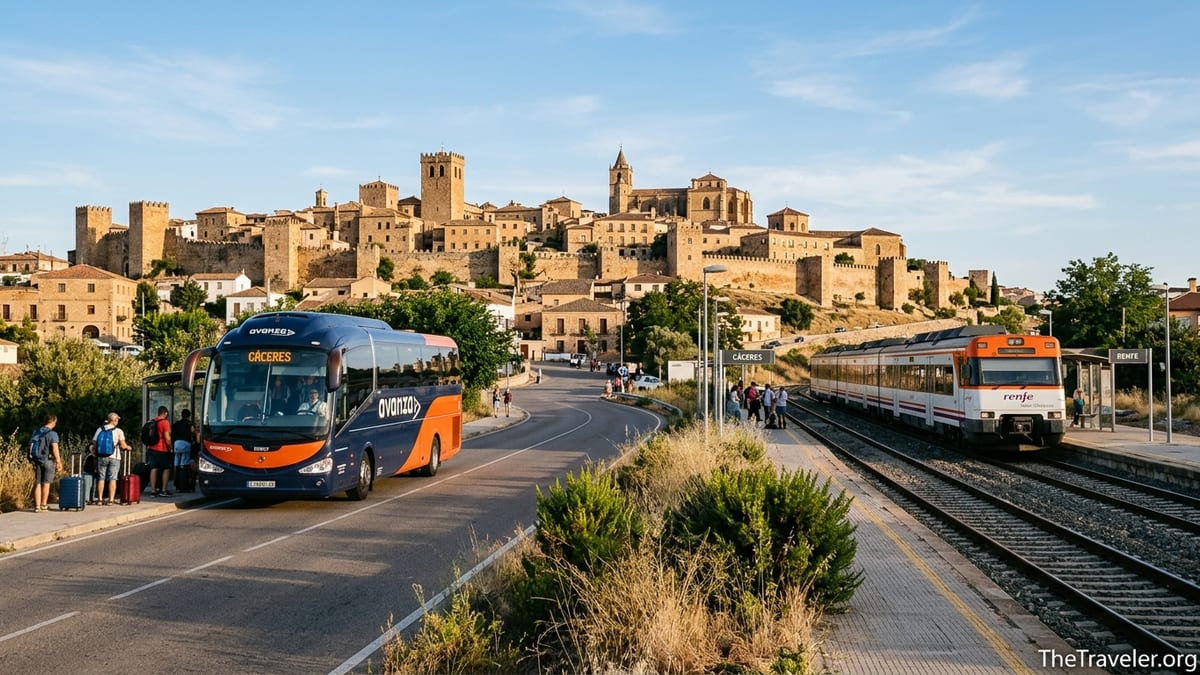
Getting from Madrid to Cáceres by Train or Bus
Madrid to Cáceres is roughly 300 kilometers, and public transport is the most practical choice for a weekend trip. On the rail side, Renfe operates Media Distancia and Alvia services from Madrid Puerta de Atocha Almudena Grandes to Cáceres along the Madrid–Cáceres–Badajoz line. Recent timetable data for November 2026 shows at least one direct morning train taking around 3 hours 25 minutes, with other services in the 3.5 to 4 hour range depending on intermediate stops and train type. Advance purchase fares for the slower regional-style services can appear from about 20 to 25 euros one way in economy, while flexible tickets and Alvia services tend to cost more, often from around 30 euros upwards per direction when bought close to departure.
Long-distance buses fill the gaps between train departures and remain the most frequent option. The main operator on the Madrid–Cáceres corridor is Avanza, running under a national concession that links Madrid with Cáceres and Badajoz. Current booking platforms that aggregate Avanza data indicate around six direct buses per day between Madrid and Cáceres, with journey times typically between 4 hours 30 minutes and 4 hours 45 minutes. Standard one-way fares commonly appear in the mid to high 20 euro range, for example around 23 to 30 euros depending on time and demand, with some promotional tickets occasionally lower when booked in advance.
For most travelers, the decision comes down to schedule and travel style. The train is usually a little faster and more spacious, and it departs from centrally located Atocha with easy metro and Cercanías connections. Buses take slightly longer but offer more departure times spread throughout the day, which can suit after-work getaways or flexible weekend returns. For a Friday to Sunday escape, a common pattern is to take a mid- or late-afternoon Avanza bus to Cáceres and return on a Sunday afternoon Renfe service, but the best choice will depend on that week’s timetables and prices.
Departure Points in Madrid and Arrival in Cáceres
Renfe services to Cáceres currently leave from Madrid Puerta de Atocha Almudena Grandes. This is the main long-distance rail hub in central Madrid, served by several metro lines and the full Cercanías suburban network. From Madrid Barajas airport, the usual route is Cercanías line C-1 or C-10 from Aeropuerto T4 to Atocha, taking roughly 30 minutes, or a taxi that in normal traffic might need a similar time but costs significantly more. Because long-distance tickets are train-specific, it is wise to allow at least 90 minutes buffer between scheduled flight arrival and train departure if you are connecting the same day.
Intercity buses to Cáceres mostly depart from Estación Sur de Autobuses, Madrid’s main long-distance bus terminal in the Méndez Álvaro area. The station is linked to Metro Line 6 and has its own Cercanías stop, Méndez Álvaro, on several commuter lines, which makes access straightforward from both the city center and the airport. Avanza’s Madrid–Cáceres routes are listed as using Estación Sur and occasionally other stops within the city, but for straightforward planning you should assume Estación Sur as your starting point and verify the bay number on the departure boards on the day of travel.
In Cáceres, Renfe trains arrive at Cáceres railway station, on the southern side of the modern city. Intercity buses terminate at Cáceres bus station, which sits in the same broader district a little to the west. Both are well outside the medieval hilltop core but within a short taxi or bus ride. Even late in the evening you will usually find taxis waiting at both stations around scheduled arrivals, although after midnight it is safer to pre-book a radio taxi through your accommodation.
From Station to Plaza Mayor: Walking, Bus and Taxi
The practical heart of Cáceres for visitors is Plaza Mayor, a long, gently sloping square that sits directly beneath the walled old town and the Arco de la Estrella gate. The distance from Cáceres railway station to Plaza Mayor is around 2 kilometers. Fit travelers with rolling luggage can walk this in about 25 minutes, mostly along broad urban streets. A common on-foot route is to head north from the station area toward Avenida de Alemania and then continue toward the pedestrian zone that funnels you into the lower end of the old quarter near Plaza Mayor.
Those arriving by bus face a similar distance. The Cáceres bus station is roughly 1.5 to 2 kilometers from Plaza Mayor, depending on the route you choose. Walking takes about 20 to 25 minutes and involves some moderate uphill sections as you approach the historic center. If you are arriving in the peak of summer heat or with heavy bags, a taxi is usually a better choice for this first leg.
Local city buses, operated under the Vectalia Cáceres network, connect both the railway and bus stations with the wider city, including stops within easy reach of the center. Various routes run past or close to Avenida de España and other central arteries from which Plaza Mayor is a short walk. Single tickets bought on board are inexpensive, typically a few euros at most. However, visitors staying near Plaza Mayor often find a taxi most convenient on arrival: a short ride from either station into the historic core generally comes in under 10 euros in normal conditions, and saves hauling bags over cobblestones.
For accessibility, it is worth stressing that the final approach to Plaza Mayor and the old town inevitably involves gradients and some uneven paving. Travelers with reduced mobility or heavy luggage should plan to be dropped as close as possible to the square by taxi and let their accommodation advise on the flattest route from there.
Walking Route through the UNESCO Medieval Ensemble
Cáceres’ old town is compact enough to explore fully on foot, yet intricate enough to fill many hours. A classic route starts in Plaza Mayor itself, where you can orient yourself among restaurant terraces and arcaded facades. From here, walk to the monumental Torre de Bujaco, a squat stone watchtower that anchors one corner of the square and speaks to the city’s frontier history between Christian and Muslim realms. The exterior alone is impressive, but paid access allows you to climb for elevated views across the rooftops and down the long sweep of Plaza Mayor.
Next, pass under the Arco de la Estrella, the dramatic gateway that pierces the walls at the upper end of Plaza Mayor. This arch, with its angled approach and coat of arms, is one of the emblematic images of Cáceres. Once inside the walled precinct, you reach the quieter Plaza de Santa María, framed by the co-cathedral of Santa María, several noble palaces and beautifully preserved stone surfaces. Pausing here in late afternoon, when the light warms the sandstone, is one of the city’s most atmospheric experiences.
From Plaza de Santa María, continue toward the Palacio de los Golfines de Abajo, one of the best-known aristocratic residences in Cáceres. Its ornate facade, mix of Gothic and Renaissance elements and heraldic shields make it a visual highlight even if you do not visit inside. Guided interior tours are organized, with entry tickets sold for scheduled time slots and numbers limited, so advance booking is recommended especially on weekends and public holidays. You can then wind your way through side streets to reach the old Jewish quarter, a more modest but deeply evocative area of narrow lanes and small houses that contrasts sharply with the grand palacios around the main squares.
The old Jewish quarter, on the southern side of the hill, rewards slow exploration: look for simple whitewashed facades, tiny plazas and remnants of medieval street plans that survived later redevelopment. Many visitors walk from here back toward the Arco del Cristo or other secondary gates in the city walls, then circle back to Plaza Mayor via less-trafficked alleys. Taken at a leisurely pace with photo stops and short visits to interiors, this basic loop through Plaza Mayor, Arco de la Estrella, Plaza de Santa María, Palacio de los Golfines de Abajo, Torre de Bujaco and the Jewish quarter can fill half a day; spread over late afternoon and evening, it becomes even more memorable.
Museums, Palaces and Towers: Access and Visiting Practicalities
Not every historic building in Cáceres’ old town is open to visitors, and many are best appreciated from the outside. Torre de Bujaco usually offers paid access to its interior, exhibition spaces and rooftop viewing platform. Typical adult tickets in recent seasons have been well under 10 euros, with reduced fares for children and seniors. Opening hours vary by season but generally include morning and late-afternoon slots, with closures in the early afternoon and limited operations on certain Mondays or public holidays. Because hours shift with the time of year, it is important to check current schedules through the tourist office or on-site signage rather than rely on past information.
Palacio de los Golfines de Abajo is one of the key interiors to prioritize. Access is by guided tour only, and group sizes are capped. Recent practice has been to require or strongly encourage advance reservations, especially for weekend visits, with adult tickets broadly in the 7 to 10 euro range. Tours are typically offered in Spanish, with some support materials in other languages. If you cannot get inside, the palace’s elaborately carved facade, corner turret and coats of arms still make it a compelling stop on a walking route.
The cathedral-like Concatedral de Santa María generally allows visitor entry outside of mass times, for a modest fee that helps fund maintenance of the building. There may be possibilities to climb a tower or access a roof area depending on current safety regulations and staffing, though such options can be suspended or altered without long notice. Other palaces such as the Palacio de Carvajal combine free access to limited interior spaces, often used as cultural or tourist information centers, with attractive courtyards that are open in daytime but closed in the evening.
The key point for planning is that while the overall historic ensemble is accessible around the clock, the most interesting interiors and towers keep fairly traditional visiting hours. For a weekend trip, it works well to devote late morning and early afternoon to interiors such as Torre de Bujaco, Santa María and Palacio de los Golfines de Abajo, then leave the early evening for simply wandering the streets and enjoying exterior views as the crowds thin.
Evenings, Atmosphere and Why Overnight Stays Matter
Cáceres receives a noticeable number of day trippers from Madrid and other regional centers, especially on Saturdays in spring and autumn when the weather is pleasant. These visitors tend to cluster in late morning and mid-afternoon, so Plaza Mayor and the immediate streets near Arco de la Estrella can feel busy, with guided groups and school excursions mixing with weekenders. By early evening, however, many buses and trains back to larger cities have departed, and the old town quietens significantly.
This pattern is part of what makes overnight stays so worthwhile. After sunset, the stone facades and towers of the UNESCO core are softly illuminated, and with fewer people around you can walk entire stretches of cobbled lanes almost alone. Sounds from small bars and restaurants echo off the walls, and you gain a sense of scale and continuity that is hard to appreciate when the squares are packed. Photographers in particular will appreciate the chance to capture Arco de la Estrella, Plaza de Santa María and the Jewish quarter under night lighting and early-morning calm.
Because of this, our verdict for most travelers is that Cáceres deserves at least one, and ideally two, nights rather than a rushed day trip from Madrid. While a very long day is theoretically possible using the first train or bus out of Madrid and the last one back, it would mean spending 7 to 9 hours of the day in transit and missing the most atmospheric time in the streets. A weekend with two overnight stays lets you explore at a humane pace, enjoy multiple meals of local cuisine and, if you wish, add a short nature excursion.
Summer heat is another factor in favor of staying longer. From June through early September, afternoon temperatures in Extremadura often climb above 35 degrees Celsius. Being based overnight lets you focus your walking tours in the early morning and late evening, retreat indoors for a long lunch and siesta, and avoid trudging up to the old town in the most punishing heat. Travelers who are sensitive to heat should consider spring or autumn weekends, or at least plan their itineraries to minimize mid-afternoon exertion.
Where to Eat: Extremaduran Specialties and Realistic Prices
Cáceres is an excellent place to try Extremaduran cuisine, which leans heavily on pastoral products like sheep’s and goat’s cheeses, Iberian pork and hearty bread-based dishes. One local classic is migas extremeñas, a savory plate built from fried breadcrumbs often cooked with garlic, paprika, chorizo or pancetta and sometimes served with grapes or fried peppers. In central restaurants around Plaza Mayor and within the old town, migas typically appear as a ración or main dish, commonly priced somewhere in the high single digits to low teens in euros depending on portion size and setting.
Torta del Casar, the region’s famous creamy sheep’s cheese, is another essential. Many bars and restaurants serve a whole or half wheel of torta del Casar brought to the table with breadsticks or rustic bread. Expect to pay in the low to mid teens in euros for a portion large enough for two to share as a starter in a sit-down restaurant, with more modest tapa-sized servings in casual bars for several euros. Because this cheese is protected by a denominación de origen, menus will normally emphasize its origin, and gourmet shops near the old town sell it for travelers to take away.
Iberian pork, including presa ibérica, secreto and pluma cuts, is widely featured in Cáceres menus. In mid-range restaurants in or near the historic core, grilled presa or secreto often appears between about 16 and 24 euros for a main course at current price levels, with more elaborate preparations or higher-end venues charging somewhat more. A couple sharing a starter of torta del Casar, two Iberian pork mains and a bottle of Extremaduran wine might reasonably expect a dinner bill in the range of 60 to 90 euros, depending on choices. More casual options around Plaza Mayor offer set menus of the day that can come in closer to 15 to 20 euros per person at lunchtime, usually including a first course, main, dessert or coffee and a basic drink.
Vegetarian visitors will find fewer traditional options but can still eat well on grilled vegetables, cheeses, local gazpachos in season and creative tapas in newer bistros. For an affordable evening, a solo traveler could combine a tapa of migas, a small serving of torta del Casar and a glass of local wine for well under 20 euros by hopping between bars near Plaza Mayor and in the newer streets just downhill from the Arco de la Estrella.
Monfragüe National Park: Feasibility without a Car
Monfragüe National Park, north of Cáceres between Trujillo and Plasencia, is renowned for its cliffs, dehesa landscapes and birdlife, particularly vultures and raptors at viewpoints like Salto del Gitano. The main visitor focus is Villarreal de San Carlos, a small settlement with information facilities and access to several trails and lookouts. By car, Cáceres to Villarreal de San Carlos is a straightforward journey of around an hour and makes an excellent day trip. Without a car, the picture is more complicated.
At present there is no dense, daily public bus network running directly from Cáceres city to Villarreal de San Carlos suitable for independent day trippers. Information from national park documentation and regional authorities points instead to seasonal or organized transport solutions, such as guided excursions from Cáceres and Plasencia that include coach transfers, or shuttle buses within the park linking Villarreal de San Carlos to key viewpoints during peak holiday periods. There are regional buses between Cáceres, Trujillo and Plasencia, but aligning their schedules to then connect with any local services to the park can be time-consuming and uncertain.
For visitors without a car, the most realistic way to experience Monfragüe as a day excursion from Cáceres is therefore to book an organized tour or a private transfer. Several local agencies and nature guides offer full- or half-day birdwatching and landscape tours that include hotel pick-up in Cáceres, transport to viewpoints such as Salto del Gitano and the Monfragüe castle area, and guiding. Prices for such small-group tours often start somewhere around 70 to 100 euros per person depending on duration, inclusions and group size. Private transfers for a couple will generally cost more than renting a car for a day, but remove the stress of navigation and parking.
Once in Villarreal de San Carlos, you should realistically allow at least four to five hours in the area to make the excursion worthwhile. This allows time to visit the main viewpoints, fit in a short hike, pause for birdwatching, and handle transport in and out. If your schedule only allows a few spare hours, it may be better to focus on nearer countryside or dehesa landscapes accessible by taxi or a shorter excursion, rather than attempt a rushed trip to Monfragüe without reliable bus connections.
Two- and Three-Day Itineraries and Where to Stay
For a focused weekend from Madrid, a practical two-day plan might look like this. On Day 1, travel from Madrid to Cáceres in the morning or early afternoon by Renfe train or Avanza bus and check into your lodging. After a late lunch near Plaza Mayor, spend the late afternoon following the core walking route: Plaza Mayor, Torre de Bujaco exterior or interior, Arco de la Estrella, Plaza de Santa María and the first section of the Jewish quarter. After sunset, enjoy an early dinner built around migas, torta del Casar and Iberian pork at a restaurant in or just outside the old town, then stroll again to enjoy the illuminated walls.
Day 2 can concentrate on interiors and any remaining corners of the old town. Visit Palacio de los Golfines de Abajo on a morning guided tour, then explore additional sites like the Concatedral de Santa María’s interior and tower (if open), smaller churches and courtyards such as Palacio de Carvajal, and any temporary exhibitions in the area. Use the early afternoon for a long lunch and perhaps a siesta during peak heat, then devote late afternoon to revisiting favorite viewpoints or walking variation routes through the Jewish quarter. In the evening, you can either dine again in Cáceres and take a late bus back to Madrid, or stay a second night and return fresh the next morning.
An optional third day allows for nature or regional exploration. With a car or organized tour, Monfragüe National Park is the top choice and can be handled as a full-day excursion from Cáceres. Without those, you might consider a shorter outing into the surrounding dehesa landscapes, a visit to a nearby village accessible by regional bus, or simply a more relaxed second day in Cáceres that includes modern quarters, local markets and additional museums. Because public transport to Monfragüe is not currently convenient for independent day-trippers, it is better not to assume you can simply “catch a bus” to Villarreal de San Carlos and back in the same day without careful confirmation of current services.
Accommodation divides roughly into three zones. Around Plaza Mayor and inside the old town walls, you will find boutique hotels, small guesthouses and converted palaces. These places put you directly in the UNESCO setting and minimize walking back at night but often come at a premium price and may involve steps and uneven floors. Just outside the historic core, in the streets descending from Plaza Mayor toward the modern city, mid-range hotels and apartments provide a good compromise between atmosphere and convenience, with easier car or taxi access and generally slightly lower prices.
Further out, near the railway or bus stations and along major avenues like Avenida de Alemania, modern business-style hotels and budget chains cluster. These are practical for travelers arriving late or leaving early, and for those prioritizing lower room rates over medieval ambiance. As a broad guide in 2026, a couple can expect to pay somewhere around 80 to 140 euros per night for a comfortable mid-range hotel close to Plaza Mayor on a typical weekend, with simpler pension-style options below that and higher-end boutique stays above. Solo travelers can often find central rooms in smaller guesthouses and hostales in the range of 45 to 80 euros per night, with cheaper options a bit further from the core.
Budgets, Accessibility and Final Verdict on Day Trips
Putting the pieces together, a reasonable weekend budget for a couple in Cáceres might be structured as follows. Return public transport from Madrid for two, combining mixed fares on buses and trains, could run roughly 100 to 200 euros in total depending on how far ahead you book and which services you select. Two nights in a mid-range hotel close to the historic center may add 160 to 280 euros. Allowing 50 to 90 euros per day for food and drinks for two, plus around 30 to 60 euros in total for admissions to towers, palaces and other attractions, yields a ballpark weekend figure somewhere between 400 and 650 euros for a couple, excluding shopping and any organized excursions.
Solo travelers can scale this down: a single person using one of the cheaper bus fares, staying in a good-value hostal just outside the core and eating a mix of menu del día lunches and tapas dinners might realistically design a two-night Cáceres weekend for around 200 to 350 euros, again excluding big-ticket tours. These figures are based on typical late 2026 prices and assume moderate comfort rather than shoestring hostel stays or luxury hotels.
Accessibility is a serious consideration in Cáceres. The old town’s cobblestone streets, slopes and stairs can be challenging for travelers with mobility impairments, stroller users and anyone unsteady on their feet. Some routes from Plaza Mayor into the walled area involve fairly steep inclines, and not all palaces or towers have lifts. If this is a concern, discuss specific needs with your accommodation, which may be able to recommend flatter approaches and highlight which sights are realistically manageable.
Weighing all factors, Cáceres works far better as an overnight or full-weekend destination than as a fast day trip from Madrid. While modern Renfe trains and Avanza buses make the journey feasible in a single long day, you would sacrifice the city’s best qualities: hushed twilight streets, illuminated towers, cool early-morning walks and unhurried meals of Extremaduran specialties. With two or three days, public transport logistics, UNESCO-listed architecture, regional cuisine and nearby nature all come together into a rewarding, car-free escape from the Spanish capital.