


More news on this day
Rotterdam in the Netherlands is sharpening its profile as a future-focused city break, pairing headline-grabbing architecture with a rapidly expanding cultural calendar to reshape its tourism appeal.
Get the latest news straight to your inbox!
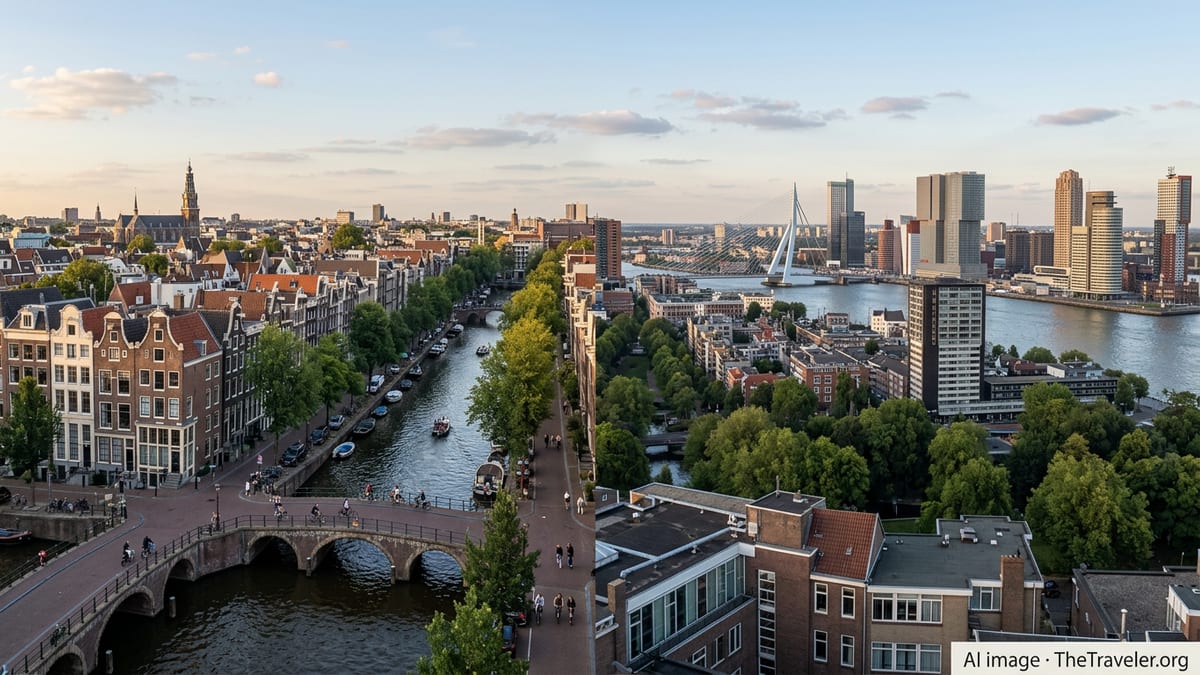
A Skyline Transformed by Experimental Design
Rotterdam’s postwar history as a largely rebuilt port city has given it unusual freedom to experiment with contemporary design, and the results are increasingly central to its tourism strategy. Visitors now encounter a skyline defined by stacked, tilted and mirrored forms rather than medieval spires, with structures like the Erasmus Bridge and the De Rotterdam complex often highlighted in international coverage as emblems of a new Dutch urbanism.
Municipal promotion materials and independent travel guides alike frame the city as an open-air architecture showcase. The combination of riverfront vistas, bold residential concepts and landmark public buildings is being packaged as an alternative to more historic Dutch destinations, particularly for travelers interested in design, photography and new cityscapes.
Recent travel features emphasize that this architectural shift is not cosmetic but structural for tourism. Accommodation providers, tour operators and cultural venues are increasingly bundling “architecture routes” that lead visitors from the central station past iconic housing projects, across the Maas River and into emerging neighborhoods that would previously have been outside the traditional sightseeing map.
Depot Boijmans Van Beuningen and the Rise of Museumpark
One of Rotterdam’s most striking new attractions is Depot Boijmans Van Beuningen, a mirrored bowl-shaped structure in Museumpark that bills itself as the world’s first fully publicly accessible art storage facility. Opened in late 2021 and designed by Rotterdam-based firm MVRDV, the building reflects the surrounding skyline across its curved façade while housing the vast collection of Museum Boijmans Van Beuningen in visible storage.
The depot has quickly become a visual shorthand for the city’s ambitions, frequently cited in architecture and travel publications as a must-see for visitors. Its rooftop forest and panoramic restaurant add a leisure dimension that helps bridge the gap between specialist art audiences and casual city breakers drawn primarily by the exterior design.
Museumpark itself is evolving into a dense cultural cluster, with the depot joining institutions such as the Kunstinstituut Melly and the Nieuwe Instituut. Published information about ongoing renovation works at Museum Boijmans Van Beuningen suggests that when the main museum building reopens later this decade, the combined campus will significantly strengthen Rotterdam’s position as a northern European art hub.
Urban planners and commentators have pointed to the Museumpark area as an example of how architecture and landscape design can be used to concentrate cultural offerings within a walkable zone. This concentration is increasingly evident in promotional images, which foreground the depot’s reflective curves as a gateway to a wider network of galleries and green spaces.
New Public Spaces and Elevated Green Corridors
Beyond the museum district, Rotterdam is investing in public-realm projects that link its architectural icons with new leisure landscapes. One of the most closely watched initiatives is the Hofbogenpark, a linear park taking shape on a 1.9-kilometre former railway viaduct in the north of the city. Municipal and tourism information describe it as set to become the longest rooftop park in the Netherlands, combining greenery with views over surrounding neighborhoods.
The Hofbogenpark reflects a wider European trend toward transforming obsolete infrastructure into elevated green corridors. For Rotterdam, it promises both a new vantage point on the city’s distinctive architecture and a way to connect residential areas with central districts in a more attractive, pedestrian-friendly manner, reinforcing the city’s reputation for innovation in urban design.
Other projects are extending this focus on accessible high-level public space. Roof walks, terraces and viewing platforms integrated into recent buildings are being promoted as experiences in their own right, inviting visitors to see Rotterdam’s skyline from multiple angles. This emphasis on vertical exploration sits comfortably alongside the city’s maritime identity, giving travelers a choice between waterfront promenades and rooftop perspectives.
Official visitor information for 2026 highlights these projects as part of a broader “must-see” list that also includes longstanding drawcards such as the Cube Houses and the Markthal. The message presented to prospective visitors is that cutting-edge design does not end at individual landmarks but is woven through parks, streets and infrastructure.
Festivals, Film and a Growing Cultural Calendar
Rotterdam’s cultural scene is also scaling up, adding depth to the architectural pitch. The International Film Festival Rotterdam, whose 54th edition took place in early 2025, has solidified the city’s status on the global cinema circuit, drawing filmmakers, critics and audiences for premieres and experimental programming. Around it, a constellation of smaller events, screenings and talks spreads activity across cinemas and cultural venues.
The city’s reputation as a laboratory for architecture is reinforced each June by Rotterdam Architecture Month, now billed as the largest architecture festival in the Netherlands. The 2025 edition brings together over 100 partners from education, design and cultural sectors, staging more than a hundred activities across dozens of locations. Organisers present it as a platform for debating the future of cities, with exhibitions, guided tours and temporary installations distributed throughout Rotterdam’s public spaces.
Specialist festivals further diversify the offer. Events such as the Architecture Film Festival Rotterdam and Camera Japan use cinemas, galleries and alternative venues to explore crossovers between film, architecture and global culture. Publicly available festival programs indicate that these events increasingly attract international visitors who combine screenings with exploration of the city’s built environment.
The cumulative effect is a year-round cultural calendar that gives Rotterdam multiple peaks of visibility in travel media. City marketers are using these festivals as anchors for short-break packages that pair tickets with hotel stays and curated city itineraries focused on design and nightlife.
Cruise Shifts and Sustainability Debates
Rotterdam’s role as a major port is also reshaping the tourism landscape. As Amsterdam introduces measures to curb overtourism and relocate large cruise operations away from its historic center over the coming decade, industry commentary and local reporting suggest that more ships are being routed toward Rotterdam, including additional river and ocean itineraries from the mid-2020s onward.
Earlier analyses already recorded a sharp increase in cruise calls at Rotterdam in the years leading up to 2023, and more recent sector reports anticipate that capacity could grow further as operators adjust Dutch routes. This shift positions the city as an increasingly important gateway for visitors who might previously have started or ended their journeys elsewhere in the Netherlands.
The growth in cruise activity is prompting renewed scrutiny of sustainability. Environmental groups and urban commentators have raised concerns about emissions and the broader impact of cruise tourism, mirroring debates in other European ports. In response, local discussions around shore power, cleaner fuels and stricter environmental standards are becoming more prominent, with tourism planners acknowledging the need to balance economic gains with climate goals.
Within this context, Rotterdam’s emphasis on public transport, cycling infrastructure and compact cultural districts is being framed as part of a more responsible visitor offer. Promotional narratives increasingly highlight the possibility of low-carbon city breaks that combine rail access, walkable neighborhoods and visits to energy-efficient or adaptive-reuse buildings, signaling that the city aims to align its tourism growth with wider sustainability ambitions.