


More news on this day
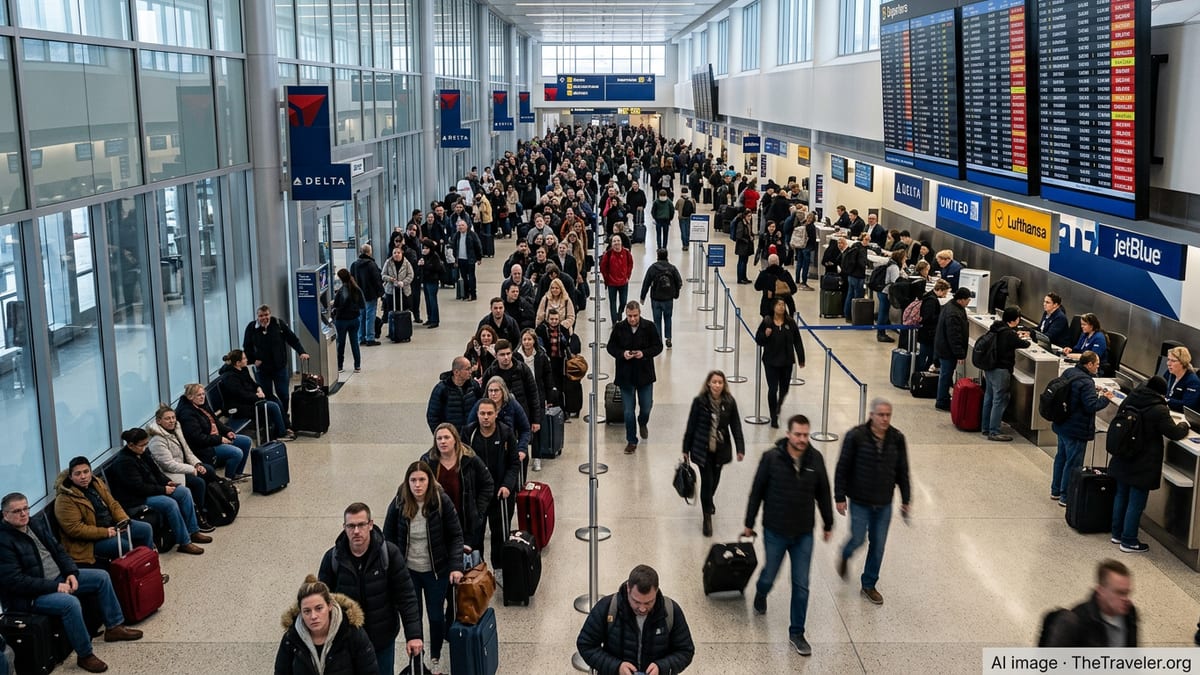
Airlines are increasingly pointing to airport congestion and weather volatility as key reasons delays keep rippling through U.S. flight networks, even as federal data shows late-arriving aircraft and airspace constraints remain major contributors to on-time struggles.
Get the latest news straight to your inbox!
Delay blame meets the data: what the latest numbers show
Publicly available U.S. Department of Transportation data underscores why airlines often cite factors outside their direct control, while also showing how delays can cascade from earlier disruptions. For June 2026, the Bureau of Transportation Statistics reported 73.12% of domestic flights arriving on time, with the remainder spread across several categories: 7.36% attributed to air carrier delay, 1.03% to weather, 6.42% to National Aviation System delays, and 9.94% to aircraft arriving late, plus 1.71% cancellations and 0.38% diversions.
Those categories matter to travelers because they highlight the chain reaction that can turn one congested hub or a line of thunderstorms into a national problem. “Aircraft arriving late” is essentially a measure of network knock-on effects: once an inbound flight lands behind schedule, the next departure can leave late even if local conditions improve.
Weather also plays a larger role in systemwide slowdowns than the simple share of weather-tagged delays suggests. Federal aviation materials that aggregate system-impacting delays indicate weather has been the largest cause of systemwide air traffic delay over multi-year periods, especially when high-demand airports operate close to capacity and cannot easily “catch up” later in the day.
Congested hubs, packed schedules: O’Hare becomes the latest flashpoint
Congestion is not just a passenger complaint; it is now shaping capacity decisions. In April 2026, the Federal Aviation Administration announced a scheduling reduction at Chicago O’Hare International Airport aimed at preventing widespread delays during the summer travel period. The agency described O’Hare as the busiest U.S. airport by flight volume and pointed to planned peak-day schedules exceeding 3,080 flights for summer 2026.
Under the FAA’s plan, daily operations were limited to 2,708 at O’Hare to avoid a larger deterioration in performance. The move followed a set of meetings the agency convened with airlines and airport stakeholders to address overscheduling, framing the changes as a way to keep the broader National Airspace System from absorbing shocks that start in Chicago and propagate nationwide.
Separate publicly posted federal documents connected to summer 2026 scheduling discussions described O’Hare as operating at levels that were “not sustainable” for the season, noting that disruptions at the airport can trigger traffic management tools such as ground delay programs. The same materials referenced third-party performance data and argued that adding hundreds of flights to an already-congested schedule would likely lead to “inevitable” delays despite available runway facilities and staffing.
Weather is the spark, congestion is the fuel
Airlines frequently point to thunderstorms, hurricanes, winter storms, and low-visibility conditions as the most visible causes of disruption. But operational materials from the FAA emphasize the compounding effect: when a major airport is already near maximum throughput, a weather-related capacity drop can quickly turn into multi-hour backlogs because there is limited slack to absorb and later recover from the hit.
This interplay is especially clear during convective weather season, when fast-developing storm lines can force route changes and spacing restrictions. FAA guidance on weather delay management highlights that planners often need to anticipate convective impacts hours in advance to adjust long-haul and short-haul flows, a reminder that the “weather” label can reflect both conditions at airports and constraints in the surrounding airspace.
For travelers, that dynamic can look like a contradiction: skies may be clear at the departure airport while the flight is still held at the gate. In practice, congestion at a destination hub, a constrained arrival route, or downstream staffing and gate availability can keep departures from launching even when local conditions are calm.
How the system tries to keep up: ground delay programs and new flow tools
When demand outstrips capacity, the FAA relies on traffic management initiatives that meter flights into constrained airports and airspace. The agency’s Air Traffic Control System Command Center regularly publishes operational advisories that outline expected constraints and anticipate additional initiatives such as ground delay programs, a mechanism designed to reduce airborne holding by keeping aircraft on the ground until arrival capacity improves.
At the same time, the FAA has been pursuing technology changes intended to make these interventions more predictive, rather than purely reactive. In June 2026, the agency announced a contract award to Air Space Intelligence tied to new flow management capabilities, describing Flow Management Data and Services as a future backbone for the Command Center and positioning an added capability, Strategic Management of Airspace, Routes, and Trajectories, as a way to coordinate schedules and trajectories before aircraft depart.
The operational promise is straightforward: if air traffic managers can better integrate data on weather patterns, airport capacity limits, runway closures, and planned demand, they can intervene earlier to prevent bottlenecks that later show up to passengers as rolling delays, missed connections, and late-night cancellations.
What travelers can realistically expect next
Published coverage and federal performance reporting suggest delay pressures are unlikely to disappear simply because demand is high and schedules are dense. Capacity caps at specific hubs, more aggressive traffic management, and newer flow tools may help reduce the worst days, but they also formalize the reality that some schedules may be trimmed to keep the system stable.
Real-time disruption snapshots can also look dramatically worse than monthly averages, especially during major weather events. On September 16, 2026, FlightAware’s live tracker showed 2,277 delays and 361 cancellations affecting flights within, into, or out of the United States at the time of capture, illustrating how quickly conditions can deteriorate when weather and congestion collide.
For passengers, the practical takeaway is that delay explanations often blend multiple factors. The DOT’s delay-cause accounting itself recognizes that flights can carry more than one cause with minutes prorated across categories, reflecting how a weather-triggered slowdown, a congested arrival bank, and a late inbound aircraft can all contribute to a single late departure.