


Few travel debates stir as much friendly argument as Salzburg versus Vienna. Both are unmistakably Austrian, with Alpine backdrops, grand Habsburg palaces and world-class music. Yet the experience on the ground feels very different. One is a compact Baroque jewel wrapped in mountains, the other a bustling capital of nearly two million people with layered neighborhoods and a serious coffeehouse culture. Choosing between them is less about which city is objectively “better” and more about which fits your travel style, budget and time frame.
Get the latest updates straight to your inbox!
First Impressions: Atmosphere and Scale
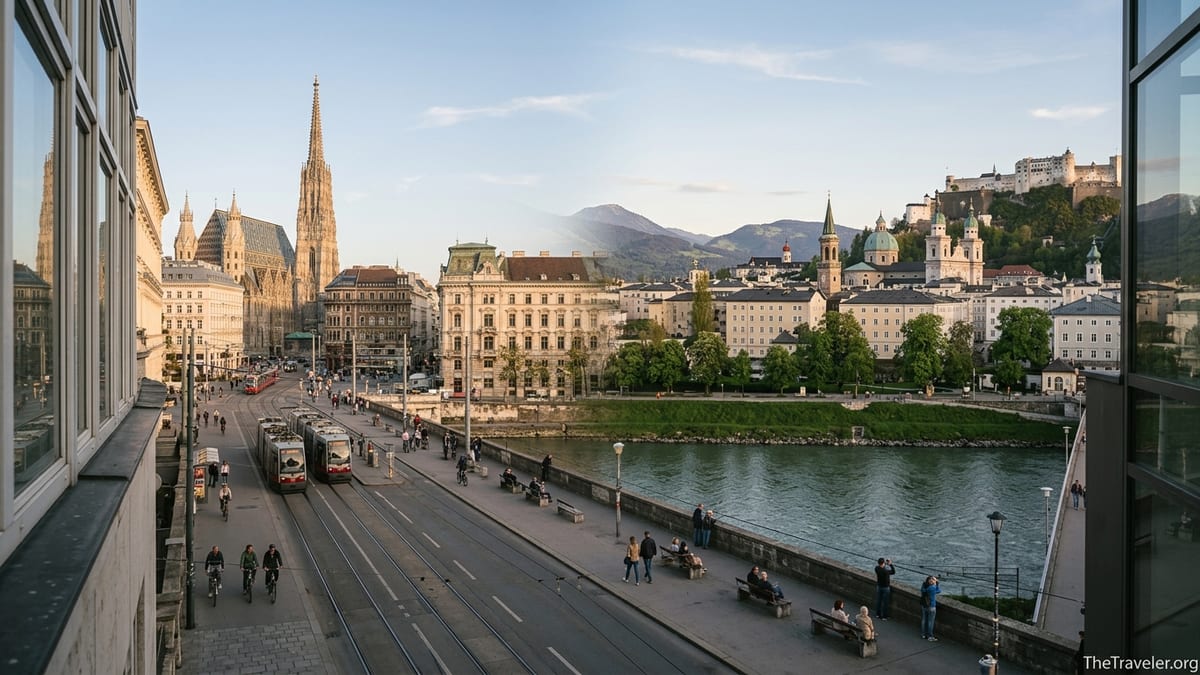
Landing in Salzburg, most visitors are struck by how quickly the city feels manageable. The historic center is small enough that you can walk from the riverfront at Makartsteg Bridge up through Getreidegasse, then climb to the Hohensalzburg Fortress in a single morning without ever needing a tram. You are rarely more than 15 minutes on foot from the next viewpoint, whether it is the Kapitelplatz with its golden sphere sculpture or the gardens of Mirabell Palace. Mountains rise in almost every direction, so even on a quick grocery run you see alpine peaks in the distance.
Vienna feels entirely different on arrival. Stepping out of Vienna Central Station, you enter a capital city where trams, U-Bahn lines and multi-lane roads fan in every direction. The historic Innere Stadt is only one slice of a much larger metropolis that includes residential districts, creative hubs like the MuseumsQuartier and industrial edges along the Danube Canal. You can spend 30 minutes on the U1 line going from the modern district around Donau City to the traditional streets near Stephansplatz, and still feel you have only crossed a fraction of the city.
This difference in scale shapes how you travel. In Salzburg, a weekend visit can cover the headline sights at a relaxed pace. In Vienna, two days feels like an introduction, not a full experience. For travelers who feel overwhelmed in big cities or who have limited time, Salzburg’s compactness can be a major advantage. Conversely, travelers who enjoy discovering new neighborhoods and getting happily “lost” in a city grid often find Vienna’s urban breadth rewarding.
Season also affects first impressions. On a December weekend, Salzburg’s Old Town can feel packed as day-trippers pour in for the Christmas markets clustered under the fortress. Vienna has large markets as well, but they are spread across the city from Rathausplatz to Schönbrunn, so crowds disperse more during the day. In summer, Salzburg’s river promenades and city parks are quickly full of festival-goers, while Vienna’s larger green spaces like the Prater and the Danube Island easily absorb joggers, cyclists and picnickers without feeling crowded.
Cultural Highlights: Opera Houses, Palaces and Baroque Streets
Culture lovers can make a case for both cities, though in different ways. Vienna is one of Europe’s heavyweight cultural capitals, with heavyweight institutions to match: the Vienna State Opera, the Musikverein concert hall where the New Year’s Concert is played, and a cluster of major museums including the Kunsthistorisches Museum and the Albertina. A single afternoon might see you moving from Gustav Klimt’s paintings in the Belvedere Palace to an evening performance by the Vienna Philharmonic. For travelers who enjoy dense museum hopping, it is hard to beat.
Salzburg’s offer is more concentrated but highly curated. Its UNESCO-listed Old Town is itself an open-air Baroque museum, with onion-domed churches and narrow lanes lined with wrought-iron guild signs. The Mozart connection is tangible: you can stand in his birth house on Getreidegasse, then walk ten minutes to his later residence on Makartplatz. The Hohensalzburg Fortress dominates the skyline and offers historical exhibits alongside panoramic views of the Alps and the Salzach River. Instead of dozens of big museums, Salzburg offers a tight handful of memorable ones, like the DomQuartier complex that joins cathedral, archbishop’s palace and art galleries under a single admission.
For classical music fans, Salzburg shines during the annual Salzburg Festival when top orchestras and soloists come to town. Tickets for headline opera performances can be expensive and sell out months in advance, but there are often more accessible concerts in churches or smaller halls during festival season. Vienna, by contrast, offers a year-round performance calendar. Even outside peak tourist months, you can find a midweek opera at the State Opera, chamber music at the Konzerthaus or more informal concerts in smaller venues.
The type of cultural day you imagine matters. If your ideal day includes several major museums followed by a grand opera in an ornate hall, Vienna aligns perfectly. If you prefer to intersperse smaller museums with time in cafe terraces and scenic viewpoints, Salzburg’s mix of compact attractions against a mountain backdrop will feel more satisfying.
Nature, Day Trips and Scenic Escapes
Where Salzburg clearly outperforms Vienna is quick access to mountains and lakes. From Salzburg’s Old Town, it is a short bus ride to trailheads and alpine scenery. A city trolleybus can take you towards Untersberg, where a cable car climbs to over 1,700 meters with sweeping views of both Austria and Germany on clear days. Local buses connect easily to lake districts like Fuschlsee and Wolfgangsee, making it realistic to spend a morning at a lakeside village and be back in town for dinner without renting a car.
Day trips from Salzburg read like a highlight reel of classic Alpine tourism. You can hop on a regional train to Hallstatt, the lakeside village often featured on Austrian postcards, or cross the border to Berchtesgaden in Germany to see the Königssee and mountain viewpoints. These journeys are straightforward enough that many visitors simply buy regional train-and-bus day tickets at the station on the morning of travel and follow well-marked connections.
Vienna does have nature access, but it often requires more planning and slightly longer transit times. Locals escape to the Vienna Woods on weekends, taking suburban trains to hiking areas around places like Kahlenberg or to the wine-growing village of Grinzing. The Danube Island provides kilometers of riverside bike paths and swimming spots within the city limits, which is wonderful in hot weather but lacks the steep Alpine drama that Salzburg can offer within an hour.
If standing on a lakeshore surrounded by high peaks or riding a cable car is a priority, Salzburg is the stronger base. Travelers who are primarily interested in historic towns and vineyards might appreciate Vienna’s day-trip options instead, such as visiting the Wachau Valley along the Danube or the spa town of Baden with its Biedermeier-era architecture and thermal baths.
Costs, Cards and Getting Around
For many travelers, budget is a deciding factor. Both cities are broadly in the same price band, but there are subtle differences. A standard local transport ticket in Salzburg’s core zone is typically a little over 2 euros if bought as part of a multiple-ride pack, while a 24-hour ticket for city buses and trolleybuses comes in at just over 5 euros according to recent tariff tables. In Vienna, a single journey ticket on public transport is usually a bit over 2 euros as well, and a popular option is a flexible seven-day ticket for under 30 euros that covers unlimited rides within the core zones. These figures can shift slightly year to year, but they illustrate that urban transport in both cities is affordable by Western European standards.
Tourist cards help bundle costs. Salzburg offers a Salzburg Card that includes free entry to many city museums and sights, free use of local public transport and discounts on selected tours. Recent official brochures list the 24-hour version for adults priced in the mid-30 euro range, with longer 48-hour and 72-hour versions costing progressively more but still usually less than the sum of individual entries and transit tickets if you are actively sightseeing. This can be excellent value if you plan to ride the city’s funicular to the fortress, visit several museums and use buses to reach places like Hellbrunn Palace.
Vienna’s equivalent is the Vienna City Card, which typically includes unlimited travel on Wiener Linien services for a chosen duration and a wide range of discounts at attractions, museums and restaurants. Even without a city card, regular transit tickets can be cost-effective: visitors staying a full week can get a seven-day ticket that covers trams, buses and the U-Bahn from Monday to Sunday for a price that is roughly equivalent to four or five individual day tickets. Travelers who mostly walk within the Innere Stadt might skip passes altogether and use occasional singles, but for anyone venturing to Schönbrunn Palace, Prater or outer districts, a pass quickly pays off.
In practical daily terms, Salzburg encourages more walking, with occasional buses for specific outings. Many visitors do not use public transport at all on a short city break, except when heading to the railway station or airport. In Vienna, relying on transit is almost inevitable. You might take a tram from your hotel in Neubau to the Ringstrasse, then the U-Bahn to Schönbrunn and later a bus to a wine tavern in the outer districts. The network is frequent and easy to navigate, but the cost of point-to-point rides adds up more quickly if you skip passes.
Food, Coffeehouses and Nightlife
Both cities deliver solid Austrian food and excellent coffee, but their dining scenes differ in tone and scale. Vienna is famous for its grand coffeehouses such as Café Central, Café Landtmann and Café Sperl, where you can linger over a Melange and a slice of Sachertorte under high ceilings and crystal chandeliers. Reservations are often useful at busy times, and prices for coffee and cake run higher than in a simple bakery, but the experience is part of the city’s cultural fabric. Beyond these historic institutions, entire districts like Neubau and Leopoldstadt are filled with modern brunch spots, vegetarian bistros and international cuisine ranging from Japanese ramen to Middle Eastern mezze.
Salzburg’s coffee and cake culture is cozier than grand. You will still find atmospheric stops like Café Tomaselli, which claims roots reaching back several centuries, but many other cafes feel more like intimate living rooms than palace halls. Food options skew toward traditional Austrian fare: schnitzel, dumplings, and hearty stews. Visitors can sample Salzburger Nockerl, a towering local dessert soufflé, or enjoy beer gardens operating from historic breweries such as the Augustiner Bräu, where you collect your own stone mug and have it filled from wooden barrels.
Nightlife is another point of contrast. Vienna’s size means there is something happening every night, from opera and ballet to jazz clubs, techno nights near the Gürtel and student bars around the university. A traveler can attend a performance at the State Opera, then continue to a cocktail bar or late-night wine tavern without much trouble. Salzburg’s nightlife is more low-key and often seasonal. During the Salzburg Festival, the city buzzes with late dinners and post-performance drinks. Outside high season, you will find a cluster of pubs and bars in the Old Town catering to locals, students and visitors, but the scene is much smaller. Travelers looking for a dense bar-hopping district or late-night clubs will find more choice in Vienna.
In terms of casual daily eating, both cities have supermarkets with comparable prices and plenty of mid-range restaurants where a main course might be in the low to mid-teens in euros. Vienna has more variety at the budget end, including numerous bakery chains and street food stands near transit hubs. Salzburg’s smaller size sometimes means fewer cheap late-night options once the tourist restaurants close, especially outside peak months.
Where to Stay and How Neighborhoods Feel
Choosing the right neighborhood can influence how you perceive each city. In Salzburg, most first-time visitors gravitate toward the Altstadt on either side of the river or the area around Mirabellplatz. Staying within a ten-minute walk of the river allows you to step outside and almost immediately see city landmarks. Boutique hotels in converted townhouses, guesthouses above shops and small design hotels make up much of the central accommodation stock. There are some larger modern hotels near the main station and on the outskirts, but the compact core dominates the visitor experience.
Because Salzburg is small, even staying slightly outside the Old Town rarely feels isolating. A hotel near the main station means a 15 to 20 minute walk to the historic center or a short bus ride. For travelers arriving late by train or planning several early morning day trips, this can be more convenient than staying within the densest tourist zone.
Vienna offers more distinct neighborhood choices. The Innere Stadt is the postcard center, wrapped by the Ringstrasse and filled with luxury hotels, designer shops and historic buildings. Prices reflect that prestige. Just beyond the ring, the numbered districts each have different characters. The 7th district, Neubau, mixes galleries, independent shops and casual eateries and appeals to younger travelers. The 2nd district, Leopoldstadt, has seen a wave of new hotels and offers easy access to both the historic center and the Prater. Budget-conscious visitors commonly stay a few U-Bahn stops from the center in districts like the 5th or 6th, where nightly rates are lower but transit connections are still straightforward.
In both cities, accommodation prices climb during major events. In Salzburg, beds fill quickly during the Salzburg Festival and around Christmas markets, which can push even modest guesthouses to rates normally associated with boutique hotels. In Vienna, New Year’s Eve and major conventions or trade fairs have a similar effect, especially on central hotels. Planning ahead and checking whether key festivals coincide with your dates can significantly impact your budget.
Trip Length, Itineraries and Traveler Profiles
Trip duration is one of the clearest practical ways to decide between Salzburg and Vienna. If you have only two full days in Austria, Salzburg allows you to see a large share of its main sights without rushing. A typical two-day Salzbrug stay might include the fortress, cathedral quarter, Mozart sites and Mirabell Gardens on one day, then a second day at Hellbrunn Palace or a nearby lake. You can factor in leisurely cafe stops and still feel you have done justice to the city.
Vienna generally rewards a longer stay. Many repeat visitors say three or four full days is a comfortable minimum to see the core highlights without feeling you are sprinting between them. One day might focus on the historic center and a museum, another on Schönbrunn Palace and its gardens, a third on the MuseumsQuartier and more contemporary neighborhoods, and perhaps a fourth on an excursion to the Vienna Woods or a wine village. Doing all of that in two rushed days is technically possible but often leaves travelers feeling they skimmed the surface.
Your travel style and priorities matter just as much. Salzburg typically suits travelers who prioritize scenery, manageable walking distances and a strong sense of historic atmosphere. It works particularly well for couples on shorter breaks, families who want easy access to lakes and mountains, and anyone who feels anxious navigating larger cities. Vienna resonates with travelers who enjoy big-city energy, multiple museum choices, diverse food options and a spectrum of nightlife.
Some itineraries combine both, often with a split such as three nights in Vienna and two in Salzburg, connected by a train ride of roughly two and a half hours through scenic countryside. This approach offers a taste of both worlds: grand imperial boulevards in the capital and intimate Baroque streets framed by peaks in Salzburg. For many visitors with a week or more, that combination becomes the ideal compromise.
The Takeaway
Framing the question as “Salzburg versus Vienna” can be misleading because both cities excel in different areas. Salzburg is the better choice if you want an easily walkable city with immediate access to Alpine landscapes and a manageable list of top sights. You can spend two or three days there and leave feeling that you know the place, from its fortress views to its riverside promenades.
Vienna is stronger if you crave cultural breadth, from grand museums and opera to varied neighborhoods and nightlife. Its transit system makes a much larger city feel navigable, but the sheer volume of possible experiences rewards those with more time. You are likely to leave with a wish list of things to see on a future trip, which many travelers view as a mark of a compelling destination.
Budget-wise, both are comparable, though Vienna offers more range at the lower and higher ends, while Salzburg’s prices can spike during major events given its smaller accommodation base. Tourist and transport cards in each city can soften costs if used strategically, especially for travelers who plan to visit several paid attractions in a short span.
Ultimately, your decision should hinge on what kind of Austrian memories you want to bring home. If you picture yourself hiking above a lake in the morning and listening to Mozart in a Baroque hall at night, Salzburg is likely your city. If your imagination runs to sipping coffee under chandeliers, walking past art nouveau facades and ending the day at the opera or a jazz club, Vienna will probably feel like the better fit. With enough time, of course, the most satisfying answer is not Salzburg or Vienna but Salzburg and Vienna.
FAQ
Q1. Which city is better for a first-time visitor to Austria, Salzburg or Vienna?
For a first trip focused on culture and a sense of Austria’s capital, Vienna is usually the better single-city choice. It offers a broader range of museums, performances and neighborhoods, along with strong transport links to the rest of Central Europe. Salzburg is superb if your time is short or you particularly value mountain scenery and a compact, historic center.
Q2. How many days should I spend in Vienna versus Salzburg?
Vienna generally deserves at least three full days, and four is better if you want to include a day trip or several major museums. Salzburg works well with two full days for the main sights, plus an extra day if you want to visit nearby lakes or mountains. With about a week in Austria, many travelers choose four nights in Vienna and two or three in Salzburg.
Q3. Is Salzburg cheaper than Vienna for accommodation and food?
Prices are broadly similar, but Vienna tends to offer more variety at both the budget and luxury ends. Salzburg’s smaller size means fewer very cheap options and sharper price increases during festivals and Christmas markets. Day-to-day costs, such as a casual restaurant meal or supermarket visit, are comparable, so the main difference comes from accommodation choices and how intensively you use paid attractions.
Q4. Which city is better if I want quick access to mountains and lakes?
Salzburg is the stronger choice for immediate access to mountain and lake scenery. From the city you can reach cable cars, hiking trails and lake districts by local bus or regional train in under an hour. Vienna has appealing green escapes such as the Vienna Woods and the Danube Island, but they do not offer the same steep Alpine landscapes that are easily reached from Salzburg.
Q5. Do I need to use public transport in Salzburg or can I walk everywhere?
In Salzburg, you can comfortably walk between most central sights, including the fortress, Mozart-related locations and Mirabell Gardens. Public transport becomes useful mainly for specific outings such as reaching Hellbrunn Palace, Untersberg or the main station with luggage. In Vienna, by contrast, using trams, buses and the U-Bahn is a normal part of daily sightseeing given the city’s size.
Q6. Which city has better nightlife, Salzburg or Vienna?
Vienna clearly has more extensive nightlife, with a wide range of bars, clubs, live music venues and late-opening restaurants across several districts. Salzburg’s nightlife is more compact and often seasonal, with a sharper buzz during the Salzburg Festival and Christmas period. If bar-hopping, clubs or varied evening entertainment are priorities, Vienna is usually the better fit.
Q7. Is it realistic to visit both Salzburg and Vienna on one trip?
Yes, it is very realistic and common to combine both. Direct trains generally take around two and a half hours between the cities, making it easy to split a week such as four nights in Vienna and two or three in Salzburg. This combination gives you both a major European capital and a smaller Alpine-framed city in one itinerary.
Q8. Which city is better suited for families with children?
Both can work well for families but in different ways. Salzburg’s compact center and quick access to attractions like Hellbrunn Palace, the fortress and nearby lakes can be easier with younger children who tire from long city walks. Vienna offers more indoor attractions and large parks, along with excellent public transport that allows families to cover more ground with strollers or older kids.
Q9. If I am a classical music fan, which city should I prioritize?
Classical music fans can thrive in either city. Vienna offers a dense, year-round program at venues like the State Opera, Musikverein and Konzerthaus. Salzburg is particularly special during the Salzburg Festival and also for its direct Mozart connections. If you can align your trip with festival dates and are happy with a smaller city, Salzburg can feel unique. Otherwise, Vienna’s steady calendar and variety may be more practical.
Q10. Is it possible to base in one city and visit the other as a day trip?
It is technically possible to do a long day trip between Vienna and Salzburg by early-morning and late-evening trains, but you will spend several hours in transit. Most travelers prefer at least one overnight stay in each city to avoid rushing. If you must choose one base, Vienna gives more big-city variety, while Salzburg works better if your focus is on nearby mountains and lakes.