


Few winter trips fire the imagination quite like Lapland. But once you start planning, one big question usually appears: should you base yourself at Santa Claus Village on the Arctic Circle near Rovaniemi, or head further north to the ski resort of Levi? Both promise snow, reindeer and a good chance of northern lights, yet they deliver very different styles of holiday. This guide compares them side by side, using real examples and current information, so you can decide which one fits your time, budget and travel style.
Get the latest updates straight to your inbox!
Setting the Scene: Two Very Different Lapland Bases
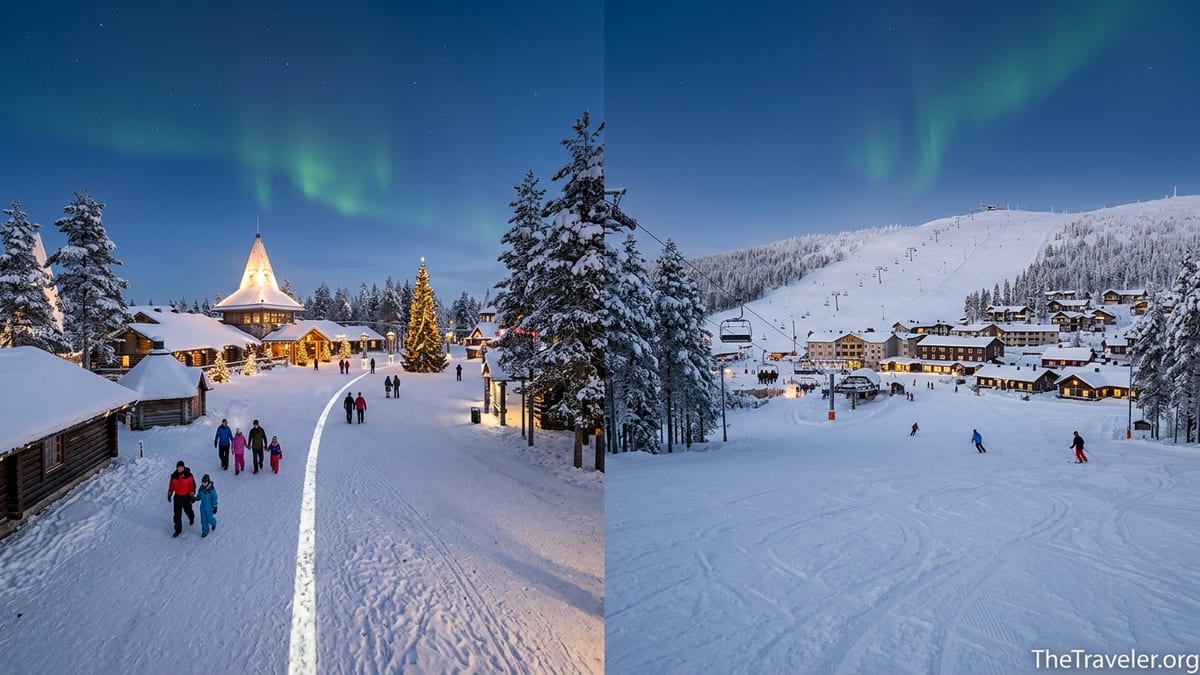
Santa Claus Village sits just north of Rovaniemi, the regional capital of Lapland, right on the Arctic Circle line. It is effectively a compact Christmas-themed park with surrounding accommodation and activity companies. The focus here is meeting Santa, doing a few classic Arctic activities and enjoying the atmosphere of a permanent Christmas village rather than exploring big wilderness areas.
Levi, by contrast, is Finland’s largest ski resort, built around the Levi fell in the municipality of Kittilä. The village is wrapped around the slopes, with chairlifts, gondolas and cross-country tracks radiating out in all directions. Instead of one central attraction, Levi offers a full-scale winter sports town with bars, restaurants, spas and dozens of operators running everything from husky safaris to aurora tours.
In practical terms, this means Santa Claus Village works well as a 1 to 3 night stop focused on Santa and family activities, while Levi can comfortably fill a full week or more, especially if you ski or snowboard. Many travelers now combine both: flying into Rovaniemi for one or two nights at the Village, then continuing roughly 170 kilometers by bus or rental car north-west to Levi for a longer stay.
Weather and light conditions are broadly similar in both locations, with polar nights, deep snow and frequent sub-zero temperatures from December to February. However, Levi’s position further inland and slightly further north often means a little more snow cover and slightly colder temperatures, which can matter if you are focused on skiing or northern lights visibility.
Access, Transfers and Getting Around
For many travelers, Santa Claus Village is the easiest first step into Lapland. Rovaniemi Airport is around 10 kilometers from the city center and roughly the same distance from the Village, with frequent winter flights from Helsinki and a growing number of seasonal direct services from major European cities. From the airport, shuttle buses and taxis take around 10 to 15 minutes to reach Santa Claus Village, so you can realistically land mid-morning and be meeting Santa before lunch.
Levi is served by Kittilä Airport, about 15 kilometers away from the resort, with its own winter flight schedule from Helsinki and selected European hubs. If your airline does not fly to Kittilä, you can arrive via Rovaniemi and continue by bus or car. The drive between Rovaniemi and Levi is around 168 to 170 kilometers and typically takes just over two hours in winter conditions. Scheduled buses align with common flight and train arrivals, which makes it workable to land in Rovaniemi in the afternoon and reach Levi in time for dinner.
On the ground, Santa Claus Village is walkable. Most key attractions, shops and cafes are tightly clustered around a central square and the Arctic Circle line. You may only need a taxi to and from the airport or the city center. This is helpful for families with young children, who can move between activities without long transfers in the cold.
Levi is larger and more spread out, although still compact by alpine-resort standards. Many hotels and apartments sit within a 5 to 15 minute walk of the main lifts, and a local ski bus connects the different sides of the fell. If you stay in a cabin a few kilometers outside the center for a quieter, more wilderness feel, you will usually rely on a rental car or pre-arranged transfers for restaurant visits, supermarket runs and excursions.
Core Experiences: Santa Magic vs Mountain Playground
At Santa Claus Village, the headline experience is meeting Santa himself. The Santa Claus Office typically operates daily, with longer opening hours in December. Families queue along a themed corridor and then step into a cozy, softly lit room to talk to Santa for a few minutes and pose for photos. You do not pay to meet him, but the professional photo and video packages add to the cost of the visit. Just next door, the Santa Claus Main Post Office sells stamps, cards and gifts, and will post letters with the official Arctic Circle postmark or schedule them for delivery the following Christmas.
The Village is also the symbolic crossing point of the Arctic Circle. A white line runs through the central courtyard, and many travelers take photos as they “cross the Arctic Circle” with the temperature display and snow-laden pines in the background. For children, the combination of music, lights, Christmas shops and the appearance of elves and costumed characters build a fairy-tale atmosphere that feels like a theme park more than a remote wilderness outpost.
Levi’s core experience is quite different. Here, the star of the show is the fell itself. The resort offers a network of alpine ski runs serviced by gondolas and chairlifts, plus extensive cross-country trails and snowshoe routes. Downhill skiers can choose from gentle family slopes to steeper World Cup runs, while non-skiers still have the lifts and panoramic restaurants at the top stations to enjoy broad views over the frozen landscape. During the long midwinter evenings, many slopes are floodlit, framing the dark sky above the village.
Off the slopes, Levi functions as a broader winter playground. Snowmobile safaris, reindeer and husky rides, ice karting, winter fat biking and guided aurora hunts are widely available, spread across multiple operators. This breadth turns Levi into an all-round activity hub for couples, groups of friends and families with older children who want varied days rather than a single, central attraction.
Activities, Day Trips and Real-World Costs
In and around Santa Claus Village, you will find compact versions of most classic Lapland activities. Short reindeer sleigh rides of approximately 10 minutes often cost in the region of 25 to 40 euros per adult, depending on route length and provider. Longer rides and small-group safaris can exceed 100 euros per person. Husky sleigh rides follow a similar pattern, with brief rides suitable for young children in the central Village precinct and longer safaris departing from kennels just outside the main area.
Several tour companies bundle experiences into half-day or full-day packages from Rovaniemi. A typical winter 2025 to 2026 example is a “Highlights of Santa Claus Village” tour that includes transfers from the city, a guided walk around the Village, a short husky ride, a reindeer sled ride and free time to visit Santa and the Post Office. Prices for this kind of package are frequently quoted around 180 to 220 euros per adult. Self-guided visitors can reduce costs by booking individual activities and relying on local buses or taxis.
In Levi, activity prices are broadly comparable, but the range of options is wider. A two-hour snowmobile safari often falls in the 130 to 170 euros per adult range, while a family-focused reindeer farm visit with a short sleigh ride might cost around 70 to 110 euros per adult. Full-day husky safaris or wilderness tours are usually higher. Ski passes add another cost layer: for example, a one-day lift ticket in peak season can easily reach a high double-digit euro amount per adult, with multi-day passes offering better per-day value.
Day trips differ too. From Santa Claus Village or Rovaniemi, you can visit attractions such as the Arktikum museum, the Pilke Science Centre, local art galleries and riverside viewpoints within a short drive. From Levi, you can join excursions to more remote areas: evening trips to dark-sky locations for aurora photography, visits to the seasonal SnowVillage built from snow and ice, or cross-country tours that move between fells over several days while your luggage is transported separately.
Atmosphere, Crowds and Nightlife
Santa Claus Village feels busiest from late November through early January, especially around Christmas and New Year. During these weeks, coach groups and families from across Europe and beyond pour into the compact central square. Queues to meet Santa can run well over an hour at peak times, and indoor restaurants and cafes often require patience. The atmosphere is festive and child-focused: think Christmas songs playing in the background, fairy lights in the snow and photo opportunities at every corner.
Even in quieter periods such as March or early April, the Village retains a commercial, curated feel. It is designed to be easy, safe and instantly charming for first-time snow visitors. You will see many people spending just a few hours in the Village as part of a broader Finnish or Scandinavian itinerary, using it as a photogenic stop rather than a multi-day base.
Levi is more of a classic resort town, and its mood shifts across the season. In early December, the focus is on the opening of the ski season and early snow conditions. During the core holiday weeks in February and March, especially around school breaks in Finland and nearby countries, the resort is lively, with restaurants and bars buzzing from late afternoon into the evening. Après-ski here is relaxed rather than wild, with live music venues, a handful of nightclubs and plenty of cozy lounges and hotel bars.
Outside the busiest weeks, Levi can feel surprisingly calm, especially in January or late season when there are fewer families. The village still has enough infrastructure to feel lived-in, but you may find it easier to get tables at popular restaurants, secure last-minute activity bookings and enjoy quieter slopes. This off-peak calm is a strong selling point for couples or solo travelers who prefer atmosphere without heavy crowds.
Where You Sleep: Cabins, Hotels and Glass-Roof Dreams
Santa Claus Village offers mainly cabin-style accommodation, often grouped into small chalet clusters a short walk from the central square. Many units are designed with families in mind: a main bedroom for adults, a small sleeping loft or bunk beds for children and a living area with kitchenette. Most come with private saunas, a staple of Finnish accommodation, which means you can warm up and dry snow gear each afternoon. Nightly rates in the peak Christmas period can climb significantly, so it is important to book early if you intend to stay over the holiday itself.
Nearby Rovaniemi city center broadens the choice to include standard hotels, hostels and apartments. Some visitors choose to stay downtown and visit Santa Claus Village as a day trip by local bus or tour transfer. This can reduce accommodation costs, especially outside the final weeks of December, and puts you closer to supermarkets and city restaurants while still keeping the Village within easy reach.
Levi provides a classic ski-resort mix of hotels around the main lifts, self-catering apartments and standalone cabins scattered in the forest surrounding the fell. Many international travelers book week-long packages that bundle flights, transfers, accommodation and some activities. Families often gravitate to slopeside or near-slope apartments, where older kids can walk to the lifts and back independently. Cabins further from the center trade convenience for quiet, dark skies and the sense of being deep in the forest.
Glass-roofed igloo-style cabins have become a signature Lapland accommodation category, and both regions offer them. Options near Rovaniemi tend to be located slightly away from the city lights to improve aurora visibility, while Levi’s igloo and panorama suites usually sit on or near the fell slopes. These premium stays command high nightly rates, often several hundred euros or more in peak periods, but deliver the quintessential experience of lying in bed and watching the northern lights ripple overhead on a clear night.
Northern Lights, Snow Reliability and Season Length
Many visitors secretly hope for northern lights more than any other experience. Both Santa Claus Village and Levi lie within the auroral zone, so seeing auroras comes down to a mix of solar activity, clear skies and a bit of luck. Statistically, visitors who stay several nights between late September and late March have a reasonable chance of at least one display, though nothing is guaranteed.
Rovaniemi and Santa Claus Village have more nearby light pollution than Levi, since the city and its suburbs sit along the same river corridor. You can still see the aurora from dark corners of the Village on strong nights, and many tours will drive you out along quieter roads or up nearby hills in search of darker skies. However, you are likely to hop into a minibus and travel 30 minutes or more for the best viewing conditions.
Levi enjoys somewhat darker surroundings. Once you move a little outside the central village or ride a gondola up the fell with a guided group, you are surrounded by broad, open views and relatively little artificial light. Activity companies often report aurora sightings on roughly one out of every few nights across the season, with peaks around equinox periods. For photographers, the combination of a snow-covered fell and dark, open sky can be particularly rewarding.
In terms of snow reliability and season length, Levi has the edge. As a high-latitude, inland fell with extensive snowmaking infrastructure, its ski season often stretches roughly from October into early May, though exact dates vary slightly each year. Rovaniemi’s lower elevation and maritime influences still deliver solid winter conditions, but early or late season trips are more vulnerable to thaw periods. If downhill skiing or cross-country touring is central to your plans, Levi is the safer bet for consistent snow cover, especially in the shoulder months of November and April.
Who Each Destination Suits Best
Putting all of this together, clear traveler profiles emerge. Santa Claus Village is ideal for families with young children who dream specifically of meeting Santa in “his” hometown, crossing the Arctic Circle and trying a curated handful of fun snow activities. The compact layout, walkable distances and strong Christmas theming help kids feel safe and engaged, while adults appreciate the ease of logistics and quick transfers from the airport.
It also works well as a short, high-impact stop on a broader itinerary. For example, a couple might fly into Rovaniemi on a Friday, spend Saturday at Santa Claus Village, then depart Sunday by bus or rental car to Levi or another Lapland destination. This kind of two-night stay provides the symbolic highlights of Lapland without committing an entire week to one themed location.
Levi, on the other hand, suits travelers who prefer a more rounded winter holiday. Skiers and snowboarders will naturally gravitate here, but so will non-skiers who like the feel of an alpine town with multiple restaurants, bars and off-slope activities. It is particularly appealing for friend groups, couples and families with teenagers who can handle longer days outside and enjoy a bit of independence.
Budget also plays a role. Neither destination is cheap in peak season, but it is often easier to manage costs in Levi by choosing self-catering accommodation, shopping at local supermarkets and mixing paid excursions with free or low-cost days on the slopes or cross-country trails. In Santa Claus Village, the density of themed shops and short, high-priced activities can make it easier to spend more per day, especially with children requesting souvenirs and add-ons.
The Takeaway
If your dream of Lapland is all about Christmas magic, letters to the North Pole and seeing your child’s face light up as they step into Santa’s office, Santa Claus Village on the Arctic Circle delivers exactly that. It is compact, easy to reach from Rovaniemi Airport and carefully designed around the Santa experience, with enough reindeer rides, husky safaris and snowy photo spots to fill a short break.
If you imagine a broader winter escape, with days on skis or snowboards, evenings in a lively village and the feeling of being surrounded by fells and forests, Levi is the stronger choice. Its long season, extensive lift network and wide activity menu make it one of Lapland’s most versatile bases, especially for a week-long trip.
For many travelers, the most rewarding option is not either-or but both. A night or two at or near Santa Claus Village combined with five or more nights in Levi strikes a balance between storybook Christmas and authentic mountain resort life. Whether you choose one base or combine them, understanding what each destination truly offers will help you plan a Lapland journey that matches your expectations, budget and travel style.
FAQ
Q1. Is Santa Claus Village or Levi better for a short weekend trip?
Santa Claus Village is generally better for a short weekend, especially with children. You can land at Rovaniemi Airport, reach the Village in about 15 minutes, meet Santa, cross the Arctic Circle and fit in a reindeer or husky ride all within one or two days, without long transfers or complex logistics.
Q2. How long should I stay in Levi to make the trip worthwhile?
Levi works best for at least four to seven nights, particularly if you plan to ski or snowboard. This gives you time to adjust to the cold, try several activities such as snowmobiling or husky safaris, enjoy rest days and still have flexibility if weather or aurora forecasts change during your stay.
Q3. Can I visit both Santa Claus Village and Levi on the same trip?
Yes, many travelers combine both. A common pattern is to fly into Rovaniemi, stay one or two nights to visit Santa Claus Village, then continue about 170 kilometers by bus or rental car to Levi for a longer stay focused on skiing and wilderness activities, before flying home from Kittilä or returning to Rovaniemi.
Q4. Which place is better for seeing the northern lights?
Both are within the auroral zone, but Levi usually offers darker surroundings and easier access to open, light-free viewpoints. From Santa Claus Village you will often drive out of the city area for the best viewing, while in Levi you can reach dark skies quickly by heading slightly outside the village or joining a guided trip up the fell.
Q5. Is Levi suitable if I do not ski or snowboard?
Yes. While skiing is a major draw, non-skiers in Levi can enjoy reindeer and husky safaris, snowshoeing, snowmobile tours, spa days, scenic gondola rides and aurora excursions. The village atmosphere, restaurants and cafes provide plenty to do even without clipping into skis.
Q6. Which destination is more budget-friendly?
Neither is cheap in peak winter, but Levi can be easier for budget control over a week or more. Self-catering apartments, supermarket shopping and mixing paid activities with free days on cross-country tracks or walking trails help manage costs. At Santa Claus Village, the density of themed shops and short attractions can lead to higher per-day spending, especially for families.
Q7. Is it better to stay in Santa Claus Village or in Rovaniemi city and visit for the day?
Staying in the Village is atmospheric and convenient with kids, but city-center Rovaniemi hotels often offer more varied dining and can be slightly more affordable outside the Christmas peak. If you are comfortable using local buses or tours, basing yourself in the city and visiting the Village as a day trip can be a good compromise.
Q8. How difficult is winter driving between Rovaniemi and Levi?
The main road between Rovaniemi and Levi is well maintained, but expect snow, ice and limited daylight in midwinter. Confident drivers who are used to winter conditions often find the journey manageable in about two to two and a half hours with a rental car equipped for snow. Less experienced drivers may prefer the simplicity of scheduled buses or private transfers.
Q9. When is the best time to avoid crowds but still have good snow?
In both destinations, January and late March to early April often feel quieter than the peak school holiday weeks in February. These periods typically still have good snow cover, though temperatures in January can be extremely cold and late-season conditions can vary from year to year, especially around Rovaniemi.
Q10. Which destination is better for a romantic trip or honeymoon?
Levi usually offers more choice for romantic stays, from secluded forest cabins and glass-roof igloos to spa hotels with mountain views and a broader selection of restaurants and evening activities. Santa Claus Village can still work for a short, playful add-on to a honeymoon, but it is more family-oriented and built around the Santa theme than around quiet, adults-only escapes.