


Most hikers arrive in Whiteoak Canyon dreaming of one waterfall. They have seen the photos of a single, graceful cascade pouring into a blue-green pool in Shenandoah National Park and assume that is the prize. Then the trail bends, the canyon tightens, and they discover that Whiteoak is not one waterfall at all but an entire staircase of six falls, each with its own character, mood, and challenge. It may be the most rewarding surprise in Virginia’s Blue Ridge.
Get the latest updates straight to your inbox!
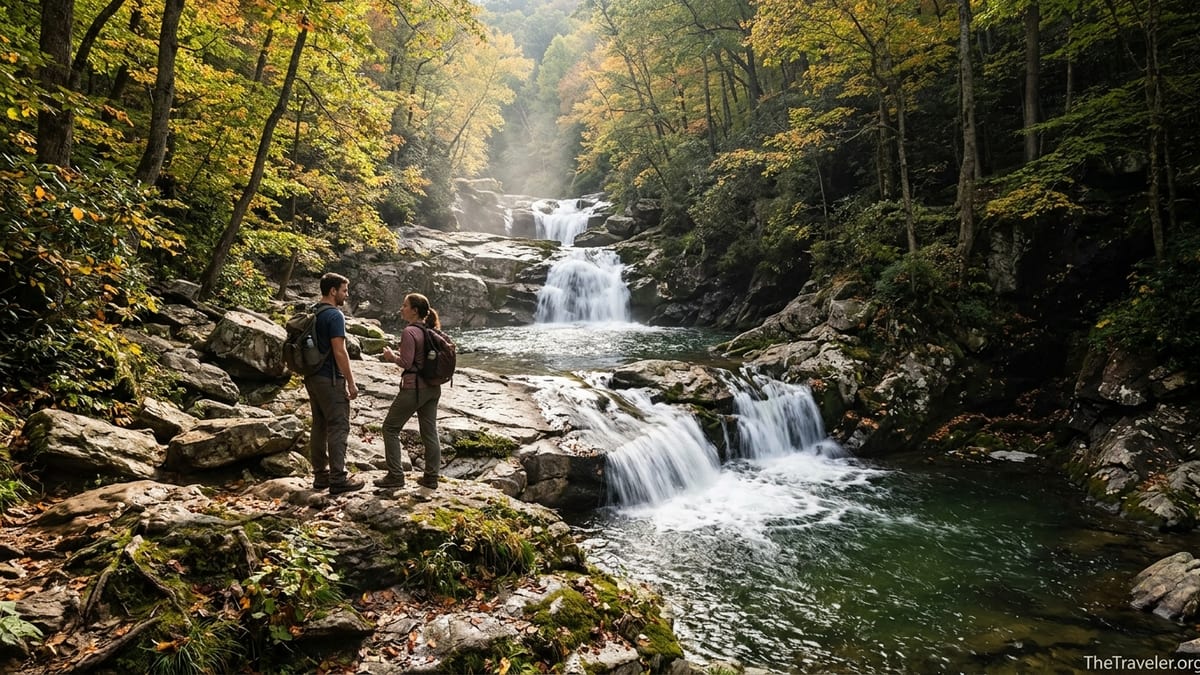
Understanding Whiteoak Canyon and Its Six Falls
Whiteoak Canyon sits roughly at milepost 42.6 on Skyline Drive in Shenandoah National Park, Virginia, a little over two hours by car from Washington, D.C. The canyon is carved by Whiteoak Run, a clear mountain stream that drops steeply off the Blue Ridge crest. Over a few rugged miles, the creek tumbles through a sequence of six main waterfalls, the tallest dropping roughly 80 to 90 feet, with slides, chutes, and deep pothole pools between them.
Most visitors see the name "Whiteoak Canyon" on the park map and imagine a quick stroll to a single overlook. In reality, the official Whiteoak Canyon Trail runs about 5 miles one way between Skyline Drive on the rim and a lower boundary parking area near the village of Syria. Between those two trailheads, the water steps down through all six falls. Some can be reached via short side paths, others are best viewed from the main trail, and a few require more careful scrambling and route finding to appreciate up close.
Because of this layout, hikers often experience the canyon in pieces. Families with young children might walk just the first mile from Skyline Drive to see the uppermost cascade from above, then turn back. Others approach from the lower boundary and hike a shorter section to the popular lower falls and their swimming holes. Ambitious hikers stitch it together into loops with the neighboring Cedar Run Trail, building big days with 2,000 feet or more of elevation gain and a waterfall around nearly every bend.
If you come expecting a simple there-and-back to one photogenic spot, the complexity of the canyon can be disorienting. But once you understand that Whiteoak is really a vertical chain of six major drops, each nested in its own pocket of forest and rock, the trail shifts from confusing to captivating. Every climb or descent has a purpose: carrying you from one waterfall world to the next.
Getting There, Parking, and Fees
To reach the upper trailhead, most visitors enter Shenandoah National Park via one of the Skyline Drive access points, such as Thornton Gap off U.S. 211 or Swift Run Gap off U.S. 33. From there, they drive to milepost 42.6, where a signed side road leads to the Whiteoak Canyon parking area at the crest. This small paved lot fills quickly on spring and fall weekends. It is common by late morning to see cars circling for spaces or parking along the approach road where allowed.
The lower trailhead sits outside the fee gates on the park’s eastern boundary near the community of Syria. Here, a private road leads to a gravel parking area used by hikers heading up-canyon to the lower falls. On peak summer days, families in flip-flops and swimsuit tops tread the first mile of trail with beach towels over their shoulders, planning to spend the afternoon in the pools below the lowest waterfalls rather than touring the entire canyon.
As of mid-2026, drivers entering Shenandoah through an official entrance station pay a per-vehicle fee that covers everyone in the car for seven consecutive days. The park has moved to cashless payment, so visitors should be ready with a credit card or mobile pay. Frequent national park travelers sometimes opt instead for an annual interagency pass, which covers entrance to Shenandoah and other major parks for one year and can be good value if you plan multiple trips.
Because fee policies can change with new federal rules, it is wise to verify the latest prices on the National Park Service’s Shenandoah page before you go. International travelers in particular have seen added surcharges at some of the most popular parks, and while Shenandoah remains more affordable than giants like Yosemite or Zion, those extra costs can influence whether you choose to spend one day or several here.
Choosing Your Route: Upper, Lower, or the Full Canyon
One of the first practical questions for Whiteoak Canyon is which end to start from. The most popular option for first-time visitors is the lower approach to the lower falls. From the boundary parking, the trail follows the creek upstream on a moderate grade, gaining roughly 400 to 500 feet over about 1.5 miles to reach the main lower cascade and its broad, inviting pool. For many families, especially with younger children, this is the perfect out-and-back: just strenuous enough to feel like a hike, but short enough to leave time for a picnic and a swim.
Hikers seeking cooler temperatures often start from the upper trailhead along Skyline Drive. From there, the trail drops through mixed hardwood and hemlock forest toward the canyon. Within the first couple of miles, you encounter the uppermost falls, including the tallest drop in the sequence, which pours into a rocky bowl framed by moss and ferns. The descent means you will be climbing on your way back, so what feels easy at first can become a lung-burner later in the day.
For experienced hikers with a full day and sturdy knees, the most rewarding option might be the full canyon point-to-point, or a challenging loop that links Whiteoak Canyon with Cedar Run. A classic route begins at the upper lot, descends past several waterfalls, crosses a footbridge, then climbs back out via Cedar Run’s own string of cascades. This figure-eight of water and rock can tally 8 to 9 miles with well over 2,000 feet of cumulative elevation gain. Trail runners from nearby Charlottesville or Harrisonburg often treat this loop as a training ground for mountain races.
Whichever direction you choose, it is helpful to remember that you do not have to “collect” all six waterfalls in one outing. On a hot July afternoon, hiking just far enough to visit the lower falls and spending an hour or two wading in the creek can be far more enjoyable than forcing tired children to grind up and down every switchback. Conversely, in crisp October light, you may find yourself energized enough to keep exploring, motivated by the sound of each unseen cascade just downstream.
Meeting the Falls: What Each Section Feels Like
Although most park maps simply mark Whiteoak Canyon as a single trail, many hikers experience it as a series of distinct zones, each anchored by one of the six main waterfalls. The uppermost section, reached first from Skyline Drive, feels high and airy. The forest here is mixed oak and hickory, with mountain laurel along the trail and long views through bare branches in early spring and late fall. The first major falls appears where the creek squeezes between slabs of gray rock and plunges into a deep, narrow pool; in winter, ice curtains can form along the sides, giving the scene a stark, alpine feel.
Drop down another mile and the canyon tightens. Here the trail sometimes edges close to the creek, with sections of stone steps and short, steep pitches. Smaller cascades roar beside you after heavy rain. In May and early June, wildflowers like trillium and bluets dot the mossy banks. One of the middle waterfalls spills over a series of shelves rather than one vertical drop, creating a broad fan of water that glows in late-afternoon sun. This is a favorite stop for photographers carrying lightweight mirrorless cameras and compact tripods, who time exposures just long enough to blur the water while keeping the rock textures sharp.
The lower canyon, most often visited from the boundary trailhead, has a different energy altogether. As you approach the main lower falls, the trail widens in spots, and you begin to hear laughter from people at the pools ahead. On a July Saturday, you might find college students from James Madison University sunning on the boulders, parents watching kids wade near the shore, and brave swimmers easing into the deeper, colder water at the base of the cascade. In lower water years, some locals slide down the smoothed rock chutes beside the falls, though park rangers warn that slick algae, submerged rocks, and sudden current can turn a playful moment into a rescue.
Beyond the lower falls, fewer people continue upstream, but the creek still has plenty to offer: side channels, polished bedrock, and small flumes ideal for quiet contemplation rather than crowds. This is where you are more likely to see a whitetail deer slipping through the forest or a black bear overturning stones in search of insects. Even if you came for “the” waterfall, pressing just a bit farther can reveal that Whiteoak’s real magic lies in the constant interplay of water, rock, light, and forest from top to bottom.
Seasonal Conditions, Safety, and Real-World Logistics
Whiteoak Canyon is beautiful in every season, but conditions change enough that your experience in March will be very different from one in August or October. In early spring, snowmelt and rain can swell the creek, turning the falls into thunderous curtains and slicking the rocks with spray. Daytime highs along Skyline Drive might hover in the 40s Fahrenheit, while the lower boundary trailhead is milder. Hikers who show up in cotton hoodies and running shoes because it looks warm in the valley sometimes find themselves shivering on a windy ridge.
Summer is prime time for swimming holes, but it also brings heat, humidity, and crowds. Parking at both trailheads can fill by midmorning on Saturdays. A practical strategy is to arrive before 8:30 a.m., especially if you are driving in from Northern Virginia. Many local hikers treat the canyon like a morning workout, hiking briskly to the falls, taking a short break, and being back at the car by lunchtime before afternoon thunderstorms build. Afternoon storms can turn narrow footpaths into temporary rivulets; lightning and flashier creek rises are real risks, so checking the day’s forecast and turning around if thunder approaches is basic backcountry sense.
Autumn brings cooler air and a blaze of color as oaks, maples, and hickories shift to reds, golds, and russets. This is also peak leaf-peeper season, when weekend congestion on Skyline Drive can rival urban traffic. A midweek visit can feel dramatically different; on a Tuesday morning in late October, you might have long stretches of trail almost to yourself, sharing the view with just a handful of other photographers and birdwatchers.
Winter in Whiteoak Canyon is perhaps the most underrated season. With leaves off the trees, you gain more open views across the canyon walls, and the waterfalls take on a sculptural quality as ice drapes over ledges and logs. Trails can be icy, especially near the falls where spray freezes on rock steps, so traction devices like microspikes are useful. Weather can change fast at elevation; drivers should check Skyline Drive status before assuming the upper trailhead is accessible, as portions of the road close temporarily after snow and ice.
What to Pack and How to Hike Responsibly
Because Whiteoak Canyon feels relatively close to the road, it is easy to underestimate it. Yet the combination of steep grades, slick rock, and variable weather justifies treating it like any serious mountain hike. At a minimum, bring a liter or two of water per person, a snack or lunch, and layers appropriate for temperatures that can be 10 to 15 degrees cooler than nearby towns. Many regulars carry compact daypacks with a lightweight rain shell, a small first-aid kit, and a printed map or offline navigation app on their phone.
Footwear is a frequent point of regret among first-time visitors. Trail runners or light hiking shoes with real tread handle Whiteoak’s roots and rocks far better than flat-soled sneakers or sandals. At the lower pools, you will see visitors stepping gingerly on slick stones in flip-flops or bare feet, occasionally slipping into cold water unexpectedly. Closed-toe water shoes can be a good compromise if you plan to spend time in the creek but still want grip and protection.
Swimming and wading are not prohibited in Whiteoak Canyon, but they come with risks the park highlights in its safety messaging. The pools can be deceptively deep and cold, especially in early summer when snowmelt is still feeding the creek. Strong swimmers who feel comfortable in a municipal pool can find themselves shocked by the temperature and current beneath a waterfall. Jumping or diving is strongly discouraged; submerged rocks shift with floods, and water levels fluctuate from week to week.
Practicing Leave No Trace ethics is vital in such a heavily used area. That means packing out every scrap of trash, from energy bar wrappers to orange peels; staying on established trails instead of creating shortcuts that erode steep slopes; and resisting the urge to carve initials into trees or rocks. In recent years, park staff and volunteer groups have devoted significant effort to repairing social trails and compacted streambanks near the most popular pools. Responsible behavior by visitors makes it more likely that swimming access will remain open rather than restricted in the future.
The Takeaway
Most hikers who set out for Whiteoak Canyon imagine a single destination: one famous waterfall, one triumphant photo, one moment of cool spray on a hot Virginia afternoon. What the canyon offers instead is a sequence of experiences, six major falls stitched together by miles of forest path, polished rock, and mountain stream. This is not the kind of hike you check off in a hurry. It is the kind you return to in different seasons and from different directions, tracking your own history against the steady rush of water.
If you plan ahead for parking and fees, choose a route that matches your fitness, and come equipped for real mountain conditions, Whiteoak repays you many times over. You might discover a favorite perch beside one of the middle cascades, where the sound of water drowns out everything else. You might find courage in the cold plunge of a lower pool, or quiet in the bare winter woods above the upper falls. Somewhere between the first trail marker and the last waterfall, most visitors realize that what drew them here was not just a picture but the possibility of surprise.
In a national park known for its overlooks and auto-friendly Skyline Drive, Whiteoak Canyon invites you to step away from the guardrails and follow the path water has carved for thousands of years. Come for one waterfall if you must. But leave time for the other five. The canyon, like most great hikes, is more generous than the brochure suggests.
FAQ
Q1. How many waterfalls are in Whiteoak Canyon, really?
There are six main waterfalls along Whiteoak Run that most hikers refer to, plus numerous smaller cascades and chutes between them.
Q2. Do I need to pay a fee to hike Whiteoak Canyon?
If you enter Shenandoah via an official entrance gate to reach the Skyline Drive trailhead, you pay a park entrance fee per vehicle. The lower boundary access sits outside the gates, though private parking fees may apply there.
Q3. Which trailhead is better for first-time visitors?
Many first-time visitors with families prefer the lower boundary trailhead, which offers a moderate hike to the popular lower falls and swimming pools without a long, steep climb back to the car.
Q4. How difficult is the hike to see the waterfalls?
The lower hike to the main lower falls is moderate, around a few miles round trip with a few hundred feet of elevation gain. Hiking the full canyon or a Whiteoak–Cedar Run loop is strenuous and best for experienced hikers.
Q5. Can I swim in the pools below the falls?
Swimming and wading are generally allowed but always at your own risk. The water is cold, rocks are slippery, and jumping or diving is strongly discouraged due to hidden hazards.
Q6. When is the best time of year to visit Whiteoak Canyon?
Spring and fall offer strong water flow and comfortable temperatures. Summer is great for swimming but can be hot and crowded, while winter is quieter but can bring ice and road closures.
Q7. Are dogs allowed on the Whiteoak Canyon Trail?
Leashed dogs are allowed on most of the Whiteoak Canyon routes, but owners should be prepared for steep, rocky sections and keep pets under control near cliffs and other hikers.
Q8. How early should I arrive to find parking?
On busy spring and summer weekends, aim to arrive before midmorning, ideally around 8 or 8:30 a.m., to improve your chances of finding a spot at either trailhead.
Q9. Do I need special gear for this hike?
Sturdy shoes with good tread, plenty of water, and weather-appropriate layers are essential. In winter, traction devices for icy sections and a warm layer can make the hike much safer.
Q10. Is Whiteoak Canyon suitable for young children?
Sections of the lower trail to the first pools can be suitable for active children, but parents should watch them closely near steep drop-offs and fast-moving water, and be ready to turn around if anyone is tired.