


Tucked just beyond Naples’ historic center, the Basilica of Santa Maria della Sanità is easy to overlook when you are focused on the city’s headline sights. Yet this Baroque church and the catacombs beneath it offer one of the most atmospheric windows into Naples’ layered history, from early Christianity to the bustling working-class district of Rione Sanità above. Whether it is worth visiting during your trip depends on how much you value art, local life and unusual underground spaces. This guide breaks down what you will actually see, what it costs, how it feels on the ground, and who will get the most out of a visit.
Get the latest updates straight to your inbox!
What and Where Is Santa Maria della Sanità?
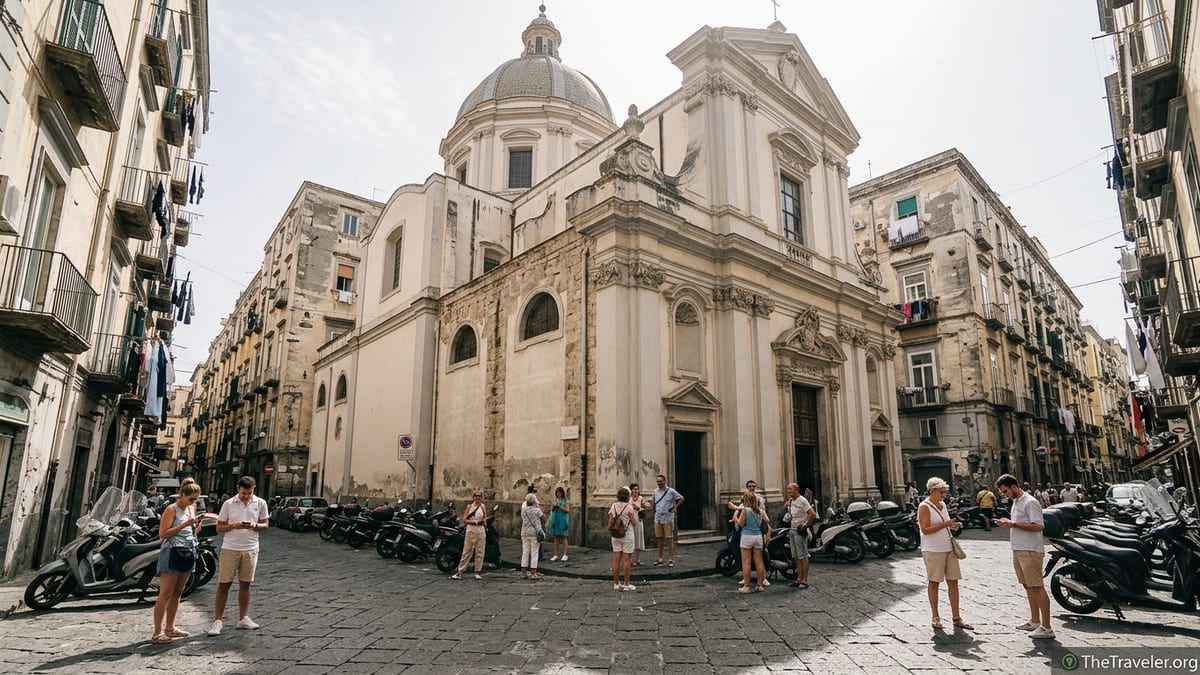
Santa Maria della Sanità is a basilica church built in the early 17th century in the Rione Sanità neighborhood, just north of Naples’ historic center. The church sits directly over the Catacombs of San Gaudioso, one of the city’s most important early Christian cemeteries, and today the two are usually experienced together on a single guided visit. You enter from a small piazza where Via Sanità meets Via Teresa degli Scalzi, about a 20 to 25 minute walk uphill from the heart of the Centro Storico around Via dei Tribunali.
The basilica is Baroque in style, with a striking domed interior and a raised main floor that was literally built above an earlier church. The catacombs below date back roughly to the 4th and 5th centuries and preserve both simple early Christian tombs and much later, haunting wall burials used by Neapolitan nobles and clergy in the 1600s. Because of this unusual vertical layering, a single visit takes you from street-level Naples down through more than 1,500 years of religious history in the span of an hour.
Practically, this is not a distant suburban outing. From Piazza Dante or Museo metro stations, you can walk into Rione Sanità via a pedestrian bridge in around 10 to 15 minutes, or take a short ride on buses that climb Via Santa Teresa degli Scalzi and drop you near the church. Many travelers pair Santa Maria della Sanità with the better-known Catacombs of San Gennaro, a short taxi or bus ride further uphill toward Capodimonte.
The site is managed as part of the “Catacombs of Naples” network, with local cooperative guides drawn from the neighborhood. Tours are offered in Italian and English at set times throughout the day, especially on weekends and in high season, and group sizes are typically small enough that you can ask questions and move comfortably in the tunnels.
Why Travelers Consider It Worth the Detour
The main reason many visitors find Santa Maria della Sanità worth their time is the combination of powerful visuals and narrative. In the church itself, you stand beneath a large green-and-gold dome, surrounded by side chapels, marble altars and staircases that hint at the hollow space beneath your feet. Descending into the catacombs, though, is what most people remember. Here you see early Christian frescoes and mosaics, as well as the distinctive 17th century “portrait” burials where skulls are embedded into the walls and the rest of the body is painted in fresco, often with the clothing or tools that signaled the person’s social status.
Guides often point out details that you might otherwise miss: for example, the tomb of Saint Gaudiosus, a North African bishop who fled to Naples in the 5th century, the oldest known depiction of the Madonna della Sanità in Campania, and a series of frescoed skeletons that inspired Neapolitan writer and actor Totò to compose his famous poem on death and equality. Travelers who enjoy tangible stories more than abstract dates typically come away with a strong sense of how beliefs about death and the afterlife shifted over centuries in Naples.
Another factor is the atmosphere of Rione Sanità itself. Unlike the manicured streets around Piazza del Plebiscito, this is a dense, lived-in neighborhood of laundry-strung balconies, small fruit stalls and kids playing soccer in the alleys. Emerging from the dim catacombs into bright midday, then grabbing a slice of pizza fritta from a corner friggitoria on Via Sanità, gives you a snapshot of everyday Naples that most quick day trips never touch.
For many itineraries, Santa Maria della Sanità also fits neatly into a themed “sacred mile” of sites, combining the catacombs of San Gaudioso and San Gennaro with the Fontanelle Cemetery and small local churches. If you are staying two or three full days in Naples and are curious about the city beneath the city, this cluster of underground sites can easily fill a half day without feeling repetitive.
What You Will See Inside the Church and Catacombs
The visit typically starts in the basilica, where you can appreciate its unusual layout. The main nave sits high above ground level, reached by broad staircases, because it was built on top of an earlier church dedicated to San Gaudioso. Look up and you will see the frescoed dome with its creamy light and greenish tones, and side chapels decorated with Baroque stucco and paintings. Your guide may briefly explain how the Dominicans in the 17th century reshaped this whole space to integrate it with the underground cemetery.
From there, you descend via stairs to the earlier church level and into the catacombs. The first impression is of low, tuff-stone corridors lined with niches. In the oldest sections you see simple tombs, frescoed symbols like fish, lambs and vines, and small mosaic fragments dating from the 5th and 6th centuries. These are some of the earliest surviving Christian images in Naples and, while the colors are muted, the fact that they are still visible after so many centuries tends to surprise visitors.
Deeper into the catacombs, the mood shifts. Along the main ambulatory walls are the 17th century aristocratic burials: real skulls set into plaster ovals, with the rest of each figure painted beneath in period dress. One might show a nobleman with his sword, another a cleric with liturgical vestments. The style is macabre but also strangely respectful, and guides usually explain how families would commission these tombs as a visible reminder of both status and mortality.
Many tours end in a broader chamber where you can stand comfortably while the guide tells stories about local legends, the rediscovery of the fresco of the Madonna that led to renewed devotion to the site, and the neighborhood’s efforts in recent decades to use the catacombs as a driver of cultural revival rather than as a forgotten, off-limits space. Photos are generally allowed, although flash may be restricted, so expect dim, grainy images rather than bright, museum-style shots.
Tickets, Opening Times and How to Plan Your Visit
At the time of writing, a standard adult ticket to the Catacombs of Naples, which includes the Catacombs of San Gaudioso under Santa Maria della Sanità and typically also grants access to the Catacombs of San Gennaro, costs in the rough range of a mid-priced museum ticket in Italy. Concessions for students, young people and some local residents are usually available, and children often pay a reduced fee or can enter free up to a certain age. Prices can change seasonally, so it is worth checking the official catacombs website or a recent brochure shortly before you travel.
Guided tours at San Gaudioso run at fixed times, commonly grouped in late morning and afternoon slots. In summer, there may be additional tours to cope with demand, while in the quieter winter months departures can be less frequent. Tours last around 45 minutes to one hour, which makes it relatively easy to fit into a day that might also include the Archaeological Museum or a food tour in the centro storico.
To reach Santa Maria della Sanità, many visitors start from Museo or Materdei metro stations on Line 1 and walk downhill into the neighborhood, or cross the high pedestrian bridge from the historic center. Alternatively, a short taxi ride from Piazza Dante or Piazza Bellini will get you to the church in under 10 minutes in light traffic. If you are planning to continue on to the Catacombs of San Gennaro afterward, factor in an additional 10 to 15 minutes by taxi, bus or on foot uphill toward Capodimonte.
Inside the church and catacombs the temperature stays relatively cool and slightly damp compared to the streets above. Even in July and August, it can feel chilly after you have been underground for a while. A light layer and comfortable walking shoes with good grip are highly recommended. Because the floors and stairs are uneven in places, visitors with mobility issues should contact the organizers in advance to ask about current conditions and any available accommodations.
Safety, Neighborhood Feel and When to Go
Rione Sanità has a complex reputation. Historically it has been one of Naples’ poorer districts, and Italian media have often associated it with petty crime and the presence of organized clans. Walking its streets, you will certainly notice that it feels more intense than the touristy lanes around Via Toledo: scooters weaving through tight alleys, groups chatting outside bar counters, street vendors calling out prices for seasonal produce like peaches in summer or oranges in winter.
For daytime visitors heading to Santa Maria della Sanità and the catacombs, however, the experience is generally positive. The immediate area around the basilica and the main streets leading to it are used to seeing a steady flow of tour groups, school classes and independent travelers. The local cooperative that runs the catacombs has played a role in encouraging safer, more welcoming conditions, and many travelers report feeling comfortable as long as they stick to the main routes and use normal big-city awareness.
In practical terms, that means visiting in daylight hours, avoiding flashing expensive jewelry or large cameras when not in use, and keeping wallets and phones secure in crossbody bags or inside zipped pockets. If you feel unsure about navigating on foot, taking a licensed taxi directly to the church and arranging a pickup afterward can provide extra peace of mind, especially in the evening when the neighborhood is less busy with tourists.
As for timing, mornings and early afternoons from Tuesday to Sunday usually offer the best combination of open businesses, active street life and multiple tour options. Mondays can be quieter and some cultural sites in Naples are closed, so it is important to check whether the catacombs are operating on your chosen day. Visiting earlier in the day also leaves room to continue on to San Gennaro or to explore the nearby Capodimonte Museum and park while there is still plenty of light.
Who Will Appreciate Santa Maria della Sanità Most?
Santa Maria della Sanità is particularly rewarding if you enjoy history that you can walk into rather than just read about. Travelers interested in early Christianity, underground architecture and the evolution of burial practices will find the catacombs under the basilica rich in detail and atmosphere. If you have already visited the catacombs of San Gennaro, San Gaudioso offers a more intimate, slightly more macabre counterpart that many consider equally compelling.
Art and architecture fans will appreciate the contrast between the luminous Baroque geometry of the church and the raw tuff stone passages below. The site provides concrete examples of how a 17th century religious order, the Dominicans, did not just build a new church on an old one but actively reshaped the older funerary spaces to reflect their own era’s theology and aesthetics. Seeing a skull embedded in plaster above a painted nobleman’s body is an image you are unlikely to forget.
Culturally curious travelers who want to understand Naples beyond its postcard views will also find value here. Pairing the visit with a coffee at a bar on Via Sanità or lunch at a family-run trattoria in the neighborhood gives you a chance to observe daily rhythms and hear local dialect. Some tours are led by young people who grew up in the district and can speak directly about how opening the catacombs to visitors has created jobs and shifted perceptions of the area.
On the other hand, if you are very claustrophobic, strongly uncomfortable around human remains, or traveling with small children who might be frightened by dim corridors and skulls in the walls, you might prefer to limit your visit to the church itself or choose more open-air sites such as Castel dell’Ovo or the seaside promenade along Via Partenope. The catacombs are not especially tight compared to some underground spaces, but they are enclosed and atmospheric by design.
How It Compares to Other Naples Catacombs and Underground Sites
Many visitors to Naples wonder whether to prioritize the Catacombs of San Gaudioso under Santa Maria della Sanità, the larger Catacombs of San Gennaro, or other underground attractions like Napoli Sotterranea. Each offers a different angle. San Gennaro, higher up the hill, is more extensive and monumental, with broad galleries and larger crowds. It focuses heavily on early Christian art and the cult of Naples’ patron saint. San Gaudioso, by contrast, feels more compact and intimate, with a strong emphasis on the 17th century wall burials and the connection to the living neighborhood above.
Compared to Napoli Sotterranea beneath the historic center, which explores ancient Greek quarries, Roman cisterns and World War II shelters, Santa Maria della Sanità is more specifically religious in tone. It is less about engineering and urban infrastructure and more about faith, death and artistic expression. If time allows, many travelers try to do at least one “Christian” catacomb (San Gaudioso or San Gennaro) and one civic underground tour like Napoli Sotterranea to get a fuller picture of how Naples has used its soft tuff stone over more than two millennia.
If your schedule is tight and you can choose only one underground site, ask yourself what appeals more: scale and grandeur, or a blend of neighborhood immersion and unusual funerary art. Those who pick San Gennaro often mention the sense of vastness and the quality of its mosaics. Those who pick Santa Maria della Sanità and San Gaudioso tend to highlight the guides’ storytelling, the skull-and-fresco burials, and the experience of stepping straight from the tunnels onto a noisy Neapolitan street.
In terms of logistics, the combined ticket that covers both catacombs is attractive if you have half a day to spare. You might, for example, visit Santa Maria della Sanità and San Gaudioso on a late morning tour, have lunch in Rione Sanità, then head uphill by bus or taxi for an afternoon tour at San Gennaro. If you prefer to move slowly, dedicating a morning just to Santa Maria della Sanità and wandering back into the historic center on foot will already give you a rich sense of Naples above and below ground.
The Takeaway
So is Santa Maria della Sanità worth visiting during your trip to Naples? For many travelers the answer is yes, provided you have at least two full days in the city and a willingness to step a little off the standard tourist circuit. The basilica and the Catacombs of San Gaudioso beneath it offer a concentrated mix of early Christian history, distinctive Baroque art and vivid local life that you will not find in exactly the same form anywhere else.
If your time is extremely limited or you know that underground spaces and human remains are not for you, you might reasonably focus on open-air highlights like the bay views, Pompeii or the Archaeological Museum. But if you are curious about how Naples’ past and present intertwine, and you like your history with a palpable sense of place, setting aside an hour for Santa Maria della Sanità is likely to be a memorable investment.
Plan ahead by checking current tour times and ticket details, wear comfortable shoes, and give yourself a bit of extra time before or after your visit to absorb the energy of Rione Sanità at street level. In a city famous for its layers, few places make those layers as tangible as this church and the catacombs below it.
FAQ
Q1. Is Santa Maria della Sanità safe to visit for tourists?
During daytime, most visitors find the area around the basilica and main streets of Rione Sanità reasonably comfortable, especially when arriving by taxi or via well-used walking routes. As in any big city, using normal precautions and avoiding poorly lit side streets at night is advisable.
Q2. How long should I plan for a visit to Santa Maria della Sanità and the catacombs?
The guided visit to the Catacombs of San Gaudioso usually lasts about 45 minutes to one hour. Including time to look around the basilica, take photos and perhaps have a coffee nearby, plan for roughly 90 minutes in total.
Q3. Do I need to book tickets in advance?
Booking ahead is recommended in high season and on weekends, when tour slots can fill up, especially for English-language visits. In quieter months it is sometimes possible to join a tour by buying a ticket on the spot, but checking the latest information shortly before your visit is wise.
Q4. Is the site suitable for children?
Older children and teenagers who enjoy history and stories about ancient traditions often find the catacombs fascinating. Very young or sensitive children may be unsettled by the dim lighting and visible human skulls, so parents should consider their child’s temperament before deciding.
Q5. What should I wear to visit the church and catacombs?
Comfortable, closed-toe shoes with good grip are important because floors can be uneven and slightly damp. Since temperatures underground are cooler than outside, bringing a light sweater or jacket is a good idea, even in summer, and clothing should be respectful of a religious site.
Q6. Can I visit Santa Maria della Sanità on my own without a guide?
You can enter the basilica freely and explore the church on your own when it is open, but access to the Catacombs of San Gaudioso is only possible on a guided tour organized by the managing cooperative. The guide’s explanations are a key part of understanding what you see.
Q7. How does Santa Maria della Sanità compare with the Catacombs of San Gennaro?
The Catacombs of San Gennaro are larger and more monumental, while San Gaudioso beneath Santa Maria della Sanità is more compact and intimate, with distinctive skull-and-fresco burials. Many visitors appreciate doing both to experience the contrast.
Q8. Is photography allowed in the catacombs?
Photography is generally permitted for personal use, but flash is often prohibited to protect the fragile frescoes and to maintain the atmosphere. It is best to confirm the current rules with your guide at the start of the tour.
Q9. Are there facilities nearby, such as cafés and toilets?
Basic services are available: the site provides restroom access for visitors, and within a few minutes’ walk you will find local cafés, bakeries and small restaurants where you can sit down for a coffee, snack or simple meal before or after your tour.
Q10. Is Santa Maria della Sanità worth it if I have only one day in Naples?
If you have just one full day, you will need to prioritize, and many travelers choose the Archaeological Museum plus a walk through the historic center. However, if underground history and living neighborhoods appeal to you more than classic monuments, dedicating part of that single day to Santa Maria della Sanità can still be a very rewarding choice.