


Built above ancient catacombs in one of Naples’ most crowded neighborhoods, the basilica of Santa Maria della Sanità is far more than a picturesque Baroque church. It is a place where the earliest Christian memory of the city, intense popular devotions, and a fragile contemporary district all meet. For travelers willing to leave the historic center and cross the 19th century bridge into Rione Sanità, this sanctuary offers a vivid lesson in why Naples’ religious history is never just past tense, but something still negotiated and lived every day.
Get the latest updates straight to your inbox!
From Valley of the Dead to Beating Heart of a District
Long before the pastel apartment blocks and laundry lines of Rione Sanità, this valley on the northern edge of Naples was a burial ground outside the city walls. In late antiquity and the early Middle Ages, Christian communities carved tombs into the soft tuff rock here, creating what would become the Catacombs of San Gaudioso. Today, visitors descend beneath Santa Maria della Sanità to walk those galleries, still lined with niches and faded frescoes, and are reminded that this district was born as a threshold between the living city and the realm of the dead.
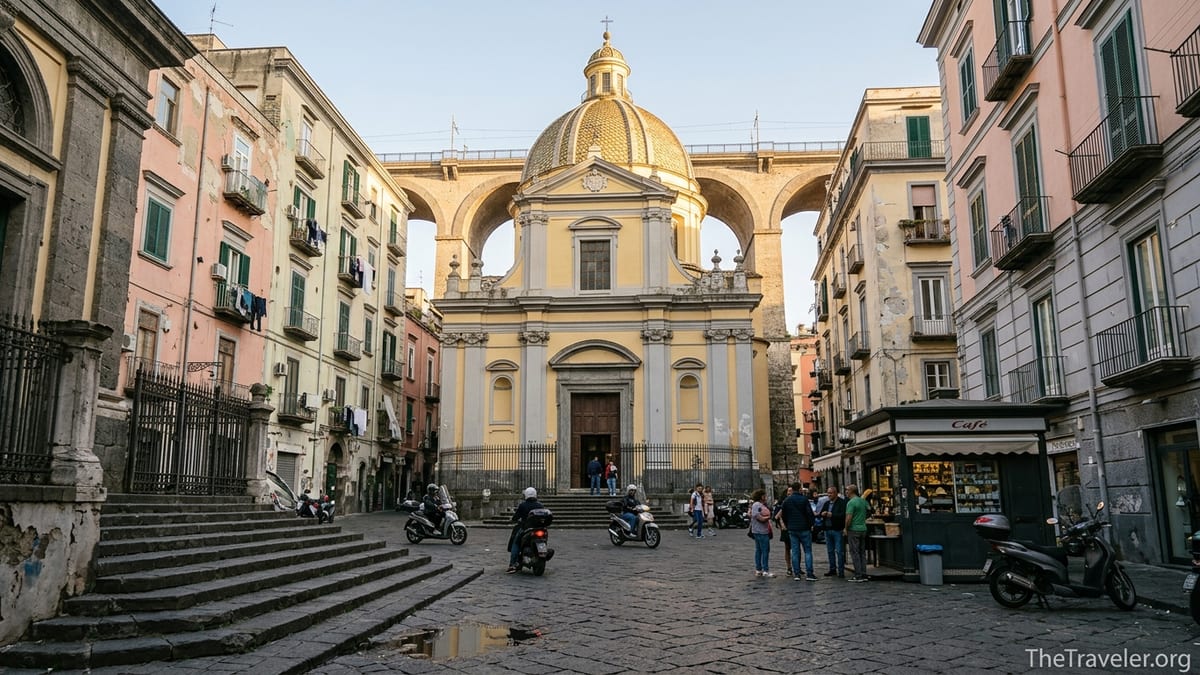
The basilica itself rose much later, between 1602 and 1613, when the Dominican friar-architect Giuseppe Nuvolo designed a church that quite literally sat on top of this early Christian memory. Its bright yellow cupola, visible as you approach along Via Santa Teresa degli Scalzi, signaled that the once marginal valley was becoming a spiritual focal point. Even now, when you step into the square, dodging scooters and fruit vendors, the church dominates the urban landscape, orienting the neighborhood physically and spiritually.
This transformation from necropolis to neighborhood helps explain why Santa Maria della Sanità still matters. Naples’ religious history is not only about grand cathedrals and royal chapels but also about how faith reuses and reinterprets spaces over centuries. Standing on the basilica’s main floor, with the traffic noise just beyond the doors and the catacombs directly underneath, travelers feel how layers of belief have accumulated here rather than being swept away.
The African Saints Beneath the Floor
Santa Maria della Sanità is anchored in the story of exiled African bishops who found refuge in Naples’ valley in the 5th century. San Gaudioso, a bishop from North Africa, is said to have been set adrift by the Vandal king and washed ashore near Naples. Here he founded a monastic community and was buried in the rock that now forms the Catacombs of San Gaudioso beneath the basilica. His tomb, along with that of another North African bishop, Quodvultdeus of Carthage, made this an early pilgrimage site.
For contemporary visitors, a guided tour of the catacombs (which in 2026 typically costs around 11 to 12 euro for adults, often combined with entry to the Catacombs of San Gennaro) makes these ancient connections tangible. You walk past frescoed arcosolia and unusual 17th century burials in which skulls are set above painted bodies on the walls. Guides frequently highlight how the cult of these African saints links Naples to the wider Mediterranean, reminding travelers that this region has always been shaped by movement, exile, and migration.
In a city where San Gennaro usually dominates the religious imagination, the presence of San Gaudioso offers an alternative focal point. Locals in Rione Sanità often talk about the trio of spiritual protectors associated with the quarter: San Gaudioso below ground, the Madonna della Sanità in the sanctuary, and San Vincenzo Ferrer (nicknamed "o Monacone") whose statue stands within the church. Together they embody a network of devotion that mixes early Christian martyr veneration, Marian piety, and more recent popular saints, showing how Neapolitan faith folds new stories into old foundations.
The Oldest Madonna and a Baroque Experiment
According to local tradition, the entire cult of Santa Maria della Sanità began with the rediscovery of a very early image of the Virgin Mary in the underground chapel. This 5th or 6th century icon, often described as one of the oldest Marian images in Campania, became the spiritual magnet that drew the Dominicans to build their large church above. When travelers visit today, guides point out the icon’s location near the right side of the sanctuary, framing it as the seed from which the basilica’s entire history grew.
Architecturally, Santa Maria della Sanità is striking even for visitors who have already toured Naples’ famous Baroque churches. Its Greek-cross plan, generous central dome, and pale, uncluttered decorative scheme feel surprisingly airy compared to the darker interiors of the historic center. Sunlight spills through the windows of the cupola in the late morning, washing across the green and white marble floor and illuminating paintings by artists such as Luca Giordano and Andrea Vaccaro. For many travelers, this combination of ancient foundations and light-filled Baroque space is what makes the first glimpse of the interior unforgettable.
The church’s design also reflects the pastoral ambitions of the Dominicans, who wanted a space suitable for preaching to large crowds. The wide central area, chapels that function almost like small side stages, and the elevated position over the crypt underscore how doctrine, liturgy, and the memory of the saints were meant to interact here. In practice, this means that a weekday Mass, a catechism class for neighborhood children, and a tour group entering the catacombs can all share the building at the same time, each inhabiting a different vertical layer of the same sacred organism.
San Vincenzo “’o Monacone” and Popular Devotion
Although officially dedicated to the Madonna della Sanità, the basilica is known to many Neapolitans simply as the church of San Vincenzo. The large statue of San Vincenzo Ferrer, a Dominican preacher from the 15th century, earned the nickname "’o Monacone" or "the big monk" and became a powerful local protector. In the past, residents would carry his statue in processions through the streets of Rione Sanità, praying for protection from disease, accidents, and poverty.
That tradition continues in adapted form today. Travelers who visit during certain feast days may see banners or small home altars honoring San Vincenzo in the alleys near the basilica. Conversations with residents and guides often reveal a pragmatic spirituality: for major citywide issues, people may turn to San Gennaro at the cathedral, but for neighborhood concerns like job insecurity or health scares, "’o Monacone" or the Madonna della Sanità feels closer and more responsive.
This tightly woven relationship between the church and the everyday life of the quarter is part of why Santa Maria della Sanità still matters in the city’s religious landscape. The basilica is not a museum piece. Its clergy preside over baptisms, funerals, and weddings for families who have lived in these crowded streets for generations. When a building collapses or a local youth is killed, memorial Masses and candlelit vigils often start from this church, turning its steps into an immediate public square of grief and solidarity.
Rescuing a District: Faith and Social Renewal
In the early 2000s, Rione Sanità was frequently portrayed as one of Naples’ most marginalized quarters, associated with unemployment, informal housing, and organized crime. The turnaround that visitors sense today, with small bakeries, artisan workshops, and guided tours weaving through the alleys, owes a great deal to the community built around Santa Maria della Sanità and the catacombs. Local parish leaders and lay volunteers helped launch the Fondazione di Comunità San Gennaro, which since 2014 has coordinated social, cultural, and educational projects in the area.
Revenue from catacomb tickets now helps fund neighborhood initiatives: after-school programs for children, apprenticeships with artisans, and street-cleaning or restoration projects. Travelers will notice, for example, well-maintained signage for the "Miglio Sacro" or Sacred Mile route that links the basilica and catacombs with other religious sites in the district. Booking a combined catacomb tour often means that part of your fee supports these community projects, turning heritage tourism into a form of local solidarity.
This model, which blends religious heritage management and social enterprise, is increasingly cited in Italian media as a case study. For visitors, it means that stepping into Santa Maria della Sanità is also a lesson in how faith communities can act as anchors in fragile urban neighborhoods. When a guide explains that young local residents are trained as professional guides or that a restored square now hosts community events thanks to catacomb income, the church’s role in Naples’ living religious history becomes concrete rather than abstract.
The Sacred Mile: Mapping Naples’ Spiritual Geography
Santa Maria della Sanità forms one of the essential stops on the so-called Sacred Mile, an itinerary created to connect some of Naples’ most important early Christian and Baroque religious sites. The route typically begins at the Catacombs of San Gennaro on the Capodimonte hill and descends through the Rione Sanità, passing by Santa Maria della Sanità and the Catacombs of San Gaudioso before continuing toward the historic center. For travelers, it is an accessible way to understand how the city’s sacred topography developed over time.
Walking this route, especially in the cooler months between October and April, reveals how the basilica functions as both a destination and a gateway. Pilgrims and tourists arriving from San Gennaro often pause on the steps of Santa Maria della Sanità to take in the bustle of the square: buses threading under the 19th century bridge, schoolchildren cutting across the piazza, and older residents lingering outside cafés. Inside, the basilica offers a moment of visual and acoustic relief before visitors descend again into the dim light of the catacombs.
In practical terms, the Sacred Mile has reinforced the basilica’s role as a spiritual crossroads. Parish liturgies increasingly welcome visitors from outside the district, and some groups arrange to participate in Mass or a brief prayer service as part of their itinerary. This blend of pilgrimage and sightseeing is typical of Naples, where religious and secular forms of movement rarely stay separate for long.
Experiencing the Basilica Today
For modern travelers, experiencing why Santa Maria della Sanità still matters requires slowing down and allowing the building to be more than a checklist stop. Many visitors choose a morning tour of the Catacombs of San Gaudioso, often in small groups with an English or Italian-speaking guide, then stay in the church afterward. This quiet time can be used to sit beneath the dome, watching how locals come and go: a woman lighting a candle before the Madonna, a workman stopping briefly at a side altar, or children rehearsing a catechism play near the sacristy.
The basilica is usually free to enter, though donations are encouraged, and modest dress is expected as in most Italian churches. Photography is generally allowed, but visitors are asked to be discreet during services. Unlike heavily touristed churches in the historic center, Santa Maria della Sanità often feels like a working parish first and a tourist attraction second. Respecting that balance is part of engaging honestly with Naples’ religious culture.
Just outside, a cluster of street food stalls offers fried pizza, arancini, and espresso at prices far lower than in the seafront districts. Choosing to spend your money here rather than in more polished neighborhoods helps sustain the fragile local economy that the basilica has worked so hard to stabilize. It also gives you a fuller sense of how faith, food, and community life intersect in Rione Sanità, much as they have done in Naples for centuries.
The Takeaway
Santa Maria della Sanità matters in Naples’ religious history because it reveals, in a single building, how the city treats its sacred past as a living resource. Built above catacombs that preserve the memory of African bishops and some of the region’s oldest Christian imagery, the basilica anchors a district where popular devotions to the Madonna and San Vincenzo still shape daily life. Its Baroque dome and paintings testify to a period when religious orders invested heavily in preaching and visual catechism, while its contemporary role in social projects and the Sacred Mile route shows how heritage can support renewal rather than nostalgia.
For travelers, visiting Santa Maria della Sanità is a chance to see Naples’ religious history not as something locked behind museum glass but as a web of relationships stretching from late antiquity to a 21st century neighborhood struggling and reinventing itself. The basilica’s steps, where children play football under the bridge and pilgrims pause after emerging from the catacombs, may be the single best place in the city to watch that long story unfold in real time.
FAQ
Q1. Where is Santa Maria della Sanità located in Naples?
Santa Maria della Sanità stands in the Rione Sanità district, just north of Naples’ historic center, near where Via Sanità meets Via Santa Teresa degli Scalzi, beneath the Capodimonte hill.
Q2. Why is Santa Maria della Sanità important in Naples’ religious history?
The basilica sits directly above the early Christian Catacombs of San Gaudioso, preserves one of the region’s oldest Marian icons, and remains a focal point of popular devotion and parish life in Rione Sanità.
Q3. What are the Catacombs of San Gaudioso and how do I visit them?
The Catacombs of San Gaudioso are an early Christian burial complex beneath the basilica, accessible only on guided tours that start inside the church and usually require a paid ticket with set time slots.
Q4. Who are the main saints associated with Santa Maria della Sanità?
The site is closely linked to San Gaudioso, a North African bishop buried in the catacombs; the Madonna della Sanità, honored by an ancient icon; and San Vincenzo Ferrer, affectionately known locally as "’o Monacone."
Q5. Is there an entrance fee to the basilica itself?
The basilica is typically free to enter, though donations are appreciated, while access to the catacombs requires a separate ticket that helps finance local community and restoration projects.
Q6. How does the basilica contribute to the local community today?
Through the parish and related foundations, income from catacomb visits supports social programs, education projects, and cultural events aimed at improving life in Rione Sanità.
Q7. What is the Sacred Mile and how does Santa Maria della Sanità fit into it?
The Sacred Mile is an itinerary linking major early Christian and Baroque sites in Naples; Santa Maria della Sanità and the Catacombs of San Gaudioso are key stops along this route between the Catacombs of San Gennaro and the historic center.
Q8. What should I wear and how should I behave when visiting?
Dress modestly with shoulders and knees covered, speak quietly, avoid flash photography during services, and remember that this is an active parish church as well as a heritage site.
Q9. When is the best time of day to visit the basilica and catacombs?
Morning visits, especially on weekdays, usually offer softer light in the basilica, smaller catacomb groups, and a better chance to observe everyday parish life without heavy crowds.
Q10. Can I attend a Mass or religious celebration at Santa Maria della Sanità?
Yes, regular Masses and feast day celebrations are held in the basilica; visitors are welcome to attend respectfully, and current schedules are typically posted at the church entrance or on local notice boards.