


More news on this day
Hundreds of travelers were left stranded at Amsterdam Schiphol Airport after a fresh wave of disruption saw around 280 flights delayed and 15 canceled in a single day, tangling schedules for KLM, Delta Air Lines, British Airways, Lufthansa, easyJet and other carriers on busy routes to London, New York, Paris and beyond.
Get the latest news straight to your inbox!
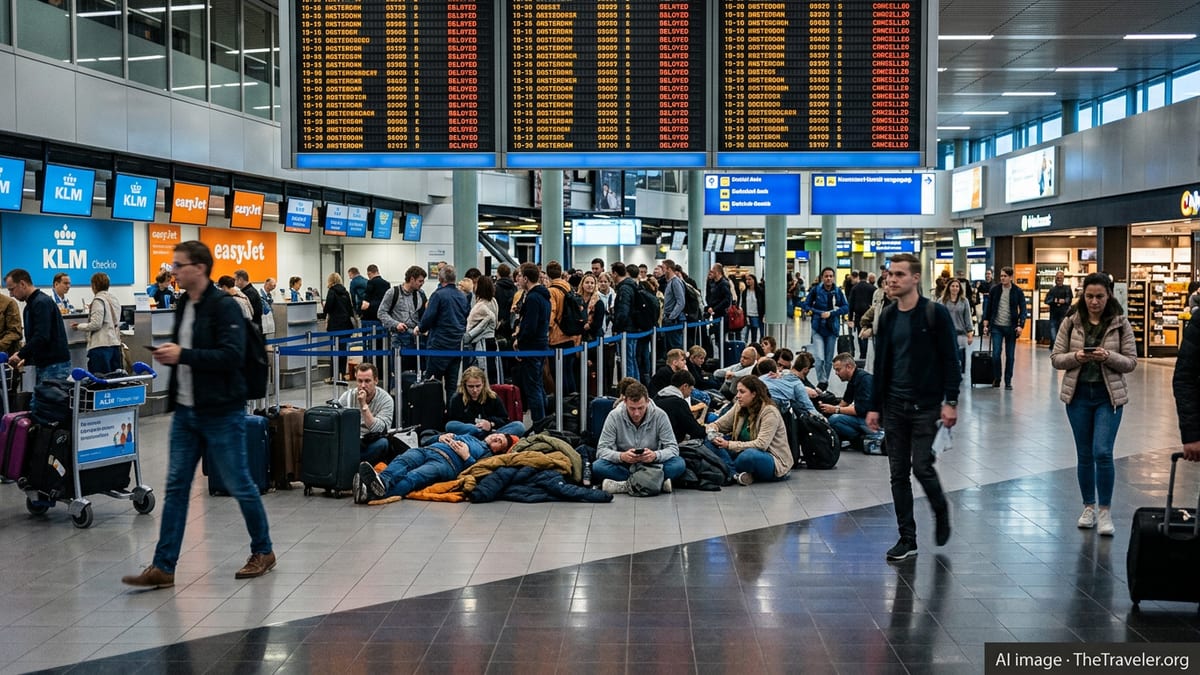
Day of Disruption at a Key European Hub
Publicly available operational data and flight tracking information indicate that Amsterdam Schiphol, one of Europe’s busiest hubs, once again experienced severe schedule disruption, with delays and cancellations rippling through both departing and arriving services. The latest figures, showing about 280 delayed flights and 15 cancellations, place the event among a series of high-impact disruption days that have hit the airport in recent weeks.
The pattern mirrors earlier episodes where hundreds of flights were pushed back by more than 15 minutes and dozens were removed from schedules altogether, leaving aircraft and crews out of position. On those days, reports show that KLM Royal Dutch Airlines, its SkyTeam partners and a range of European and long haul carriers all experienced significant operational strain, with Schiphol repeatedly appearing near the top of European delay rankings.
Schiphol’s role as a primary transfer point for intercontinental and intra-European traffic means even limited capacity constraints or short operational outages can quickly translate into widespread disruption. When services begin the day behind schedule, minor knock on issues have little buffer, and a localized delay event can rapidly grow into a network wide challenge.
Major Airlines and Flagship Routes Hit Hard
Published disruption summaries and flight tracking snapshots show that services operated by KLM, Delta Air Lines, British Airways, Lufthansa and easyJet were among the most affected during the latest wave of delays and cancellations. These airlines anchor many of Schiphol’s busiest connections, including high demand links to London, New York and Paris, which in turn feed onward routes across Europe, North America and the Middle East.
On previous heavy disruption days this summer, data has highlighted extensive delays on trunk routes between Amsterdam and London Heathrow, where KLM and British Airways provide frequent services catering to both business and leisure travelers. Similar patterns have been visible on flights to New York area airports, where KLM and Delta jointly operate transatlantic services, as well as on Paris routes connected to the wider Air France KLM network.
Beyond those flagship connections, disruption has also affected Lufthansa and easyJet flights serving German, French, British and Mediterranean destinations, further reducing options for stranded travelers seeking alternative routings. With multiple alliance and low cost carriers impacted at the same hub, passengers often face limited same day rebooking possibilities, especially during peak summer periods when load factors are already high.
Passengers Face Long Queues, Missed Connections and Overnight Stays
Accounts gathered through publicly available coverage and traveler reports describe long queues at check in and transfer desks as passengers sought rebooking options or information on their rights. With so many flights running late, missed connections became common for those relying on tight transfer windows, particularly on journeys linking European feeder flights with long haul departures to North America, Africa and Asia.
For some, delays extended into overnight stays when final outbound services departed before inbound aircraft could arrive, or when onward connections had no remaining seats. Recent disruption analyses for Schiphol note that during large scale events involving hundreds of delayed flights, thousands of passengers can be forced to replan itineraries, sometimes spending additional nights near the airport or being rerouted through alternative hubs such as Paris, Frankfurt or London.
The impact has been especially acute for travelers with complex itineraries, including multi segment tickets stitched together across different airlines or booking platforms. In those cases, self managing rebooking and ensuring that all segments remain aligned can be particularly challenging, often requiring multiple interactions with airline support channels and, in some instances, out of pocket purchases of new tickets that are later submitted for reimbursement.
Operational and Structural Pressures Behind the Delays
Recent coverage of Schiphol’s performance points to a mix of operational and structural factors behind the sequence of disruption days. Past analyses have cited staff constraints, ground handling bottlenecks, rolling effects from earlier weather events and air traffic flow restrictions as recurring contributors that interact in complex ways. Even when no single severe storm or safety incident is present, a combination of smaller issues can trigger large cumulative delays at such a busy hub.
Reports this summer have also drawn attention to ongoing changes in ground operations and baggage handling at Schiphol, with adjustments in service providers and procedures adding further complexity to aircraft turnaround times. Any slowdown in refueling, loading, security or boarding can cascade through tightly timed schedules, especially at peak hours when runway and gate capacity are fully utilized.
Analysts note that Amsterdam’s importance as a connecting hub for KLM and its partners means airlines are under constant pressure to maintain high utilization of aircraft and crews. This model improves efficiency during normal operations but leaves relatively little slack in the system. Once disruption crosses a certain threshold, airlines may opt to proactively cancel flights to prevent even more extensive knock on effects, a pattern visible in recent data where modest cancellation numbers accompany very high delay counts.
What Stranded Travelers Can Expect Under Passenger Rights Rules
Specialist platforms that track flight disruption and passenger rights across Europe have observed increased interest from travelers affected by Schiphol delays, particularly in relation to compensation and care entitlements. Under established European passenger rights rules, travelers on flights departing from EU airports, or on EU based carriers, may be eligible for reimbursement or fixed sum compensation in cases of long delays or cancellations that are not caused by extraordinary circumstances such as severe weather or airspace closures.
Public guidance from airlines and consumer organizations typically notes that passengers whose flights are canceled at short notice are entitled to choose between rerouting at the earliest opportunity, traveling at a later date, or receiving a refund of the unused ticket portion. In addition, airlines are generally expected to provide meals, refreshments and, when necessary, hotel accommodation and transport to and from the hotel for travelers stranded overnight.
For those affected by the latest disruption at Schiphol, experts commonly recommend retaining boarding passes, booking confirmations and receipts for any extra expenses incurred during the delay. Travelers are also encouraged to document the length of the delay at arrival and the reason given by the airline, as these details can be important when submitting claims through airline channels or third party platforms that assist in assessing eligibility under European regulations.