


More news on this day
Late-summer storms and air-traffic constraints combined this week to create widespread flight disruptions across key U.S. hubs, with 3,168 delays and 349 cancellations reported across Atlanta, New York City, and Philadelphia, stranding tens of thousands of passengers at some of the country’s busiest airports.
Get the latest news straight to your inbox!
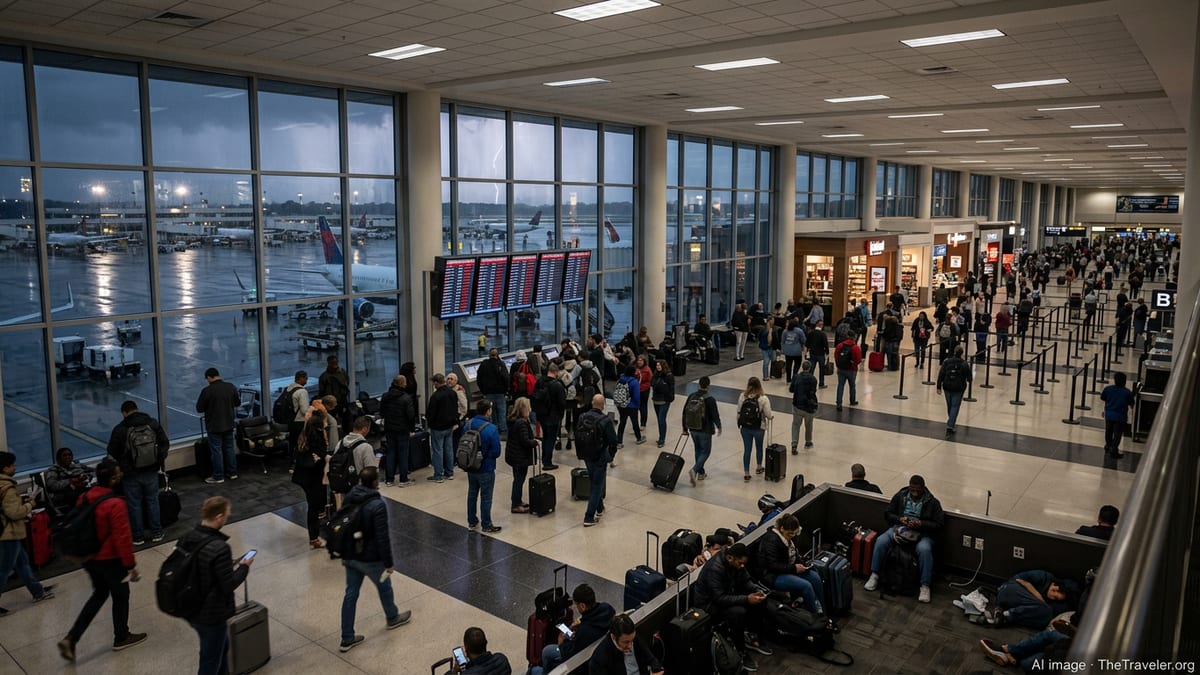
Storm Systems Collide With Peak Summer Demand
Publicly available air-traffic planning reports point to a volatile mix of strong thunderstorms, low clouds, and high winds across the eastern United States in recent days, repeatedly targeting some of the densest corridors in the national airspace. Federal aviation updates for August 28, 2026 highlight convective weather around Atlanta, multiple New York–area airports, and the mid-Atlantic region as a primary driver of anticipated delays and flow restrictions.
Those conditions arrived at a time when passenger volumes remain near seasonal highs. Long-range transportation statistics show Atlanta’s Hartsfield-Jackson International Airport alone handling more than 340,000 scheduled departures over a recent 12‑month period, reinforcing its role as a critical domestic and connecting hub. When storms slow operations at airports with that scale of traffic, delays cascade rapidly across the system, intensifying disruption far beyond the immediate weather footprint.
As severe cells moved along the Eastern Seaboard, major New York airports experienced some of the sharpest impacts. Recent published coverage, drawing on data from flight-tracking services, has recorded single-day totals of more than 200 delays and dozens of cancellations at LaGuardia, as thunderstorms forced ground stops and departure metering. Similar patterns have appeared at John F. Kennedy International, where lightning and low ceilings have periodically curtailed operations.
Philadelphia International Airport, a key connector for transatlantic and domestic routes, has also reported knock-on effects when New York and Washington corridors slow. Advisories issued in late July described arrival delays of up to 30 minutes into Philadelphia airspace, and live airport status boards in recent days continue to show a patchwork of on-time flights interspersed with weather-related holds.
Atlanta, New York, and Philadelphia Bear the Brunt
The cumulative figure of 3,168 delays and 349 cancellations across the three metro areas reflects both their traffic density and their interdependence. Atlanta serves as a southern anchor for east-coast flows, while New York and Philadelphia concentrate a complex mix of domestic shuttle traffic and international long-haul flights. When any one of these hubs slows, it often triggers rotating disruptions at the others as aircraft and crews fall out of position.
In recent weather events, LaGuardia has repeatedly topped national rankings for delays and cancellations, according to published roundups that compile real-time tracking data. On one August afternoon, reports indicated more than 220 delayed flights and close to 80 cancellations departing from or arriving at the airport, outpacing most other U.S. facilities. That level of disruption at a compact, slot-constrained airport magnifies queueing on the ground and in the surrounding airspace.
Atlanta’s role is different but equally pivotal. Data from federal transportation statistics underscore its dominance in passenger throughput and scheduled operations, which in turn make it highly sensitive to even short-lived storm cells. Narrative accounts from recent weeks describe gate areas filling rapidly as afternoon thunderstorms induced rolling delays, particularly on routes linking Atlanta with northeastern cities such as New York and Philadelphia.
Philadelphia, while smaller than Atlanta or the combined New York system, can quickly become a pressure point when reroutes and diversions stack up. Historical advisories this summer have warned of airborne holding and arrival delays as traffic managers attempt to absorb surges from constrained neighboring sectors. When these conditions coincide with peak arrival banks from Europe and transcontinental U.S. cities, schedule recovery becomes more complicated.
National Disruption Beyond the Northeast Corridor
The disruption centered on Atlanta, New York, and Philadelphia has coincided with waves of broader national disorder. Mid-August coverage documented more than 1,300 delays and over 160 cancellations in a single day across U.S. airports after storms and a temporary ground delay program at Chicago O’Hare rippled into the Northeast. Another recent round of reporting counted more than 1,400 delayed flights and around 250 cancellations as severe weather again targeted major hubs.
These national tallies underline how quickly local weather events can become a systemic issue when they intersect with core network nodes. Routes linking Chicago, New York, and Atlanta have been repeatedly cited among the most affected, along with flights from the East Coast to major western gateways. As aircraft miss rotations and crews time out on duty limits, airlines have limited flexibility to restore normal operations before the next wave of storms arrives.
Federal air-traffic planning reports stress that forecasts provide only a “reasonable expectation” of impacts, with real-world outcomes heavily influenced by storm intensity and timing. Nevertheless, the pattern through August 2026 has been consistent: afternoon and evening convective activity in key regions is strongly correlated with spikes in departure holds, en route reroutes, and resultant airport delays.
Beyond weather, the broader system remains under strain. Industry observers note that carriers and airports are still balancing strong demand with staffing constraints in operations, maintenance, and ground handling. When schedules are tightly calibrated to meet demand, there is limited slack to absorb unexpected shocks such as rapidly intensifying thunderstorms or air-traffic flow restrictions along crowded corridors.
What Travelers Encountered on the Ground
From a passenger perspective, the flight chaos has manifested in crowded terminals, shifting departure times, and repeated rebookings. Airport flight-status boards at facilities such as Philadelphia International on August 29 displayed a pattern of scattered delays, with some arrivals from smaller markets pushed back and others operating on time, reflecting how weather bands and traffic programs can affect routes unevenly even within the same hub.
On the New York side, passengers connecting between John F. Kennedy and LaGuardia have faced additional uncertainty. Discussions on public forums describe travelers being shifted between airports as schedules are reworked, sometimes compounding stress when ground transportation and tight connection windows are involved. These anecdotal accounts align with the broader data showing elevated disruption levels on days when thunderstorms linger over the region.
Travelers moving through Atlanta during recent storms have reported congested concourses and longer-than-average waits for both departures and connections, as airlines attempt to re-sequence flights once lightning clears and ramp operations resume. With Atlanta functioning as a primary connection point for many itineraries between the Southeast and Northeast, even modest initial delays there can lead to missed connections at downstream airports.
Industry data on on-time performance for specific trunk routes, including services between New York and Atlanta, suggest that some individual flights have maintained relatively strong punctuality metrics over rolling two‑month windows. However, those averages can mask the extreme variability experienced on days with significant storms, when a single disruption can cascade across multiple departures and returns.
Guidance for Passengers Facing Future Disruptions
With late-summer thunderstorm patterns persisting into early September, travel analysts expect continued vulnerability to disruption at major eastern hubs. Federal aviation advisories continue to flag Atlanta, New York, and mid-Atlantic airports as at risk on days with unstable air masses, and airlines have published travel waivers around some recent storm systems to allow itinerary changes without additional fees.
Consumer advocates emphasize several strategies drawn from recent episodes. First, monitoring flight status through airline apps or websites remains crucial, as gate changes and revised departure times can shift quickly when traffic managers implement new flow-control measures. Second, building longer connection buffers through congestion-prone hubs such as LaGuardia, JFK, and Atlanta can reduce the risk of misconnecting when departures begin to stack up.
Travelers are also encouraged to review airline contracts of carriage and federal consumer guidance regarding refunds and rebooking rights. The U.S. Department of Transportation’s Air Travel Consumer Report series includes sections on flight delays, cancellations, and consumer complaints, providing a statistical backdrop for understanding how individual experiences fit into broader trends. Those reports have become a reference point for discussions about how carriers handle extended disruptions.
Finally, experts suggest that passengers with flexibility consider early-morning departures, which are statistically less exposed to accumulated system delays, and avoid tight same-day turns through airports that have seen repeated weather-related disruption this month. While no strategy can eliminate the risk posed by rapidly changing storm conditions, informed planning can help travelers navigate an environment in which large-scale delay events, such as the 3,168 delays and 349 cancellations recorded across Atlanta, New York City, and Philadelphia, have become a recurring feature of the peak travel season.
US DOT Air Travel Consumer Reports 2026
Coverage of nationwide delays and cancellations August 27, 2026
Report on widespread U.S. flight disruptions August 13, 2026