


Seychelles International Airport on Mahé may be small, but working out how to use the local buses from the terminal can still be confusing. Rules around luggage, new cashless payments and limited late-night services mean it pays to understand the system before you land. This guide explains, in practical detail, how public buses connect the airport with Victoria and the rest of Mahé, what you can and cannot bring on board, how to buy and use bus cards, and when a taxi or hotel transfer will be the better choice for your budget and schedule.
Get the latest updates straight to your inbox!
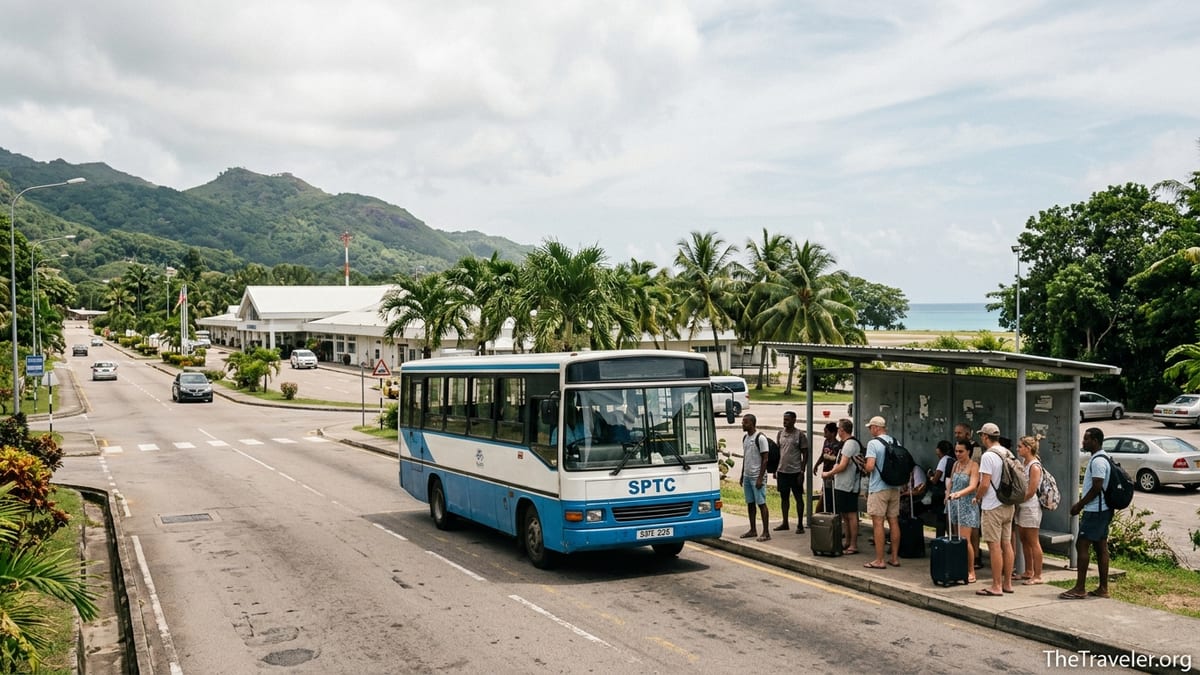
Understanding the Airport and Bus Basics
Seychelles International Airport (SEZ) sits on the east coast of Mahé, about 10 kilometers from the capital Victoria. For visitors trying to keep costs down, the Seychelles Public Transport Corporation (SPTC) buses offer by far the cheapest way to travel between the airport, Victoria and many local guesthouses. The trade-off is that buses are designed first for residents commuting with small bags, not for tourists with large cases, so you need to be realistic about what is practical.
SPTC buses run on fixed routes and timetables on Mahé and Praslin and operate roughly from early morning to early evening, with reduced frequency at night and on Sundays. From the airport, the key corridor is the main east coast road, which carries buses north toward Victoria and south toward Anse Aux Pins and Anse Royale. Travel time from the airport to Victoria bus terminal is typically around 20 to 30 minutes in normal traffic, which makes the bus an attractive option if you are arriving in daylight with light luggage and no urgent connection to catch.
The airport itself has a modest arrivals area where you exit customs directly into a small hall with money exchange, car-rental counters, a travel shop and taxi rank. Local buses do not pull up directly outside the doors. Instead, there is a public bus stop on the main road just outside the airport perimeter. Reaching it involves a short walk of about five minutes from the terminal building, which is fine with a backpack but can be awkward with multiple suitcases or small children in tow.
Importantly, public buses are a completely separate system from any dedicated shuttle services arranged by ferry companies or tour operators. If your ferry ticket or hotel booking includes a shuttle from the airport, that will be a private minibus and different rules apply. This guide focuses on the regular SPTC buses, which are open to everyone and run to fixed, public timetables.
Routes and Connections Between the Airport and Victoria
The core route linking Seychelles International Airport with Victoria is the SPTC service that runs along the east coast road between the capital and the southern districts. In current timetables, this is covered by routes that include the airport stop between Victoria, Cascade and Anse Aux Pins. Buses typically show “Victoria” on the front when heading north and the district names, such as “Anse Royale,” when heading south. The stop for the airport is usually labeled “Airport” or “Pointe Larue” on planning apps and printed timetables.
From the arrivals exit, you follow signs or ask staff for the main roadside bus stop. Buses toward Victoria usually stop on the side of the road closest to the sea, while those heading south use the inland side, but always double check with waiting passengers or the driver when a bus pulls up. It is common practice to confirm by asking “Victoria?” as you board. Locals are generally helpful and used to visitors doing this, especially those clearly coming from the terminal with small carry-on bags.
Once on board, the journey to Victoria’s main bus terminal takes around 25 minutes, though it can be slightly longer during morning and late-afternoon peaks when traffic increases around the industrial area and entry into town. As a budget benchmark, the standard single fare on SPTC buses is very low compared with taxis, generally under 10 Seychelles rupees for a one-way ride. That means a couple using the bus from the airport to Victoria might spend around 20 rupees in total, compared with 250 to 350 rupees for a similar trip by taxi depending on negotiation and time of day.
On arrival in Victoria, buses terminate at the central bus station close to the market and city-center shops. From here, you can walk to budget guesthouses in central Victoria in around 5 to 10 minutes, or change to another bus for onward travel to popular areas such as Beau Vallon, Anse Boileau or Port Glaud. For example, a traveler landing at 11:00, catching the 11:30 bus, and arriving in Victoria just before noon could comfortably make a connection to Beau Vallon on an afternoon bus, provided they have no large suitcases.
Cashless Bus Fares and Visitor Cards
The Seychelles bus system has moved toward cashless payments, which affects how new arrivals can use buses from the airport. Tourists are encouraged to use a stored-value or unlimited Visitor Travel Card, which is tapped on a card reader when boarding. These cards are designed to simplify boarding and keep queues shorter at busy stops such as Victoria market or the airport corridor.
Visitor bus cards are sold at several outlets, including the travel shop inside the airport arrivals area, SPTC offices and the main Victoria bus terminal. For a practical example, a traveler landing on a weekday morning can exit customs, change some money, then walk to the Travel Plus or similar airport shop and purchase a card preloaded with enough credit for several days of travel. Another visitor arriving late in the evening, when airport shops are closed, would need to wait until the following morning to buy a card in Victoria, which immediately makes late-night bus use much less convenient.
There are also electronic payment options using QR codes and the official SPTC app, which allow residents and longer-stay visitors with local bank cards or mobile wallets to pay directly from their phones. In practice, short-stay tourists still tend to rely on the physical Visitor Travel Card, as setting up local payment methods can be time-consuming. You cannot normally pay drivers in foreign currency, and paying in cash at all is increasingly discouraged or limited to certain routes and times.
Because the card is reusable, it suits travelers staying several days on Mahé or returning to the island after visiting Praslin or La Digue. For example, a couple spending a week on Mahé might top up their card once with an amount that covers airport to Victoria, several day trips to beaches such as Anse Royale and Port Launay, and the final return trip to the airport, still spending far less than they would on a single taxi transfer to a distant resort.
Luggage Rules: What You Can and Cannot Bring on the Bus
The biggest surprise for many visitors is that public buses in Seychelles are not designed for full-size travel luggage. SPTC’s passenger guidelines emphasize that oversized luggage is not permitted, and drivers have the discretion to refuse boarding to passengers with large suitcases, bulky sports equipment or items that block aisles and exits. Many recent travelers report that drivers strictly enforce this rule, especially on busy routes and at peak times.
As a practical rule of thumb, small backpacks, soft daypacks, laptop bags and modest cabin-size roller cases that you can hold on your lap or keep between your legs are usually accepted. A solo traveler carrying one airline cabin-size trolley and a small backpack is far more likely to be allowed onboard than a couple each wheeling 23-kilogram checked suitcases. Anything that would need to rest in the aisle or occupy a spare seat is likely to be refused.
Real-world reports from visitors in 2025 and 2026 highlight repeated experiences of being turned away with standard checked suitcases, even when buses were not yet completely full. Local commuters do not want their regular service delayed or overloaded by tourist luggage, and drivers are under clear instructions to give priority to residents. Several travelers mention waiting at the airport stop only to discover that drivers would not accept their large bags and that they had to fall back on taxis or pre-booked private transfers at short notice.
If you are traveling light, public buses can work well. For example, someone arriving from Nairobi with only a 7-kilogram cabin backpack could walk to the main road, board the next bus to Victoria, and pay the normal fare without issue. By contrast, a family of four arriving from Europe with two large hard-shell suitcases and two medium roller bags should plan from the outset to use a taxi or hotel transfer from the airport, then rely on buses later in their stay for day trips without luggage.
Victoria Connections and onward hotel access
Victoria’s bus terminal is the hub for almost all SPTC services on Mahé, which means most budget-conscious visitors will pass through it at least once. From the airport, you ride into Victoria, then either walk to your accommodation or change buses. The terminal is a busy open-air facility with simple shelters and bays for different routes, and it sits just a few minutes’ walk from the Sir Selwyn Selwyn-Clarke Market and the small city center.
Once in Victoria, you can reach a wide range of guesthouses and hotels by bus. For example, for Beau Vallon on the north coast, you change to a bus marked “Beau Vallon” or “Bel Ombre,” which climbs over a low pass and then descends into the bay. Travelers report that this journey takes around 15 to 20 minutes from Victoria and is entirely feasible with a small backpack or beach bag. Similarly, budget guesthouses along the east coast can be reached by taking southbound buses from Victoria through Anse Etoile, Anse Aux Pins or Anse Royale.
However, many mid-range and high-end hotels are located along secondary roads or hillsides where buses do not stop directly at the entrance. This is particularly true for boutique properties perched on slopes above Beau Vallon, villas on narrow side roads around Anse Royale, or resort-style hotels with private drives. In these cases, the bus may drop you at the main road, leaving a steep uphill walk of 10 to 20 minutes, sometimes in strong sun and humidity. With light daypacks this is manageable, but with even a cabin suitcase it can be tiring after a long flight.
A sensible strategy for budget travelers is to combine public buses with walking and occasional short taxi hops. For instance, you might take a bus from Victoria to the general area of your hotel, then jump in a local taxi from the bus stop for the final kilometer or two. This still saves significant money compared with taking a taxi from the airport all the way to a distant bay, while sparing you the uphill climb with luggage in the heat.
Hotel Limitations, Late Arrivals and Early Departures
Not all hotels and guesthouses are equally well suited to guests using public buses from the airport. City-center guesthouses in Victoria and simple beachside properties directly on the main road at Anse Royale, Anse Aux Pins or Anse Boileau are the most practical. You can usually walk from the nearest bus stop to the property in under 10 minutes using paved sidewalks or quiet local lanes.
By contrast, isolated hillside villas, resorts at the far ends of bays or properties accessed only by rough tracks can be difficult or unsafe to reach on foot, especially after dark. In areas with narrow, winding roads and limited street lighting, walking with bags from a remote bus stop may not be realistic. Many such properties explicitly recommend or include airport transfers or expect guests to arrive by taxi or rental car. Before booking, it is worth checking satellite images or asking the property how far it is to the nearest bus stop and what the walk is like in practice.
Time of arrival and departure also matters. Public buses to and from the airport corridor generally operate only from early morning until early evening. If your international flight lands around midnight or departs at dawn, you should assume you will not be able to use the bus at all for those legs. A traveler arriving on a late-evening Middle East connection, for example, will find airport shops closed, no bus services running past the perimeter, and only taxis or pre-booked shuttles available.
For early-morning departures, visitors staying in Victoria sometimes consider catching the first bus toward the airport. However, even when a timetable shows a bus leaving a southern district around 6:30 and passing the airport soon afterward, this is a risky choice if you have a long-haul flight. Delays, limited space and the possibility of being refused with luggage all add uncertainty. In these situations, most experienced travelers recommend booking a taxi or private transfer the night before, even for budget trips.
When Taking the Bus Is Not Practical
While it is possible to use public buses from Seychelles International Airport under the right conditions, there are clear scenarios where the bus is not a practical or sensible option. The most obvious is when you have large or multiple pieces of luggage. If you are carrying standard checked suitcases, sports gear such as dive bags or golf clubs, or bulky baby equipment like travel cots and strollers, you should work on the assumption that drivers may refuse boarding.
Another situation where buses are a poor choice is when you have a tight onward connection, such as a pre-booked inter-island ferry or domestic flight leaving from the nearby domestic terminal. For example, a traveler landing at 12:20 and aiming to catch a 14:00 ferry from Victoria might technically have enough time to walk to the roadside bus stop, board a bus, ride to Victoria and walk to the jetty. In reality, any delay at immigration, a missed bus or a driver refusing you with luggage could eat up that margin and turn a manageable transfer into a stressful rush.
First-time visitors arriving after a long overnight flight may also find the bus challenging. The short walk to the bus stop in hot, humid air, the need to manage a new card system, and the occasionally crowded, non-air-conditioned buses can be a shock. A common compromise is to use a taxi from the airport to your first hotel, then rely on buses for sightseeing once you are rested and traveling with only a beach bag.
Finally, travelers with mobility issues or very young children will usually be more comfortable arranging door-to-door transfers. Most SPTC buses are standard step-entry models, and while newer low-floor vehicles are being introduced, accessibility is uneven. Getting on and off with a stroller or walking aid can be awkward, and seats may not always be available during busy times.
Practical Tips for Budget Travelers Using the Bus
For those determined to make the most of Seychelles’ public buses from the airport, a few practical strategies can make the experience smoother. First, pack with the bus in mind. Aim to travel with a single, soft-sided cabin backpack or small roller case that you can easily lift and keep on your lap. If you know you will later stay at a remote resort where you will not use buses, consider leaving a bulky suitcase in hotel storage in Victoria during side trips.
Second, plan your first leg around daylight and business hours. Try to book flights that land between mid-morning and mid-afternoon on weekdays, when buses along the airport corridor run more frequently and the airport shop selling bus cards is likely to be open. Check the approximate bus timetable before you travel, but remember that real-world traffic and boarding times can add several minutes to each run.
Third, combine the bus with short walks and occasional taxis. It can make sense to take a bus from the airport to Victoria, enjoy a cheap lunch at the market, then take another bus to a beach like Anse Royale and check in to a simple guesthouse on the main road. On the day of your departure, you might reverse the process: bus from your beach back to Victoria, enjoy a final stroll through town, then pay for a taxi for the last, time-sensitive ride to the airport if you are carrying more shopping than when you arrived.
Finally, stay flexible. If the bus is too crowded, drivers refuse your luggage, or the next service is significantly delayed, do not be afraid to switch to a taxi or negotiate a ride with a licensed driver at the rank outside the terminal. Even if you only save money on one leg of your journey instead of both, using the bus into Victoria or for day trips around Mahé can still reduce your overall transport costs meaningfully.
The Takeaway
Seychelles’ public buses offer a genuinely local, ultra-budget way to move between Seychelles International Airport, Victoria and many of Mahé’s coastal communities. For travelers arriving in daylight with light cabin baggage, and staying in guesthouses close to the main roads, they can be a sensible and rewarding choice that costs a fraction of a taxi ride and gives an immediate glimpse of everyday Seychellois life.
At the same time, strict luggage rules, limited operating hours and the need to use cashless fare systems mean that buses are not a universal solution. If you have large suitcases, arrive late at night or need to catch a tight ferry or flight connection, it is wiser to budget for a taxi or pre-booked transfer. The bus can then be used later in your stay for flexible, low-cost exploration when you are traveling light.
The key is to be honest about your own luggage, stamina and schedule. With realistic expectations and some advance planning around bus cards, routes and hotel locations, Seychelles’ public buses can help keep your island trip affordable without sacrificing too much comfort or convenience.
FAQ
Q1. Can I take the public bus from Seychelles International Airport if I have a large suitcase?
Large suitcases are generally not allowed on SPTC buses. Drivers can refuse boarding if your luggage is bulky or would block aisles, so it is safer to plan a taxi or transfer when traveling with full-size checked bags.
Q2. Where is the bus stop in relation to the airport terminal?
The public bus stop is on the main road just outside the airport perimeter, about a five-minute walk from the arrivals exit. You leave the terminal, follow the access road to the highway and wait at the marked roadside stop.
Q3. How much does the bus from the airport to Victoria cost?
Single fares on SPTC buses are very low compared with taxis, typically under 10 Seychelles rupees for the airport to Victoria journey. Exact fares can change, but the bus will almost always be the cheapest option.
Q4. Do buses from the airport run late at night or very early in the morning?
No. Regular public buses on Mahé generally run from early morning to early evening, with reduced frequency on Sundays. If your flight arrives late at night or leaves at dawn, you should assume you will need a taxi or pre-booked transfer.
Q5. How do I pay for the bus if it is cashless?
Most visitors use a Visitor Travel Card, which you tap on a reader when boarding. These cards are sold at the airport’s travel shop during opening hours and at SPTC offices and the Victoria bus station. Some residents use an official app and QR codes, but short-stay tourists usually rely on the physical card.
Q6. Is it realistic to use the bus to catch an inter-island ferry from Victoria?
It can be, if you travel with only cabin luggage and allow plenty of time. You ride the bus from the airport to Victoria terminal, then walk around 10 minutes to the ferry jetty. With large suitcases or a tight connection, however, most travelers prefer a taxi or dedicated shuttle.
Q7. Are buses from the airport air-conditioned and comfortable?
Most SPTC buses are simple, functional vehicles without strong air conditioning. They can be crowded and warm at busy times. For a 25-minute ride from the airport to Victoria, this is manageable for most visitors, but it is more basic than private shuttles or hotel transfers.
Q8. Which types of accommodation are easiest to reach by bus from the airport?
Guesthouses and small hotels located directly in Victoria or along the main coastal roads at Anse Aux Pins, Anse Royale and similar districts are the easiest. Properties up steep hillsides or down long private drives usually require either a walk from the bus stop or a short taxi ride.
Q9. Can I rely on the bus for my transfer to the airport on departure day?
You can, if your flight leaves later in the day, you have light luggage and you build in a generous time buffer. However, because drivers may refuse large bags and delays can occur, many travelers use buses only into town and opt for taxis when catching an international flight.
Q10. Is using the bus from the airport safe for solo travelers?
Yes. Public buses on Mahé are widely used by locals and are generally considered safe for solo travelers, including women. The main concerns are comfort and practicality rather than security: crowded conditions, heat and the strict luggage rules.