


More news on this day
Air Astana is accelerating its expansion in China as Shanghai joins Hangzhou and Guangzhou on the Kazakh carrier’s growing list of routes, signaling a fresh push to tap surging travel and trade between Kazakhstan and the world’s second‑largest economy.
Get the latest news straight to your inbox!
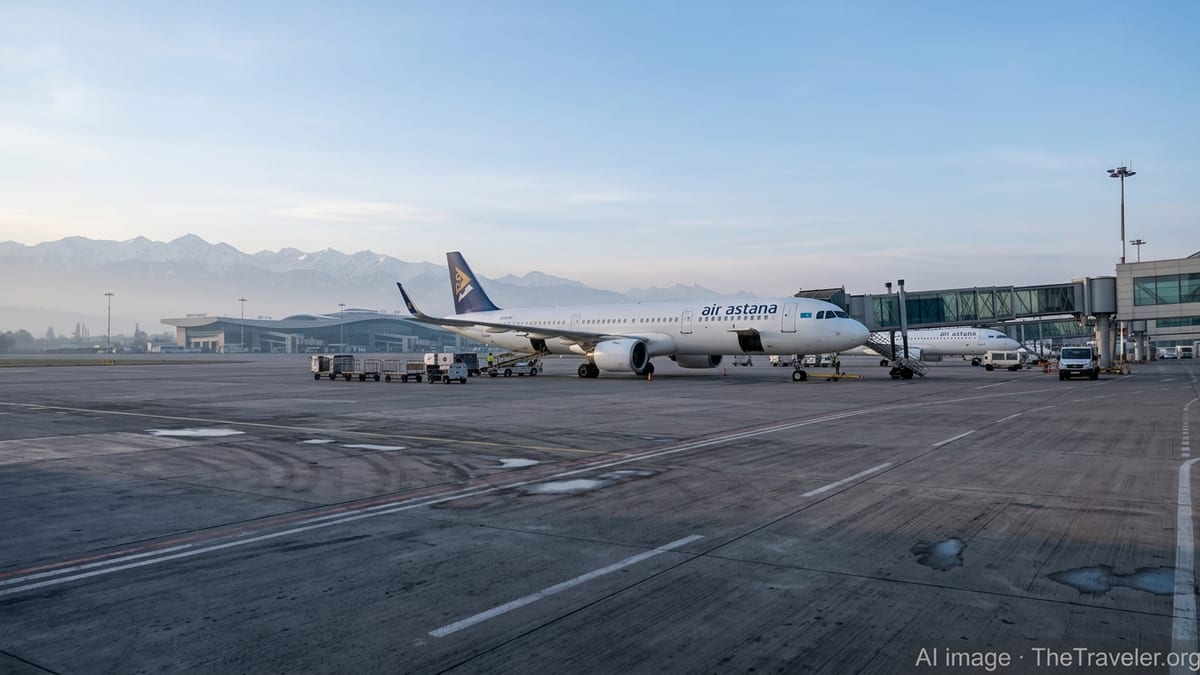
Shanghai Launch Caps a New Phase in China Expansion
Publicly available information shows that Air Astana began operating its new Almaty–Shanghai service at the end of March 2026, coinciding with the start of the northern summer schedule. The route connects Kazakhstan’s largest city with Shanghai Pudong, one of Asia’s busiest international hubs, with three weekly flights planned during the initial phase.
Reports indicate that the service typically departs Almaty in the evening and arrives in Shanghai early the following morning, targeting both business travelers and leisure passengers seeking same‑day onward connections across East Asia and the Pacific. The flight time is listed at just over six hours eastbound and around seven and a half hours westbound, reflecting prevailing winds on the return leg.
Industry coverage notes that Shanghai becomes Air Astana’s latest Chinese gateway after Beijing, Guangzhou, Urumqi and Sanya, underlining China’s role as one of the airline’s fastest‑growing international markets. The new route is also expected to add several hundred seats per week between Kazakhstan and coastal China, on top of recently expanded services to southern cities.
According to recent financial and network updates from the group, China and India sit at the core of Air Astana’s growth strategy for 2025 and 2026, with total flights to China projected to rise from the mid‑teens in 2024 to more than twenty weekly frequencies across a six‑city network.
Hangzhou and Guangzhou Strengthen Southern China Coverage
Shanghai’s addition comes as Air Astana builds out a broader presence in southern and eastern China, with Guangzhou already established as a key long‑haul gateway and Hangzhou emerging as a complementary link into the Yangtze River Delta. Publicly available company and airport information shows that Almaty–Guangzhou became one of the first post‑pandemic routes to be restored and has since seen capacity increases as travel rebounds.
Travel industry reports further indicate that Air Astana plans to introduce or increase services linking Astana with Guangzhou in 2026, creating a dual‑hub pattern from Kazakhstan into the Pearl River Delta region. This is designed to give both northern and southern Kazakhstan better access to China’s manufacturing and technology heartlands, as well as onward flights to Southeast Asia and Oceania operated by Chinese and other Asian carriers.
Hangzhou, a major technology and tourism center near Shanghai, has been highlighted in Chinese and Kazakh media as part of a wider connectivity push linking Kazakhstan to second‑tier but economically significant Chinese cities. While schedules remain thinner than on trunk routes to Beijing and Shanghai, the presence of Hangzhou on Air Astana’s map helps diversify the airline’s China portfolio away from only the largest metropolises.
Taken together, Shanghai, Hangzhou and Guangzhou give Air Astana coverage across three of China’s most dynamic coastal economic zones: the Yangtze River Delta, the Greater Bay Area and the broader eastern seaboard. Aviation analysts view this as a deliberate move to align the airline’s network with trade and investment flows rather than focusing solely on capital‑to‑capital links.
Trade, Tourism and Transit Drive Demand Between Kazakhstan and China
Recent tourism statistics cited in regional media show that Chinese visitor numbers to Kazakhstan have climbed sharply since border restrictions were eased, helped by relaxed visa rules and increased marketing of Central Asian destinations to Chinese travelers. Conversely, more Kazakhstan residents are traveling to China for shopping, education, medical care and family visits, adding to baseline business demand generated by energy and infrastructure projects.
Shanghai’s role as a financial and logistics hub positions it as a natural gateway for Central Asian exporters seeking to move goods through Chinese ports toward global markets. Additional non‑stop belly‑cargo capacity between Almaty and Shanghai is expected to support shipments of metals, agricultural products and textiles from Kazakhstan, while imports to Central Asia will likely include consumer electronics, machinery and e‑commerce parcels.
On the passenger side, the new route allows travelers from Kazakhstan to reach East Asian and Pacific destinations with a single connection in Shanghai, complementing existing options over Beijing and Guangzhou. Airline and airport data show that Pudong handles extensive traffic to Japan, South Korea, Southeast Asia and Australia, which can be paired with Air Astana’s regional network to create competitive one‑stop itineraries.
Business travel is another major factor. Reports on bilateral relations point to rising cooperation in sectors such as renewable energy, logistics and digital services. Direct flights to Shanghai and Guangzhou reduce travel times for executives and specialists moving between corporate offices, factories and project sites, making face‑to‑face meetings more practical and frequent.
Fleet Growth and Partnerships Underpin New Routes
Air Astana’s latest network additions are supported by a modernizing fleet and a series of partnership agreements with Chinese carriers. Recent corporate disclosures describe a multi‑year narrow‑body renewal program centered on Airbus A320neo family aircraft, which offer improved fuel efficiency and operating economics suited to medium‑haul routes like Almaty–Shanghai and Almaty–Guangzhou.
The airline has also continued to grow its long‑haul and wide‑body capability, allowing it to balance high‑density services on trunk routes with right‑sized narrow‑body capacity on emerging city pairs. Analysts suggest this flexibility is particularly valuable in China, where demand can grow quickly but remains sensitive to policy changes and macroeconomic shifts.
In parallel, Air Astana has expanded codeshare arrangements with China Southern Airlines and other regional partners. Public financial filings note that these agreements cover multiple routes between Kazakhstan and China, including flights to Beijing and Guangzhou, and create through‑ticketing options to dozens of onward Chinese and international destinations. This enables Air Astana to market a far larger virtual network than it could serve alone.
Industry observers argue that such partnerships are increasingly important in a competitive China market where domestic carriers command strong brand recognition. By integrating its services into Chinese distribution systems and loyalty schemes, Air Astana can capture connecting traffic while maintaining its position as the primary carrier between Kazakhstan and its neighbors.
Central Asia’s Connectivity Ambitions Reach the Chinese Coast
The expansion into Shanghai, Hangzhou and Guangzhou reflects a broader ambition by Kazakhstan to position itself as a transit and logistics hub linking China with Western Asia, the Caucasus and Europe. Policy documents and government statements consistently highlight aviation connectivity as a pillar of this strategy, alongside rail corridors and overland trucking routes.
Almaty and Astana airports are being developed as dual hubs, with investment in terminal infrastructure, air traffic management and intermodal connections. The opening of a new international terminal at Almaty in 2024, followed by the ramp‑up of China services in 2025 and 2026, has been framed in public communications as part of a long‑term effort to capture more transfer traffic between East and West.
For travelers, the practical impact is an expanding menu of route options that no longer require detours through larger Gulf or European hubs. As Shanghai joins Hangzhou and Guangzhou on Air Astana’s map, passengers in Central Asia gain more direct access to Chinese business centers and leisure destinations, while Chinese travelers see Kazakhstan emerging as a convenient stopover and gateway to the wider region.
With new aircraft on order and additional China capacity signaled in the latest annual results, Air Astana’s network on the eastern flank appears set for further growth. The arrival of Shanghai alongside Hangzhou and Guangzhou is likely to be followed by incremental frequency increases and potentially new secondary cities, as the airline seeks to consolidate its position as the primary bridge between Central Asia and coastal China.