


Sliding into the clear, shallow water at Shark Ray Alley in Belize, you quickly understand why this has become one of the most famous wildlife encounters in the Caribbean. Dozens of nurse sharks and southern stingrays glide through a pale turquoise channel, weaving around snorkelers who have arrived by boat from Ambergris Caye or Caye Caulker. It is thrilling, sometimes chaotic, and very much a managed wildlife experience inside Hol Chan Marine Reserve, not a casual beach swim. This guide explains how Shark Ray Alley works on the water, what to expect from the animals, the rules that protect them and how to make the most of your time in the water.
Get the latest updates straight to your inbox!
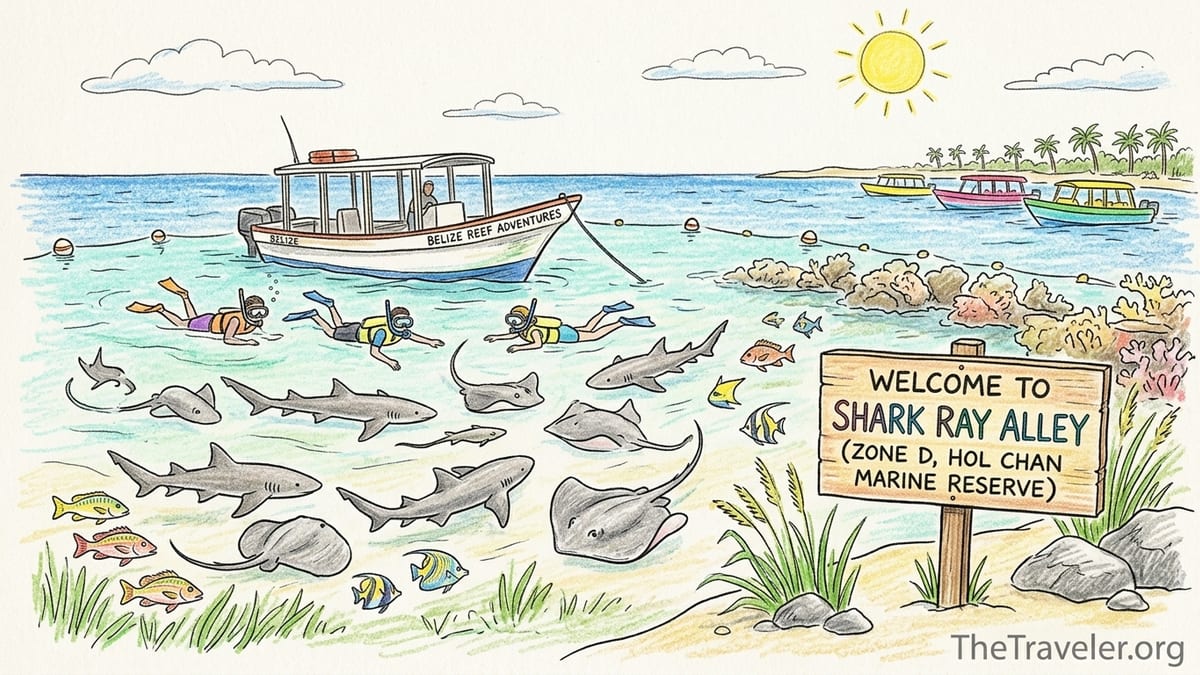
Where Shark Ray Alley Fits in Hol Chan Marine Reserve
Shark Ray Alley is one of several designated recreational sites inside Hol Chan Marine Reserve, off the coast of Ambergris Caye in northern Belize. The reserve itself was established in the late 1980s to protect a slice of the Belize Barrier Reef, and later expanded to include Shark Ray Alley as Zone D, an area set aside specifically for controlled tourism and limited fishing. Visitors often think of Shark Ray Alley as a separate attraction, but in reality every legitimate visit is managed through Hol Chan’s permit system and rules.
In practice, Shark Ray Alley is almost never sold as a standalone excursion. Boats from San Pedro and Caye Caulker typically run half day or full day Hol Chan trips that combine at least two water stops: one focused on reef and coral life, such as the Hol Chan Channel or Coral Gardens, and one focused on sharks and rays at Shark Ray Alley. A standard half day trip from San Pedro or Caye Caulker might include a 35 to 45 minute snorkel at Hol Chan Channel, then a shorter, intense 20 to 30 minute session at Shark Ray Alley before returning to the caye.
From the visitor perspective this matters because you will not spend your entire tour at Shark Ray Alley, and you will not simply walk off a beach to reach it. Boats run out through the lagoon and across the reef in about 20 to 30 minutes from San Pedro and slightly longer from Caye Caulker, timing their arrival around other groups. On busy days, you can look across the mooring field and see several tour boats cycling groups in and out of the water, each following Hol Chan’s rotation system to keep the site manageable.
The reserve entrance fee, which tour operators collect on behalf of the authorities, typically covers both stops. As of 2026, many small-boat operators advertise half day Hol Chan plus Shark Ray Alley snorkeling for roughly 90 to 120 US dollars per adult from San Pedro or Caye Caulker, including gear and guide. Larger sailing catamaran day trips, which add lunch and a few hours on Caye Caulker, often run closer to 120 to 150 US dollars per person. Prices vary by season, boat size and inclusions, but almost all of these options include Shark Ray Alley as one of several scheduled stops, not the entire focus of the day.
Why Sharks and Rays Congregate at Shark Ray Alley
Shark Ray Alley sits along a sandy, seagrass-fringed channel just inside the barrier reef. Historically, local fishermen from Ambergris Caye used this stretch of water as a place to clean their catch and discard scraps overboard before returning to town. Over time, resident nurse sharks and southern stingrays learned that boat noise often meant an easy meal. Early snorkeling operators took advantage of this behavior, and years of food conditioning have made the animals unusually tolerant of boats and people.
Nurse sharks are naturally slow, bottom-oriented sharks that feed on crustaceans, small fish and invertebrates by suctioning them from the sand. Southern stingrays, which look like flying dinner plates in the water, are also benthic foragers that flap wings of sand aside to hunt buried prey. At Shark Ray Alley, both species gather because the habitat suits them and because generations of sharks and rays have learned to associate boat traffic with food opportunities. Even as active feeding is now restricted by regulation, the pattern of aggregation has persisted.
When you slip into the water here, you are meeting animals that are habituated to people in a way that would not be typical on an untouched section of reef. Many of the rays will pass within arm’s length and some nurse sharks drift directly underneath a floating group of snorkelers. Guides who have worked the site for years often recognize individual animals by scars, size or coloration, and will point out, for example, a particularly large female stingray that is a daily regular.
This conditioning makes Shark Ray Alley both accessible and controversial. On the one hand, it allows beginners and families to see charismatic marine life at close range without long boat rides or advanced dive skills. On the other, studies of provisioned sharks and rays in Belize and elsewhere have raised questions about long term effects on natural behavior, social structure and health. That is one reason the official rules now limit direct feeding and touching, and why responsible operators brief guests carefully on how to behave in the water.
Depth, Conditions and What the Encounter Feels Like
The first surprise for many visitors is how shallow Shark Ray Alley really is. The main sandy patch under the mooring buoys is usually in the range of 8 to 12 feet deep, with some slightly deeper channels and shallower seagrass patches nearby. In calm weather, you can often see the sharks and rays clearly from the boat even before anyone gets in the water. Visibility usually runs from 40 to 80 feet, although it can drop when wind and swell stir up the sand.
On a typical visit, your captain will secure the boat to a mooring buoy, and your guide will enter the water first with a life ring or float. Guests follow down the ladder or over the side, usually staying in a loose group near the boat. Within minutes, dark shapes of nurse sharks cruise in from across the sand, sometimes accompanied by schools of jacks and horse-eye trevally that dart through the mix. Southern stingrays rise from the bottom, wing tips curling, and glide through the crowd looking for edible scraps along the sand.
The emotional experience depends a lot on your comfort in the water. Confident swimmers often describe the encounter as exhilarating, like being dropped into a documentary. Less experienced snorkelers sometimes feel overwhelmed at first by the density of animals and the proximity of their mouths and tails. Because the water is shallow and there is a boat ladder within a short swim, many people find they relax after a minute or two once they see how calmly the animals move.
You will hear the steady hum of boat engines from other operators, the slap of fins on the surface and your own breathing through the snorkel. The sharks tend to ignore people, slipping between bodies as if you were just another part of the scenery. Rays may brush lightly against your legs or fins as they pass, particularly if everyone crowds together in one spot. On quieter days, when only one or two boats are present, the scene can feel surprisingly peaceful, with sharks resting on the sand and rays circling just below.
Rules, Regulations and How Tours Are Run
Because Shark Ray Alley lies within Hol Chan Marine Reserve, it is governed by specific regulations designed to balance tourism with conservation. The reserve is divided into zones, and Shark Ray Alley is classed as an exclusive recreational area within Zone D. Scuba diving is prohibited in this recreational section, and only snorkeling and surface activities are allowed. Fishing is not permitted inside the clearly marked Shark Ray Alley itself, and tour operators must follow permit conditions and display diver down flags while guests are in the water.
Official rules also cover how people may interact with wildlife. Feeding of fish and rays by tourists is prohibited in the management plan, and guides are required to brief visitors on safe, non-contact behavior. In practice, the interpretation of feeding rules has evolved over time, and not every operator behaves identically. Responsible companies emphasize passive observation, discourage chasing or grabbing animals and avoid dramatic baiting displays that were more common in the early days of the site. As a visitor, choosing operators who talk clearly about Hol Chan rules during booking is one of the most effective ways to support better practices.
A typical half day Hol Chan and Shark Ray Alley tour from San Pedro might run from 8:30 am to around 12:30 pm. Boats usually carry 8 to 16 snorkelers plus guides, though some sailing catamarans can take 20 or more with additional staff. From Caye Caulker, full day trips that include Hol Chan, Shark Ray Alley, Coral Gardens and a lunch stop often run from around 9:30 am to 4:30 pm. Across these itineraries, actual time in the water at Shark Ray Alley is usually limited to approximately 20 to 30 minutes, bracketed by longer swims at reef sites where coral and fish life are the focus.
On board, guides hand out masks, snorkels and fins, explain basic safety and demonstrate hand signals before anyone enters the water. Most boats require guests to wear a snorkeling vest or float belt. Children are often kept closer to the ladder or hold onto a guide’s life ring. When the group enters, one guide usually leads at the front and another watches from the boat, keeping an eye out for current, weather changes or any guest who looks uncomfortable. Once time is up, the guide will call everyone back to the ladder, do a quick head count and move the boat out so the next group can use the mooring.
Wildlife Etiquette: How to Swim with Sharks and Rays Responsibly
Shark Ray Alley works as an experience because the animals still behave in ways that are mostly natural, but at a much closer range than usual. Respecting that boundary is essential if the site is to remain both magical and sustainable. Hol Chan regulations already prohibit touching or harassing marine life, and most guides reinforce this message during the pre-snorkel briefing. As a visitor, you can go a step further by holding yourself and your travel companions to a few simple standards in the water.
The first and most important is to keep your hands to yourself. Even though southern stingrays here seem relaxed and swim close, they are still wild animals armed with a barbed tail spine. The risk of injury is low when people stay calm and give them space, but rises if snorkelers try to grab, ride or block the animals’ path. The same applies to nurse sharks, which have strong jaws designed to crush shellfish. They are generally placid when undisturbed, yet can snap defensively if grabbed or cornered.
Second, pay attention to your fins. In a shallow, sandy site with many animals and people around, careless fin kicks can send clouds of sand billowing into the water, which stresses wildlife and ruins visibility for everyone else. Kicking gently with your knees rather than bicycling from the hips keeps your body more horizontal and reduces the chance of accidentally striking a shark, ray or fellow snorkeler. Guides will often demonstrate this streamlined position before you enter the water.
Finally, remember that you are a guest in a protected area. Do not attempt to bring your own bait or food, and resist the temptation to pressure guides into more dramatic animal interactions. If your captain or guide shuts down a request to touch, feed or pose with wildlife, they are likely following both the letter and spirit of Hol Chan rules. Choosing to book with operators that prioritize these rules, even if they are slightly more expensive, helps set a higher standard across the fleet.
Snorkeling Tips, Gear and Comfort in Shallow Water
Because Shark Ray Alley is shallow and close to the reef, conditions can change quickly with weather and tide. On calm days, the site feels almost like a saltwater pool with a gentle drift; on windy afternoons, there can be noticeable chop on the surface and small waves pushing over the reef. If you are prone to seasickness, a morning tour is often more comfortable, and motion-sickness tablets taken an hour before boarding can make the boat ride and bobbing at anchor easier to handle.
Most operators provide basic gear, but bringing or renting a high quality mask that fits your face well can transform the experience. Leaky masks are a common complaint among first-time visitors, especially children. Trying your mask on in front of a mirror at your hotel before the tour, adjusting straps and checking the seal, can save you from constant clearing once sharks and rays appear. Short fins are usually sufficient at this shallow site and make moving around the boat ladder easier.
Rash guards or lightweight long-sleeve swim shirts are useful at Shark Ray Alley because the site offers no shade. Even on overcast days, the reflection from the sand can intensify sun exposure, and you may spend 20 to 30 minutes floating almost stationary at the surface. Many visitors get more sun during this single stop than during an entire afternoon walking around San Pedro. Reef-safe sunscreen applied at least 20 minutes before boarding helps, but clothing coverage is more reliable during repeated swims.
If you are anxious about swimming in deep water, Shark Ray Alley can actually be one of the more reassuring sites, provided you are comfortable with the animals themselves. Life vests or snorkeling vests keep you positively buoyant, and the seafloor is visible at all times, which many people find calming. Let your guide know if you are not a strong swimmer; many are happy to tow nervous guests on a float line, particularly families who want children to see the sharks and rays without exhaustion or panic.
How Much Time You Really Spend at Shark Ray Alley
Marketing materials often highlight Shark Ray Alley as the headline attraction, with dramatic photos of snorkelers surrounded by sharks and rays. It is important to understand, though, that your actual in-water time at this specific site is only one component of a broader Hol Chan tour. On most itineraries, boats aim to keep groups in the water here for roughly 20 to 30 minutes. That window is long enough for the animals to gather around the boat, for guests to ease into the experience, and for everyone to take a few photos before fatigue and crowding set in.
The relatively short duration is also a practical response to how the animals behave. When the first few boats arrive in the morning, sharks and rays may respond quickly to engine noise and gather in a dense group under the hulls. As more tours cycle through, the animals tend to spread out, rest on the bottom or move along the channel. Limiting each group’s time in the water prevents constant pressure on the wildlife and allows for quieter stretches in between bursts of activity.
From a planning standpoint, you should budget about half a day door to door for a standard Hol Chan plus Shark Ray Alley snorkel from San Pedro, and most of a day if combining the same stops with Coral Gardens and Caye Caulker on a sailing trip. That means your decision is less about how long you spend at Shark Ray Alley itself and more about what kind of broader day you want: a focused two-stop snorkel with an early afternoon return, or an unhurried full day linking reef sites with a beach town lunch.
Crucially, Shark Ray Alley is not accessible as a walk-up beach swim from Ambergris Caye or Caye Caulker. You will need to join a licensed tour or charter a private boat with a guide permitted to operate inside Hol Chan Marine Reserve. Attempting to take a small private skiff without the proper permissions is both unsafe and at odds with reserve rules, and you are unlikely to be allowed to tie up at the moorings without a legitimate operator.
The Takeaway
Shark Ray Alley is one of those rare sites that generally delivers what the brochures promise: multiple sharks and rays in clear, shallow water, within easy reach of Belize’s busiest islands. At the same time, it is a managed, somewhat choreographed encounter inside a marine reserve, not a secret wild lagoon. Accepting that balance helps set realistic expectations and can make the experience more satisfying.
Framing Shark Ray Alley as one component of a Hol Chan Marine Reserve snorkel day also puts the focus back where it belongs: on the broader protected ecosystem of reef, seagrass and mangroves that supports these animals in the first place. The sharks and rays are the dramatic highlight, but the health of the reef, the professionalism of local guides and the respect shown by visitors all contribute to whether this remains a worthwhile stop for the next generation of travelers.
If you arrive prepared for a half hour of intense, close-range wildlife watching, comfortable with basic snorkel skills and committed to hands-off etiquette, Shark Ray Alley can be a memorable, ethically conscious highlight of a Belize trip. Choose a reputable operator, listen carefully to your guide, and remember that you are stepping into a protected corner of the Caribbean that belongs first to its resident sharks and rays, and only second to your vacation photos.
FAQ
Q1. Is Shark Ray Alley part of Hol Chan Marine Reserve?
Yes. Shark Ray Alley lies within Zone D of Hol Chan Marine Reserve and is officially managed as an exclusive recreational area rather than a separate attraction.
Q2. Can I scuba dive at Shark Ray Alley?
No. Scuba diving is prohibited in the recreational section of Shark Ray Alley. The site is designated for snorkeling and surface activities only under current regulations.
Q3. How deep is the water at Shark Ray Alley?
The main sandy area under the moorings is usually around 8 to 12 feet deep, with slightly deeper channels and shallower seagrass patches surrounding the core site.
Q4. How long do tours usually spend at Shark Ray Alley?
On most Hol Chan tours, groups spend about 20 to 30 minutes in the water at Shark Ray Alley, combined with longer snorkels at nearby reef sites such as Hol Chan Channel or Coral Gardens.
Q5. Is it safe to snorkel with nurse sharks and stingrays here?
Incidents are rare when guests follow guide instructions, keep a respectful distance and avoid touching or feeding the animals. The sharks and rays are habituated but still wild, so calm, hands-off behavior is essential.
Q6. Do I need to be an experienced snorkeler to enjoy Shark Ray Alley?
Not necessarily. The site is shallow and operators usually provide flotation vests and in-water guides. Basic comfort in the water helps, and nervous swimmers can stay close to the boat or hold onto a float line.
Q7. Can I visit Shark Ray Alley directly from the beach without a tour?
No. Shark Ray Alley is offshore and accessible only by boat. You must visit with a licensed operator or charter that holds the necessary permits to enter Hol Chan Marine Reserve and use the moorings.
Q8. Are there rules against touching or feeding the animals?
Yes. Reserve regulations prohibit feeding fish and discourage any contact with sharks and rays. Responsible guides will brief you to keep your hands to yourself and avoid chasing, grabbing or blocking animals.
Q9. What should I bring for a Shark Ray Alley snorkel trip?
Bring a well-fitting mask if you have one, swimwear, a rash guard or long-sleeve swim shirt, reef-safe sunscreen applied in advance, and a dry towel. Most operators supply basic snorkel gear and flotation.
Q10. When is the best time of day to visit Shark Ray Alley?
Morning tours often enjoy calmer seas and slightly fewer boats, especially in the breezier months. However, Shark Ray Alley is visited throughout the day, and conditions depend largely on wind and weather rather than the clock.