


Paris Charles de Gaulle (CDG) divides opinion more sharply than almost any major European hub. Some travelers breeze through its sleek Terminal 2E, enjoy a glass of Bordeaux in an Air France lounge and call it a perfect layover. Others remember sprinting between distant gates, security bottlenecks, abrupt terminal closures at night and vow never to connect in Paris again. If your next itinerary includes a long layover at CDG, the real question is not whether the airport is good or bad in the abstract, but whether it can be trusted for the kind of layover you actually have: daytime or overnight, Schengen or non-Schengen, with or without checked bags, with or without lounge access. This guide looks at CDG’s reliability, comfort and practical options so you can decide, with eyes wide open, whether to embrace that long layover or avoid it.
Get the latest updates straight to your inbox!
How Reliable Is CDG for Making Your Connection?
From a purely operational standpoint, CDG is a busy but functioning European hub. Published minimum connection times are typically around 60 to 75 minutes for straightforward same-terminal connections, and around 90 to 120 minutes or more when you change terminals or move between Schengen and non-Schengen areas. Industry guides that track minimum connection times regularly flag CDG as an airport where you should “allow extra time,” which aligns with traveler feedback that tight connections often feel uncomfortably rushed during peak periods.
For example, a Paris-based connection from New York to Rome on one Air France ticket, arriving and departing from Terminal 2E, often runs smoothly with a 2.5 to 3 hour layover. You clear immigration in the arrival hall, re-clear security, and still have time for a shower in an Air France lounge or a sit-down meal in the concourse. In contrast, a self-constructed itinerary that lands you in Terminal 1 on a low-cost carrier and departs from Terminal 2F on another airline can easily require 3 to 4 hours once you factor in baggage claim, passport control, the CDGVAL inter-terminal train and another security check.
CDG’s reliability also depends on the broader French air traffic picture. Periodic air traffic control or transport strikes in France are a fact of life and can ripple through CDG, adding delays and gate changes. Recent network performance briefings for 2025 highlighted Paris CDG as an airport where authorities are actively working to reduce schedule-related delays, a reminder that punctuality is still a work in progress rather than a solved problem. Travelers connecting on one through ticket are usually protected with rebooking if a delay causes a missed connection, but those on separate tickets carry much more risk.
If you are planning a long layover primarily as “insurance” against delay, CDG can be trusted to deliver you onward eventually, but you should avoid cutting things fine. Aim for at least two hours for simple through-ticket connections and three hours or more if you must change terminals, reclaim and re-check baggage, or move between different airlines on separate tickets.
Comfort on a Long Layover: Terminals, Seating and Atmosphere
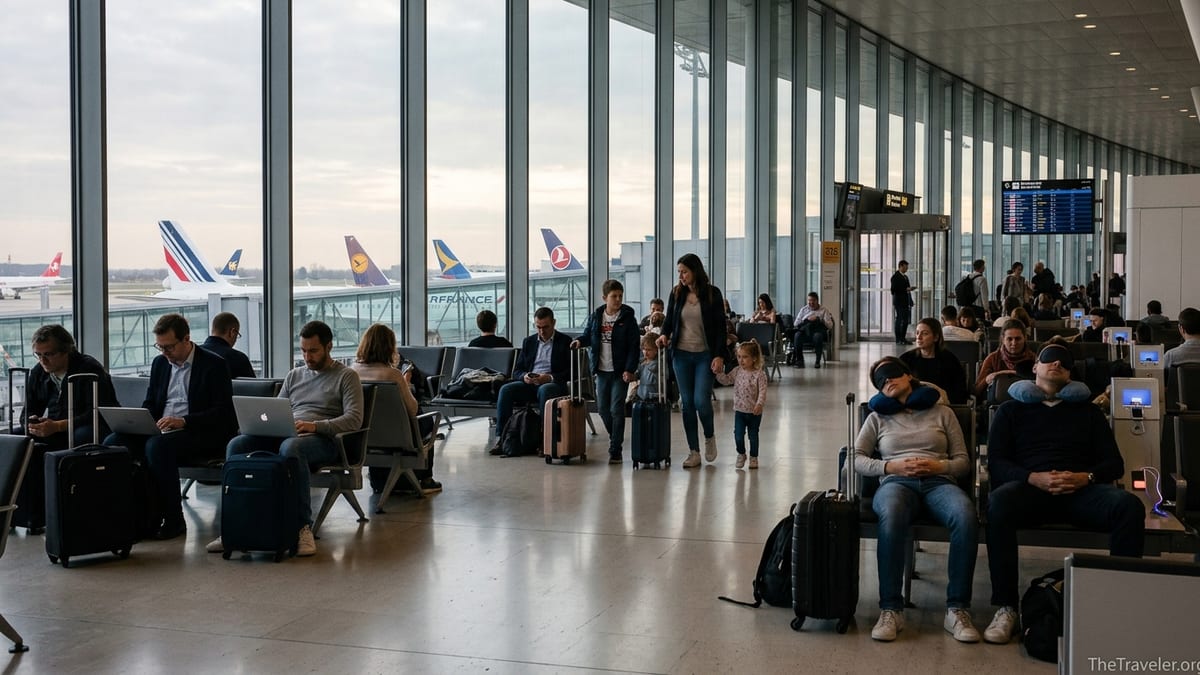
Whether CDG is a tolerable place to spend six to ten hours hinges on which terminal you use. Terminal 2E, the main long-haul hub for Air France and many SkyTeam partners, is generally regarded as the most pleasant for a daytime layover. Its K, L and M concourses offer tall glass walls with natural light, high ceilings and a decent range of cafes, brasseries and duty-free stores. You will find padded seating areas, some with partial recline or armrest-free stretches where you can lie down, though these are often quickly claimed during busy times.
Terminal 2F, handling much of Air France’s European Schengen traffic, has been renovated in recent years and feels bright and modern. The downside is that it fills rapidly at peak departure banks, especially mornings and late afternoons. Shoppers and families with strollers can clog the central spine, which makes it feel hectic rather than relaxing, although individual gate piers may still have calmer seating areas farther from the main food courts.
Terminal 1, a circular concrete “drum” from the 1970s, has seen extensive refurbishment, and many travelers now find it surprisingly pleasant for a few hours. However, it lacks obvious rest zones designed for napping and tends to empty out late at night, leaving you with bright lighting, sparse staff and fewer open services. Terminal 3, used mainly by low-cost and charter flights, remains the least comfortable for a long stay: basic benches, limited food beyond fast snacks, and a more utilitarian feel make it manageable for a short wait but a poor choice for a deliberate long layover.
Across the airport, airside sleeping remains an improvised affair. Independent layover guides and recent traveler reports describe clusters of passengers stretching out on padded benches near quiet gates or on carpeted floor space by windows, especially in 2E. Cleaning staff and security generally tolerate discreet sleepers, but some areas have armrests on almost every seat, and bright overhead lighting makes true rest difficult. If your long layover includes an overnight stretch, the lack of designated rest zones or official “sleeping areas” is a major factor in deciding whether to stay in the terminal or pay for a hotel.
Lounges, Showers and Paid Spaces: When Comfort Is Worth Paying For
For travelers willing to pay for comfort or those with airline status or premium tickets, CDG becomes significantly more manageable. Air France operates several lounges in Terminal 2E and 2F, with shower facilities, hot and cold buffets, self-service wine and spirits, and relatively quiet work areas. Reviews describe the flagship lounges in 2E as spacious and attractive, particularly the 2E Hall L lounge with its large windows and shower suites, although peak times can still feel crowded and nap-worthy seating is not always available.
Independent travelers without status increasingly lean on paid lounges or micro-hotels. In Terminal 2E, YotelAir offers cabin-style rooms and day-use stays airside close to the L gates. Travelers report using it during long daytime layovers to grab a proper bed and shower for 4 to 8 hours, treating it as a mini hotel within the secure area. Access is typically booked by the hour, and while exact prices fluctuate, it is often competitive with a mid-range airport hotel when you factor in the saved time and the convenience of avoiding immigration and security queues.
That said, YotelAir at CDG has mixed reviews. Some passengers expecting a full-service lounge via Priority Pass or certain credit card programs have arrived to find more of a minimalist rest space with limited snacks and simple seating rather than the lavish spread of a top-tier business lounge. Others have been caught out by its exact location relative to security, occasionally needing to exit and re-clear screening to reach it depending on arrival gate and staffing. These real-world experiences underline the importance of reading the fine print and double-checking terminal maps before relying on YotelAir or any third-party lounge for your comfort plan.
Outside security, the Sheraton Paris Charles de Gaulle, integrated into the Terminal 2 complex near the rail station, is a regular choice for travelers on overnight layovers or long daytime waits. You can walk there directly from the terminal without taking a shuttle, and many guests book day rooms to sleep, shower and work before heading back through security for an evening departure. Several other chain hotels cluster around the airport and can be reached via the free CDGVAL train or dedicated shuttles. When your layover exceeds 8 to 10 hours, especially with children or after an overnight flight, paying for one of these options often transforms a punishing wait into an acceptable rest stop.
Overnight Layovers: How Safe and Practical Is Sleeping at CDG?
Overnight layovers are where CDG’s weaknesses become most obvious. After around 11 pm, many security checkpoints wind down and some parts of the terminal close or “sleep,” consolidating passengers into fewer zones. Travelers hoping to move between concourses airside may find routes blocked and be forced to wait landside until security reopens in the early morning. Independent airport sleeping guides note that getting yourself through the right security checkpoint before it closes can make or break your night, particularly if you are trying to sleep airside in 2E.
Reports from 2024 and 2025 paint a consistent picture: it is usually physically safe to stay in the public areas overnight, with a noticeable security and cleaning presence, but comfort is limited. Expect bright lighting, intermittent announcements, armrest-heavy seating and floors that are cleaned during the small hours. Some travelers describe decent nights of improvised sleep stretched across bench seats in quieter corners of Terminal 2E or 2F. Others recount being woken by staff during cleaning rounds, or struggling to rest because of constant noise and the lack of dimmed lighting compared with airports that actively encourage overnight stays.
For an overnight layover exceeding 7 to 8 hours, CDG can technically host you, but relying on the terminal itself for real sleep is a gamble. A better strategy is often to book a room at YotelAir if you are already airside in 2E, or reserve a nearby hotel such as the Sheraton or one of the off-airport chains accessible via CDGVAL. Travelers with early morning departures, for instance a 7 am flight to North America after arriving from elsewhere in Europe at around 9 pm, often find that a short hotel stay offers exponentially better rest than attempting to sleep slumped over a carry-on in a fluorescent-lit gate area.
Safety-wise, routine precautions apply. Keep your passport and valuables on your person, ideally in a money belt or under-clothing pouch, and loop a bag strap around your arm or leg if you lie down. Petty theft is a risk in any large European hub, particularly in public landside areas, so it is unwise to leave electronics or bags unattended while you sleep. For solo travelers uncomfortable with this, a private room or at least a staffed lounge with restricted access offers extra peace of mind.
Leaving the Airport During a Long Layover: When CDG Is a Good Gateway
One of the potential upsides of a long layover at CDG is the chance to see Paris itself. The airport connects to the city via regional RER B trains, coaches and taxis. In practice, though, whether this is sensible depends heavily on your layover length and timing. For a 7 to 8 hour daytime layover on a single ticket, many travelers successfully clear immigration, take the RER B into central Paris for a walk along the Seine or a quick visit to the Louvre area, then return with a couple of hours to spare for security and boarding.
In contrast, using a 5 hour layover to “pop into Paris” is significantly riskier. Queues at passport control can be unpredictable, and any disruption on the rail line or at the airport can quickly erode your margin. Families with children, travelers with checked bags that are not tagged through, or those unfamiliar with French transport may find the stress outweighs the charm of a rushed city excursion. In those cases, staying at the airport and investing in a lounge, hotel day room or at least a quiet restaurant often makes more sense.
Red-eye layovers that straddle midnight are rarely good candidates for a city visit. Many attractions and shops will be closed, RER services are less frequent late at night, and arriving back at a busy security checkpoint in the early morning can mean long lines. If your overnight layover is largely about sleep, you are usually better off booking a nearby hotel and focusing on rest rather than sightseeing. CDG is a functional gateway to Paris, but trusting it for a rapid city dash only pays off when your schedule and risk tolerance genuinely allow it.
For travelers connecting beyond Paris on separate tickets, such as an incoming low-cost European flight followed by a long-haul departure purchased independently, leaving the airport adds another layer of risk. You may need to collect and re-check bags, meet separate check-in deadlines and navigate back through security from the public side. In these scenarios, even when the layover is technically long enough to squeeze in a city visit, most experienced travelers recommend treating CDG itself as the destination and keeping your focus on making the next flight without drama.
Practical Strategies to Make a CDG Layover Work
If you decide to trust CDG with a long layover, a few practical choices dramatically improve your odds of a smooth experience. First, whenever possible, book your entire trip on a single ticket with one airline or alliance, for example an all-Air France or broader SkyTeam itinerary. This ensures your checked bags are tagged through, your connections respect official minimum connection times, and you have clear protection if delays cause a misconnection.
Second, know your terminal in advance. If your inbound flight arrives in Terminal 2E and your onward flight departs from 2F, for instance, you can study the walking routes, plan for a security checkpoint and decide whether it is worth booking an Air France lounge pass in 2F or a YotelAir cabin in 2E. Many travelers are caught off guard by how spread out the 2 complex is, especially the trek to satellite 2G and the necessity of the CDGVAL and shuttle buses between some buildings. A few minutes of research before you travel can save half an hour of confusion when you land.
Third, time your comfort upgrades. If you are landing early in the morning after a transatlantic flight with an 8 hour layover before a European connection, using the first three to four hours for a hotel room or YotelAir cabin and then spending the remaining hours in a lounge or at a restaurant often works well. Conversely, on a daytime layover when you are relatively well-rested, paying for a nap pod may be less valuable than securing lounge access later in the day when you start to fade.
Finally, build a personal buffer. Even though published figures suggest that 60 to 75 minutes can be enough for simple intra-terminal connections at CDG, your own tolerance for risk and stress should guide you. If you travel with children, have mobility issues, or simply dislike rushing, aim to exceed the official minimums by a wide margin. Many frequent flyers who know CDG well will not deliberately book separate-ticket connections with less than three hours in between, and often prefer four, especially when moving between Terminal 1 and the Terminal 2 complex or when relying on checked baggage.
The Takeaway
So, should you trust Paris Charles de Gaulle Airport for long layovers? The nuanced answer is that CDG can be a perfectly acceptable, even pleasant, place for a planned long layover if you control the variables: use single-ticket connections, target the better terminals such as 2E and 2F, and invest in lounges or day rooms when comfort matters. Daytime layovers of 4 to 8 hours, especially when you have premium cabin tickets or lounge access, often work out very well, with enough time for a meal, a shower and a bit of rest before the next flight.
Where CDG struggles is with tight or poorly planned self-transfers, long overnight stretches without paid sleeping options and overly ambitious attempts to combine a connection with a rushed trip into central Paris. The airport’s sprawling layout, occasional operational delays and limited official rest facilities mean that you should be cautious about assuming things will “just work out” if you cut margins too fine. Travelers on separate tickets, those arriving late at night, and anyone expecting to sleep comfortably for free inside the terminal need realistic expectations and a backup plan.
In the end, CDG is not the effortless, compact hub that some smaller European airports can be, but neither is it the guaranteed nightmare that its harshest critics describe. Treat it as a large, complex hub that rewards preparation: know your terminals, give yourself generous time, and be willing to pay for strategic comfort. Do that, and trusting Paris Charles de Gaulle with a long layover becomes a reasonable, even smart, choice rather than a leap of faith.
FAQ
Q1. Is Paris Charles de Gaulle a good airport for an 8 to 10 hour daytime layover?
An 8 to 10 hour daytime layover at CDG can work well, especially if you are in Terminals 2E or 2F and have access to a lounge or are willing to pay for a day room. You will have enough time to clear formalities, relax, shower, enjoy a proper meal and even take a short nap before your next flight.
Q2. Is it safe to sleep overnight inside CDG airport?
It is generally safe to stay inside CDG overnight, as there is a visible security and cleaning presence, but comfort is limited. Expect bright lighting, noise and limited fully flat seating, so most travelers sleep lightly rather than getting deep rest, and many prefer booking YotelAir or a nearby hotel instead.
Q3. How long should I allow for a self-transfer on separate tickets at CDG?
For self-transfers involving separate tickets, checked baggage or terminal changes, aim for at least three hours and preferably four. This allows time for baggage claim, passport control, the CDGVAL train between terminals and another round of security without having to sprint.
Q4. Are there showers available during a layover at CDG?
Yes, several Air France lounges in Terminals 2E and 2F offer showers, and some independent lounges and the YotelAir in 2E have shower facilities as well. Access may require premium tickets, elite status, paid access or a day-use room booking, so confirm eligibility before you travel.
Q5. Can I leave the airport to visit Paris during a long layover?
You can usually leave the airport during a layover of 7 hours or more, provided you have the right visa to enter France and allow at least two hours for your return through security. This is most practical for daytime layovers, while overnight layovers are generally better spent resting in or near the airport.
Q6. Which terminal at CDG is best for a comfortable layover?
Terminal 2E is typically considered the most comfortable for long layovers, thanks to its natural light, modern design and access to multiple Air France lounges and YotelAir. Terminal 2F is also a solid choice after its renovation, though it can feel busy at peak times.
Q7. Does CDG have sleeping pods or nap cabins?
CDG has cabin-style rooms at YotelAir in Terminal 2E, which function similarly to sleeping pods and can be booked by the hour. These are located airside near the L gates and are especially useful for long layovers when you need a quiet, private place to rest.
Q8. What are the main risks of relying on a long layover at CDG?
The main risks include delays from air traffic or staffing issues, long lines at passport control and security, and confusion over terminal transfers. These can eat into your buffer time, particularly on self-constructed itineraries with separate tickets or when moving between Terminal 1, Terminal 2 and low-cost operations.
Q9. Is CDG a good option if I am traveling with children?
CDG can be manageable with children, but it is worth paying for extra comfort. A hotel day room, YotelAir cabin or lounge access makes long waits much easier, and allowing generous connection times reduces the stress of moving kids, strollers and bags through busy terminals.
Q10. Should I avoid CDG entirely for overnight layovers?
You do not need to avoid CDG entirely for overnight layovers, but you should plan carefully. If you can afford a hotel in or near the airport or a YotelAir cabin, an overnight layover becomes much more comfortable. If you plan to sleep in public seating, be prepared for a basic, sometimes restless night.