


Paris Charles de Gaulle Airport can feel intimidating, especially on a first visit. Sprawling terminals, multiple security and passport checks, and a mix of trains, buses, and shuttles make it one of Europe’s more complex hubs. With a clear picture of how the airport actually works from arrival to departure, however, it becomes far more manageable. This guide walks you through a typical journey at CDG, using real-world examples so you know what to expect at each stage.
Get the latest updates straight to your inbox!
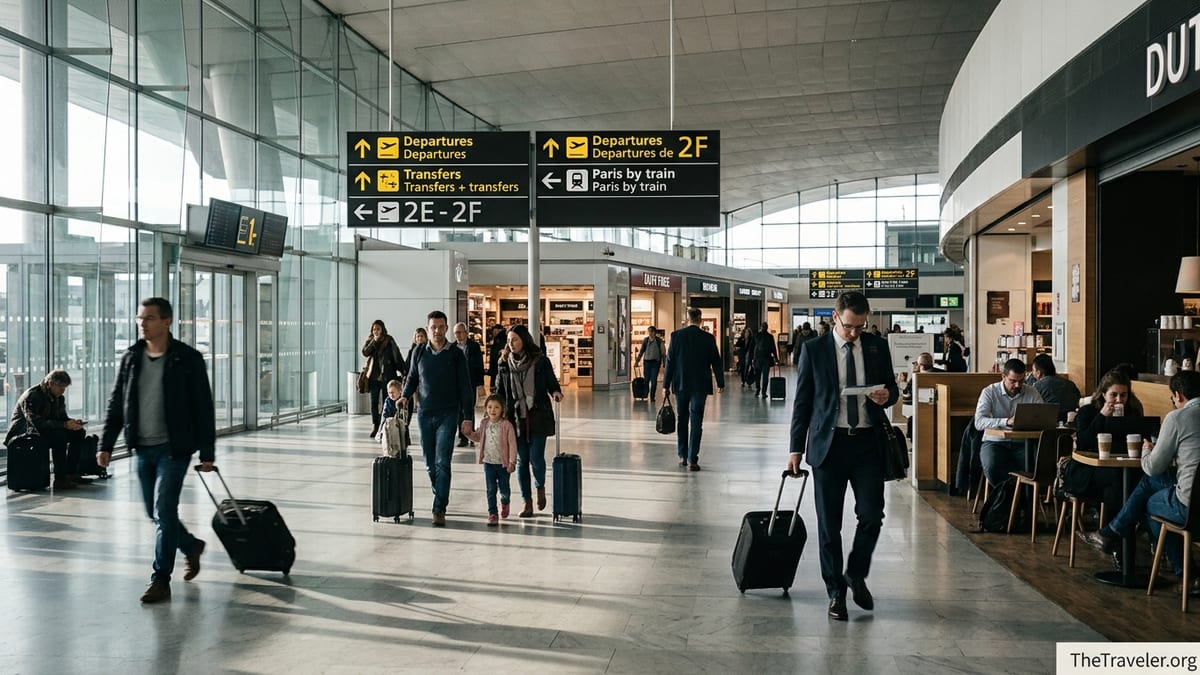
Understanding the Layout of Paris Charles de Gaulle
Paris Charles de Gaulle (CDG) sits about 25 kilometers north of central Paris and is the main international gateway for the French capital. It is one of Europe’s busiest hubs, handling tens of millions of passengers a year, which means crowds and queues are common at peak times. The airport is divided into three main terminal areas: Terminal 1, Terminal 2, and Terminal 3, all connected by a free driverless shuttle train called CDGVAL. Terminal 2, the largest, is split into sub-terminals 2A through 2G that curve around the airfield like a long arc, with separate check in halls and boarding areas.
In broad terms, Terminal 1 often handles Star Alliance airlines and a mix of long haul and European routes, while Terminal 2 is dominated by Air France and its SkyTeam partners, plus various international carriers. Within Terminal 2, halls 2E and 2F are major hubs for Air France’s long haul and European flights, and 2G handles many regional flights operated by Air France’s partners. Terminal 3 tends to serve low cost and charter airlines, including flights from smaller European cities and some seasonal leisure destinations. These patterns can change, so your boarding pass or airline app is the final word, but knowing the basic structure helps you picture how you will move through the airport.
A typical example shows how the layout matters: an American traveler arriving from New York on Air France might land at Terminal 2E and connect onward to Rome from Terminal 2F. That person will remain entirely within the Terminal 2 complex, walking or taking an airside shuttle between halls, without using the CDGVAL. By contrast, someone arriving on a low cost carrier into Terminal 3 and departing later that day on a long haul Air France flight from Terminal 2E will exit into the public arrivals area, take CDGVAL from the Terminal 3 Roissypôle area to Terminal 2, then check in again. Understanding which of these scenarios applies to your trip is the key to planning your timing.
CDG’s complexity is most noticeable when you need to change terminal areas or when you mix full service and low cost airlines on separate tickets. Moving from Terminal 1 to Terminal 2F for a separate connection, for instance, can easily take 40 to 60 minutes once you factor in walking, CDGVAL, check in, security, and any passport checks. The official airport map, available in the Paris Aéroport app and on information boards in the terminals, is worth studying before you travel so you can visualize these distances rather than discovering them on the ground with a tight connection.
Arriving at CDG: From Aircraft Door to Landside
On arrival, your experience at CDG usually follows four steps: disembarkation, passport control, baggage reclaim, and customs. If you arrive on a long haul flight from outside the Schengen area, such as New York, Dubai, or Johannesburg, you will pass through French border control before entering the baggage hall. Arriving from another Schengen country such as Germany or Spain, by contrast, usually means you walk straight into the luggage area without a passport check, although identity checks can still happen at spot controls.
As you leave the aircraft, overhead signs in French and English guide you toward Connections and Baggage reclaim / Exit. If CDG is your final destination, you follow the baggage and exit signs. After a long haul flight landing at Terminal 2E, for example, you might walk through several glass corridors and pass moving walkways before reaching immigration. Queue times vary widely: early morning long haul arrivals can see lines of 30 to 60 minutes, while mid day midweek flights might clear in under 20 minutes. Since late 2025, a new Entry/Exit System has gradually replaced manual passport stamping for many non EU passengers, so you may be directed to use automated kiosks before seeing a border officer, which can speed up the process but sometimes creates its own queues.
Once through passport control, you enter the baggage reclaim hall. Screens list arriving flights with corresponding carousel numbers, and announcements are made in French and English. Average baggage delivery typically runs around 20 to 40 minutes after arrival, but it can be faster on less busy flights or slower at peak times, especially during summer holidays. If you are traveling carry on only, you can bypass the wait and head directly toward Customs and exit. Customs checks at CDG are usually light touch: you walk through either the green channel for “Nothing to Declare” or the red channel if you are carrying goods above duty free allowances, with occasional random inspections.
Beyond the customs doors is the landside arrivals area. Here you will find meeting points for family and drivers, currency exchange booths, ATMs, car rental desks, information counters, and signposted exits to taxis, trains, and buses. For instance, in Terminal 2E the arrivals hall opens onto a concourse where official taxi ranks are clearly marked with “Taxis officiels” signs, and private transfer companies wait with name boards near the barrier. If you have arranged a private chauffeur, the company will typically instruct you to meet them immediately after customs near a specific column or signpost. This is the point at which your journey at CDG branches: you either leave the airport entirely, connect to Paris or other cities by ground transport, or head to another terminal for a connecting flight.
Leaving the Airport: Taxis, Trains, Buses, and Transfers
For many travelers, the next step after clearing arrivals is reaching central Paris. The most common options are the RER B suburban train, official taxis, ride share services, and pre booked car services, along with regional buses and coaches to other cities. The RER B train connects CDG to major Paris stations such as Gare du Nord and Saint Michel Notre Dame in roughly 35 to 45 minutes depending on the pattern of stops. As of early 2026, a standard adult ticket from CDG to central Paris typically costs around 12 euros one way, with small variations depending on fare adjustments and any integrated Metro connections included in the ticket.
The RER B station at CDG is located in the Roissypôle area near Terminal 3 and within the Terminal 2 complex. If you arrive at Terminal 1, you take CDGVAL for a few minutes to Roissypôle, follow the RER B signs, and descend by escalator or elevator to the platforms. If you land in Terminal 2E or 2F, you follow “Paris by train” signs through the terminal, often down several levels, until you reach the rail station shared with the TGV high speed trains. Real world timing matters here: a family arriving at 9:00 a.m. with checked bags might not be on the RER platform until 9:45 or later once queues at passport control and baggage reclaim are factored in, so planning a strict 10:00 a.m. commitment in central Paris would be risky.
Official Paris taxis remain popular for their fixed fares and relative simplicity for newcomers. As of 2026, typical flat rates from CDG to central Paris are around 55 to 65 euros depending on whether you are headed to the Left Bank or Right Bank and on municipal rules. The ride time ranges from 35 minutes in light traffic to over an hour during rush hours or if there are roadworks on the A1 motorway. To take an official taxi, follow the taxi signs from the arrivals hall; do not accept offers from individuals inside the terminal who approach you unsolicited. Queues are usually shortest in Terminal 2 but can still build at peak mid morning and evening arrival banks.
Pre booked transfers occupy a middle ground between taxis and ride share services. A company may track your flight, wait in the arrivals area with a sign, and offer a fixed price to your hotel, which can appeal to nervous first time visitors or those arriving late at night. Prices vary by company and vehicle type, but for a typical sedan transfer to central Paris you might expect something in the 70 to 100 euro range. Coaches and regional buses also depart from CDG to destinations such as Disneyland Paris and various provincial cities; these usually leave from marked bus bays near Roissypôle or specific terminal forecourts. Reading your booking confirmation carefully before arrival is essential because some services instruct you to meet at a particular numbered bus stand or hotel shuttle zone.
Making Connections: How Transfers Work Inside CDG
CDG is a major connecting hub, especially for Air France, which banks arrivals and departures in waves throughout the day. If your flights are on a single ticket, such as Atlanta to Paris to Florence on Air France, your baggage is usually checked through to your final destination and you follow “Transfer” signs rather than exiting to the public arrivals area. Your exact path depends on whether you are arriving from outside the Schengen area and whether your onward flight is Schengen or non Schengen.
A common scenario is arriving from a non Schengen country into Terminal 2E and connecting to a Schengen destination from Terminal 2F. In this case, you typically go through passport control at CDG to enter the Schengen zone, then security screening, then walk or take a short shuttle within the secure area to 2F. Queues can be substantial during morning arrival peaks, so connection times of 90 minutes or more are generally comfortable, while 60 minutes can feel tight if your inbound flight is delayed. Many airlines that use CDG as a hub offer official minimum connection times, often around 60 to 75 minutes for such changes, but if you have a choice when booking, aiming for at least 90 minutes provides more margin.
Connections entirely within Schengen, such as Frankfurt to Paris to Madrid, are usually simpler. You arrive at Terminal 2F or another Schengen area, remain airside, and pass only through security before your next flight. By contrast, connecting from a Schengen flight to a long haul non Schengen departure, such as Paris to Tokyo from 2E, will involve leaving the Schengen area via outbound passport control along with security screening. Real world examples shared by frequent travelers indicate that a 2 hour layover between 2E and 2F is generally comfortable, while self connections that mix Terminal 3 low cost arrivals with Terminal 2E long haul departures benefit from 3 hours or more to account for CDGVAL transfers and full re processing landside.
CDGVAL plays a key role in some connections. This automatic train runs a loop between Terminal 1, the Roissypôle / Terminal 3 area, and parts of Terminal 2, and is free of charge. For example, if you land at Terminal 1 from a non Schengen flight, clear passport control and baggage, then need to catch a separately booked Air France flight from Terminal 2E, you would exit to landside, follow CDGVAL signs, ride to Terminal 2, then find the 2E check in area, before repeating check in, security, and passport control. Each stage adds minutes, so what looks like a simple terminal change on a map can in reality consume an hour or more during busy times.
Departing CDG: Check In, Security, and Boarding
For departures, CDG works much like other large European hubs, but long walking distances and occasional bottlenecks mean you should add extra time. Most full service airlines open check in counters about three hours before long haul departures and around two hours before short haul flights, with final check in cutoffs usually 60 minutes before intercontinental flights and 40 minutes before European services. Many airlines encourage online check in, but you may still need to drop bags or verify documents at a counter or kiosk.
On a typical morning departure from Terminal 2E for a flight to New York, for example, you might arrive at the terminal at 7:00 a.m. for a 10:00 a.m. flight. After entering through sliding doors, information screens show which check in zone your airline uses. You queue to check bags, present your passport, and receive boarding passes if you do not already have them on your phone. Bag drop can be relatively quick at off peak times but stretch to 30 minutes or more during busy holiday periods. Once checked in, you head for security, where you may find separate lanes for families, premium passengers, and those with fast track access through either airline status or a purchased service.
Security procedures involve the usual X ray screening of bags and walkthrough metal detectors or full body scanners. Liquids must be carried in containers of 100 milliliters or less and placed in a clear plastic bag, and laptops and larger electronics are often requested to be removed, although some newer screening lanes allow them to remain in bags. Wait times fluctuate significantly: some travelers clear in under 15 minutes, while others report 30 to 45 minute queues at peak times, especially early mornings in Terminals 2E and 2F. After security come outbound passport checks for non Schengen flights. If you are flying to a destination like the United States, Canada, or Japan, you present your passport to French border officers or pass through automated gates if eligible.
Beyond security and passport control lies the airside departure lounge, where duty free shops, cafés, restaurants, and airline lounges cluster around the gate areas. In Terminal 2E, for instance, the K, L, and M gate piers each contain a mix of French fashion boutiques, cosmetics counters, newsstands, and casual dining spots ranging from coffee chains to brasseries serving croque monsieur and salads. Prices reflect airport norms: a simple coffee may run 3 to 4 euros, a sandwich around 7 to 10 euros, and a sit down meal 20 euros or more per person. Boarding typically begins 30 to 45 minutes before departure time, with priority groups called first, followed by economy passengers in zones. At busy gates, queues often snake into the walking corridor, so listening for announcements and watching the gate screens is more reliable than relying on the mass of people.
Facilities and Services That Make CDG Easier to Use
Beyond the basics of arrivals and departures, CDG provides a range of services that can make a long journey smoother if you know they exist. Wi Fi is available throughout the terminals and is generally free, though performance can vary depending on how crowded a particular area is. Many seating areas have power outlets, but they are not universal, so having a small multi adapter or power bank remains sensible. Drinking water fountains are present in several terminals, particularly in the newer parts of 2E and 2F, though they are not as numerous as some travelers might expect, so refilling a bottle when you see a fountain is wise.
Lounges play a large role for frequent flyers and premium cabin passengers at CDG. Air France operates multiple lounges across Terminal 2E and 2F, offering showers, hot and cold food, quiet workspaces, and comfortable seating. Access is usually granted to business and first class passengers, as well as elite status members of SkyTeam airlines, and in some cases to travelers using premium credit cards or paid day passes through independent lounges. For example, a traveler facing a four hour layover between a transatlantic flight and a European connection in 2E might spend most of that time in an Air France lounge, emerging only shortly before boarding. This changes how CDG feels: what can otherwise be a noisy, crowded hub becomes a place to rest and recharge.
Families and mobility impaired travelers have additional resources. CDG provides dedicated assistance services that can be booked through airlines before travel, including wheelchair support and buggy rides in some long corridors. Family zones with play areas appear in selected terminals, offering a space for children to burn energy before a long flight. Baby changing rooms and accessible toilets are signposted, though occasional queues form at peak times. The airport also hosts luggage wrapping services, short term luggage storage in certain areas, and on site or nearby hotels connected by shuttle or directly linked to terminals, which can be invaluable for very early departures or overnight delays.
Shopping and dining can be more than a diversion; they can affect how you plan your time. If you know that your long haul departure from Terminal 2E gives you access to a wide range of French fashion brands and gourmet food shops, you might choose not to buy souvenirs in the city and instead pick up macarons, chocolates, or cosmetics while waiting to board. Conversely, if you are departing from Terminal 3 on a low cost carrier, you might find a more modest selection of outlets and therefore prefer to eat before arriving at the airport or bring snacks, bearing in mind any security rules on liquids.
Practical Strategies for a Smooth CDG Experience
Because CDG can be demanding, a few practical strategies can make a significant difference. First, build in more time than you think you need, especially if you are unfamiliar with the airport. For departures, arriving three hours before long haul flights and at least two hours before European flights provides a comfortable buffer in most circumstances. For connections, aim for 90 minutes or more for same terminal Schengen to Schengen or Schengen to non Schengen changes, and two and a half to three hours for self connections that require exiting to landside, changing terminals via CDGVAL, and checking in again.
Second, travel as light as your trip allows. Each checked bag adds potential waiting time at arrivals and more handling at departures. If you are self connecting between airlines, using only cabin baggage can convert a stressful 2 hour connection into a manageable one. Third, use digital tools: download your airline’s app and, if it fits your privacy comfort level, the Paris Aéroport app, which provides maps and basic guidance on terminal layouts and services. Flight status notifications can alert you to delays or gate changes, and some carriers operating in CDG’s main terminals push real time updates on boarding times and estimated baggage delivery.
Another practical tip is to pay attention to signage and language. While staff increasingly speak English and signage is bilingual in French and English, announcements may be made rapidly or with strong accents. Reading the overhead signs, which consistently use the same colors and icons for trains, buses, taxis, and transfers, often provides clearer guidance than trying to decode crowded audio announcements. If you are unsure, do not hesitate to ask an information desk attendant; they are accustomed to guiding confused travelers between the maze like sub terminals of Terminal 2.
Finally, manage your expectations. CDG will rarely feel as seamless as a small regional airport or a brand new terminal complex built from scratch. At busy times, you may encounter long walks, multiple queues, and occasional bottlenecks at security or passport control. Approaching the experience with realistic timing, flexible plans, and a basic mental map of how the airport is organized can transform it from a source of anxiety into a tolerable, even occasionally interesting, gateway to Paris and beyond.
The Takeaway
Paris Charles de Gaulle Airport is large, busy, and sometimes confusing, but it is also a highly functional global hub once you understand its basic logic. Arrivals flow from aircraft to passport control to baggage and customs, at which point you choose between ground transport into Paris or transfers to other flights. Departures move in the other direction, from check in and security through duty free zones to the gate. Transfers sit in the middle and are shaped by whether you are crossing the Schengen border and whether you need to change terminal areas using CDGVAL.
By picturing your own journey in these terms and allowing realistic time for each step, you can greatly reduce stress. Check which terminal and hall you use before traveling, decide in advance whether you will take the RER B, taxi, or a pre booked car into Paris, and build buffers into tight connections, especially when mixing low cost and full service airlines on separate tickets. With a little preparation and a clear sense of how CDG works from arrival to departure, this sprawling airport becomes less a maze and more a straightforward, if busy, gateway to the City of Light.
FAQ
Q1. How early should I arrive at Paris Charles de Gaulle for my departing flight?
For long haul international flights, aim to arrive at the terminal about three hours before departure. For European or short haul flights, two hours is generally sufficient, though you may want extra time during peak summer holidays or major events.
Q2. Is 1 hour enough time to connect between flights at CDG?
A one hour connection is often considered the legal minimum only on through tickets and in the same terminal, and it can be stressful if there are delays. If you have a choice, aim for at least 90 minutes for same terminal transfers and two hours or more if changing between non Schengen and Schengen flights.
Q3. How do I get from CDG to central Paris by train, and how long does it take?
You can take the RER B suburban train from the airport rail stations at Terminal 2 and Roissypôle near Terminal 3. The journey to central Paris usually takes around 35 to 45 minutes, with trains stopping at major stations such as Gare du Nord.
Q4. Are taxis from CDG to Paris a fixed price, and what should I expect to pay?
Taxis from CDG to central Paris typically operate with fixed fares that are broadly in the mid double digit euro range. Depending on your exact destination, you can usually expect to pay somewhere around 55 to 65 euros, with travel time varying based on traffic.
Q5. What is CDGVAL and when will I need to use it?
CDGVAL is the free automated shuttle train that connects Terminal 1, the Roissypôle and Terminal 3 area, and parts of Terminal 2. You will use it when you need to move between these terminal areas landside, for example when arriving into Terminal 1 and departing later from Terminal 2 on a separate ticket.
Q6. Do I have to go through passport control when connecting at CDG?
You pass through passport control if you are entering or leaving the Schengen area. For instance, arriving from the United States and connecting to Italy, you would clear passport control at CDG. However, arriving from Germany and connecting to Spain, you would normally stay within the Schengen area and only go through security.
Q7. Is it easy to find English speaking staff and information at CDG?
Yes. Most passenger facing staff at CDG, including information desk workers, many security officers, and airline agents, have at least basic English, and signage is in both French and English. During very busy times you may need to be patient, but assistance in English is generally available.
Q8. What happens if my flight is delayed and I miss my connection at CDG?
If all your flights are on a single ticket, the airline that issued the ticket is normally responsible for rebooking you on the next available service and may provide meal vouchers or accommodation depending on the circumstances. If you booked separate tickets, you usually need to buy a new onward ticket at your own expense, so longer layovers are advisable in that case.
Q9. Are there showers or places to rest inside CDG during a long layover?
Several airline and independent lounges at CDG offer showers, quiet areas, and reclining chairs for eligible passengers or those who purchase access. In addition, there are hotels directly linked to or very close to the terminals, which can be convenient for overnight layovers or early morning departures.
Q10. Can I leave the airport during a long layover at CDG to visit Paris?
Many travelers do leave the airport for a few hours if they have a layover of at least six to eight hours and are eligible to enter France. You must allow time for passport control, transport into the city, and security and passport checks when you return, so it is safest when you have a full day connection rather than just a few hours.